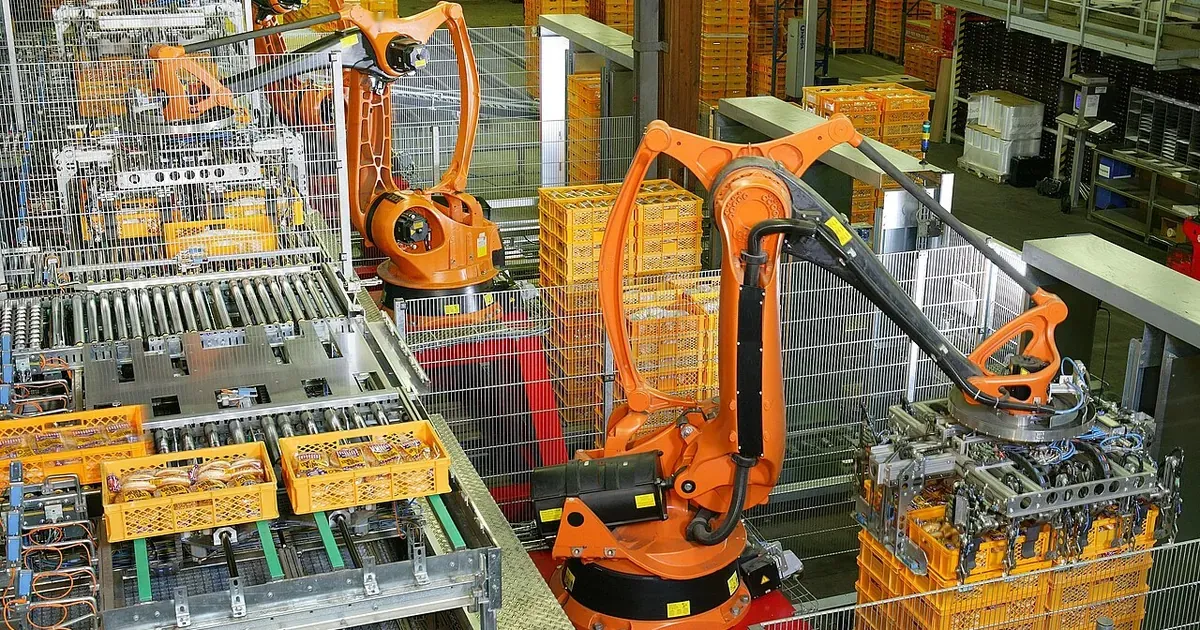
TL;DR: Vertical suspension and flex motion cables survive millions of dynamic bend cycles where fixed wires snap. Below 80 m, flat EN 50214 PVC cables (KYFLTFCY, 300/500 V, 10×H bend) fit standard shafts. High-rise shafts up to 300 m (10 m/s) need central steel-wire-rope (SWR) round cables (4.5 to 9.0 kN break load). Outdoor rack hoists use BAULIFT (80 m, 1,000 N), and mine shafts need 2,000 V 37-43TF (-40 °C to +90 °C). High-speed drag chains use 600/1,000 V single-cable hybrid servo (7.5×OD).
- Flat EN 50214 Lift Cable (KYFLTFCY) — Voltage & Governing Basis: 300/500 V (DIN EN 50214 (VDE 0283-2 / legacy VDE 0281-403)) | Suspension / Motion Limit: 35 to 80 m free drop; up to 6.0 m/s shaft | Bend / Loop Rule: 10×H flat plane | Primary Equipment & Site Duty: Mid-rise guided elevator shafts and screened festoons (70% to 80% Cu braid)
- High-Rise Round Lift Cable (SWR) — Voltage & Governing Basis: 300/500 V (450/750 V at 1.5 mm²); EN 50214 / IEC 60245-5 | Suspension / Motion Limit: 200 to 300 m drop; 4.5 to 9.0 kN SWR; 10 m/s | Bend / Loop Rule: 12 to 15×OD loop | Primary Equipment & Site Duty: Super-tall elevator shafts and high-wind outdoor tower hoists
- Construction Hoist (BAULIFT-T / W) — Voltage & Governing Basis: 300/500 V (3.0 kV AC test; IEC 60228 Cl. 5) | Suspension / Motion Limit: Up to 80 m drop; 1,000 N max pull | Bend / Loop Rule: 5×D; ≥ 450 mm basket | Primary Equipment & Site Duty: Rack-and-pinion construction hoists and mast climbers
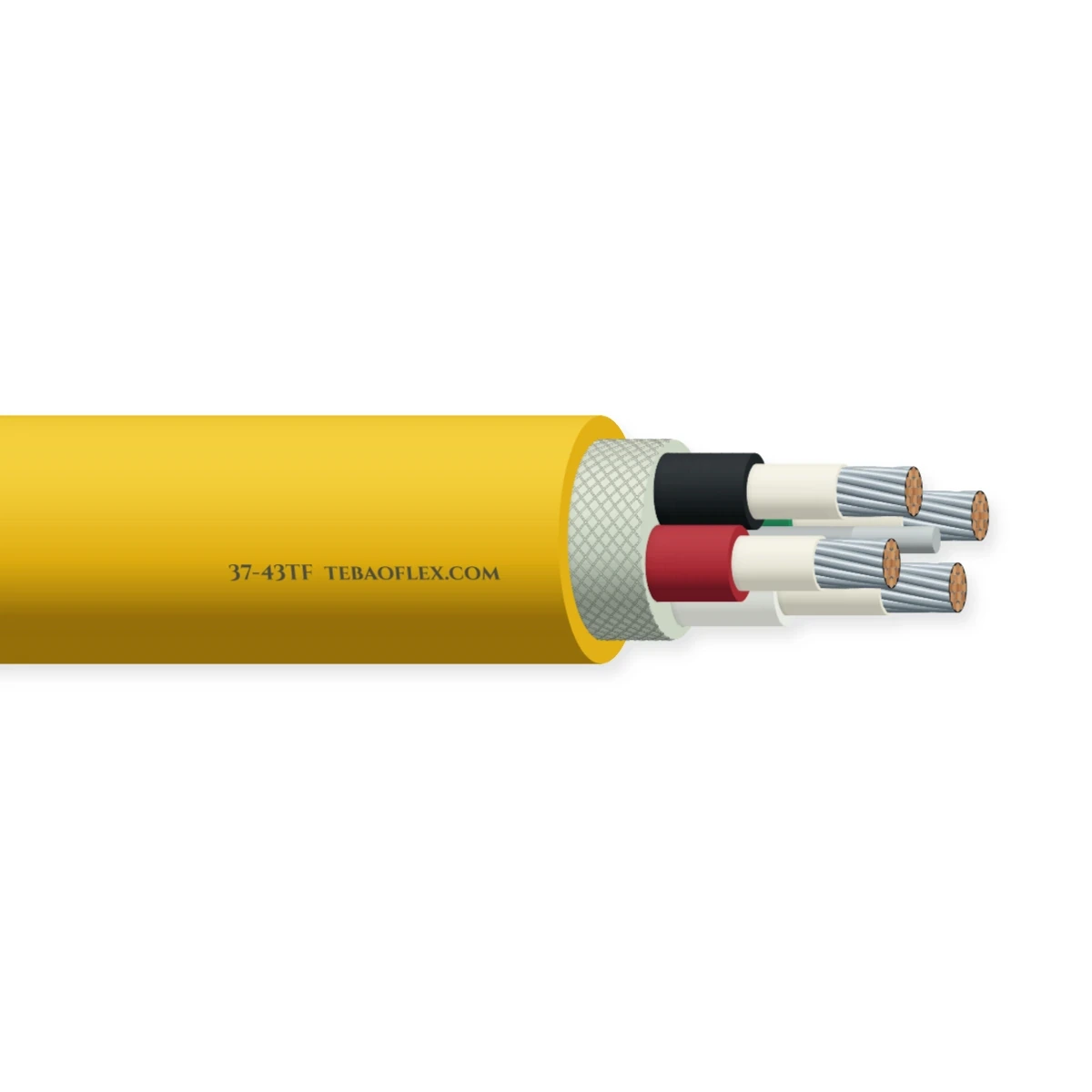
- Mine Shaft Hoist (37-43TF) — Voltage & Governing Basis: 2,000 V (ICEA S-75-381 / NEMA WC 58 / MSHA) | Suspension / Motion Limit: Dynamic vertical cage & sheave loop (-40 °C to +90 °C) | Bend / Loop Rule: 6×OD | Primary Equipment & Site Duty: Underground mine skip cages and shaft sheave power/control drops
- Hybrid Servo DSL (SERVO FD 7DSL) — Voltage & Governing Basis: 600/1,000 V (UL AWM Style 21223 / CSA) | Suspension / Motion Limit: Continuous drag-chain flexing (-40 °C to +80 °C, 9 layers) | Bend / Loop Rule: 7.5×OD | Primary Equipment & Site Duty: Single-cable HIPERFACE DSL servo motor + digital encoder axes
- Coax Hybrid Servo (SERVO-DDI) — Voltage & Governing Basis: 600/1,000 V (UL AWM Style 21223 / IEC 60204-1) | Suspension / Motion Limit: High-acceleration drag chains (-40 °C to +80 °C, 7 layers) | Bend / Loop Rule: 7.5×OD | Primary Equipment & Site Duty: Single-cable coaxial digital motor interface (DDI) power + feedback
1. High-Rise Elevator Traveling Cables: Flat EN 50214 vs. Round Steel-Core Designs
Elevator traveling cable is a flexible hanging link from a moving lift car to a mid-shaft box. It powers car lights, door motors, safety switches, intercoms, and CCTV or bus lines over millions of trips.
Below 80 m of free hang, flat PVC cables built to DIN EN 50214 (H05VVD3H6-F, H07VVD3H6-F, and screened KYFLTFCY) are the low-cost choice. Side steel ropes or tough yarn cords bear the hang weight. Flat cores bend smoothly in one plane at 10×H (flat height H). A 70% to 80% copper braid blocks drive noise.
Above 80 m drop, or as tall-shaft speed rises past 4.0 m/s toward the 6.0 m/s guided flat-cable ceiling, flat cables hit two physical walls. First, wide flat profiles act like sails in fast shafts. Piston wind whips the loop into walls and guide brackets. Second, side ropes cannot stop twist across 200 m to 300 m drops.
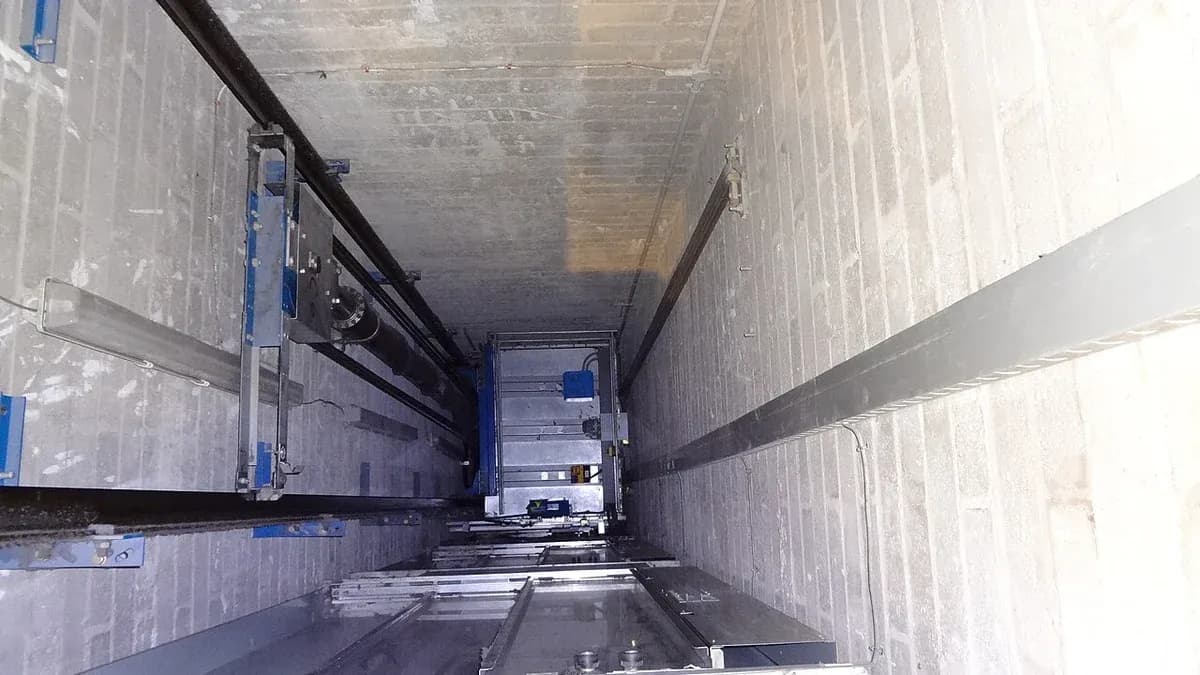
Why Super-Tall Shafts Switch to Central Steel-Core Round Cables
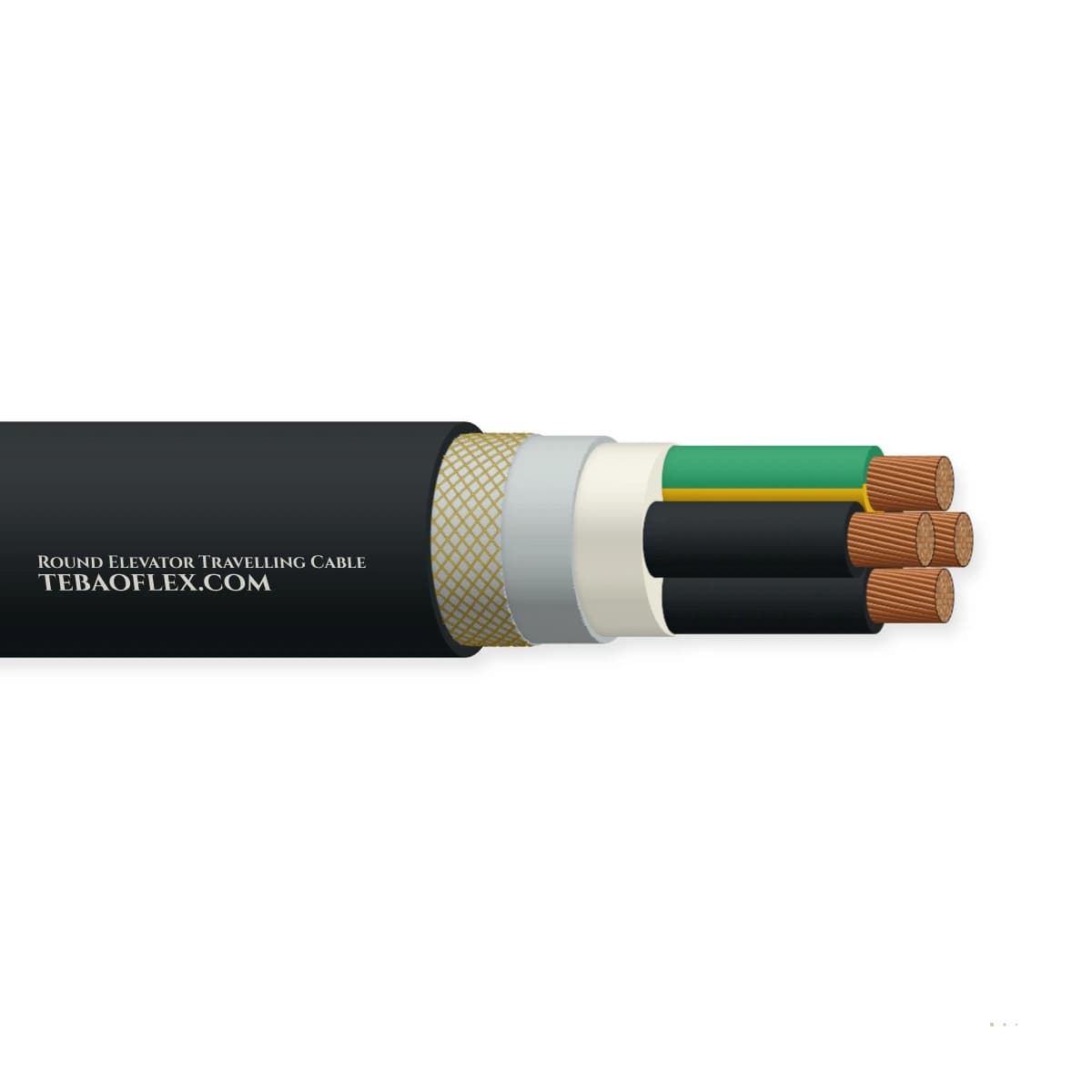
Round elevator traveling cables cut wind drag and stop core stretch up to 300 m drop and 10.0 m/s speed. A central galvanized steel wire rope (SWR, 4.5 to 9.0 kN break load) holds the full weight along the cable center.
Around that steel rope, fine IEC 60228:2023 Class 5 copper cores lay up in opposing S/Z layers under an anti-twist braid. Opposite lay torques cancel spin under load. As a result, the hanging U-loop stays plumb within ≤ 5° twist at 12 to 15×OD.
Worked Vertical Suspension Tension and Natural Loop Check
Engineers verify both dead-weight tension and peak car acceleration (a_max ≤ 2.5 m/s²) before shaft sign-off. For example, check a 250 m free-hanging drop using round 18G0.75 steel-core traveling cable. Its catalog specs are 15.8 mm OD, 0.358 kg/m mass, and 4.5 kN SWR minimum breaking load:
1. Static dead-weight tension at the mid-shaft hanger (g = 9.81 m/s²):
   F_static = 250 m * 0.358 kg/m * 9.81 m/s² = 878.0 N (0.88 kN)

2. Peak dynamic tension under 2.5 m/s² car acceleration:
   F_dyn = 250 m * 0.358 kg/m * (9.81 + 2.5) m/s² = 1,101.7 N (1.10 kN)

3. Central SWR tensile safety factor (4.5 kN minimum breaking load):
   SF_static  = 4,500 N / 878.0 N   = 5.13
   SF_dynamic = 4,500 N / 1,101.7 N = 4.08

4. Minimum natural plumb U-loop diameter (catalog 14.0×OD):
   D_loop = 14.0 * 15.8 mm = 221.2 mm (verified ≥ 12×OD = 189.6 mm)
For full shaft options, see our elevator and traveling cable hub and festoon and suspension cable range. Compare rubber and PVC builds in our H07VVH6-F PVC vs. NGFLGOEU rubber flat cable guide and flat vs. round festoon cable guide.
2. How Do Construction Hoist and Mine Shaft Cables Prevent Core Slippage and Wind Snags?
Outdoor site hoists and mine shafts punish vertical power cables far harder than indoor lift shafts. Strong wind whips exposed cables into steel mast ties. Deep wet mines add 2,000 V power loads, acid water, and sharp falling rock.
Rack-and-pinion construction hoist cable (BAULIFT) is a 300/500 V power-and-control cable for outdoor mast climbers and site hoists up to 80 m (1,000 N max pull).
Dynamic mine shaft hoist cable (37-43TF) is a 2,000 V MSHA-compliant cable for vertical skips and headframe sheaves. It pairs lubricated 259-strand tinned copper cores, 90 °C EPR insulation, and a bonded yellow CPE jacket.
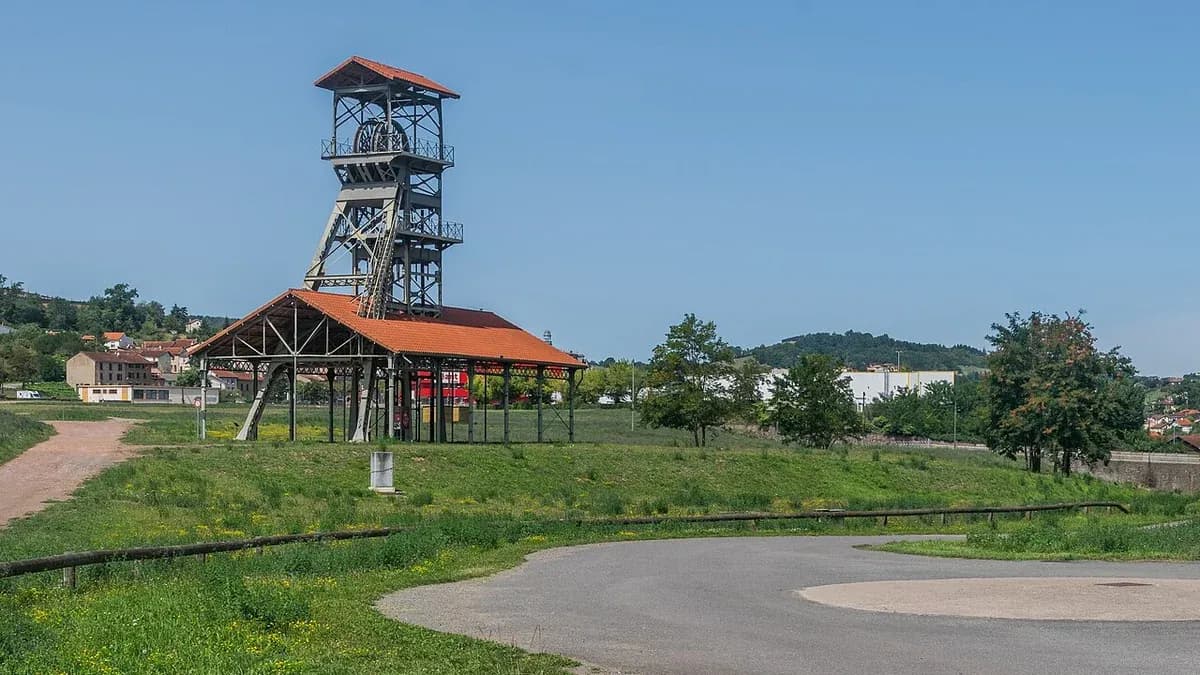
Gravity Basket Coiling (BAULIFT-T) vs. Mast Guide Trolleys (BAULIFT-W)
Rack-and-pinion construction hoists handle vertical slack in two ways. On BAULIFT-T basket rigs, the round composite cable coils inside a cylindrical gravity collection basket (≥ 450 mm diameter). Because coiled cable must relax cleanly without kinking, gravity basket coiling is rated down to 0 °C.
In cold outdoor sites (-30 °C to +70 °C), contractors run BAULIFT-W on mast-mounted cable guide trolleys. Both designs support a 5×D minimum free-coiling flex bend (with 10×OD recommended for conservative pendant-lift duty) and pass 3.0 kV AC routine tests. They combine color-coded power conductors and numbered 1 mm² control cores under one cold-flexible, oil-resistant sheath. For example, verify both basket clearance and 80 m hang mass before commissioning a BAULIFT hoist:
1. BAULIFT-T basket clearance check (example 22 mm OD hoist cable):
   Min. flex bend radius = 5 * 22 mm = 110 mm (220 mm minimum bend diameter)
   Basket diameter 450 mm provides > 2.0x geometric coiling margin.

2. BAULIFT vertical mass limit at 80 m max suspension (1,000 N pull cap):
   Max static mass/m = 1,000 N / (80 m * 9.81 m/s²) = 1.27 kg/m
   (Apply wind-load and dynamic start margins when sizing above 50 m.)
Stopping Vertical Core Slippage on 2,000 V Mine Shaft Hoists (37-43TF)
Deep mine shafts cannot use loose-sheathed cables. Under heavy vertical weight and fast skip lifts over sheaves, loose copper cores slide down inside the jacket. That downward creep strains top lugs and bunches insulation at the lower cage loop.
TEBAOFLEX 37-43TF (ICEA S-75-381 / NEMA WC 58, 2025: ANSI/NEMA WC 23058 / MSHA) stops core slip using two opposing grip zones. Inside each 4 AWG to 4/0 AWG core, 259 internally lubricated tinned copper strands glide smoothly during 6×OD bends. Outside the 90 °C EPR bundle, a mold-cured yellow CPE jacket bonds deep into core valleys. That bonded skin locks cores against gravity slip and resists acid water, oil, and rock cuts from -40 °C to +90 °C.
See our mine shaft cable video showcase and crane festoon loop depth and EMC guide. You can also read our cold-weather festoon bend fatigue testing guide.
3. Single-Cable Hybrid Servo Systems (OCT) and Drag-Chain Motion Mechanics
Factory lines, gantries, and packing robots run millions of fast strokes inside drag chains. In the past, each servo axis needed two separate cables: one shielded power-and-brake cable and one thin encoder cable.
Single-cable hybrid servo technology (OCT) packs 600/1,000 V motor power, brake pairs, and shielded digital encoder feedback into one PUR or TPU drag-chain cable. It supports HIPERFACE DSL or coaxial DDI links.
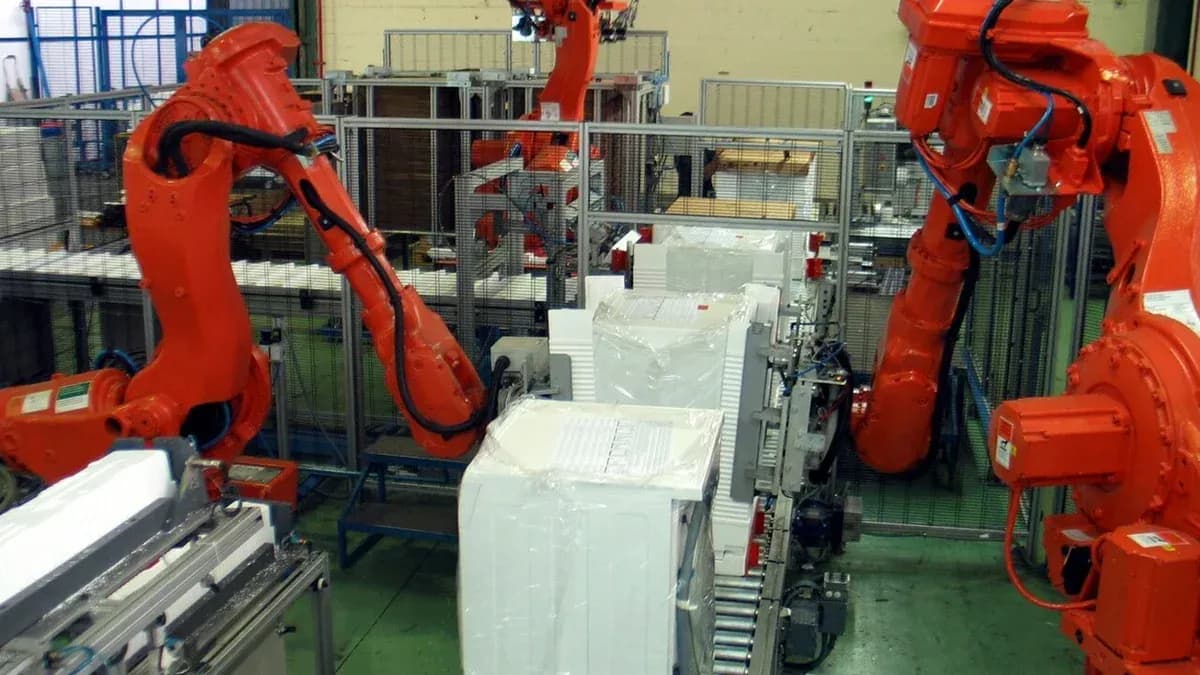
Eliminating Crosstalk Between PWM Motor Power and Digital Feedback
Running high-frequency PWM power right next to a digital encoder pair creates heavy EMI noise. Fast IGBT pulses inject noise that drops data packets and trips servo drives.
Single-cable builds include SERVO FD 7DSL Chain Hybrid (9 concentric layers) and SERVO-DDI Coax Hybrid (7 layers). Both cut crosstalk with three defenses aligned to IEC 61800-3:2022 Adjustable Speed Power Drive Systems EMC and IEC 60204-1:2016 Electrical Equipment of Machines:
- Low-capacitance polypropylene (PP) insulation: PP lowers dielectric constant well below PVC. This cuts charging current and voltage spikes in long drag chains.
- Shield-in-shield layout: Both the brake pair and the feedback element (DSL pair or DDI coax) wear their own tinned-copper screens before laying up beside power cores.
- Dense braided EMC shield and matte PUR/TPU jacket: An outer copper braid drains HF noise to 360-degree EMC glands. Low-friction matte PUR or TPU resists coolants, oils, and chain wear from -40 °C to +80 °C.
Worked Drag-Chain Fill and Dynamic Bend Radius Check
Mechanical failure inside energy chains almost always traces back to overfilled troughs or tight bend radii. For example, size an automated axis using SERVO-DDI Coax Hybrid 4G1.5. Its catalog specs are 9.2 mm OD, 128 kg/km mass, and 7.5×OD (74 mm installed) minimum bend radius:
1. Minimum drag-chain bend radius check:
   R_min = 7.5 * 9.2 mm = 69.0 mm (catalog installed rfix = 74 mm)
   Conservative chain selection -> specify energy chain R ≥ 75 mm (or ≥ 10×OD = 92 mm for ultra-high speed).

2. Energy-chain cavity clearance & fill rule:
   Vertical cavity height H_inner ≥ 1.10 * 9.2 mm = 10.12 mm (use ≥ 10.2 mm to keep ≥ 10% round-cable clearance).
   Total cross-section of all cables ≤ 30% of usable chain window to prevent side binding.

3. Ambient thermal grouping check:
   Apply grouping and temperature derating per DIN VDE 0298-4 when multiple 600/1,000 V axes share one enclosed carrier.
Moving from two cables to one hybrid cuts chain weight, halves motor plugs, and narrows trough width. Browse our industrial automation cable hub and automation and motion cable range. For deeper rules, read our guides on drag-chain core rupture and fill-weight rules and double-shielded servo power cables with brake pairs. You can also review encoder vs. resolver feedback capacitance sizing and TPE/PUR vs. PVC/PUR 10-million-cycle drag-chain servo cables.
4. TEBAOFLEX Vertical Suspension, Mine Hoist, and Hybrid Servo Cable Portfolio
Matching cable shape, load core, and jacket compound to the motion axis stops early wire breaks and drive faults. The table below compares six TEBAOFLEX lift, hoist, and hybrid servo lines checked against catalog records.
Comparing Six Core TEBAOFLEX Vertical Suspension & Motion Cable Series
- Round Elevator Travelling Cable — Rated Voltage & Basis: 300/500 V (450/750 V at 1.5 mm²); EN 50214 / IEC 60245-5 | Tensile / Screen Architecture: Central galvanized SWR (4.5 to 9.0 kN) + S/Z cores + anti-torsion braid | Jacket & Temp. Range: Black PCP / EM2 or cold-flex elastomer (-30 °C to +70 °C flex) | Bend / Suspension Limit: Up to 300 m drop; 10 m/s; 12 to 15×OD loop | Typical Industrial Duty: Super-tall passenger/freight elevators and exposed outdoor tower hoists
- KYFLTFCY Flat EMC Lift Cable — Rated Voltage & Basis: 300/500 V (300 V at 0.5 mm²); DIN EN 50214 (VDE 0283-2 / legacy VDE 0281-403) | Tensile / Screen Architecture: Lateral steel ropes or textile cords + 70% to 80% Cu EMC braid | Jacket & Temp. Range: Black oil-resistant cold-flex PVC (-25 °C to +60 °C flex) | Bend / Suspension Limit: 35 to 80 m drop; up to 6.0 m/s; 10×H | Typical Industrial Duty: Mid-rise guided elevator shafts and screened crane festoons
- BAULIFT-T / BAULIFT-W Hoist Cable — Rated Voltage & Basis: 300/500 V (3.0 kV AC routine test); IEC 60228 Cl. 5 | Tensile / Screen Architecture: Composite power + numbered 1 mm² control cores (1,000 N max pull) | Jacket & Temp. Range: Cold-flex TPE / special PUR blend (-30 °C to +70 °C; 0 °C basket) | Bend / Suspension Limit: Up to 80 m drop; 5×D flex (10×OD pendant); ≥ 450 mm basket | Typical Industrial Duty: Rack-and-pinion construction hoists (T basket / W trolley)
- 37-43TF 2 kV MSHA Mine Hoist Cable — Rated Voltage & Basis: 2,000 V; ICEA S-75-381 / NEMA WC 58 / MSHA | Tensile / Screen Architecture: Internally lubricated 259-strand tinned Cu (4 AWG to 4/0 AWG) + EPR | Jacket & Temp. Range: Bonded yellow extra-heavy-duty CPE (-40 °C to +90 °C) | Bend / Suspension Limit: Dynamic shaft drop & sheaves; 6×OD | Typical Industrial Duty: Underground mine skip cages, hoist drops, and wet acidic shafts
- SERVO FD 7DSL Chain Hybrid — Rated Voltage & Basis: 600/1,000 V; UL AWM Style 21223 / CSA | Tensile / Screen Architecture: 9-layer PP-insulated power + brake + shielded HIPERFACE DSL element | Jacket & Temp. Range: Oil- and abrasion-resistant TPU sheath (-40 °C to +80 °C) | Bend / Suspension Limit: Continuous drag-chain motion; 7.5×OD | Typical Industrial Duty: Single-cable OCT servo drives in CNC lines and assembly robots
- SERVO-DDI Coax Hybrid — Rated Voltage & Basis: 600/1,000 V; UL AWM Style 21223 / IEC 60204-1 | Tensile / Screen Architecture: 7-layer PP-insulated power + screened brake + coaxial digital data core | Jacket & Temp. Range: Low-adhesion matte PUR sheath (-40 °C to +80 °C) | Bend / Suspension Limit: Drag chains & VFD racks; 7.5×OD | Typical Industrial Duty: Single-cable digital motor interface (DDI) automated production cells
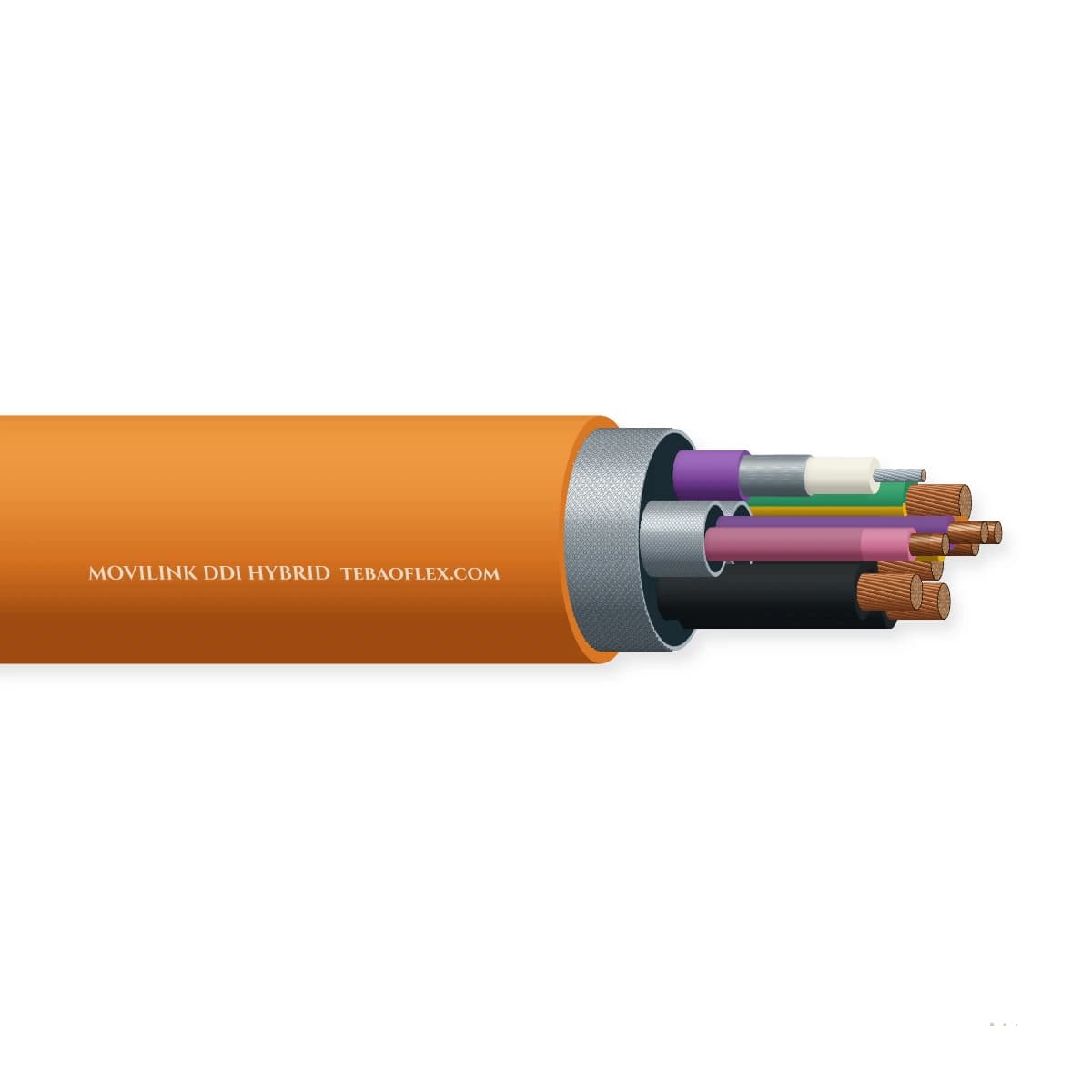
The cutaway below shows the TEBAOFLEX SERVO-DDI Coax Hybrid build. It highlights the matte orange PUR sheath, dense EMC braid, coax data core, shielded brake pair, and fine copper power cores.
For more high-flex specs, see our UL AWM and DESINA drag-chain servo qualification guide and ±360 degree torsion-resistant robot cable guide. You can also watch our PUR-C-HF EMC festoon and drag-chain cable video.
5. Factory Acceptance Testing and Pre-Order Checklist for Lift, Hoist, and Motion Cables
Dynamic cables rarely fail on day one from an open circuit. Instead, bad lay pitch, off-center sheath walls, or uneven braid tension cause twist, creep, or shield breaks months later. Clear pre-shipment Factory Acceptance Testing (FAT) catches those build defects before delivery.
Plumb dead-weight loop verification is a vertical factory test on freely hanging traveling cables. It confirms a clean natural U-loop with ≤ 5° axial twist before shaft installation.
Routine & Type Qualification Matrix for Lift, Hoist, and Motion Cables
Referenced standards (EN 50214, IEC 60245-5, ICEA S-75-381, UL AWM Style 21223, IEC 60204-1) set core build and test methods. If a project needs third-party listing, MSHA marks, or witnessed type tests, put those terms in the purchase order upfront.
- Conductor DC Resistance (20 °C) — Applicable Cable Family: All vertical & motion cables | Measurable Acceptance Basis & Reference: 100% drum check per IEC 60228:2023 Class 5/6 limits | Field Failure Prevented: Broken strands, undersized copper, excess voltage drop
- AC Dielectric Withstand & IR — Applicable Cable Family: All vertical & motion cables | Measurable Acceptance Basis & Reference: 2.0 to 3.0 kV AC (KYFLTFCY, BAULIFT, SWR); ≥ 20 MΩ·km IR; ICEA S-75-381 HV dielectric & IR test on 2 kV 37-43TF | Field Failure Prevented: Insulation pinholes, flashover during drive switching
- Plumb Loop & Twist Balance — Applicable Cable Family: Round & flat traveling cables | Measurable Acceptance Basis & Reference: Dead-weight free-hanging test (≤ 5° loop rotation on SWR round cables) | Field Failure Prevented: Hoistway wall slapping, loop tangling, corkscrewing
- Support-Element / SWR Tensile Test — Applicable Cable Family: Round SWR & KYFLTFCY | Measurable Acceptance Basis & Reference: Sample pull check: ≥ 4.5 to 9.0 kN central SWR MBL (Round SWR); DIN EN 50214 lateral support-element tensile/flex check (KYFLTFCY) | Field Failure Prevented: Support-core snap during emergency brake deceleration
- Cold-Bend & Flame Propagation — Applicable Cable Family: Outdoor hoists, shafts & chains | Measurable Acceptance Basis & Reference: -30 °C cold-bend integrity (IEC 60811-504) & vertical flame test per IEC 60332-1-2:2025 | Field Failure Prevented: Winter jacket cracking in unheated shafts or outdoor masts
- Dimensional & Wall Thickness Audit — Applicable Cable Family: All vertical & motion cables | Measurable Acceptance Basis & Reference: Caliper and sheath thickness checks per IEC 60811-202 plus meter marks | Field Failure Prevented: Drag-chain cavity binding, non-concentric extrusion wear
- EMC Screen & Thermal Ampacity Check — Applicable Cable Family: Hybrid servo & KYFLTFCY | Measurable Acceptance Basis & Reference: Optical braid coverage check (70% to 80%+), IEC 61800-3:2022 EMC fit, & DIN VDE 0298-4 derating | Field Failure Prevented: Servo encoder packet loss, overheating in packed trays
For automated endurance rigs, see our 5-million-cycle robot torsion test rig PO guide.
Six-Point Pre-Order RFQ Checklist for Lift, Hoist, and Hybrid Servo Buyers
Before you request a quote or custom drawing for vertical or motion cables, lock six site inputs:
- Free-hanging height or drag-chain stroke length. Specify maximum shaft suspension drop (35 m, 80 m, or 300 m) or total carrier stroke and unsupported span.
- Speed, acceleration, and cycle target. List travel velocity (m/s), peak acceleration (m/s²), and annual bending cycles to match stranding pitch and jacket compound.
- Exact conductor schedule and protocol type. State power gauge, brake pair, screened control pairs, CCTV/fiber elements, or servo bus (HIPERFACE DSL, coaxial DDI, EnDat).
- Physical geometry limits. Provide hoistway loop clearance, gravity collection basket diameter (≥ 450 mm), headframe sheave diameter, or drag-chain bend radius and inner cavity height.
- Cold, moisture, and chemical exposure. Declare minimum flexing temperature (0 °C, -25 °C, -30 °C, or -40 °C), outdoor UV exposure, acidic mine water, or machining coolants.
- Markings, test reports, and witness checks. Lock EN 10204 3.1 certificates, UL AWM / MSHA / CE compliance records, sequential meter marks, and pre-shipment visual checks upfront.
Editorial Note. Jyen (Vertical Lift & Industrial Motion Cable Engineering Desk) checked all data in this guide against TEBAOFLEX catalog sheets. Key references include DIN EN 50214, IEC 60245-5, ICEA S-75-381, UL AWM Style 21223, IEC 60228, IEC 60204-1, IEC 60332-1-2, IEC 60811-202, IEC 61800-3, and DIN VDE 0298-4. Visit our About TEBAOFLEX factory and testing page or contact our engineering desk with your shaft or chain drawing.
Image credits. Hero cover photo "Factory Automation Robotics Palettizing Bread.jpg" by KUKA Roboter GmbH / Bachmann via Wikimedia Commons (Public Domain, brand markings retouched). Elevator hoistway photo "Lift shaft of a hydraulic elevator.jpg" by Harrihealey02 (CC BY-SA 3.0). Mine headframe photo "Headframe in former mine La Découverte 04.jpg" by Krzysztof Golik (CC BY-SA 4.0). Automated packaging robots photo "Robots empaquetado automatico.jpg" by Tecnowey (CC BY-SA 3.0, brand markings retouched). Round Elevator Travelling Cable and SERVO-DDI Coax Hybrid cutaways by TEBAOFLEX.
Frequently Asked Questions
When must an elevator shaft switch from flat EN 50214 PVC cable to round steel-core traveling cable?
Flat EN 50214 PVC cables with side ropes (KYFLTFCY, H05VVD3H6-F) suit mid-rise shafts from 35 to 80 m drop at moderate speeds. Above 80 m (up to 300 m) or near 10 m/s, switch to a central steel-wire-rope (SWR) round cable. Round SWR cables cut wind sway and hold plumb loop balance.
What is the difference between BAULIFT-T and BAULIFT-W construction hoist cables?
Both are 300/500 V composite power-and-control cables rated up to 80 m height and 1,000 N pull at 5×D bend. BAULIFT-T coils freely inside a gravity collection basket (≥ 450 mm diameter) down to 0 °C. BAULIFT-W rides on mast cable guide trolleys for cold outdoor use down to -30 °C.
How does 2 kV 37-43TF mine shaft hoist cable prevent conductor core slippage during vertical operation?
37-43TF pairs 259-strand internally lubricated tinned copper cores with a mold-cured yellow CPE jacket bonded into the core valleys. Internal lubrication eases bending over headframe sheaves (6×OD). At the same time, the bonded outer jacket locks the cores against gravity slip.
Why are automated factories switching from dual power-and-encoder cables to single-cable hybrid servo (OCT)?
Single-cable hybrid servo builds (SERVO FD 7DSL, SERVO-DDI Coax Hybrid) combine 600/1,000 V power, brake wires, and digital encoder lines inside one PUR or TPU sheath. Replacing two cables with one halves motor plugs, narrows drag chains, and lowers moving mass. It also speeds up axis service.
How do single-cable hybrid servo cables stop PWM drive noise from corrupting encoder feedback?
Hybrid servo cables use low-capacitance PP insulation and individual shields around the brake pair and feedback core (DSL pair or DDI coax). A dense outer tinned-copper braid covers the whole bundle. Terminated in 360-degree EMC glands per IEC 61800-3, that shield-in-shield layout blocks IGBT switching noise.
Which Factory Acceptance Tests (FAT) should buyers require before shipping lift, hoist, or hybrid servo cables?
Buyers should require 100% DC conductor resistance (IEC 60228) plus routine AC dielectric and IR tests (2.0 to 3.0 kV or 2 kV ICEA HV class). Include wall checks (IEC 60811-202) and flame checks (IEC 60332-1-2). For tall shafts, add plumb loop twist tests (≤ 5°), sample SWR pull tests, and an EN 10204 3.1 report.