TL;DR: Subsea electro-optical-mechanical (EOM) cables deliver power, optical telemetry, and tensile lift at extreme ocean depths. Work-class ROV lift umbilicals pair 3.3/4.5 kV XLPE cores with contra-helical steel armour (12×OD bending). Neutrally buoyant tethers use foamed PUR jackets (6×OD) to match seawater density (1.025 g/cm³). Seismic airgun umbilicals unite 2,000 to 3,000 psi air hoses with ≥ 75 dB isolated firing pairs. Meanwhile, 10 kV DC observatory trunks shield 24 to 48 fibers inside laser-welded steel tubes (20×OD). Always lock working load, sheave D/d, and hydrostatic FAT gates upfront.
- Work-Class ROV Lift Umbilical (RM0049) — Typical Voltage / Media: 3.3/4.5 kV XLPE power + SM/MM fiber | Strength Member & Jacket: Double torque-balanced galvanized steel wire armour | Min. Bend Radius: 12×OD | Primary Offshore & Ocean Duty: Deepwater LARS winches, TMS cages, vertical lift & station keeping
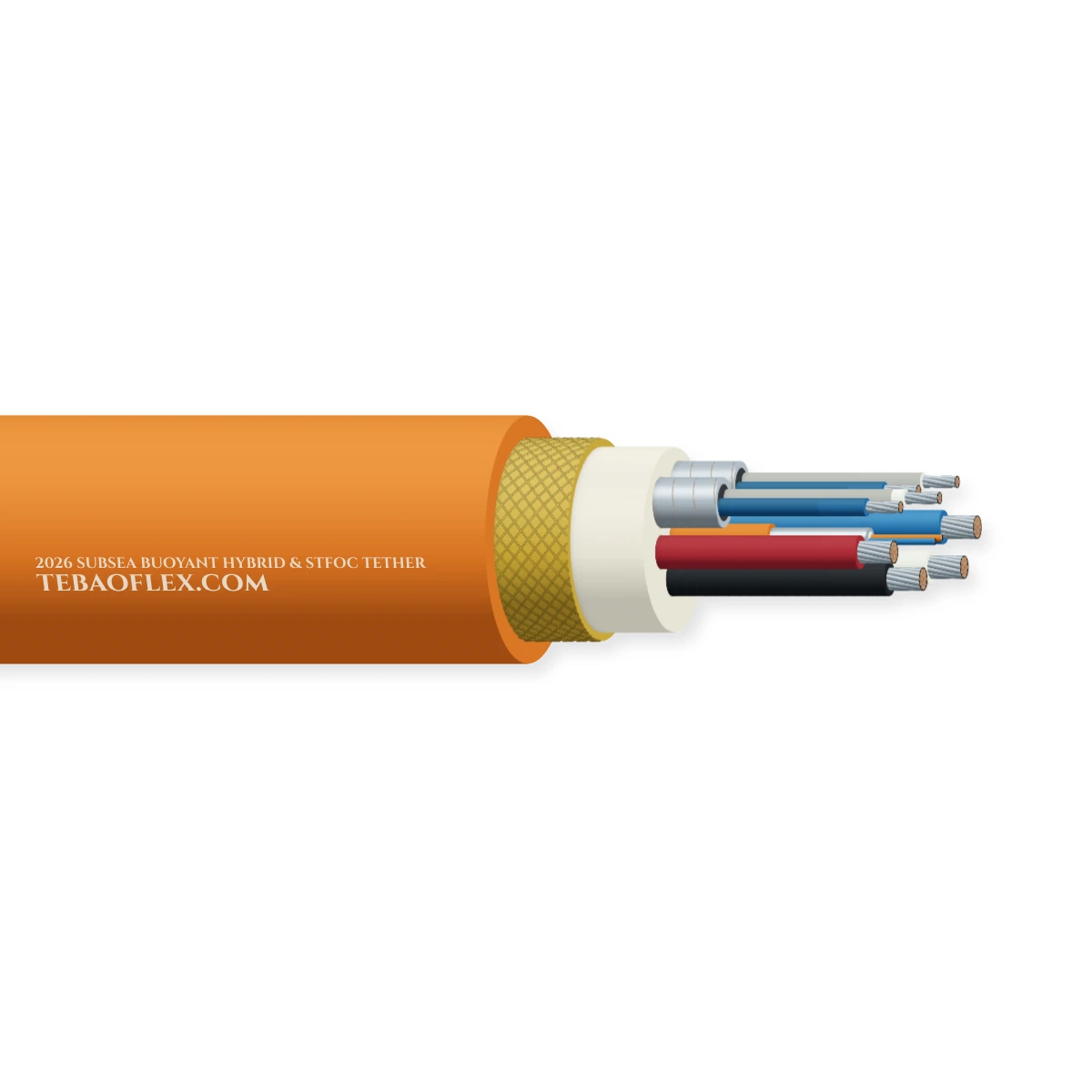
- Neutrally Buoyant ROV Tether (2026 STFOC) — Typical Voltage / Media: 600/1,000 V FEP/ETFE + ITU-T G.657 fiber | Strength Member & Jacket: Aramid/synthetic braid + cellular foamed PUR sheath | Min. Bend Radius: 6×OD | Primary Offshore & Ocean Duty: Free-swimming ROV & AUV excursion tethers from TMS drums
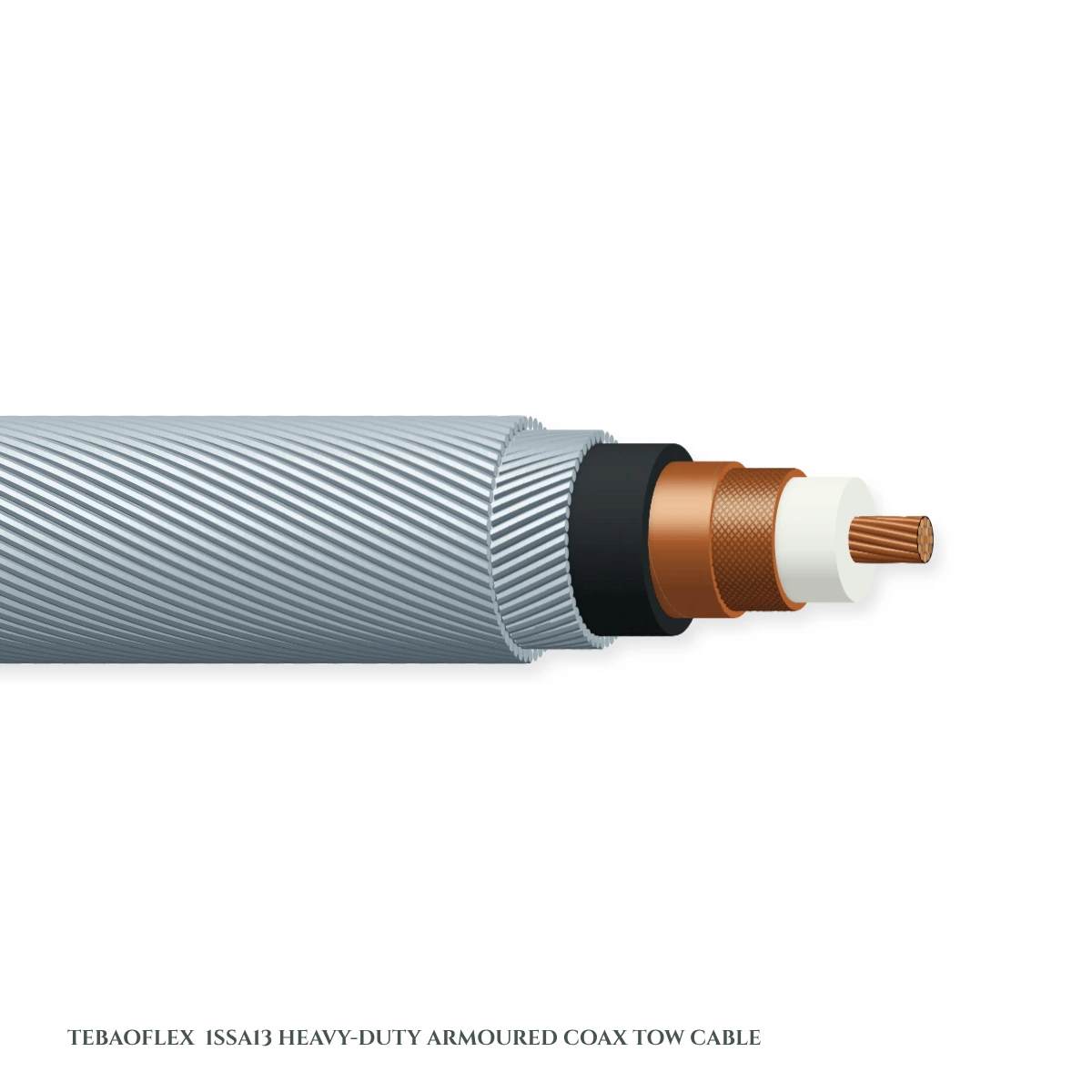
- Heavy Armoured Coax Tow (1SSA13) — Typical Voltage / Media: 1,000 V coaxial (HDPE dielectric + Cu braid) | Strength Member & Jacket: Double torque-balanced galvanized steel wire armour | Min. Bend Radius: 12×OD | Primary Offshore & Ocean Duty: Side-scan sonar, towed magnetometer arrays, deep ocean survey
- Seismic Airgun Umbilical — Typical Voltage / Media: 138 to 207 bar air hose + 10 to 48 pairs (600/1,000 V) | Strength Member & Jacket: Polyaramid/steel tow armour (80 to 350 kN MBL) + heavy PUR | Min. Bend Radius: 10×OD dynamic | Primary Offshore & Ocean Duty: Towed marine seismic source arrays (100 g acoustic shock duty)
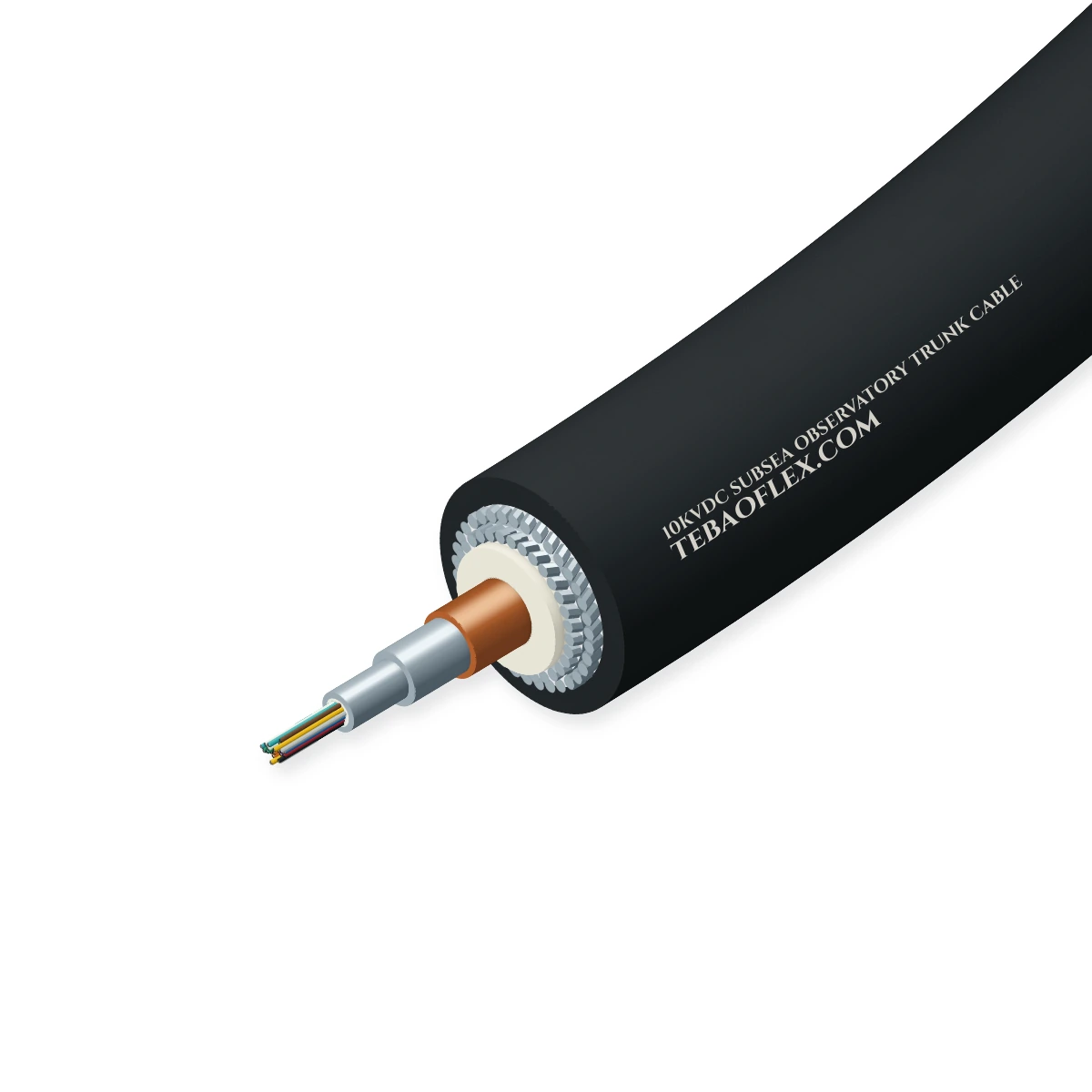
- 10 kV DC Observatory Trunk — Typical Voltage / Media: 10 kV DC copper tube + 24 to 48F G.654E/G.652D | Strength Member & Jacket: Laser-welded SS vault + double steel armour & PP serving | Min. Bend Radius: 20×OD | Primary Offshore & Ocean Duty: Permanent cabled ocean observatories and deep seabed sensor nodes
- 232 °C Flat ESP Power (ESP 450 F) — Typical Voltage / Media: 3 kV or 5 kV 3-phase (PI + EPDM) | Strength Member & Jacket: Lead gas barrier + galvanized/alloy steel tape armour | Min. Bend Radius: Fixed install | Primary Offshore & Ocean Duty: High-temperature sour oil, gas, and geothermal downhole ESP wells
1. Subsea Electro-Optical-Mechanical (EOM) Cable Architecture and Deepwater Duty
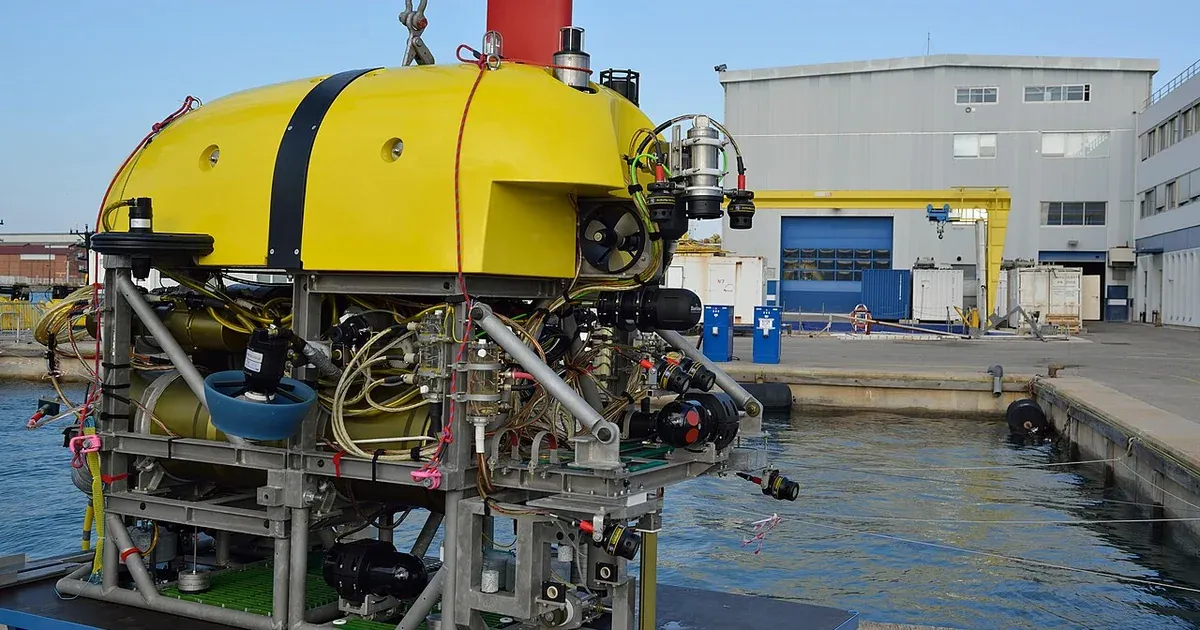
Subsea electro-optical-mechanical (EOM) cable is a dynamic marine umbilical that combines power conductors, optical fibers, and tensile armour inside one water-blocked body. A single topside winch can lift, power, and steer deepwater vehicles kilometers below the vessel.
Deepwater work puts four harsh loads on every cable run. First, ship heave cycles tension across the launch-and-recovery (LARS) overboarding sheave every few seconds. Second, water depth adds 1 bar (0.1 MPa) of external hydrostatic pressure for every 10 m of depth. Third, cable self-weight eats up usable working load once depth passes 2,000 m. Fourth, repeated drum bending stresses copper strands and optical glass at the same time.
Explore our underwater and ocean exploration cable portfolio and subsea umbilical and tow cable range for full deployment classes.
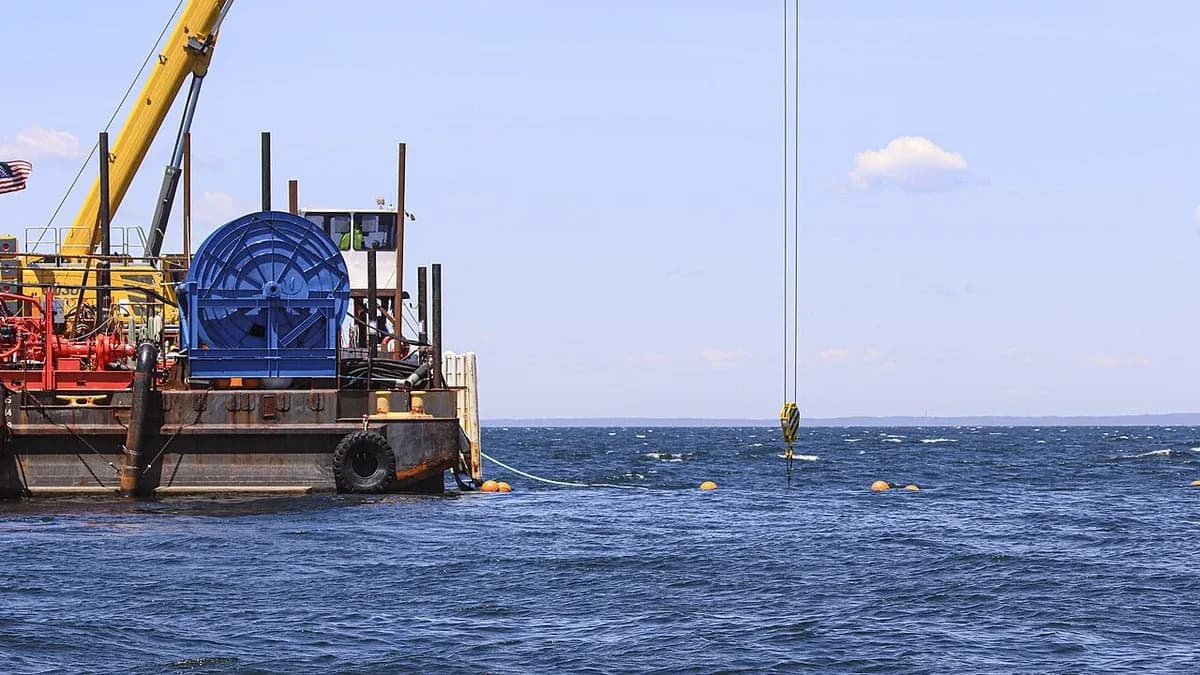
Steel Wire Armour (GIPS) vs. Synthetic Aramid Strength Members
The strength member sets winch size, deck weight, and maximum working depth. Most work-class ROV lift umbilicals use either double contra-helical galvanized improved plow steel (GIPS) wire or synthetic aramid and liquid-crystal polymer (LCP) fibers.
Contra-helical torque-balanced armour is a two-layer helical strength system wound in opposite lay directions with matched pitch angles. Opposite lay torques cancel twist under load. As a result, the cable resists hockling, birdcaging, and core corkscrewing when tension drops on seabed contact.
Three engineering trade-offs separate steel armour from synthetic aramid fibers:
- Weight in seawater (W_water): Steel wire (~7.85 g/cm³) keeps roughly 87% of its air weight underwater. By contrast, synthetic aramid (~1.44 g/cm³) weighs only 29% of its air weight in seawater. That weight savings protects working load beyond 3,000 m.
- Abrasion and crush defense: Double GIPS steel armour resists seabed rock contact, deck fairlead scuffing, and high multi-layer drum crushing. Synthetic aramid needs a thick polyurethane (PUR) or HDPE outer jacket plus careful traction-winch tension control.
- Winch and sheave ratio (D/d): Steel-armoured lift umbilicals need a minimum dynamic bend radius of 12×OD (at least 24×OD sheave diameter, or wider at full load). Synthetic umbilicals bend tighter when jacketed well, which saves space on compact survey decks.
Worked Deepwater Safe Working Load (SWL) and Voltage-Drop Check
Engineers size lift umbilicals from three numbers: vehicle wet weight, cable wet self-weight, and dynamic amplification factor (DAF). For example, take a 3,000 m drop with steel-armoured cable weighing 1.6 kg/m in seawater (~15.7 N/m). Assume it supports a 35 kN submerged ROV + TMS cage under a 2.0 rough-sea DAF:
1. Cable submerged self-weight at 3,000 m:
   W_cable = 3,000 m * 15.7 N/m = 47.1 kN

2. Static top tension at the overboarding sheave:
   T_static = 35.0 kN + 47.1 kN = 82.1 kN

3. Peak dynamic tension (DAF = 2.0 during rough-sea heave):
   T_peak = 2.0 * 82.1 kN = 164.2 kN

4. Minimum Breaking Load (MBL) required (3.5:1 static, ≥ 2.0:1 peak dynamic):
   MBL_req ≥ max(3.5 * 82.1 kN, 2.0 * 164.2 kN) = 328.4 kN -> specify ≥ 330 kN
Electrical losses grow just as fast with length. Sending 150 kW at 480 V down 3,000 m forces huge copper cores and steep I²R drop. Raising topside supply to 3.3 kV or 4.5 kV three-phase cuts line current nearly sevenfold. Compact XLPE conductors built to IEC 60228:2023 Conductors of Insulated Cables then fit cleanly inside a slim lift umbilical.
For full worked voltage-drop tables, read our deepwater ROV umbilical SWL and HV drop guide. You can also review our Kevlar versus contra-helical steel armour design guide.
2. How Do Neutrally Buoyant ROV Tethers Hold Neutral Buoyancy at Depth?
A work-class ROV descends inside a tether management system (TMS) cage on the main lift umbilical. Once at depth, the vehicle swims 150 m to 600 m out from the cage on a flexible tether. A heavy tether sinks and snags on subsea pipelines or wellheads. Conversely, a highly positive tether arches into thrusters and pulls the vehicle off trim.
Neutrally buoyant ROV tether is a lightweight 600/1,000 V hybrid power-and-optical excursion cable. It uses a cellular foamed polyurethane (PUR) or polyolefin jacket tuned so bulk specific gravity sits near 0.98 to 1.02 in seawater (1.025 g/cm³).
Specific Gravity Buoyancy Balance Math
Copper conductors (8.96 g/cm³) and stainless optical tubes (7.9 g/cm³) both sink in water. To offset that dense core, engineers extrude a closed-cell foamed outer jacket with density near 0.55 to 0.75 g/cm³. Neutral trim occurs when total air mass per meter matches displaced water mass:
Bulk Specific Gravity (ref. pure water rho_0 = 1.000 g/cm³):
  SG_cable = M_air / ( (pi / 4) * OD^2 * L * 1.000 g/cm³ )
  [M_air in g/m, OD in cm, L = 100 cm/m]

Target Window:
- Freshwater inspection (rho_water = 1.000 g/cm³): SG_cable = 0.98 to 1.00
- Seawater offshore duty (rho_water = 1.025 g/cm³): SG_cable = 1.00 to 1.02

Example check (22.0 mm OD buoyant tether in seawater):
  Displaced seawater mass = 0.7854 * (2.2 cm)^2 * 100 cm * 1.025 g/cm³ = 389.6 g/m
  Displaced pure water ref = 0.7854 * (2.2 cm)^2 * 100 cm * 1.000 g/cm³ = 380.1 g/m
  For +10 g/m positive trim, keep M_air ≤ 379.6 g/m (SG_cable = 379.6 / 380.1 = 1.00)
Hydrostatic pressure sets the depth limit for foamed sheaths. At 1,000 m (100 bar), soft closed-cell foam compresses inward and loses displaced volume. As a result, a tether that floats at the surface can sink near the seabed. Deep-rated tethers pair firmer closed-cell foamed PUR or syntactic blends with thin fluoropolymer (FEP or ETFE) conductor insulation. That thin dielectric saves core space so the foam jacket carries less copper weight.
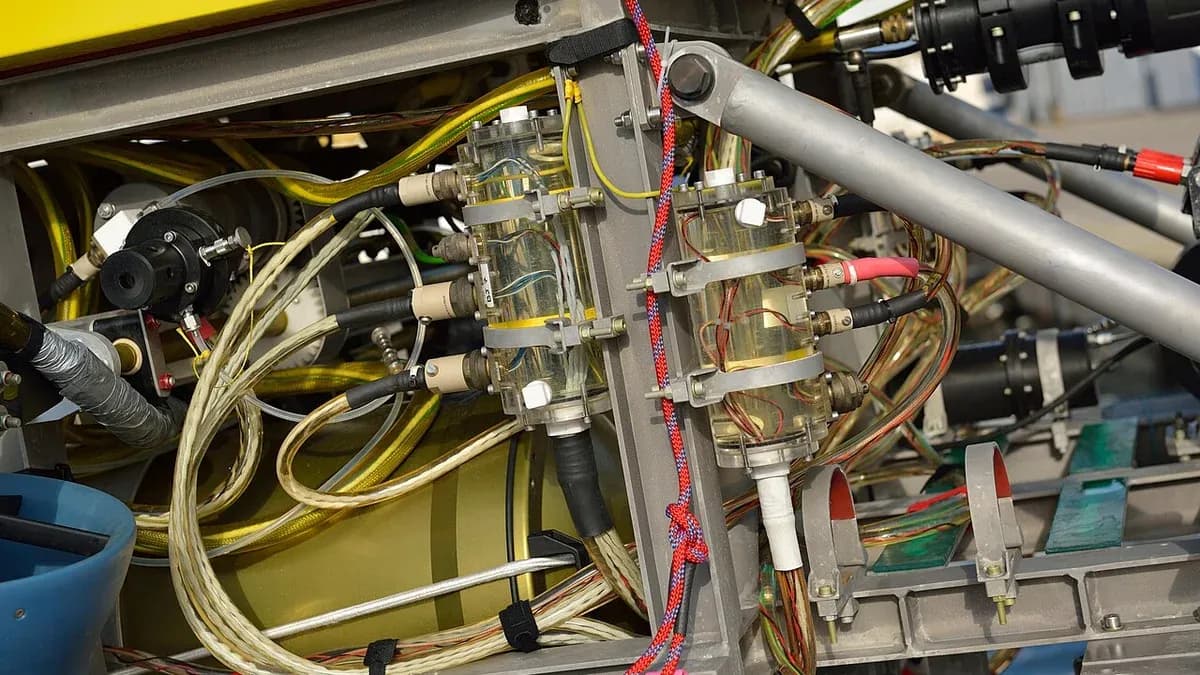
Protecting Optical Fibers Inside Tight TMS Drums
Excursion tethers wind onto compact TMS drums at bends down to 6×OD in cold seawater. Standard telecom fibers lose signal fast under tight drum tension. Therefore, subsea designers specify bend-insensitive single-mode fibers aligned with ITU-T G.657 Single-Mode Optical Fiber Recommendations. Housing those fibers inside a gel-filled stainless steel tube (FIMT) or tight-buffered water-blocked core protects against micro-bending and hydrogen darkening.
Water blocking is equally vital at every wet interface. Oil-filled pressure-compensated junction boxes and wet-mate bulkhead connectors equalize ambient sea pressure. Meanwhile, gel-filled interstices and water-swellable tapes block axial water travel if a sharp steel edge or marine bite cuts the jacket. See our failure study on ROV umbilical birdcaging, hockling, and FIMT hydrogen darkening to catch early wear signs.
3. Armoured Tow Cables, Seismic Airgun Umbilicals, and 10 kV DC Observatory Trunks
Beyond ROV work, survey ships, seismic vessels, and seabed observatories rely on three specialized cable types. Each architecture balances drag, electrical noise, and hydrostatic pressure in a different way.
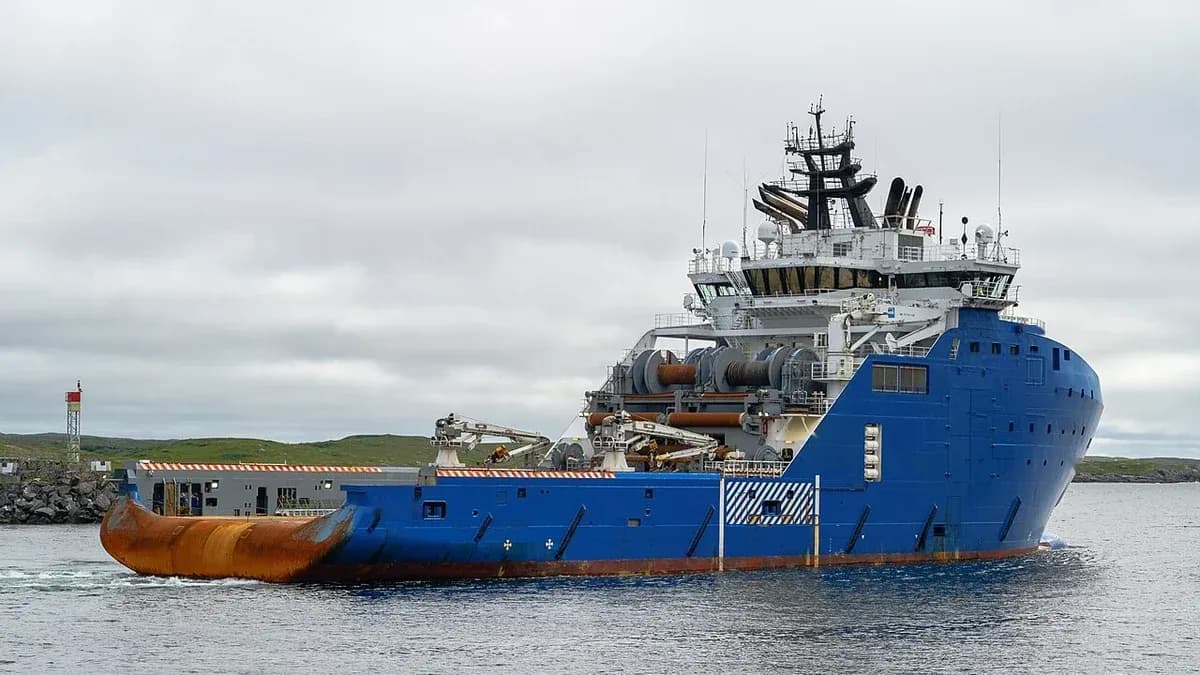
Hydrodynamic Drag and Armoured Coaxial Tow Arrays (1SSA13)
Side-scan sonars, sub-bottom profilers, and magnetometers fly far behind a moving survey ship. Unlike vertical ROV cables, towed cables face heavy normal water drag. That drag pulls the cable aft and limits tow depth at survey speed:
Normal Hydrodynamic Drag per Meter:
   F_drag = 0.5 * rho_water * C_d * OD * v^2

Example check (v = 2.5 m/s ~ 5 knots, OD = 0.018 m, C_d = 1.2 for smooth steel armour):
   F_drag = 0.5 * 1,025 * 1.2 * 0.018 * (2.5)^2 = 69.2 N/m
   Across 1,000 m submerged tow scope, drag adds tens of kilonewtons to stern winch load.
Drag grows directly with cable outer diameter OD. For that reason, coaxial tow cables like 1SSA13 pack a stranded copper center core, low-loss HDPE dielectric, and braided copper screen inside compact double torque-balanced steel wire armour. Its 1,000 V build operates from -40 °C to +80 °C at a 12×OD minimum bend radius. A slender profile cuts water drag while carrying clean wideband sonar data. Review full scope math in our marine towed array hydrodynamic drag and tow tension guide.
Seismic Airgun Umbilicals: High-Pressure Air, Solenoid Pulses, and 100 g Shock
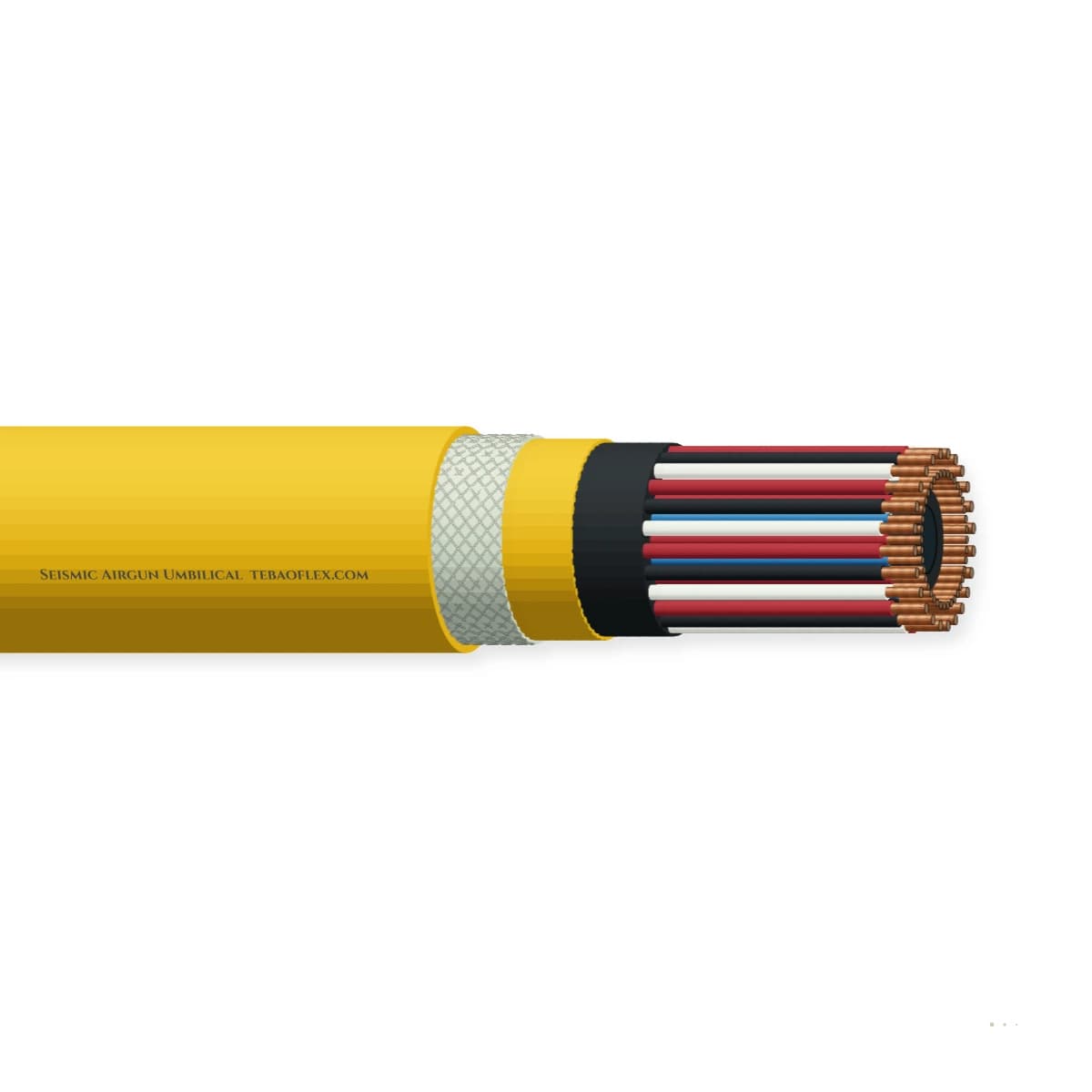
Seismic airgun umbilical is a towed electro-pneumatic marine bundle. It unites a 2,000 to 3,000 psi (138 to 207 bar) polyaramid air hose with 10 to 48 screened solenoid firing and hydrophone pairs inside a tough PUR tow jacket.
Marine 3D and 4D seismic vessels fire airgun arrays every few seconds for weeks without pause. Three extreme stresses separate airgun umbilicals from ordinary subsea cables:
- High-pressure air safety and heat: Central 1/2 in or 3/4 in air hoses run at 138 to 207 bar working pressure with 4:1 minimum burst safety (552 to 828 bar). They also withstand compressor discharge heat up to +85 °C.
- Firing-to-sensor cross-talk isolation (≥ 75 dB): Solenoid firing pairs (600/1,000 V, 16 AWG (1.5 mm² metric), ≤ 13.7 Ω/km tinned copper) run right beside millivolt 100 ± 10 Ω near-field hydrophone (NFH) pairs. Individual pair screening holds ≥ 75 dB cross-talk attenuation so firing pulses never corrupt acoustic readings.
- 100 g acoustic shock and 80 to 350 kN tow load: Every gun shot hits the submerged bundle with a sharp 100 g shock wave. Polyaramid or steel tow armour absorbs 80 to 350 kN breaking loads. Heavy-wall PUR (DIN ISO 4649 ≤ 35 mm³ abrasion loss) and gel water blocking stop jacket splits and flooding.
Read our breakdown of seismic airgun umbilical and streamer shock-wave failure for bend-stiffener and termination design rules.
10 kV DC Subsea Observatory Trunks and Downhole ESP Crossover
Permanent ocean observatories need multi-decade power and optical bandwidth across deep seabed basins. 10 kV DC subsea observatory trunk cable seals 24 to 48 G.654E or G.652D fibers inside a laser-welded stainless steel tube. A steel pressure vault, continuous 10 kV DC copper conductor tube, MDPE/HDPE insulation, and double galvanized steel armour with PP serving protect the core (20×OD minimum bend).
Offshore oil and gas fields face harsh downhole heat as well. High-temperature sour wells (+232 °C / 450 °F) require three-phase 3 kV or 5 kV flat electrical submersible pump (ESP) cables. These builds pair polyimide (PI) + EPDM insulation with a lead H₂S gas barrier and steel tape armour. Browse our oil and gas specialty cable portfolio, our marine and offshore cable hub, and our ESP motor lead extension IEEE 1018 and 1019 guide.
4. TEBAOFLEX Subsea EOM, Buoyant Tether, Tow, and Seismic Airgun Umbilical Portfolio
Choosing the wrong subsea cable class leads to poor vehicle trim, early armour fatigue, or winch groove damage. The table below compares six verified TEBAOFLEX subsea, seismic, and downhole cable families.

Comparing Six Core TEBAOFLEX Subsea & Offshore Specialty Cable Series
- RM0049 Deepwater Work ROV Lift Umbilical — Rated Voltage / Media: 3.3/4.5 kV AC | Core & Optical Architecture: Stranded Cu + XLPE insulation + hermetic SS/tight-buffered SM/MM fiber | Armour & Outer Sheath: Double torque-balanced galvanized steel wire armour | Temp. & Min. Bend: -40 °C to +80 °C; 12×OD | Governing Basis & Typical Duty: DNV-OS-E402 / ISO 13628-5; heavy work-class ROV vertical lift & TMS winches
- 2026 Subsea Buoyant Hybrid & STFOC Tether — Rated Voltage / Media: 600/1,000 V AC | Core & Optical Architecture: Stranded Cu + FEP/ETFE insulation + SM/MM ITU-T G.657 optical unit | Armour & Outer Sheath: Water-blocked core + neutrally buoyant cellular foamed PUR sheath | Temp. & Min. Bend: -40 °C to +80 °C; 6×OD | Governing Basis & Typical Duty: ITU-T G.657 / DNV Subsea; TMS-deployed ROV & AUV excursion tethers
- 1SSA13 Heavy-Duty Armoured Coax Tow Cable — Rated Voltage / Media: 1,000 V coaxial | Core & Optical Architecture: Stranded Cu center conductor + low-loss HDPE dielectric + Cu braid | Armour & Outer Sheath: Double torque-balanced galvanized steel wire armour | Temp. & Min. Bend: -40 °C to +80 °C; 12×OD | Governing Basis & Typical Duty: DNV-OS-E402 / MIL-C-17; side-scan sonar & oceanographic tow arrays
- Seismic Airgun Umbilical — Rated Voltage / Media: 138 to 207 bar air + 600/1,000 V (10 to 48 pairs) | Core & Optical Architecture: Central 1/2" or 3/4" HP hose + 16 AWG firing & 100 Ω NFH pairs | Armour & Outer Sheath: Polyaramid/steel tow armour (80 to 350 kN MBL) + heavy marine PUR | Temp. & Min. Bend: -5 °C to +50 °C sea (+85 °C air); 10×OD dyn. | Governing Basis & Typical Duty: ISO 13628-5 / API 17E / SAE J517 100R8; marine seismic source arrays
- 10 kV DC Subsea Observatory Trunk Cable — Rated Voltage / Media: 10 kV DC + 24 to 48F SM | Core & Optical Architecture: Laser-welded SS fiber tube (G.654E/G.652D) + steel vault + Cu tube + MDPE/HDPE | Armour & Outer Sheath: Double galvanized steel wire armour + PP outer serving | Temp. & Min. Bend: -20 °C to +70 °C; 20×OD | Governing Basis & Typical Duty: ITU-T G.972 / IEC 60794; permanent seabed observatories & science trunks
- ESP 450 F 232 °C Lead-Sheathed Flat ESP Cable — Rated Voltage / Media: 3 kV or 5 kV 3-phase | Core & Optical Architecture: Solid/stranded copper + Polyimide (PI) + EPDM insulation | Armour & Outer Sheath: Extruded lead gas barrier + steel tape armour | Temp. & Min. Bend: Up to +232 °C; fixed well install | Governing Basis & Typical Duty: Project-spec EN 10204 3.1; high-H₂S sour oil & geothermal downhole pumps
Next, the cutaway below shows TEBAOFLEX's seismic airgun umbilical layout. You can inspect the central high-pressure air hose, individually screened solenoid and hydrophone pairs, water-blocked inner sheath, polyaramid tow braid, and yellow marine PUR jacket.
For topside offshore platforms and seabed trenchers, compare our subsea trencher versus IWOCS umbilical design guide. You can also view our Guyana offshore platform RFOU cable case study and our BS 6883 6.6 kV offshore medium-voltage cable video.
5. Hydrostatic, Dielectric, OTDR, and Mechanical FAT Qualification Checklist
Offshore support vessels cost tens of thousands of dollars every day. An optical loss spike, hose leak, or armour twist fault discovered at sea can halt an entire campaign. For that reason, thorough pre-shipment Factory Acceptance Testing (FAT) protects project schedules and vessel budgets.
Subsea umbilical Factory Acceptance Test (FAT) is the documented pre-shipment test protocol required before offshore dispatch. It verifies dielectric withstand, OTDR fiber loss, hydrostatic pressure hold, dimensions, and mechanical strength against DNV Maritime and Offshore Rules and Standards (including DNV-OS-E402 umbilical provisions and subsea class rules), ISO 13628-5:2009, and API Spec 17E.
Core Subsea EOM Routine & Type Qualification Matrix
Published standards (DNV-OS-E402, ISO 13628-5, API Spec 17E, IEC 60502-2, and IEC 60794) define engineering scope and test procedures. By contrast, third-party class witness or formal type certification must be locked into the purchase contract before production starts.
- Conductor DC Resistance (20 °C) — Applicable Subsea Family: All EOM, tethers, tow & ESP | Measurable Acceptance Basis & Reference: 100% drum check per IEC 60228:2023 (e.g., ≤ 13.7 Ω/km on 16 AWG / 1.5 mm² Class 5 tinned firing pairs) | Defect Prevented Offshore: Undersized copper, broken strands, excessive ROV voltage drop
- AC / HV Dielectric & PD Withstand — Applicable Subsea Family: Lift umbilicals, airgun, 10 kV DC, ESP | Measurable Acceptance Basis & Reference: Routine AC test (e.g., 3.0 kV / 5 min airgun; MV methods per IEC 60502-2:2014/AMD1:2024 & IEC 60885-3 PD) | Defect Prevented Offshore: Insulation pinholes, screen voids, partial discharge failure under load
- Optical OTDR Attenuation Trace — Applicable Subsea Family: Lift umbilicals, STFOC tethers, observatory trunks | Measurable Acceptance Basis & Reference: Bi-directional OTDR check at 1310 / 1550 nm (SM) or 850 / 1300 nm (MM) on full drum length | Defect Prevented Offshore: Macro-bending loss, pinched FIMT tubes, micro-cracked glass fibers
- Signal Cross-Talk & Impedance — Applicable Subsea Family: Seismic airgun & telemetry umbilicals | Measurable Acceptance Basis & Reference: 100 ± 10 Ω pair impedance; ≥ 75 dB near-end cross-talk isolation (solenoid vs. NFH) | Defect Prevented Offshore: Firing-pulse noise corrupting seismic hydrophone data
- Hydrostatic Hose & Pressure Proof — Applicable Subsea Family: Seismic airgun & hydraulic umbilicals | Measurable Acceptance Basis & Reference: 1.5× working pressure (207 or 310.5 bar) hold for 30 min with zero pressure decay | Defect Prevented Offshore: Burst hoses, weep leaks at JIC end fittings during deep firing
- Dimensional & Outer Sheath Audit — Applicable Subsea Family: All subsea cables | Measurable Acceptance Basis & Reference: Caliper and wall checks per IEC 60811-202 plus continuous meter marks | Defect Prevented Offshore: Winch groove mismatch, thin jacket spots, wrong buoyancy OD
- Break Load, Torque & Bending Type Test — Applicable Subsea Family: Armoured lift umbilicals & tow cables | Measurable Acceptance Basis & Reference: Contracted sample MBL, rotation-vs-tension balance, and cycling over project sheave D/d | Defect Prevented Offshore: Hockling on seabed touch-down, birdcaging, premature wire fatigue
For pressure-chamber protocols, see our subsea umbilical DNV and ISO 13628-5 hydrostatic FAT guide. You can also check our dynamic subsea tow cable IEC 63026 and CIGRE TB 722 testing guide.
Seven-Point Pre-Order RFQ Checklist for Subsea Cable Buyers
Before requesting a quotation for a custom EOM, buoyant tether, tow, or seismic airgun umbilical, gather seven core inputs:
- Operating depth, salinity, and temperature range. Specify max depth (meters or bar), freshwater versus seawater density (1.000 vs. 1.025 g/cm³), and deck ambient range (-40 °C to +80 °C).
- Complete electrical, optical, and pneumatic core schedule. List voltage (600 V, 3.3/4.5 kV, or 10 kV DC), current, fiber count (G.657, G.654E, OM3), and any high-pressure hose ID and pressure rating.
- Working load, dynamic factor, and target MBL. State wet vehicle or array weight, required SWL, sea-state dynamic factor, and minimum breaking load (kN).
- Winch drum, overboarding sheave, and TMS dimensions. Provide barrel diameter, flange inner width, fleet angle, sheave tread diameter, and maximum cable OD.
- Target buoyancy or weight-in-water tolerance. For ROV tethers, state desired specific gravity (0.98 to 1.02) and preferred trim at operating depth.
- Termination and mechanical bullet interface. Confirm bare-ended delivery for field potting or factory-installed armour terminations, bend restrictors, or JIC air fittings.
- Contracted FAT certificates and witness hold points. Lock EN 10204 3.1 reports, OTDR traces, hydrostatic hold times, and any DNV witness points into the order.
Editorial Note. All specifications and qualification checks in this guide were reviewed by Jyen (Subsea & Offshore Specialty Cable Engineering Desk) against TEBAOFLEX product records. Referenced standards include DNV-OS-E402, ISO 13628-5, IEC 60228, IEC 60811-202, ITU-T G.657, and IEEE Standards Association downhole rules. Explore our About TEBAOFLEX manufacturing and laboratory page or contact our subsea engineering team with your depth profile and core schedule.
Image credits. Hero cover photo "HROV Ariane (23970)" and ROV electro-optical harness photo "(23974)" by Olivier Dugornay via Wikimedia Commons (CC BY 4.0). Offshore cable winch photo "Cable Installation - 52990534214.jpg" by BOEM-OPA (CC BY-SA 2.0). Support vessel photo "HORIZON ARCTIC - IMO 9732838.jpg" by Gordon Leggett (CC BY-SA 4.0), hull markings retouched. RM0049 lift umbilical and seismic airgun umbilical cutaways by TEBAOFLEX.
Frequently Asked Questions
What is the difference between a work-class ROV lift umbilical and an excursion tether?
A work-class ROV lift umbilical is a heavy steel- or aramid-armoured primary cable (3.3/4.5 kV, 12×OD). It suspends the ROV and TMS cage vertically from the ship winch. By contrast, a neutrally buoyant tether (600/1,000 V, 6×OD) pays out horizontally from the TMS drum with a foamed PUR jacket so the vehicle swims freely.
How is neutral buoyancy achieved on a subsea ROV tether?
Cable engineers wrap heavy copper conductors and optical tubes inside a low-density cellular foamed polyurethane (PUR) or polyolefin jacket. Tuning wall thickness and foam density balances core mass against displaced water. As a result, bulk specific gravity stays near 0.98 to 1.02 in seawater (1.025 g/cm³) without dragging or bowing upward.
When should engineers choose steel wire armour (GIPS) over synthetic aramid on deepwater umbilicals?
Choose double contra-helical GIPS steel armour down to roughly 3,000 m when rock abrasion defense, drum crush resistance, and standard deck winches matter most. Switch to synthetic aramid or LCP strength members at ultra-deepwater sites (≥ 3,500 m) where steel self-weight eats usable working load. Pair synthetic armour with a traction winch and heavy PUR outer sheath.
What makes a seismic airgun umbilical different from a standard subsea power umbilical?
A seismic airgun umbilical unites a 2,000 to 3,000 psi (138 to 207 bar, 4:1 burst safety) air hose with 10 to 48 individually screened 600/1,000 V firing and 100 Ω hydrophone pairs. It holds ≥ 75 dB cross-talk isolation, withstands 100 g acoustic shock waves, and supports 80 to 350 kN tow breaking loads.
Why do 10 kV DC subsea observatory cables use laser-welded stainless steel fiber tubes?
At abyssal ocean depths (≥ 4,000 m), hydrostatic pressure exceeds 400 bar and dissolved hydrogen darkens glass fibers over time. A laser-welded stainless steel tube inside a steel pressure vault creates a hermetic moisture and hydrogen barrier around 24 to 48 G.654E or G.652D fibers for multi-decade seabed life.
Which Factory Acceptance Tests (FAT) should buyers require before shipping a subsea umbilical?
Every production reel should pass 100% conductor DC resistance (IEC 60228) and AC or HV dielectric testing (IEC 60502-2 / IEC 60885-3 PD where specified). Buyers should also require bi-directional OTDR fiber traces, outer dimension checks (IEC 60811-202), and 30 min hydrostatic proof holds (1.5×WP) for pneumatic or hydraulic hoses on an EN 10204 3.1 certificate.