Choose an H07VVH6-F cable (or cold-flexible KYFLY) for indoor overhead cranes, hoists and C-rail festoon trolleys operating at travel speeds up to 96 m/min (1.6 m/s) with a 10 × H minimum bending radius. Choose NGFLGÖU rubber flat cable when the crane runs outdoors in UV, ozone or wet conditions, at speeds up to 180 m/min, or with a 3–5 × H bending loop.
A crane and hoist buyer in Southeast Asia recently asked whether we manufacture PVC flat cable under the spelling H07VVH06F. In crane procurement, H07VVH06F is a frequent typing variant for harmonised H07VVH6-F flat PVC festoon cable to DIN EN 50214. Knowing how H07VVH6-F, H05VVH6-F, KYFLY, screened KYFLCY and rubber NGFLGÖU differ prevents premature jacket cracking and trolley jamming on overhead cranes.
What H07VVH6-F, H05VVH6-F and KYFLY Designations Mean
Harmonised European flat PVC cables for lifts, hoists and crane festoon systems are governed by DIN EN 50214 (VDE 0283-2) and DIN VDE 0281-403 under the CENELEC European Electrotechnical Standardization framework. On our KYFLY flat PVC festoon cable page, three closely related designations appear side by side:
- H05VVH6-F (300/500 V): Flat PVC-insulated (TI2) and PVC-sheathed (TM2) flexible cable with IEC 60228:2023 Class 5 bare copper conductors. It covers small control cross-sections up to 1.0 mm² (2.0 kV AC routine test voltage, up to 45 m free suspension height).
- H07VVH6-F (450/750 V): The 450/750 V flat PVC festoon and hoist cable for conductor cross-sections of 1.5 mm² and above. It undergoes a 2.5 kV AC routine test and supports up to 35 m free suspension height. Buyers often write H07VVH06F with an extra zero before the 6.
- KYFLY (300/500 V & 450/750 V cold-flexible PVC flat cable): Built with special cold-resistant TI2/TM2 PVC compounds and Class 5 or extra-fine Class 6 copper conductors (including bundled quad units). That cold-flexible compound extends the flexing ambient temperature range down to −30 to +70 °C (−40 to +70 °C fixed), compared with −25 to +60 °C flexing on standard H07VVH6-F.
For smaller twin-core appliance leads that do not run on crane trolleys, see H05VVH2-F 300/500 V flat twin PVC flexible cord.
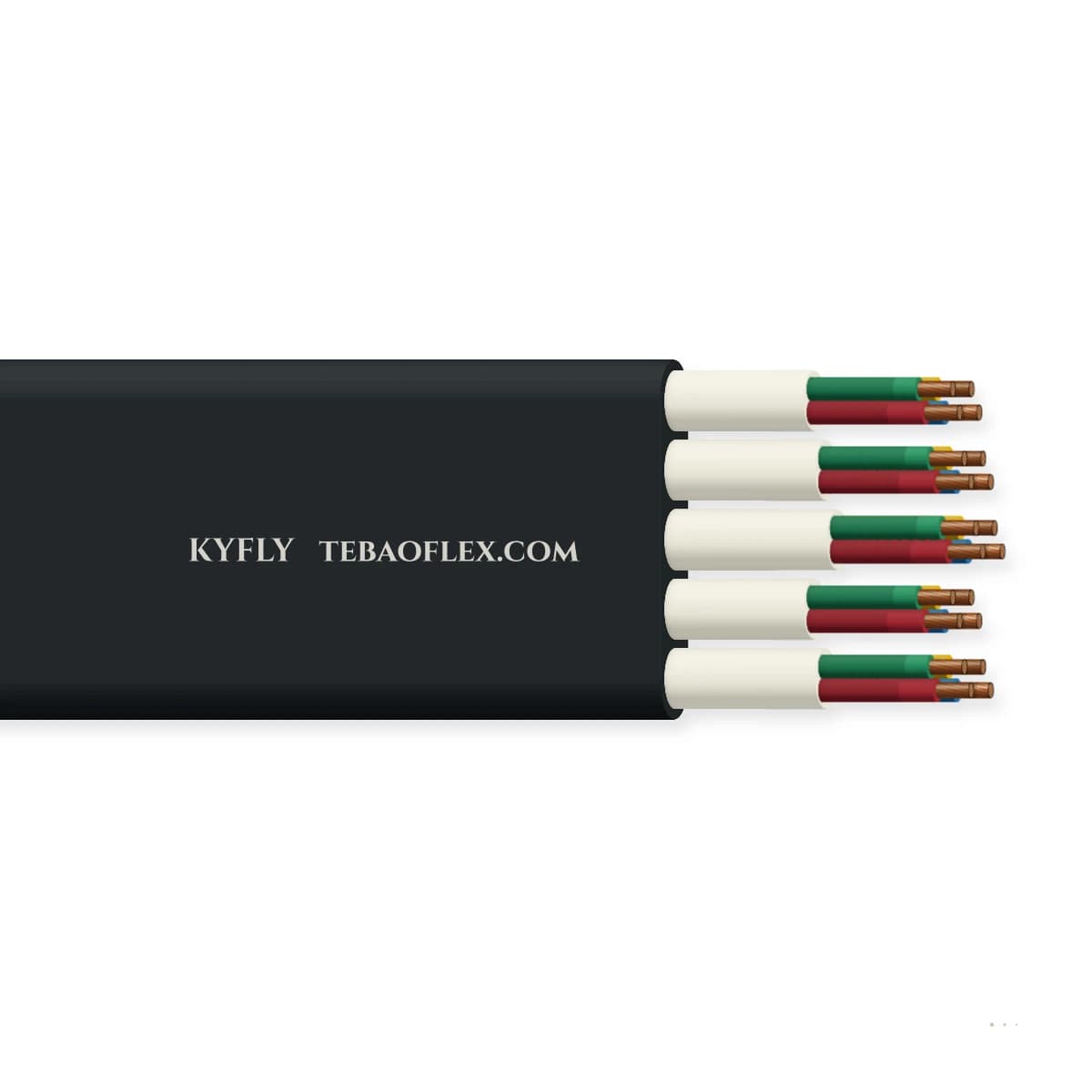
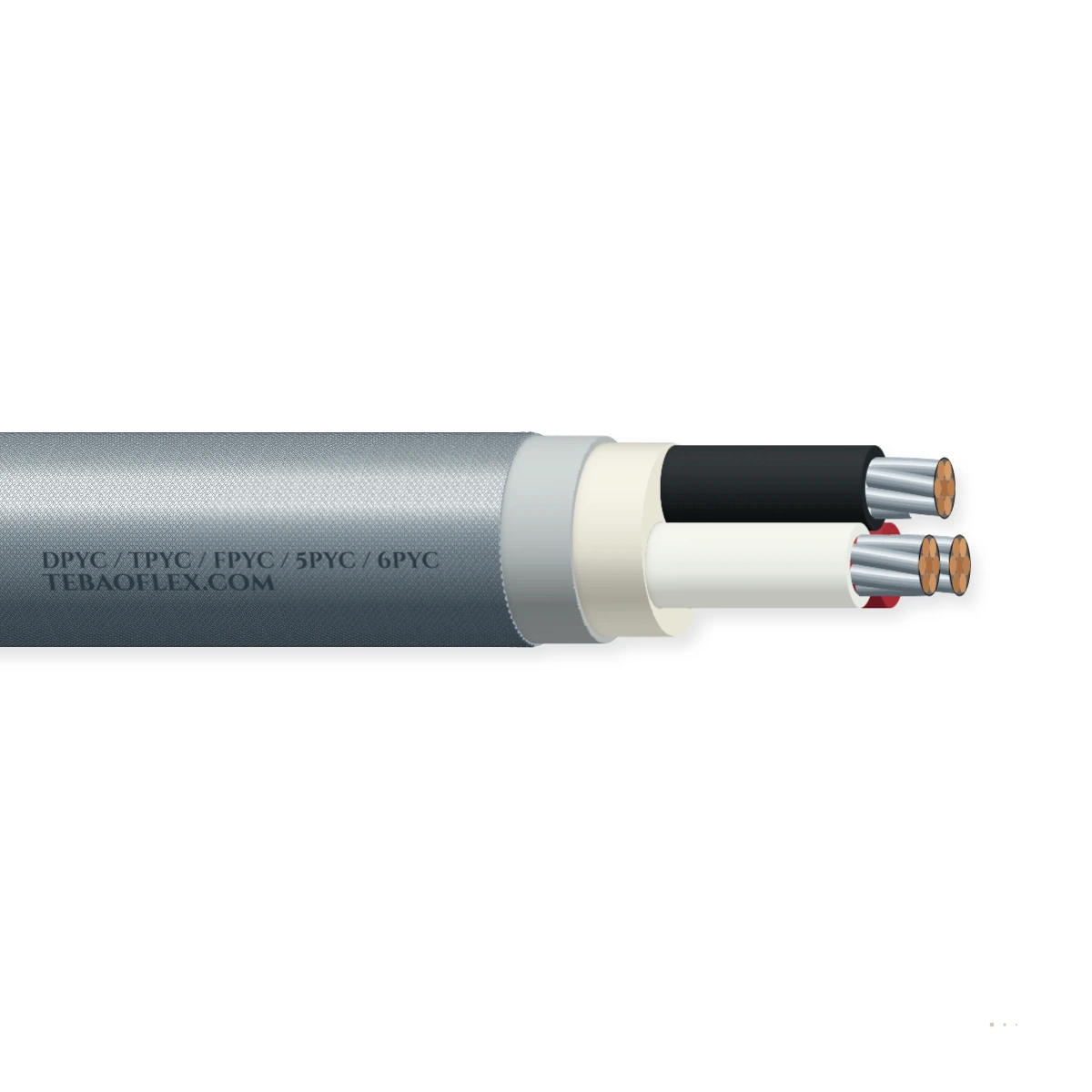
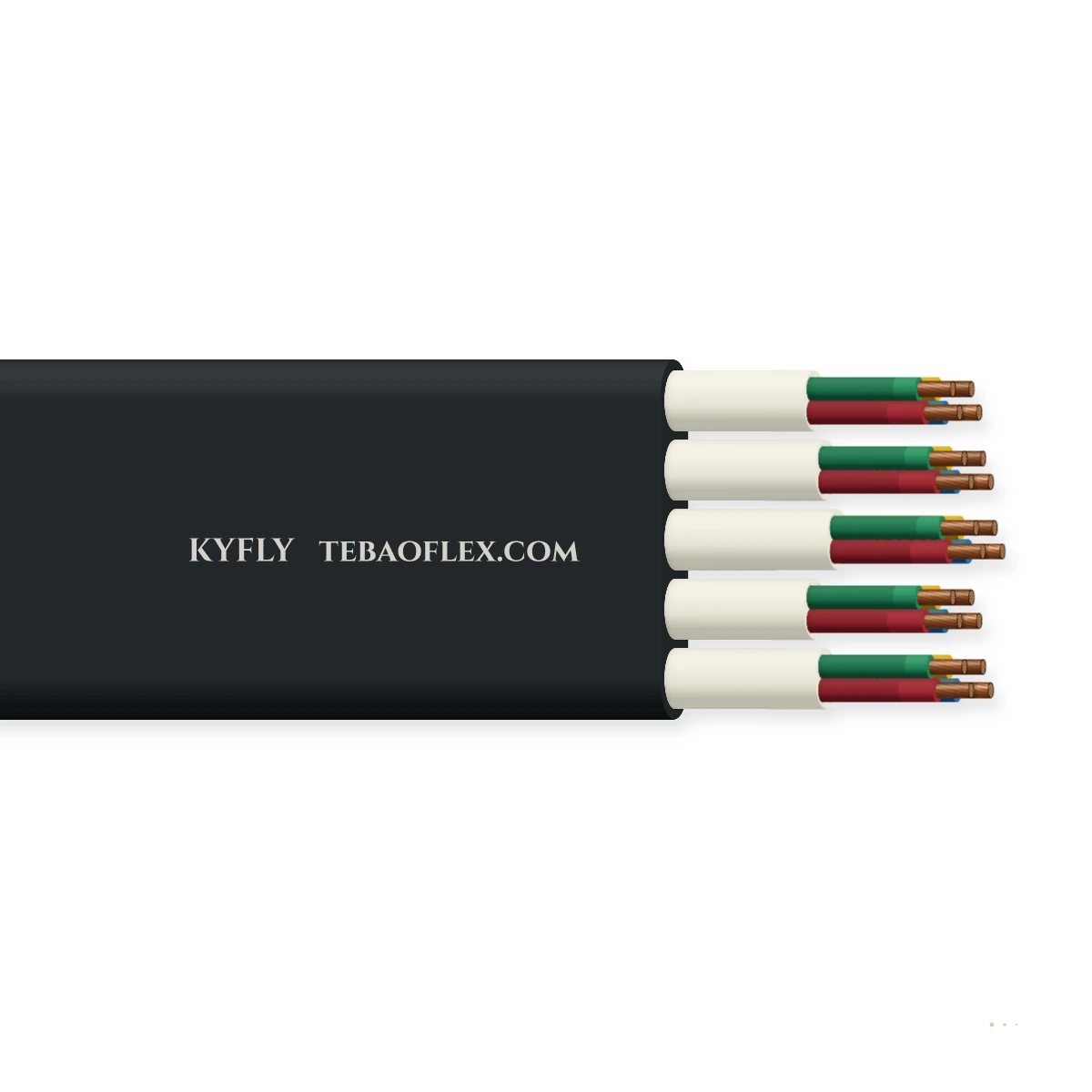
Horizontal cutaway of KYFLY / H07VVH6-F cold-flexible PVC flat festoon cable
H07VVH6-F Cable vs NGFLGÖU Rubber Flat Cable: Five Selection Factors
Both H07VVH6-F cable and NGFLGÖU flat rubber festoon cable arrange parallel flexible copper cores in one flat plane for single-plane bending. However, their thermoplastic vs elastomeric compounds set very different operating limits:
- 1. Bending radius and trolley saddle diameter: H07VVH6-F and KYFLY require a minimum single-plane flexing bending radius of 10 × cable height H. By contrast, NGFLGÖU (built to DIN VDE 0250-809 with 3GI3 EPR insulation and 5GM3 polychloroprene rubber sheath) bends down to 3–5 × H. That tighter radius allows smaller festoon trolley saddles and shorter parking loops at the end of the crane bridge.
- 2. Travel speed on C-rail and I-beam trolleys: H07VVH6-F, KYFLY and screened KYFLCY flat EMC PVC festoon cable are rated for maximum festoon travel speeds of 96 m/min (1.6 m/s). NGFLGÖU is rated up to 180 m/min (3.0 m/s) for high-speed container cranes, automated transfer lines and steel-mill overhead cranes.
- 3. Temperature and thermal overload limits: PVC flat cables have a maximum continuous conductor temperature of +70 °C and a 5-second short-circuit limit of +150 °C. NGFLGÖU rubber flat cables operate at +90 °C conductor temperature (+250 °C short-circuit) and flex from −35 to +80 °C (down to −50 °C fixed).
- 4. Indoor vs outdoor weather, UV and moisture exposure: An H07VVH6-F flat cable performs reliably in dry, humid and wet indoor factory bays, electroplating halls and warehouse cranes. For outdoor gantry cranes exposed to continuous sunlight (UV), ozone, salt mist or freezing rain, polychloroprene-sheathed NGFLGÖU resists weather ageing and low-temperature stiffening far better than PVC.
- 5. Conductor size range: H07VVH6-F and KYFLY primarily cover control and light power sizes (typically 0.75 to 16 mm² or 35 mm² across 4 to 24 cores). NGFLGÖU covers 40 standard sizes from 3 × 1.5 mm² up to heavy 4 × 240 mm² crane power feeders.
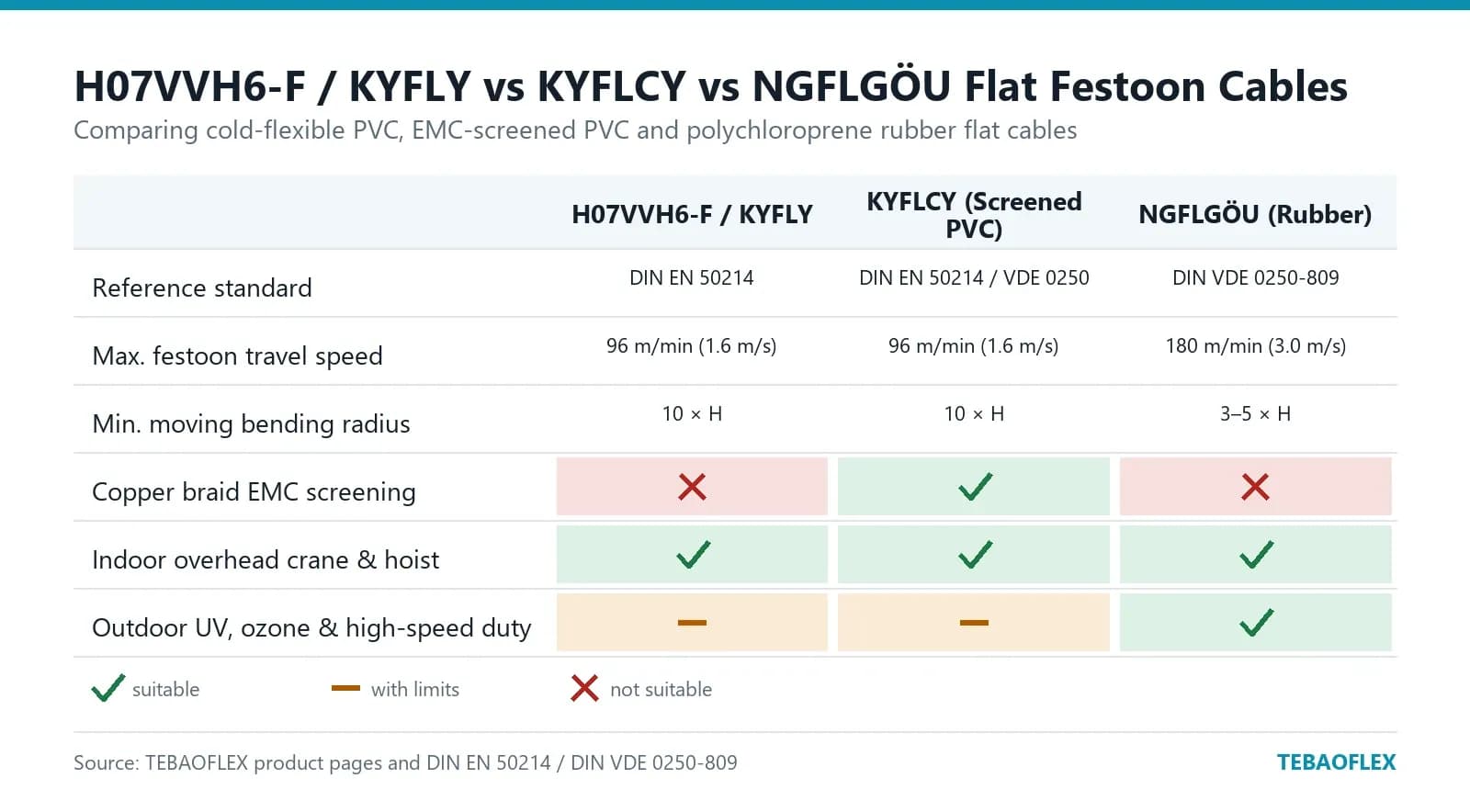
Key ratings for H07VVH6-F / KYFLY PVC flat cable, KYFLCY EMC-screened PVC flat cable and NGFLGÖU rubber flat cable
Comparison matrix — text version
For each criterion below, values are listed in this order: H07VVH6-F / KYFLY; KYFLCY (Screened PVC); NGFLGÖU (Rubber).
- Reference standard: DIN EN 50214; DIN EN 50214 / VDE 0250; DIN VDE 0250-809.
- Max. festoon travel speed: 96 m/min (1.6 m/s); 96 m/min (1.6 m/s); 180 m/min (3.0 m/s).
- Min. moving bending radius: 10 × H; 10 × H; 3–5 × H.
- Copper braid EMC screening: no; yes; no.
- Indoor overhead crane & hoist: yes; yes; yes.
- Outdoor UV, ozone & high-speed duty: limited; limited; yes.
When to Add Copper Braid Screening (KYFLCY vs NGFLCGÖU)
Variable-frequency drives (VFDs) on modern crane hoists and trolley travel motors generate high-frequency common-mode noise. Without screening, that interference can disturb encoders, load cells and PLC communication lines:
- Indoor VFD crane festoons (KYFLCY): Choose KYFLCY flat EMC PVC festoon cable when an indoor crane needs cold-flexible PVC (−30 to +70 °C flexing, 96 m/min travel speed, 10 × H bending radius) with electromagnetic screening. KYFLCY adds a bare or tinned copper wire braid screen (70–80 % optical coverage) over individual cores or core bundles.
- Outdoor or high-speed VFD festoons (NGFLCGÖU): Choose screened rubber flat cable when the VFD-driven crane operates outdoors, above 96 m/min, or on compact trolley saddles requiring a 3–5 × H bending radius. For more detail on stacking flat cables on multi-tier trolley saddles, see Flat vs Round Festoon Cable: How to Choose for Cranes and Flat Festoon Cables Compared: NGFLGÖU, NGFLCGÖU & KYFLCY.
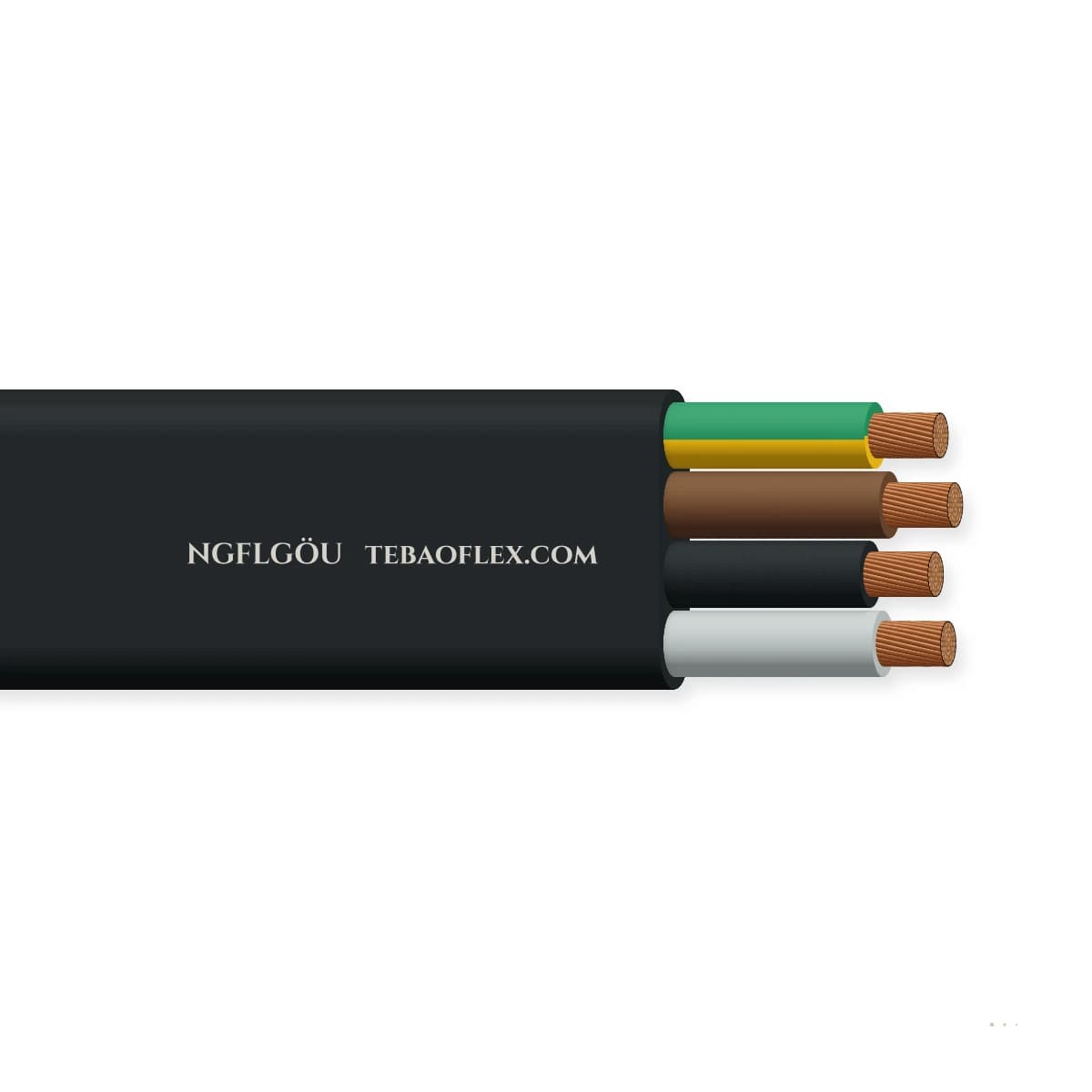
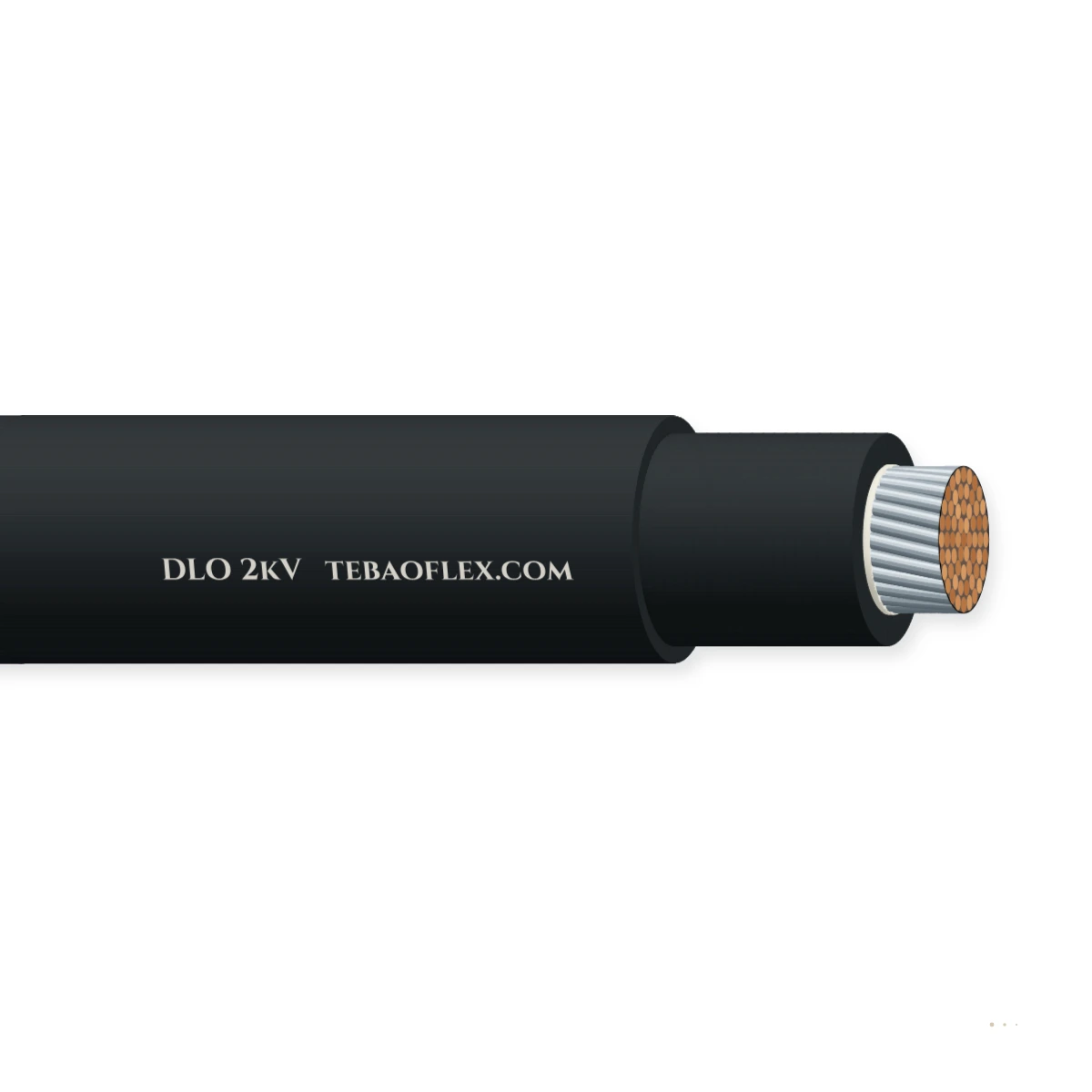
Horizontal cutaway of NGFLGÖU DIN VDE 0250-809 flat rubber festoon cable
How to Specify Flat Festoon Cables for Your Crane or Hoist
Before ordering replacement flat cables or sizing a new festoon package, confirm these parameters:
- Core count and cross-section: List power cores (such as 4 × 6 mm² or 4 × 16 mm²) separately from control cores (such as 12 × 1.5 mm² or 24 × 1.5 mm²).
- Environment and ambient temperature: Specify indoor hall vs outdoor gantry, minimum winter start-up temperature, and presence of oil mist or chemical vapours.
- Trolley speed and loop geometry: Give the travel speed in m/min, trolley saddle diameter (≥ 10 × H for PVC or ≥ 3–5 × H for rubber), and loop depth. Keep total suspended length within 35 m for H07VVH6-F / KYFLY and static copper tension within 15 N/mm².
- EMC screening: State whether unscreened (H07VVH6-F / NGFLGÖU) or copper-braid screened (KYFLCY / NGFLCGÖU) construction is needed.
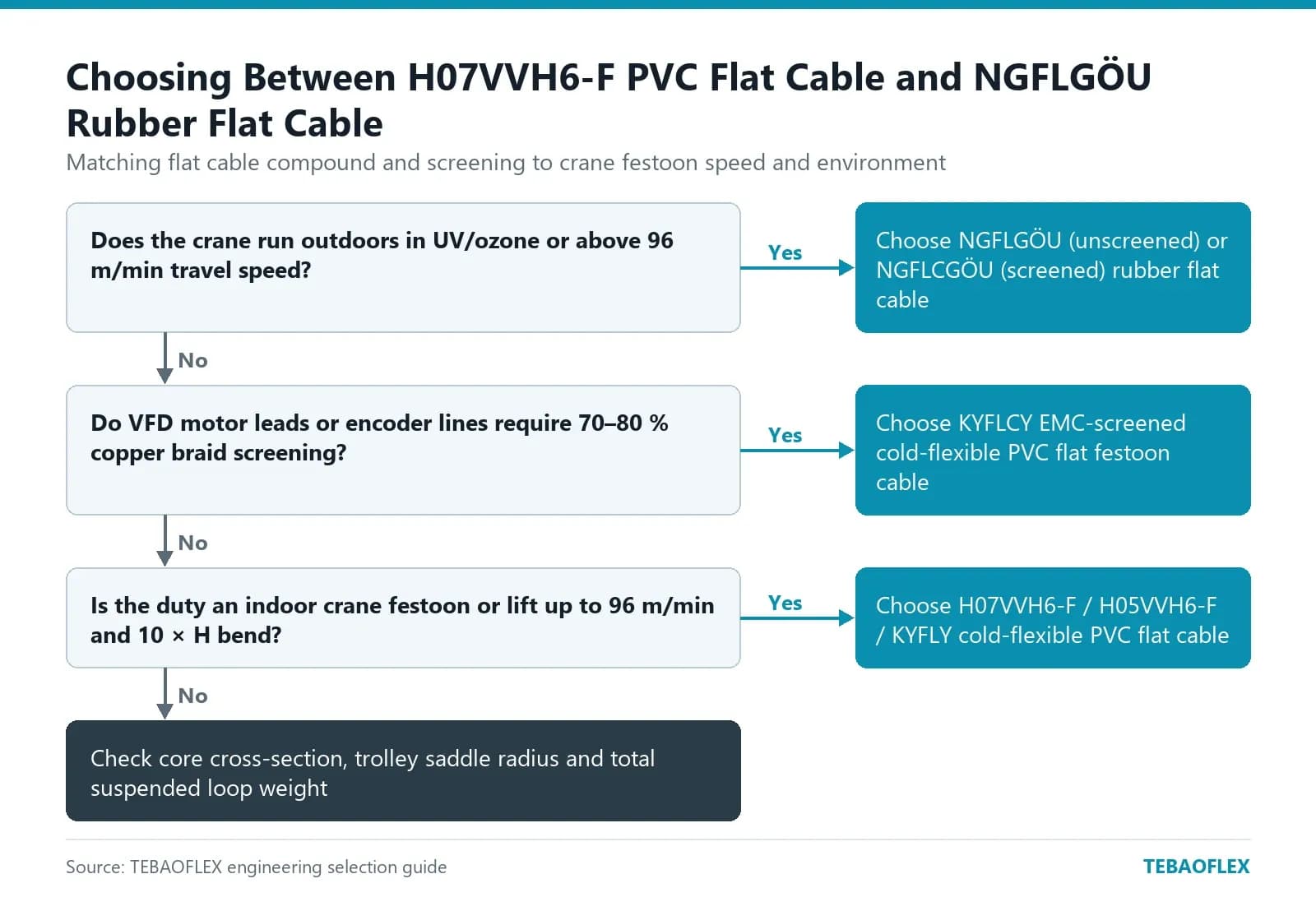
Selection flow for crane festoon and hoist flat cables
Selection flowchart — text version
- Does the crane run outdoors in UV/ozone or above 96 m/min travel speed? If yes: Choose NGFLGÖU (unscreened) or NGFLCGÖU (screened) rubber flat cable.
- Do VFD motor leads or encoder lines require 70–80 % copper braid screening? If yes: Choose KYFLCY EMC-screened cold-flexible PVC flat festoon cable.
- Is the duty an indoor crane festoon or lift up to 96 m/min and 10 × H bend? If yes: Choose H07VVH6-F / H05VVH6-F / KYFLY cold-flexible PVC flat cable.
Otherwise: Check core cross-section, trolley saddle radius and total suspended loop weight.
Compare specifications on our KYFLY flat PVC festoon cable, KYFLCY flat EMC PVC festoon cable and NGFLGÖU flat rubber festoon cable pages, or contact TEBAOFLEX via WhatsApp at +86 185 9591 3361, email at info@tebaoflex.com, or our contact form.
Frequently Asked Questions
When should you choose H07VVH6-F cable instead of NGFLGÖU rubber flat cable for crane festoons?
Choose H07VVH6-F or cold-flexible KYFLY PVC flat cable (to DIN EN 50214) for indoor overhead cranes, hoists and lifts. Typical limits are travel speeds up to 96 m/min (1.6 m/s), flexing temperatures of −25 to +60 °C (−30 to +70 °C for KYFLY), and a 10 × H bending radius. Choose NGFLGÖU rubber flat cable (to DIN VDE 0250-809) for outdoor cranes exposed to UV and ozone, speeds up to 180 m/min, −35 to +80 °C flexing temperatures, or 3–5 × H bending radii.
Is H07VVH06F the same cable as H07VVH6-F flat PVC cable?
Yes. H07VVH06F is a common buyer spelling variant for H07VVH6-F, the harmonised 450/750 V flat PVC-insulated and PVC-sheathed flexible cable defined in DIN EN 50214 and DIN VDE 0281-403. In the same family, 300/500 V sizes up to 1.0 mm² are designated H05VVH6-F. Cold-flexible multi-core crane versions rated down to −30 °C in motion are designated KYFLY.
What is the maximum free suspension height and tensile load for H07VVH6-F flat cable?
Under DIN EN 50214 and DIN VDE 0281-403, the maximum free suspension height is 35 m for H07VVH6-F and KYFLY flat cables (and up to 45 m for smaller 300/500 V H05VVH6-F cables). Static tensile load on the copper conductors must not exceed 15 N/mm² of total conductor cross-section, with a 30 N/mm² peak dynamic limit during acceleration.
Can flat PVC festoon cable be used on a motorized crane reeling drum?
No. Flat PVC cables such as H07VVH6-F, KYFLY and KYFLCY are designed strictly for single-plane bending across the flat cable height H on festoon trolleys or vertical lift loops. They cannot absorb multi-plane deflection or axial torsion on motorized gantry reels. For drum reeling, choose a round anti-torsion reeling cable or a dedicated monospiral flat rubber reeling design.