

Wherever it fits, flat festoon cable is the default choice. VAHLE and Aero-Motive favour it in their festoon catalogues. Section 41 22 13.14 of the Unified Facilities Guide Specifications (UFGS), used by US military engineering agencies, goes further and requires flat cables for a festoon pendant conductor system. Round cable takes over in the heaviest STS (ship-to-shore) crane packages, where Conductix-Wampfler's XL-Line trolleys carry round cables in multi-layer saddles.
Work through these checks in order:
- Rated voltage against the crane's supply
- Shape: flat or round
- Saddle size and trolley load
- Package build and clamping
- Speed, acceleration and tow ropes
- Cable length and clearance
- Sheath, screening for VFD (variable-frequency drive) motors, and fibre
Key Takeaways
- Start with flat cable where it fits: VAHLE's C-Track catalogue sets flat cable's minimum bending radius at 5 times its thickness, against 5 times the diameter for round cable.
- Turn to round cable for the heaviest STS packages; Conductix-Wampfler's round-cable XL-Line 0375 trolleys are rated at 800 kg each.
- Size saddles for the most demanding cable: Conductix-Wampfler's guidelines set 10 x OD (outside diameter) for round cable, and a fibre cable's radius can call for more.
- Check each trolley's load against its stated rating, using the same guidelines' trolley-load formula: FLW = 2 x loop depth x package weight per metre.
- Screen VFD motor feeds when the drive maker asks for it: ABB's drive cabling guide recommends symmetrical shielded motor cables with 360° grounding of the shield.

Same conductor size, different saddle: flat cable bends on its thickness, round cable on its diameter (flat example 300/500 V, round example 0.6/1 kV). Schematic drawn for this article from the datasheet values cited.
Flat vs Round Festoon Cable at a Glance
Flat cable bends on its thickness and hangs straight, while round cable bends on its outside diameter and suits the heaviest multi-layer saddles. Cable examples are from our own datasheets; hardware rules are from the festoon system makers cited.
- Feature: Bending radius measured on — Flat cable: Thickness (VAHLE) — Round cable: Outside diameter (VAHLE)
- Feature: Example: 4 x 50 mm² minimum moving radius — Flat cable: 95 mm for NGFLGÖU (stated) — Round cable: 224 mm for (N)GRDGÖU (calculated as 5 x its 44.8 mm OD)
- Feature: Rated voltage of the examples — Flat cable: 300/500 V (NGFLGÖU, KYFLY) — Round cable: 0.6/1 kV ((N)GRDGÖU, PUR-HF, PUR-C-HF, (N)12YRD11Y-J/O)
- Feature: Saddle diameter rule (Conductix-Wampfler) — Flat cable: 8 x thickness up to 12.5 mm; 10 x thickness from 12.5 mm (guidelines) — Round cable: 10 x OD
- Feature: How it hangs — Flat cable: Straight down (Aero-Motive) — Round cable: Loops out to the sides (Aero-Motive)
- Feature: Clamping — Flat cable: Clamped so movement occurs in the loop, not at the termination (NGFLGÖU datasheet) — Round cable: Outer cables clamped; inner cables move freely (Conductix-Wampfler)
- Feature: Typical use — Flat cable: Most festoons where it fits; required for festoon pendant conductor systems in UFGS 41 22 13.14 — Round cable: Heaviest packages, such as STS trolleys on XL-Line 0375 saddles
Why Flat Cable Is the Default
Flat cable is the default because it bends on its thickness, so the same conductors need smaller saddles and less festoon storage. VAHLE's C-Track catalogue puts the minimum bending radius at 5 times the diameter for round cable and 5 times the thickness for flat cable.
VAHLE's cable catalogue reproduces the multiples from Table 2 of DIN VDE 0298-3, a German cable standard. Minimum radii for flexible cables are 3d up to 8 mm, 4d from 8 to 12 mm and 5d above 12 mm. For flat cable, d is the thickness. NGFLGÖU fits that pattern: its 4 x 50 mm² size is up to 19 mm thick, and its stated 95 mm radius equals 5 x 19 mm.
Aero-Motive's festoon catalogue recommends flat cable whenever possible, because it minimises the size of the intermediate car (the trolley or carrier that holds the cable saddle) and so reduces system cost and size. Flat cables also hang straight down, while round cables loop out to the sides. According to the same catalogue, multi-conductor round cables have a shorter service life than flat cables.
For festoon pendant conductor systems, one US specification makes flat cable mandatory. UFGS 41 22 13.14 states that the festoon cables "must be flat cables suspended from carriers riding on an I-beam or C-track." The chart below compares NGFLGÖU with four round 4 x 50 mm² cables, whose radii are calculated from datasheet multiples (or the DIN VDE 0298-3 multiple) and stated diameters. The flat example is rated 300/500 V and the round examples 0.6/1 kV, so check the rated voltage against the crane's supply before comparing shapes.

Sources: NGFLGÖU (stated 95 mm); calculated from the stated diameters and multiples of (N)GRDGÖU (5 x OD per the DIN VDE 0298-3 table in VAHLE's cable catalogue), (N)12YRD11Y-J/O (7.5 x OD), PUR-HF and PUR-C-HF (8 x OD). Retrieved September 2026.
When Round Cable Is the Better Choice
Round cable is the better choice for the heaviest packages, such as festoons on STS cranes. Conductix-Wampfler's heavy-duty I-Beam XL-Line 0375 trolley, used on STS cranes, carries round cables in multi-layer side-loading saddles. It is rated at 800 kg and 300 m/min per trolley, against 350 kg and 160 m/min for the supplier's flat-cable L-Line 0350.
Conductix-Wampfler's motorised XL-Line 0380/0385 page notes that today's requirements, especially in container handling, often exceed the physical limits of conventional systems for speed, acceleration and cable package weight. At an STS retrofit in Dunkirk, the supplier reports cable packages of about 50 kg per metre, made up of 35 power and control cables.

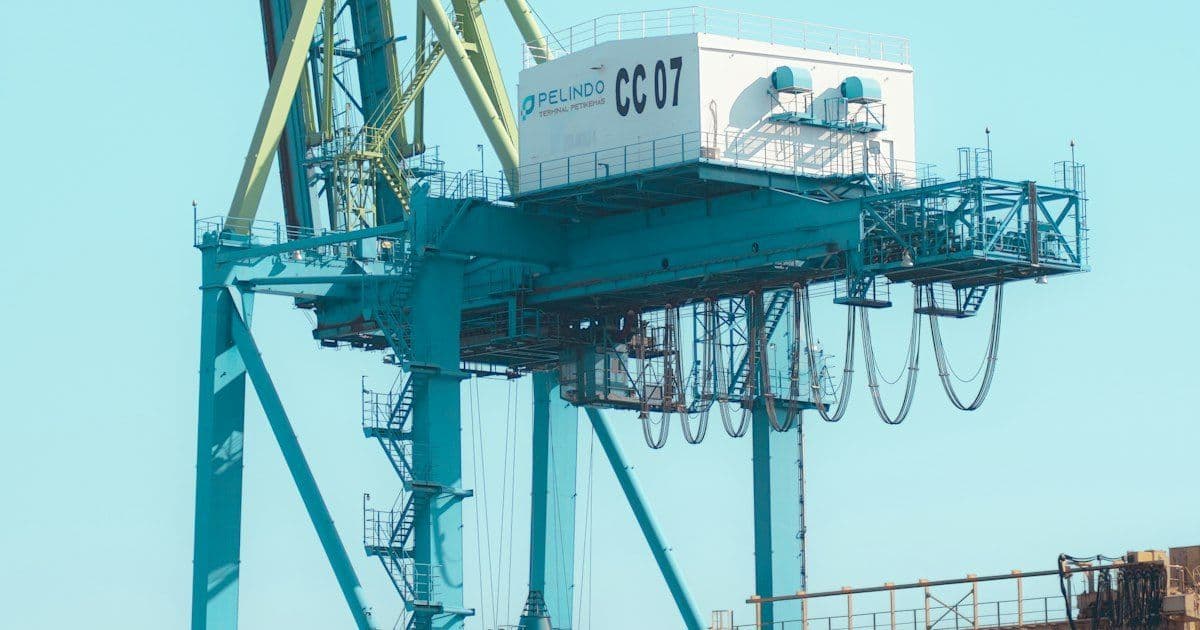
Heavy festoon packages run along the boom of a ship-to-shore crane. Photo: Sorin Basangeac on Unsplash (Unsplash License), cropped.
Weight alone is no reason to change shape. For 4 x 50 mm², flat rubber NGFLGÖU weighs 2,830 kg/km and round rubber (N)GRDGÖU 3,450 kg/km. The round PUR (polyurethane) cables are lighter: PUR-HF at 2,400 kg/km and (N)12YRD11Y-J/O at 2,185 kg/km.
Size the Saddle and Check the Trolley Load
Size the saddle for the most demanding cable, then check the trolley load against the trolley's rating. Conductix-Wampfler's engineering guidelines base the smallest permissible saddle diameter, da, on the largest cables. For flat cable, da is 8 x thickness up to 12.5 mm and 10 x from 12.5 mm; round cable needs 10 x OD.
Gleason's US I-beam brochure sets both the minimum radius and the saddle diameter by OD. Under 0.3 in (about 7.6 mm), they are 3 x and 6 x OD; under 0.5 in (about 12.7 mm), 4 x and 8 x; above that, 5 x and 10 x.
Worked example 1 (calculated): NGFLGÖU 4 x 50 mm² is up to 19 mm thick, so da = 10 x 19 mm = 190 mm. That is twice its stated 95 mm radius, so the rules agree.
Fibre can change the answer. FESTOON PUR FO 2x12 needs a 150 mm bending radius, so its saddle must be at least 300 mm across (calculated). If it shares the package, that 300 mm sets the saddle for every cable.
The same guidelines give trolley load as FLW = 2 x h x GL (h: loop depth in m; GL: package weight in kg/m). Worked example 2 (calculated): NGFLGÖU 4 x 50 at 2.83 kg/m plus NGFLGÖU 24 x 1.5 at 1.04 kg/m makes 3.87 kg/m. With 1.5 m loops, FLW = 2 x 1.5 x 3.87 = 11.6 kg per trolley.
On load alone, that is well inside stated ratings such as VAHLE's WST2 (35 kg at 100 m/min) and Conductix-Wampfler's C-rail trolleys (up to 125 kg). Heavier packages need heavier hardware, such as Conductix-Wampfler's flat-cable L-Line 0350 (350 kg, 160 m/min) or VAHLE's W145 (500 kg, 240 m/min).
Build and Clamp the Cable Package
Build the package from fewer, wider cables, put the largest power cables on top, and clamp so the loops take the movement. Conductix-Wampfler's engineering guidelines suggest one 12 x 1.5 cable instead of three 4 x 1.5 cables. Larger power cables such as 4 x 50 go on top, which aids heat dissipation and ensures proper clamping of the smaller cables.

Festoon loops beneath the girder of a single-girder overhead crane. Photo: Elham Farhadi, CC BY-SA 4.0, via Wikimedia Commons, converted to WebP.

Round packages follow a different pattern. Only the outer cables are clamped; the inner cables run in the saddle's inner windows and move freely. The guidelines favour unshielded power cables with larger copper cross sections, such as 1 x 120 or 4 x 25, for the outer positions. Where adjacent diameters differ by more than 15 mm, add clamping pieces, and avoid clamping shielded cables.
Gleason's brochure adds three checks. At least 50% of the cable surface must be under clamp pressure, and flat stacks work best when their width is 3 or 4 times their height. The heaviest cables go nearest the centreline, with the load spread evenly.
Conductix-Wampfler's mounting instructions place the package towards the middle of the track beam so the torque stays in balance. With layered flat cables, each layer gets slightly less slack than the layer below. Maintenance falls due after 300 hours of operation or every month, whichever comes first. The NGFLGÖU datasheet adds: keep the broad face oriented through the loop, and clamp so movement occurs in the loop rather than at the termination.
Match Speed, Acceleration and Towing
Choose a cable rated for at least the crane's travel speed, keep acceleration within the hardware's limits, and add tow ropes for fast or long festoons. Stated festoon ratings differ by cable: NGFLGÖU up to 180 m/min in one-plane bending, PUR-HF and PUR-C-HF up to 200 m/min, and Festoonflex C-PUR-HF up to 210 m/min. FESTOON PUR FO 2x12 is rated up to 240 m/min on motor-driven crane trolleys.
Conductix-Wampfler's engineering guidelines recommend tow ropes above 50 m/min. The supplier's 0350/0360/0364 catalogue recommends them from 50 m/min or for travel over 30 m. Aero-Motive's catalogue suggests tow cables (tow ropes) on systems with over 100 feet (about 30.5 m) of working travel.
Acceleration has limits too. VAHLE's standard flat-cable I-beam assemblies cover up to 80 m/min and 0.3 m/s²; for more, VAHLE asks buyers to consult the factory. Gleason asks to be consulted above 2.0 ft/s² (about 0.61 m/s²).
Order the Right Cable Length
Order the storage and travel length plus a safety allowance, which grows with speed, tow ropes and curves. VAHLE's round-cable catalogue gives L = (storage length including clearance + travel distance) x f. The factor f runs from 1.1 to 1.2, or 1.15 to 1.25 with tow rope assemblies. For loops over 0.3 m, it is 1.1 up to 35 m/min, 1.15 or 1.1 up to 50 m/min, and 1.2 or 1.15 up to 80 m/min. The higher values apply to loops up to 0.8 m, as the chart at the end of this section shows.
Conductix-Wampfler's C-Track brochure adds 10% to the track length, then the hook-up lengths at the fixed and mobile ends. VAHLE's V3 track catalogue adds 10 to 15% on straight runs and 20% on curves, and caps loops on curves at 0.7 x the smallest radius.
Check the space below the loops too. Gleason asks for at least 5 inches (about 127 mm) between the bottom of the loops and any fixed obstruction. Under UFGS 41 22 13.14, festoon loops must not extend below the high hook position.
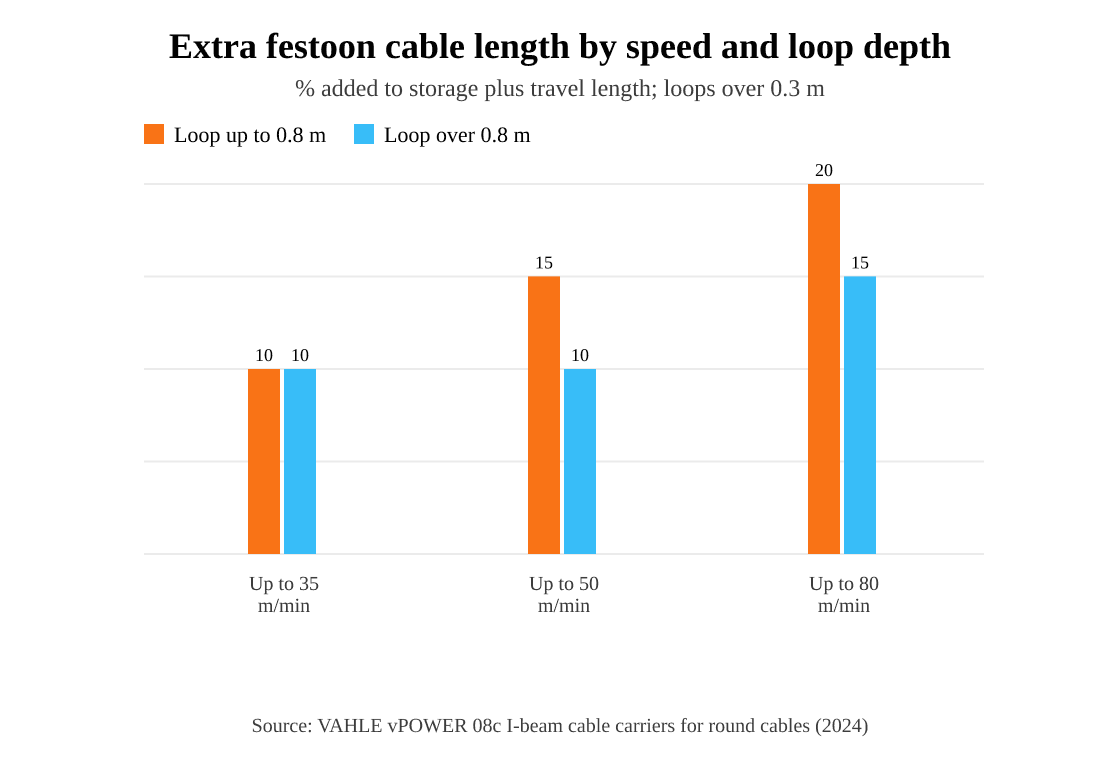
Source: VAHLE vPOWER 08c, I-beam cable carriers for round cables (2024), cable safety factor f shown as extra length in percent. Retrieved September 2026.
Pick the Sheath, Screen and Fibre
Pick the sheath for the lowest moving temperature, a screen when the electrical system needs one, and fibre when data must reach the crane. Conductix-Wampfler's C-Track brochure says its PVC (polyvinyl chloride) cable is not suitable for festoons below −10 °C, and its neoprene cable not below −35 °C.
Moving ratings differ by compound: flat PVC KYFLY and KYFLCY are rated to −25 °C, CR (chloroprene rubber) sheathed NGFLGÖU to −35 °C and PUR-HF to −40 °C. Since KYFLY's PVC is rated lower than Conductix-Wampfler's, check the moving rating of the actual cable, not just its compound.
Choose a screened cable because the electrical system needs screening, not because it sounds tougher, as our port and material-handling cranes page advises. For VFD cable runs, ABB's drive cabling guide recommends symmetrical shielded motor cables with 360° grounding of the cable shield.
Flat screened designs exist too: KYFLCY has a copper braid over the core assembly, and NGFLCGÖU a braid screen on each core. Round screened options include PUR-C-HF with an 80% tinned-copper braid and Festoonflex C-PUR-HF with about 85%. Check any design against the drive maker's cabling rules, and remember that, for round packages, Conductix-Wampfler's guidelines advise against clamping shielded cables.
Fibre can share the festoon. FESTOON PUR FO 2x12 carries 24 fibres, needs a 150 mm bending radius and takes a maximum continuous load of 1,000 N. It carries no power conductors, so power needs its own cables.
Standards to Check
Check the cable's product standard, the application guide and the crane's electrical and project rules. The special cables overview covers standards for other cable types.
- DIN VDE 0250-809 (1985, listed as valid): rubber flat cable, the standard on the NGFLGÖU datasheet.
- EN 50214:2024, a European Standard (EN): flat flexible PVC or halogen-free cables at 300/500 V and 450/750 V. Its uses include lifts, hoists and travelling cranes, and it supersedes EN 50214:2006.
- DIN VDE 0298-3:2006: the guide to using non-harmonised cables, and the source of the bending-radius multiples above.
- IEC 60204-32:2023 from the International Electrotechnical Commission (IEC): electrical equipment of hoisting machines up to 1,000 V AC, including feeders such as flexible cables.
- UFGS 41 22 13.14 (November 2019): the flat-cable and loop-height rules cited above.
Frequently Asked Questions
What is the difference between flat and round festoon cable?
Flat cable bends on its thickness and round cable on its outside diameter, so flat cable needs a much smaller bending radius for the same conductor size. VAHLE's cable catalogue says so, and Aero-Motive adds that flat cables hang straight, while round cables loop out sideways.
Why is flat cable preferred for festoon systems?
Flat cable keeps the festoon compact and hangs straight. Aero-Motive recommends it whenever possible because it reduces the size of the intermediate cars, and reports a shorter service life for multi-conductor round cables. UFGS 41 22 13.14 requires it for festoon pendant conductor systems.
What bending radius does a festoon cable need?
Use the minimum bending radius on the cable's datasheet, which varies with shape, size and compound. For 4 x 50 mm², flat NGFLGÖU states 95 mm, while round PUR-HF needs 264 mm, calculated as 8 x its 33.0 mm maximum OD. Fibre needs its own check: FESTOON PUR FO 2x12 states 150 mm.
How much load does a festoon trolley carry?
Each trolley carries about twice the loop depth times the package weight per metre, using Conductix-Wampfler's formula FLW = 2 x h x GL. A 3.87 kg/m package in 1.5 m loops gives 11.6 kg per trolley (calculated). Stated ratings vary widely: VAHLE rates its WST1 carrier at 22 kg (80 m/min) and its W135 at 400 kg (240 m/min).
Should a festoon cable for a VFD-driven motor be screened?
Yes, if the drive maker calls for a shielded motor cable, as ABB's drive cabling guide does. Screened festoon cables come in both shapes, such as flat KYFLCY and NGFLCGÖU or round PUR-C-HF. In round packages, keep them out of the clamped outer positions, as Conductix-Wampfler's guidelines advise, and ground the screen as the drive maker specifies.
Specify Your Festoon Cable
Specify the cable from the full package and its duty. Send our engineering team the supply voltage, package list, loop depth, travel length and speed, acceleration, ambient temperature, and any need for VFD screening or fibre through the contact page. For the system choice, see festoon vs cable reel vs conductor bar; for reel cables, see the crane reeling cable guide.
About the Author
Jyen is a technical and operations engineer at TEBAOFLEX, responsible for the company's online platforms. This guide draws on the standards and festoon system documents cited above and on TEBAOFLEX product datasheets. The NGFLGÖU, NGFLCGÖU, KYFLY, KYFLCY, (N)GRDGÖU, PUR-HF, PUR-C-HF, Festoonflex C-PUR-HF, FESTOON PUR FO 2x12 and (N)12YRD11Y-J/O datasheets cited are TEBAOFLEX's own product pages; the festoon hardware data come from the system makers named.
Cover photo: Defrino Maasy on Unsplash (Unsplash License), cropped.