What the video shows
85 s 1080p60 engineering showcase of TEBAOFLEX 0.6/1 kV NSHTÖU-FO 3×95 + 1×3G50/3 + 12×2.5 mm² + 12FO DIN VDE 0250-814 hybrid fiber-optic reeling cable for port STS cranes, capturing 6.5 m spoked monospiral reels, pivoting 4-roller guide horns, sheath legend QC, 6-layer 3D strip-back, and 4K specimen archive.
The video illustrates a sample, process, or operating context. Final product construction, suitability, standards, and test acceptance criteria are confirmed against the ordered specification.
TL;DR: 0.6/1 kV NSHTÖU-FO 3×95 + 1×3G50/3 + 12×2.5 mm² + 12FO is a DIN VDE 0250-814 anti-torsion hybrid reeling cable. It combines Class 5 bare copper power cores, symmetrical split PE, 12 PLC control cores, and a 6-tube 12FO unit inside a double 5GM5 sheath with a TÖ cross-braid. Built for spoked monospiral STS crane reels up to 180 m/min (-35 °C to +80 °C), 95 mm² phases carry 219 A at 40 °C quay ambient versus only 134 A on a 3-layer drum (DIN VDE 0298-4:2023-06). Budget 3.15 dB across the 12FO rotary-joint link and audit all 6 electrical plus OTDR FAT checks before shipment.
Watch the 1:25 factory showcase video on the NSHTÖU-FO 3×95+12FO video engineering hub. It captures giant 6.5 m spoked monospiral STS crane reels (00:06), pivoting 4-roller guide horns (00:12), and wharf turnover-pit payout animation (00:17). It also documents extrusion caterpillar haul-off and 0.6/1KV Reeling Cable 3x95SQ+1x3G50/3SQ+12x2.5SQ+12FO sheath printing (00:24–00:30), precision full-drum take-up (00:37), 6-layer 3D strip-back (00:40), and 4K specimen QC (01:02). Our methodology applies IEC 60228 Class 5 resistance, DIN VDE 0298-4 reel derating, IEC 60949 fault math, and IEC 60794-1-21 optical attenuation budgets to our verified production sample.
| Engineering Parameter | 0.6/1 kV NSHTÖU-FO 3×95 + 1×3G50/3 + 12×2.5 mm² + 12FO Value | Governing Standard / Reference |
|---|---|---|
| Hybrid Core Layup | 3×95 mm² power + 3×16.7 mm² split PE + 12×2.5 mm² control + 12FO (6 tubes) | DIN VDE 0250-814 / IEC 60228 Class 5 |
| Insulation & Sub-Bundles | 3GI3 cross-linked EPR (+90 °C / +250 °C SC); wrapped 12×2.5 (3+9) unit | DIN VDE 0207-20 / DIN VDE 0293-308 |
| Sheath & Anti-Torsion Mesh | Extruded 5GM5 inner sheath + bidirectional TÖ aramid/polyester braid + black 5GM5 | DIN VDE 0207-21 / DIN VDE 0250-814 |
| Rated & Test Voltage | 0.6/1 kV AC nominal (max 1.2 kV AC system); 3.0 kV AC 5-minute routine withstand | DIN VDE 0250-814 |
| Reeling Speed & Climate | Up to 180 m/min (3.0 m/s) monospiral reeling; -35 °C to +80 °C flexing | TEBAOFLEX 2026 QC / Marine Salt-Fog |
| Active Copper & Pull Rating | 365 mm² total Cu + central aramid cradle; 4,275 N (15 N/mm² power Cu) to 5,700 N+ (aramid-assisted) | DIN VDE 0298-3 / Aramid Reinforced |
| Ampacity (95 mm², 30 °C) | 316 A air; 301 A trench; 241 A (monospiral/1L), 184 A (2L), 147 A (3L) | DIN VDE 0298-4 / TEBAOFLEX Datasheet |
| Showcase Video Runtime | 1 minute 25 seconds (1920×1080 60 fps, 6 technical chapters) | TEBAOFLEX 2026 Factory Archive |
1. Why Do 180 m/min STS Monospiral Reels Break Unreinforced Hybrid Fiber Cables?
NSHTÖU-FO Hybrid Reeling Cable is a heavy-duty 0.6/1 kV elastomeric drum-reeling cable built to DIN VDE 0250-814:1985-02. It integrates high-current power cores, symmetrical split earth, PLC control cores, and loose-tube optical fibers inside one anti-torsion trunk. Along modern container quays, automated Ship-to-Shore (STS) cranes, RMGs, and ship-loaders travel down 400 m rails at up to 180 m/min (3.0 m/s). Every gantry reversal sends sharp axial tension waves, reverse guide-horn bends, and torsional torque straight through the cable.
Corkscrewing Torque, Silica Fiber Strain, and Cruciform Balancing
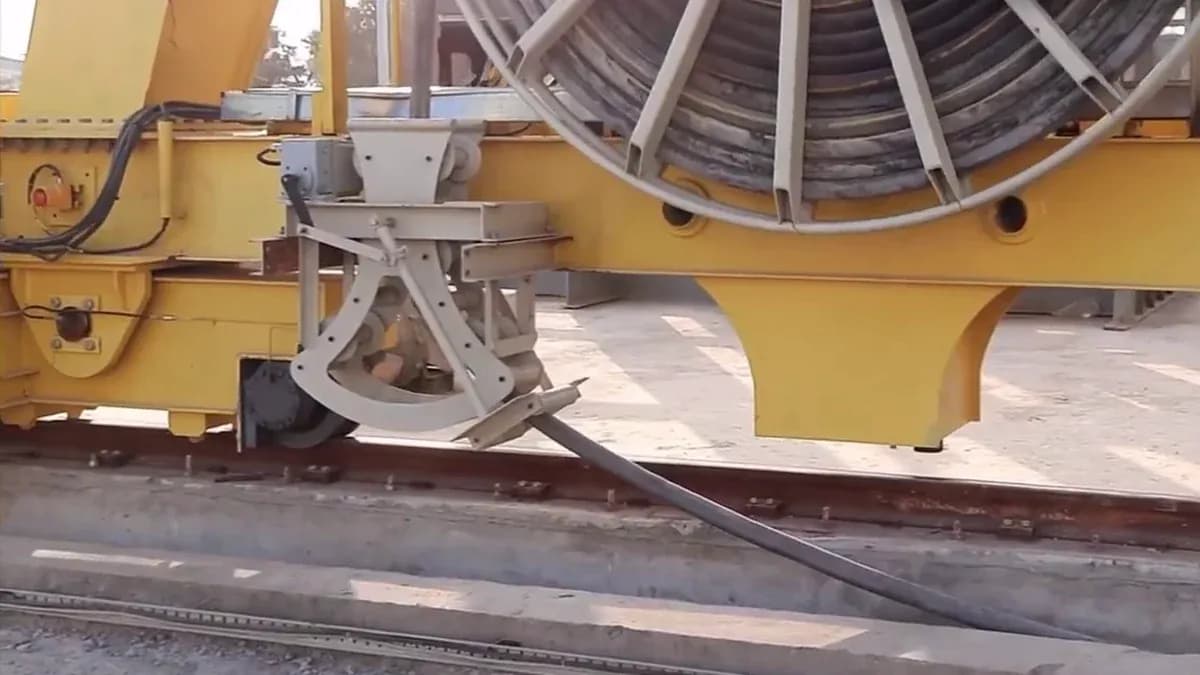
Standard trailing rubber cables without torsion reinforcement twist progressively when passing through a pivoting 4-roller guide horn into a stainless quay cable trench (00:12 in our video). Over several thousand travel cycles, axial twist builds internal "corkscrew" waves that crush control cores and snap optical glass fibers. Silica optical fibers suffer permanent fatigue failure when sustained tensile strain exceeds roughly 0.2% (IEC 60794-1-21:2015+AMD1:2020).
Anti-Torsion Cross-Braid (TÖ) is a high-tenacity bidirectional aramid or polyester textile mesh vulcanized directly between the inner and outer rubber sheaths (DIN VDE 0250-814:1985-02). It locks both elastomer layers mechanically so outer jacket drag from guide rollers never slides relative to the inner core bundle. Inside the core, Fiber Excess Length (EFL) is a controlled 0.4% to 0.8% helical over-length packed inside gel-filled loose buffer tubes (IEC 60794-1-21:2015+AMD1:2020). That spare length keeps glass fibers at zero axial strain even while the copper trunk stretches elastically during reel acceleration.
Marine Salt-Fog, UV Exposure, and 3GI3 / 5GM5 Compound Endurance
Quay cable trenches trap seawater spray, spilled hydraulic fluid, and sun-baked summer heat reaching 40 °C to 50 °C. 3GI3 EPR Insulation is a cross-linked ethylene-propylene rubber dielectric rated for 90 °C continuous conductor temperatures and 250 °C short-circuit peaks without softening (DIN VDE 0207-20:1993-07). 5GM5 Polychloroprene Sheath is a heavy-duty vulcanized chloroprene elastomer that resists ozone, UV sunlight, and mineral oil immersion (EN 60811-404:2012). It also passes vertical flame retardancy (IEC 60332-1-2:2025) across -35 °C to +80 °C dynamic reeling. For port-wide crane electrification architecture across STS, ERTG, and shore-power systems, read our port terminal electrification reeling cable master guide.
2. Monospiral Spoked Reel vs. Multi-Layer Drum Ampacity and 12FO Optical Budget
Selecting a 6.5 m spoked monospiral reel (00:06 to 00:23 in our video) over a multi-layer cylindrical drum is not merely a mechanical layout preference. Winding a 3×95 mm² hybrid power-and-fiber cable onto a 3-layer cylindrical drum traps radial heat and crushes the 12FO loose-tube unit under stacked turns. Compared against a 3-layer cylindrical drum, an open-spoked monospiral reel preserves 64% higher continuous current capacity at 40 °C tropical quay ambient (DIN VDE 0298-4:2023-06).
| Reel Geometry & Winding Condition | DIN VDE 0298-4 Factor | 30 °C Ambient | 35 °C Ambient (0.96) | 40 °C Ambient (0.91) | 50 °C Ambient (0.82) | Port Crane Engineering Assessment |
|---|---|---|---|---|---|---|
| Free Air (Single Cable Suspended) | 1.00 | 316 A | 303 A | 288 A | 259 A | Festoon / open span only; never valid for wound reels |
| Uncoiled Flat in Quay Trench | 0.95 | 301 A | 289 A | 274 A | 247 A | Applies only to cable laid flat inside the wharf trench |
| Spoked Monospiral / 1-layer Reel | 0.80 | 241 A | 231 A | 219 A | 198 A | Target geometry for 180 m/min STS hybrid 12FO reels |
| Cylindrical Drum, 2 Layers | 0.61 | 184 A | 177 A | 167 A | 151 A | Thermal limit fails 210 A crane drives at 40 °C |
| Cylindrical Drum, 3 Layers | 0.49 | 147 A | 141 A | 134 A | 121 A | Severe inner-layer heating plus radial crush risk on 12FO |
Base 30 °C ampacities reflect TEBAOFLEX 95 mm² rubber reeling datasheets and DIN VDE 0298-4:2023-06 (90 °C 3GI3 EPR conductor); wound-reel factors (0.80, 0.61, and 0.49) apply to the 301 A uncoiled trench baseline, and ambient factors apply √[(90 − T_amb) / 60] per DIN VDE 0298-4:2023-06 Table 17.
Worked Port Crane Feeder and 12FO Link Calculation (690 V AC, 210 A, 150 m)
For example, evaluate an RMG or low-voltage ship-loader gantry drive operating at 690 V 3-phase 50 Hz and 210 A RMS continuous (213.3 kW active power at cos φ = 0.85, sin φ = 0.527). The crane feeds power and 12FO telemetry through 150 m of TEBAOFLEX 0.6/1 kV NSHTÖU-FO 3×95 + 1×3G50/3 + 12×2.5 mm² + 12FO. The cable runs from a center wharf SS316 turnover pit onto a 6.5 m spoked monospiral reel at 40 °C quay ambient. Each bare Class 5 95 mm² phase uses R_20 = 0.206 Ω/km max DC resistance (IEC 60228:2023) and X = 0.085 Ω/km.
Step 1: Verify Monospiral Reel Thermal Margin at 40 °C Quay Ambient
Because wound turns on the crane reel govern maximum conductor temperature, evaluate the spoked monospiral factor (0.80) against multi-layer cylindrical drums at 40 °C (f_t = 0.91 per DIN VDE 0298-4:2023-06).
Ambient factor at 40 °C (90 °C EPR conductor, DIN VDE 0298-4):  f_t = sqrt[(90 - 40)/60] = 0.91
Spoked monospiral / 1-layer reel:  I_z,mono = 241 A * 0.91 = 219.3 A  (≥ 210 A PASS)
Cylindrical 2-layer drum check:    I_z,2L   = 184 A * 0.91 = 167.4 A  (< 210 A FAIL)
Cylindrical 3-layer drum check:    I_z,3L   = 147 A * 0.91 = 133.8 A  (< 210 A SEVERE OVERHEAT)
Only the ventilated monospiral reel satisfies 210 A continuous duty at 40 °C (219.3 A ≥ 210 A PASS). Switching to a compact 2-layer cylindrical drum forces a costly jump to 120 mm² or 150 mm² phases.
Step 2: Check 150 m Voltage Drop, Resistive Heat, and 3G50/3 Fault Survival
Next, scale the 20 °C bare Class 5 resistance (0.206 Ω/km) to 90 °C (α₂₀ = 0.00393 /°C) and apply a 1.010 50 Hz AC multiplier. Then verify line voltage drop and adiabatic fault survival (k = 143 A·s^0.5/mm² for 90 °C to 250 °C EPR per IEC 60949:1988+AMD1:2008).
R_90,dc = 0.206 * [1 + 0.00393 * (90 - 20)] = 0.26267 Ω/km
R_90,ac = 0.26267 * 1.010 = 0.26530 Ω/km
dV      = sqrt(3) * 210 A * 0.150 km * (0.26530 * 0.85 + 0.085 * 0.527)
        = 54.560 * (0.2255 + 0.0448) = 14.75 V  (2.14% of 690 V PASS)
P_loss  = 3 * (210 A)^2 * 0.26530 Ω/km * 0.150 km = 5,265 W total (35.1 W/m)
Short-circuit (95 mm² phase, 1.0 s):      I_sc = 143 * 95 / sqrt(1.0) = 13.6 kA RMS
Short-circuit (50 mm² split PE, 1.0 / 0.5 s):  I_pe = 7.15 kA (1.0 s) / 10.1 kA (0.5 s) PASS
Voltage drop holds at 2.14% of nominal 690 V, safely inside the 3% to 5% motor feeder threshold (IEC 60364-5-52:2009+AMD1:2024). In addition, the three symmetrical 16.7 mm² earth cores (50 mm² total PE) clear 10.1 kA ground faults over 0.5 s.
Step 3: Compute the 12FO Single-Mode Optical Link Budget Across the Hub FORJ
Finally, verify optical signal margin at 1310 nm using ITU-T G.652.D / G.657.A1 single-mode fibers (≤ 0.35 dB/km cabled attenuation per IEC 60794-1-21:2015+AMD1:2020). Trace total path loss from the SS316 wharf turnover pit through the 150 m cable and hub Fiber-Optic Rotary Joint (FORJ).
150 m cabled fiber loss (0.150 km * 0.35 dB/km):  0.05 dB
2 fusion splices (wharf pit + crane cabinet):     0.30 dB  (2 * 0.15 dB)
2 mated LC/APC patch connectors:                  0.80 dB  (2 * 0.40 dB)
Multi-channel Fiber-Optic Rotary Joint (FORJ):    1.50 dB  (incl. rotational variation)
Dynamic reeling bend & aging margin:              0.50 dB
Total optical path loss:                          3.15 dB  vs. 11.0 dB SFP budget -> 7.85 dB MARGIN PASS
With 7.85 dB of spare optical budget on standard industrial 1000BASE-LX or 10GBASE-LR transceivers, crane PLC automation, anti-collision LiDAR, and CCTV streams remain error-free even after years of continuous salt-fog quay operation.
3. Inside the 6-layer NSHTÖU-FO Cruciform Hybrid Architecture and Port Reeling Cable Selection
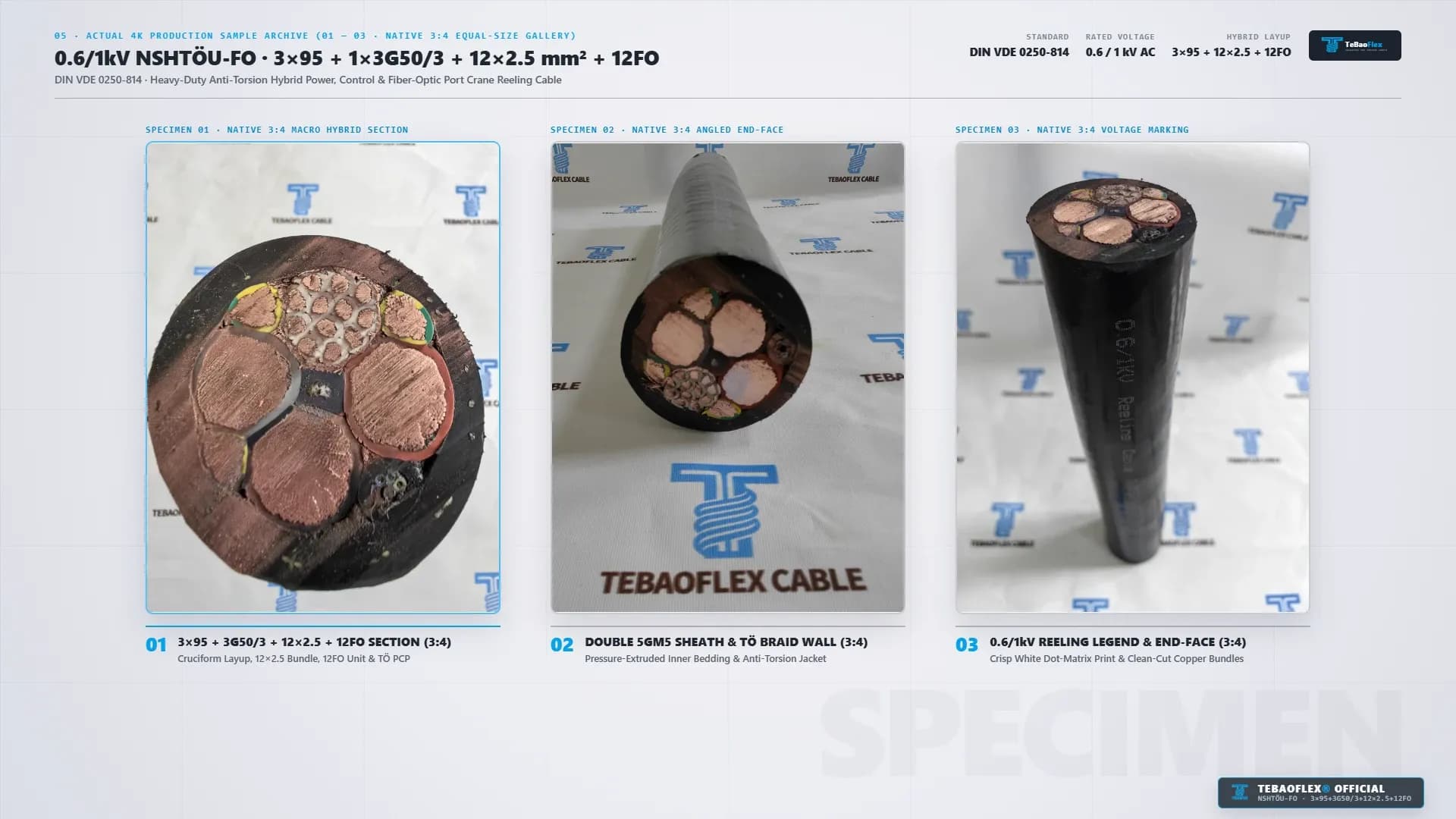
Chapters 03 and 04 of our video (00:40 to 01:01) peel back all six concentric layers of TEBAOFLEX 0.6/1 kV NSHTÖU-FO 3×95 + 1×3G50/3 + 12×2.5 mm² + 12FO. Each layer coordinates power, control, split earth, and optical glass inside one torsion-neutral trunk.
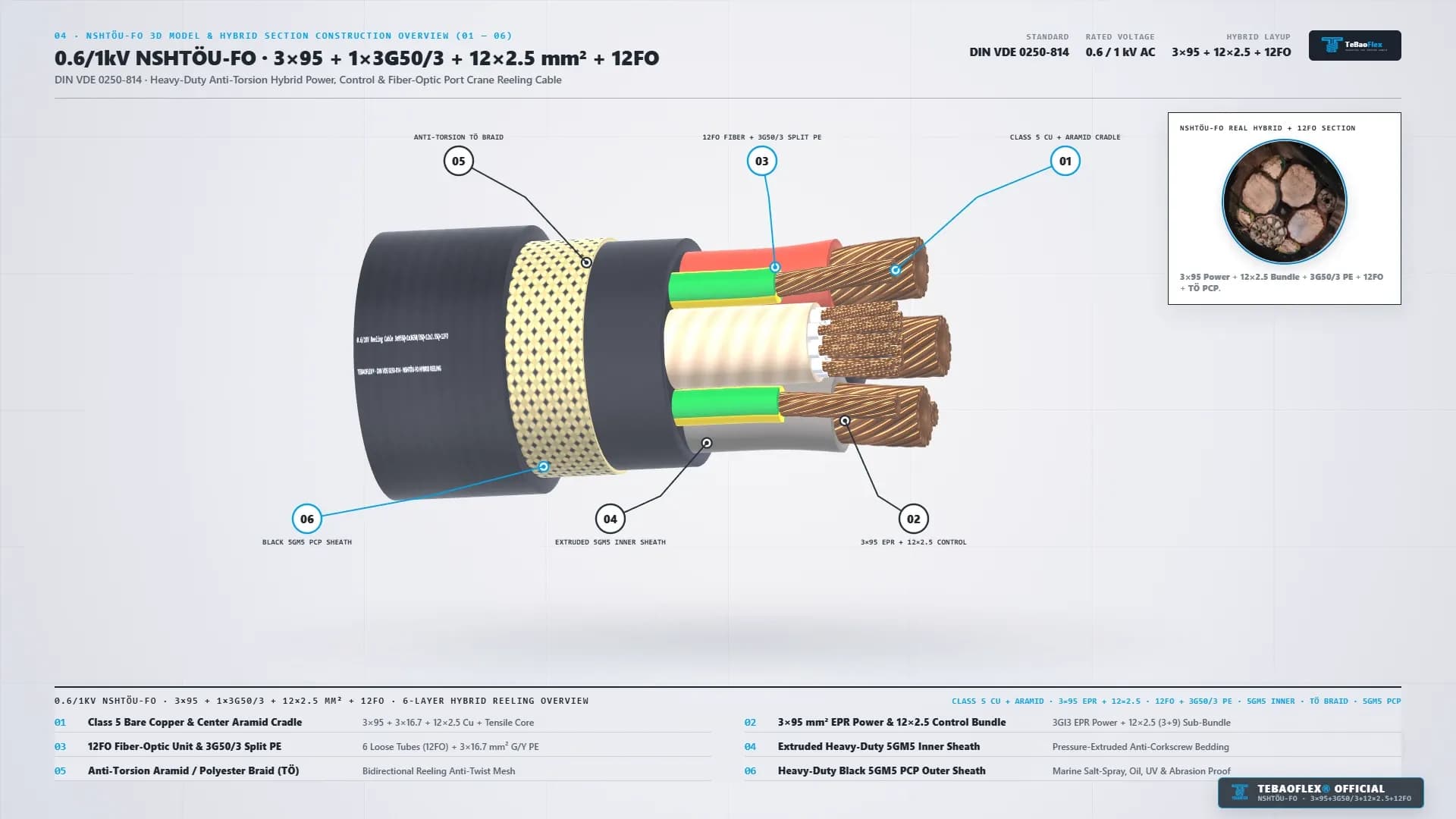
- Layer 01, Class 5 Bare Copper Conductors & Central Aramid Cradle: Three 95 mm² phases, three 16.7 mm² split PE cores, and twelve 2.5 mm² control cores deliver 365 mm² of IEC 60228 Class 5 copper. They wrap around a central aramid tensile cradle that absorbs reeling acceleration peaks.
- Layer 02, 3×95 mm² 3GI3 EPR Power & 12×2.5 mm² Control Sub-Bundle: Cross-linked 3GI3 EPR (+90 °C continuous, +250 °C short-circuit per DIN VDE 0207-20) insulates the main power phases. A tape-wrapped 12×2.5 mm² (3+9) control sub-unit balances opposite those phases.
- Layer 03, 12FO Loose-Tube Fiber-Optic Unit & 3G50/3 Split PE: Six gel-filled loose buffer tubes (12FO with controlled fiber excess length) sit inside the protected outer interstice. Three symmetrical 16.7 mm² green-yellow PE cores (3G50/3) flank them to lower VFD zero-sequence impedance.
- Layer 04, Extruded Heavy-Duty 5GM5 Inner Sheath: Pressure-extruded polychloroprene bedding fills every valley around the cruciform assembly, preventing internal core slippage and radial crushing of the 12FO optical sub-unit.
- Layer 05, Anti-Torsion Aramid / Polyester Cross-Braid (TÖ): A bidirectional high-tenacity braid embedded tightly between the inner and outer rubber sheaths cancels axial twist during rapid 180 m/min monospiral reel reversals.
- Layer 06, Heavy-Duty Black 5GM5 PCP Outer Sheath: Vulcanized polychloroprene armor resists marine salt spray, hydraulic oil (EN 60811-404), UV radiation, and quay trench abrasion from -35 °C to +80 °C. Crisp white dot-matrix legend printing (0.6/1KV Reeling Cable 3x95SQ+1x3G50/3SQ+12x2.5SQ+12FO, seen at 00:30) verifies reel traceability.
Adjacent Heavy NSHTÖU and Hybrid NSHTÖU-FO Reeling Reference Sizes
When designing port crane monospiral drums, engineers compare standard NSHTÖU-J heavy-duty reeling cables against the hybrid 3×95 + 1×3G50/3 + 12×2.5 + 12FO build to verify trench width, drum spoke spacing, and tensile limits.
| Reeling Cable Model | Copper & Fiber Layup | Max OD (mm) | Pull Limit (DIN VDE 0298-3) | 30 °C Trench / Monospiral | Primary Crane Duty |
|---|---|---|---|---|---|
| NSHTÖU-J 4G70 | 4×70 mm² Class 5 Cu, TÖ braid | 48.7 | 4,200 N (15 N/mm²) | 250 A / 200 A | Medium RMG & yard gantry reels |
| NSHTÖU-J 4G95 | 4×95 mm² Class 5 Cu, TÖ braid | 57.3 | 5,700 N (15 N/mm²) | 301 A / 241 A | Standard 0.6/1 kV power-only reels |
| NSHTÖU-FO 3×95 + 3G50/3 + 12×2.5 + 12FO | 3×95 + 3G50/3 + 12×2.5 + 12FO + Aramid | ~64 to 68 | 4,275 N (Cu) to 5,700 N+ (aramid) | 301 A / 241 A | STS / RMG power + PLC + 12FO telemetry |
| NSHTÖU-J 4G120 | 4×120 mm² Class 5 Cu, TÖ braid | 62.0 | 7,200 N (15 N/mm²) | 352 A / 282 A | Heavy LV ship-loaders & bulk cranes |
4G70, 4G95, and 4G120 figures reflect typical DIN VDE 0250-814 4-core reference builds (standard 5GM3 outer sheath; 15 N/mm² tensile limit on 4-core copper section); NSHTÖU-FO 3×95+1×3G50/3+12×2.5+12FO reflects the aramid-reinforced 5GM5 double-sheath hybrid port crane build filmed in this showcase.
Heavy-Duty Port & Industrial Reeling Cable Selection Matrix
Low-voltage 0.6/1 kV NSHTÖU-FO fits LV gantry cranes, RMGs, and ship-loaders cleanly, whereas 6/10 kV mega-STS cranes, vertical spreader baskets, or extreme abrasion PUR decks require specialized TEBAOFLEX designs. Match your exact equipment boundary below (see also our reeling cable selection guide).
| TEBAOFLEX Product Family | Voltage & Core System | Governing Standards | Primary Application Boundary | When to Choose Over 0.6/1 kV NSHTÖU-FO |
|---|---|---|---|---|
| NSHTÖU Reeling Cable & RXG / RXG-D PCP Reeling | 0.6/1 kV, power + optional control/FO | DIN VDE 0250-814, 3GI3 EPR, TÖ braid, 5GM5 | Port STS/RMG monospiral reels, stacker-reclaimers (see stacker-reclaimer video) | Baseline choice for 0.6/1 kV anti-torsion port crane and bulk-yard reels |
| NTSCGEWÖU MV Reeling Cable | 1.8/3 kV to 18/30 kV (7 grades), 3C + 3E + optional 12FO | DIN VDE 0250-813, triple-extruded semicon | Mega-STS container cranes running 6.6 kV or 11 kV shore busbars | Mandatory above 1 kV (compare with our 6/10 kV NTSCGEWÖU-FO 12FO video) |
| STS-HV / STS-MT / STS-HT High-Speed Spreader & Drum Reel | 0.6/1 kV (STS-MT/HT) to 3.6/6–12/20 kV (STS-HV), optional 6–24FO | DIN VDE 0250-813 / -814, high-tensile aramid core | High-speed STS/RMG gantry reels (up to 240–300 m/min) and vertical spreader baskets | Required for MV high-speed gantry drums above 180 m/min or vertical spreader gravity baskets |
| NSHTÖU-V Aramid High-Tensile Crawler Cable | 0.6/1 kV, reinforced central aramid | DIN VDE 0250-814, extreme axial pull | Long-travel rail/crawler reels with steep vertical elevation lifts | Required when vertical lift dead-weight exceeds standard 15 N/mm² to 20 N/mm² copper ratings |
| TF-REEL Fiber-Power Drum Umbilical | Custom LV/MV power + high-count FO | IEC 60794-1-21, PUR/PCP marine jacket | Automated cranes, ship-to-shore telemetry, subsea/wharf winches | Choose when > 12 fibers, PUR abrasion shells, or custom Ethernet quads are required |
4. How Should Ports Specify Guide Horn 10×D Radius, FORJ Termination, and 6-point FAT?
Most early fiber-optic failures on port crane reeling cables occur at two mechanical pinch points rather than in the straight quay trench. The main culprits are undersized roller guide horns and careless loose-tube breakout inside the reel hub slip-ring box.
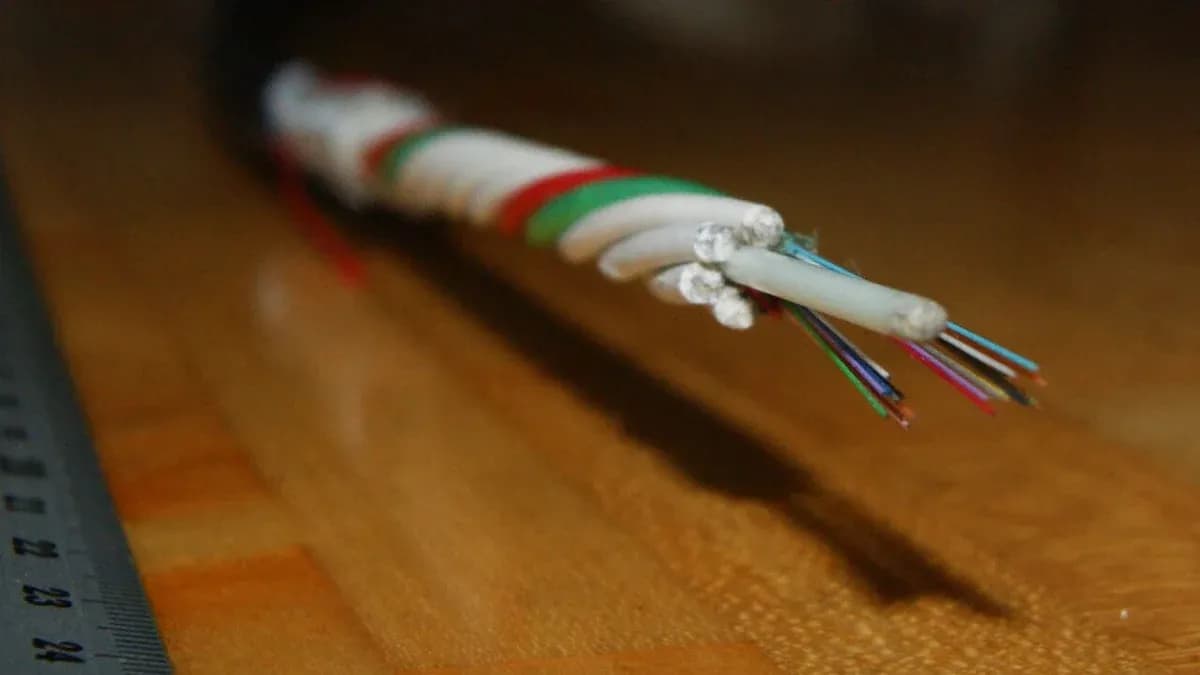
Guide Horn Bending Radii and 12FO Breakout Discipline
For a ~65 mm OD hybrid NSHTÖU-FO 3×95+3G50/3+12×2.5+12FO trunk, separate static cabinet sweeps from dynamic guide-horn and reel hub radii under DIN VDE 0298-3:2006-06 and IEC 60794-1-21:2015+AMD1:2020. Follow these four mechanical routing rules:
- Fixed Turnover Pit Entry (6×D = 390 mm radius): Applies strictly to clamped, stationary sweeps inside the stainless SS316 wharf turnover pit where the cable never flexes during gantry travel.
- Pivoting 4-roller Guide Horn & Monospiral Reel Core (10×D = 650 mm minimum bending radius): Hold every deflection roller arc and reel inner hub to at least a 10×D minimum bending radius (650 mm radius, or 1,300 mm minimum barrel diameter). For example, retrofitting a ~65 mm hybrid cable onto a 1,000 mm cylindrical drum (500 mm radius = 7.7×D) violates DIN VDE 0298-3 and spikes 1550 nm macro-bending loss. By contrast, a 6.5 m spoked crane reel hub (1,800 mm diameter, 900 mm radius = 13.8×D) provides safe optical and copper fatigue margin.
- Zero-Twist Fleet Angle (≤ 2°) and Tension Limiter: Align the pivoting 4-roller guide horn (00:12 in our video) straight over the quay trench centerline. Proper alignment stops sideways rubbing against steel reel spokes during 180 m/min reversals.
- 12FO Loose-Tube Fan-Out & Strain Relief: Strip the 5GM5 sheaths cleanly and clamp both the central aramid cradle and TÖ braid firmly into the cable grip. Route the 6 loose tubes through protective spiral tubing into the FORJ splice cassette with ≥ 30 mm coil radius. For detailed moving-equipment fiber test methods, read our IEC 60794-1 fiber-optic cable testing guide.
6-point Hybrid Electrical and Optical Factory Acceptance Test (FAT) Protocol
Every finished export drum shown in Chapter 02 (00:24) and Chapter 05 (01:02) completes combined electrical, mechanical, and optical verification at TEBAOFLEX Manufacturing under our documented Quality and Certifications program. Audit all six verifiable FAT records before releasing your port crane reel:
| FAT Checkpoint | Test Method & Acceptance Criterion | Governing Standard | Inspection Scope |
|---|---|---|---|
| 1. Class 5 Cu DC Resistance (20 °C) | Verify 20 °C DC resistance ≤ 0.206 Ω/km (95 mm² bare), ≤ 0.386 Ω/km (3G50/3 combined PE; ≤ 1.21 Ω/km per 16 mm² equiv. branch), and ≤ 7.98 Ω/km (2.5 mm²) | IEC 60228 Class 5 / DIN VDE 0295 | Every production reel |
| 2. Routine 3.0 kV AC Withstand & Spark | Completed power and control cores withstand 3.0 kV AC (50 Hz) for 5 minutes without breakdown, plus 100% inline core spark test | DIN VDE 0250-814 | Every production reel |
| 3. 12FO Bidirectional OTDR Attenuation | Test all 12 single-mode fibers at 1310 nm (≤ 0.35 dB/km) and 1550 nm (≤ 0.22 dB/km) with zero point discontinuities | IEC 60794-1-21 / ITU-T G.652.D | 100% of 12 fibers per reel |
| 4. 5GM5 Tear, Abrasion & TÖ Braid Check | Verify 5GM5 compound tear strength ≥ 30 N/mm (VDE 0472-613), abrasion ≤ 300 mm³ (VDE 0472-605 A), and TÖ braid coverage | DIN VDE 0207-21 / DIN VDE 0250-814 | Every 5GM5 batch & drum |
| 5. Marine Oil Immersion & Flame Test | Verify mineral/hydraulic oil immersion retention (EN 60811-404) and vertical flame self-extinction (IEC 60332-1-2) | EN 60811-404 / IEC 60332-1-2 | Type test & periodic audit |
| 6. Dynamic Tensile & -35 °C Cold Flex | Type-verified reeling tensile-attenuation test (≤ 0.05 dB reversible delta under load, IEC 60794-1-21 E1) and -35 °C flexing | IEC 60794-1-21 E1 / DIN VDE 0250-814 | Type test & periodic sample |
Need custom-length 0.6/1 kV NSHTÖU-FO hybrid reeling cables with pre-terminated LC/APC 12FO pigtails, stainless pulling socks, and a complete 6-point FAT dossier? Email TEBAOFLEX engineering at info@tebaoflex.com or message WhatsApp +86 185 9591 3361. Share your reel diameter, travel speed, and fiber type (G.652.D / G.657.A1 / OM3) for a fast specification check.
Authored by Jyen, Technical Editor for DIN VDE 0250-814, IEC 60794, and port crane hybrid reeling cables at Jiangsu Tebaoflex Special Cable Co., Ltd.
Frequently Asked Questions
1. Why use a 6.5 m spoked monospiral reel instead of a multi-layer drum for NSHTÖU-FO 3×95+12FO?
An open-spoked monospiral reel winds the hybrid cable in a single vertical spiral plane without burying inner turns. Under DIN VDE 0298-4:2023-06 at 40 °C quay ambient, 95 mm² phases carry 219 A on a monospiral reel (0.80 factor) versus 167 A on a 2-layer drum (0.61) or 134 A on a 3-layer drum (0.49). Single-plane winding also eliminates radial layer-on-layer crushing of the 12FO loose-tube unit.
2. How do the 12 optical fibers survive 180 m/min STS crane reeling without breaking?
Three mechanical barriers isolate the glass fibers from dynamic reeling strain. First, a central aramid tensile cradle and embedded bidirectional TÖ anti-torsion braid carry acceleration tension and cancel twist. Second, the 12 fibers sit inside 6 gel-filled loose buffer tubes with 0.4% to 0.8% Fiber Excess Length (EFL), keeping glass strain at zero during elastic cable stretch (IEC 60794-1-21:2015+AMD1:2020). Third, cruciform core balancing keeps the cable torsion-neutral through the guide horn.
3. Why is the protective earth split into 3G50/3 (3×16.7 mm²) instead of one 50 mm² core?
Splitting the 50 mm² protective earth into three 16.7 mm² green-yellow conductors placed symmetrically in the outer interstices improves both roundness and electrical symmetry. Mechanically, it balances the cruciform layup alongside the 12×2.5 mm² control bundle and 12FO unit to prevent reel corkscrewing. Electrically, symmetrical split PE lowers zero-sequence impedance on VFD crane drives while withstanding 7.15 kA for 1.0 s (10.1 kA for 0.5 s) under IEC 60949.
4. What minimum bending radius is required for NSHTÖU-FO 3×95+12FO on a port crane guide horn?
Hold fixed stationary entries inside the SS316 wharf turnover pit to at least 6×D bending radius (390 mm for a ~65 mm OD hybrid trunk). On dynamic pivoting 4-roller guide horns and monospiral reel cores operating up to 180 m/min, enforce at least a 10×D minimum bending radius (650 mm radius, or 1,300 mm minimum barrel diameter) under DIN VDE 0298-3. This protects both 1550 nm optical loss and Class 5 copper strand life.
5. Which 6 factory acceptance tests should port buyers verify on NSHTÖU-FO 3×95+12FO before shipment?
Buyers should audit all 6 hybrid FAT records before drum release. First, verify IEC 60228 Class 5 20 °C DC resistance (≤ 0.206 Ω/km on 95 mm² bare phases). Second, confirm 3.0 kV AC 5-minute withstand and 100% inline core spark tests. Third, audit bidirectional OTDR traces on all 12 fibers (≤ 0.35 dB/km at 1310 nm; ≤ 0.22 dB/km at 1550 nm). Fourth, check 5GM5 tear (≥ 30 N/mm), abrasion (≤ 300 mm³), and TÖ braid coverage. Fifth and sixth, confirm EN 60811-404 oil, IEC 60332-1-2 flame, IEC 60794-1-21 E1 tensile-attenuation, and -35 °C cold-flex reports.
References and Visual Credits
- DIN VDE 0250-814:1985-02: Cables, Wires and Flexible Cords for Power Installation, Part 814: Rubber-Sheathed Reeling Cables Type NSHTÖU, VDE.
- DIN VDE 0207-20:1993-07 & DIN VDE 0207-21:1993-07: 3GI3 EPR Insulating Compound and 5GM5 Heavy-Duty Polychloroprene Sheathing Compounds, VDE.
- DIN VDE 0298-3:2006-06 & DIN VDE 0298-4:2023-06: Permissible Tensile Stress, Dynamic Reeling Radii, and Current-Carrying Capacity for Wound Reels, DIN / DKE DIN VDE 0298-4:2023-06.
- IEC 60228:2023: Conductors of Insulated Cables (Class 5 Bare and Tinned Copper DC Resistance Limits), IEC Webstore (IEC 60228:2023).
- IEC 60794-1-21:2015+AMD1:2020: Optical Fibre Cables, Part 1-21: Mechanical Test Methods (Method E1 Tensile Performance & Attenuation), IEC Webstore (IEC 60794-1-21).
- ITU-T G.652.D & ITU-T G.657.A1: Characteristics of Single-Mode and Bending-Loss-Insensitive Optical Fibres, ITU-T G.652 / ITU-T G.657.
- IEC 60364-5-52:2009+AMD1:2024 & IEC 60949:1988+AMD1:2008: Feeder Voltage Drop Limits and Adiabatic Short-Circuit Calculation (k = 143), IEC Webstore (IEC 60949) / IEC.
- EN 60811-404:2012 & IEC 60332-1-2:2025: Mineral Oil Immersion Test and Vertical Flame Propagation, CEN-CENELEC / IEC Webstore (IEC 60332-1-2:2025).
Visual & Media Credits
- Cover photo (hero.webp) & Section 1 monospiral guide-horn reel photo (nshtou-fo-sts-quay-cranes-terminal.webp): TEBAOFLEX in-house field and factory video archive (NSHTÖU-FO 0.6/1 kV 3×95+1×3G50/3+12×2.5+12FO, 6.5 m spoked monospiral STS crane reel and pivoting 4-roller guide horn).
- Section 3 product cutaway and 4K specimen frames (nshtou-fo-6-layer-architecture.webp, nshtou-fo-specimen-qc-gallery.webp): TEBAOFLEX in-house factory production archive (NSHTÖU-FO 0.6/1 kV 3×95+1×3G50/3+12×2.5+12FO).
- Section 4 loose-tube optical unit photo (nshtou-fo-loose-tube-optical-unit.webp): Optical fiber cable-10ASD.jpg by Asurnipal, licensed under CC BY-SA 4.0 via Wikimedia Commons.