- Location
- Belarus
- Application
- Corrosive acid/alkali chemical tank hydrostatic level transmitters (-40 °C to +70 °C)
- Cable type
- 4×0.2 mm² + Capillary Tube Combined Shielded F46 (FEP) Cable →
- Evidence
- 4 images
TL;DR: Vented capillary submersible level cable links submerged pressure probes to dry panels while venting air through an inner hollow tube. For a Belarusian pressure transmitter maker in acid and alkali tanks (-40 °C to +70 °C), TEBAOFLEX built a 1,000 m trial lot of 4×0.2 mm² + Capillary Tube Combined Shielded Cable. It pairs PE cores, a PE inner sheath, a CuSn braid, and a black F46 (FEP) outer jacket. Caliper FAT confirmed 6.99 to 7.11 mm OD (spec 6.9 to 7.3 mm) and 0.59 to 0.70 mm FEP wall. The internal 1.60 mm capillary bore stayed completely open.
- Region & Industry: Belarus · Corrosive chemical tank & process hydrostatic level transmitters
- Cable Designation: TEBAOFLEX 4×0.2 + Capillary Tube Combined Shielded Cable (sequential meter marks 0001M to 1000M)
- Trial Delivery Scope: 1,000 m first-article engineering qualification batch ahead of serial OEM supply
- Electrical Cores & Screen: 4×0.2 mm² flexible tinned copper (CuSn), PE insulation (Yellow, Green, Blue, Red) + CuSn braided EMC shield
- Venting & Tensile Core: Built-in 1.60 mm OD hollow PE capillary vent tube + polyamide tensile yarns + symmetrical polymer fillers
- Inner & Outer Sheath: Black PE inner sheath + chemical-resistant black F46 (FEP) fluoropolymer outer sheath (0.59 to 0.70 mm measured)
- Finished Outer Diameter: Spec 6.9 to 7.3 mm; caliper verified 6.99 mm, 7.10 mm, and 7.11 mm (mean 7.07 mm)
- Thermal & Chemical Duty: -40 °C to +70 °C continuous range; high resistance to strong acids, alkalis, and corrosive liquid vapors; ~0.077 kg/m
1. Belarus Chemical Level-Transmitter Duty: Acid/Alkali Immersion and -40 °C Exposure
A Belarusian instrument maker with over two decades of pressure-sensor production approached TEBAOFLEX for a custom submersible level cable. Their level probes run submerged inside acid tanks, alkali sumps, and outdoor vessels facing -40 °C winters.
Hydrostatic barometric compensation is the real-time balance of air pressure behind a submerged sensor diaphragm via an open vent tube. Without an open vent path, weather fronts shift the level reading even when tank height stays fixed.
F46 (FEP) fluoropolymer jacketing is a melt-extruded outer barrier that resists strong acids, caustic alkalis, and harsh vapors. Standard PVC or PUR jackets swell or crack in those same fluids.
Why Standard Polyurethane Vented Cables Fail in Acid and Alkali Tanks
In clean wells or fresh water, PUR or TPU vented cables offer strong wear life. Inside strong acid or alkali tanks, ester-based PUR breaks down from chemical hydrolysis and swells. Harsh vapors can also pass through soft jackets and attack inner vent tubes.
To stop swelling, vapor ingress, and -40 °C cold cracks, the OEM chose a dual-barrier design. PE insulation and a black PE inner sheath keep capacitance low and block moisture. Outside, a solid black F46 (FEP) jacket takes direct acid and alkali contact from -40 °C to +70 °C per IEC 60529 continuous immersion rules.
Worked Barometric Error and Hydrostatic Pressure Check
An intact capillary bore is critical for accurate level measurement in shallow and mid-depth chemical tanks. For example, evaluate a 10 m acid tank (ρ = 1,200 kg/m³) during a routine ± 25 hPa (2,500 Pa) winter atmospheric front:
1. Uncompensated level error in fresh water (rho = 1,000 kg/m3, g = 9.81 m/s2):
   delta_h_water = 2,500 Pa / (1,000 kg/m3 * 9.81 m/s2) = 0.255 m (25.5 cm false reading)

2. True hydrostatic pressure at 10 m depth in 1.20 SG acid (rho = 1,200 kg/m3):
   P_hydro = 1,200 kg/m3 * 9.81 m/s2 * 10 m = 117.72 kPa (1.18 bar gauge)

3. Unvented barometric drift error in 1.20 SG acid:
   delta_h_acid = 2,500 Pa / (1,200 kg/m3 * 9.81 m/s2) = 0.212 m (21.2 cm = 2.12% full scale)

4. Required vent-tube performance:
   Built-in hollow capillary tube must remain open, kink-free, and collapse-resistant
   under external 1.18+ bar hydrostatic head so atmospheric reference pressure stays equalized.
For related chemical immersion jacket trade-offs, review our acid-resistant submersible pump cable sheath guide and our submersible cable AD7 and AD8 immersion testing PO guide.
2. How Did TEBAOFLEX Solve High-Temp FEP Extrusion Over PE and Core Geometry Stress?
Turning the client specification into a reliable 1,000 m trial cable required resolving two concrete manufacturing conflicts before extrusion began. Both engineering adjustments were verified with the client's engineering desk prior to line start.
Challenge 1: Extruding High-Melt F46 (FEP) Over Low-Melt PE Cores and Capillary Tube
During pre-production review, TEBAOFLEX process engineers flagged a sharp polymer thermal mismatch. F46 (FEP) melts near 260 °C and extrudes far hotter than standard plastics. Right under the CuSn braided shield sit low-melt PE insulation, a PE inner sheath, and a hollow PE vent tube that softens above 105 to 120 °C.
Without tight heat control, molten FEP flattens the hollow vent bore or fuses the PE layers solid. TEBAOFLEX solved this window with two stacked thermal buffers: a non-woven heat wrap over the core bundle and a dense CuSn metal braid that spreads heat evenly. Tuned line speed, controlled die draw-down, and rapid water cooling right after the crosshead kept inner layers cool. Strip checks proved zero PE melting and a fully round 1.60 mm open vent bore.
Challenge 2: Upgrading Asymmetric Core Placement to a Symmetrical Four-Quadrant Lay-Up
Symmetrical four-quadrant core lay-up is a cable geometry that spaces four signal cores at equal 90° steps around a central vent tube. Balanced fillers and tensile yarns hold every core in place.
In the OEM's first drawing, the Yellow and Red 0.2 mm² cores sat side by side on one edge of the bundle. That off-center layout left uneven support around the hollow vent tube. Under tight gland clamping or tank coiling, uneven radial force can pinch the air tube shut. TEBAOFLEX engineers separated the Yellow and Red cores with matched fillers and polyamide tensile yarns so all four cores sit symmetrically. The client team signed off on the revised drawing before production began.
Worked Self-Weight Suspension and 4-20 mA Signal Loop Check
Before installing a 100 m deep chemical sump drop, engineers check both static hang pull and 4 to 20 mA loop drop. For example, run a 100 m vertical check on TEBAOFLEX 4×0.2 + Capillary Tube Combined Shielded Cable. Its nominal mass is 0.077 kg/m with 0.2 mm² tinned copper cores (using a conservative ≤ 100 Ω/km conductor resistance cap at 20 °C; even at +70 °C warm-up, two-wire loop drop stays below 0.50 V):
1. Static vertical hang tension at the top tank gland (100 m free drop):
   F_static = 100 m * 0.077 kg/m * 9.81 m/s2 = 75.5 N (7.70 kgf)
   -> Internal polyamide tensile yarns carry vertical self-weight off the 0.2 mm2 copper cores.

2. Two-wire 4-20 mA loop resistance check (200 m round-trip path, <= 100 Ohm/km design cap):
   R_loop = 0.20 km * 100 Ohm/km = 20.0 Ohm

3. Maximum cable voltage drop at 20 mA full-scale signal:
   V_drop = 0.020 A * 20.0 Ohm = 0.40 V
   Remaining supply on 24.0 V DC loop = 24.0 V - 0.40 V = 23.6 V (ample margin above 12 V lift-off)
For analog loop grounding rules, read our ground loops in shielded control cables guide. You can also review our Ex i instrumentation cable capacitance and inductance guide.
3. 7-Layer Cable Architecture: TEBAOFLEX 4×0.2 + Capillary Tube Combined Shielded Cable
The stripped factory specimen below verifies all seven functional layers built for the 1,000 m Belarusian trial order. From the outer glossy black F46 (FEP) jacket inward, every layer directly matches the approved engineering drawing.
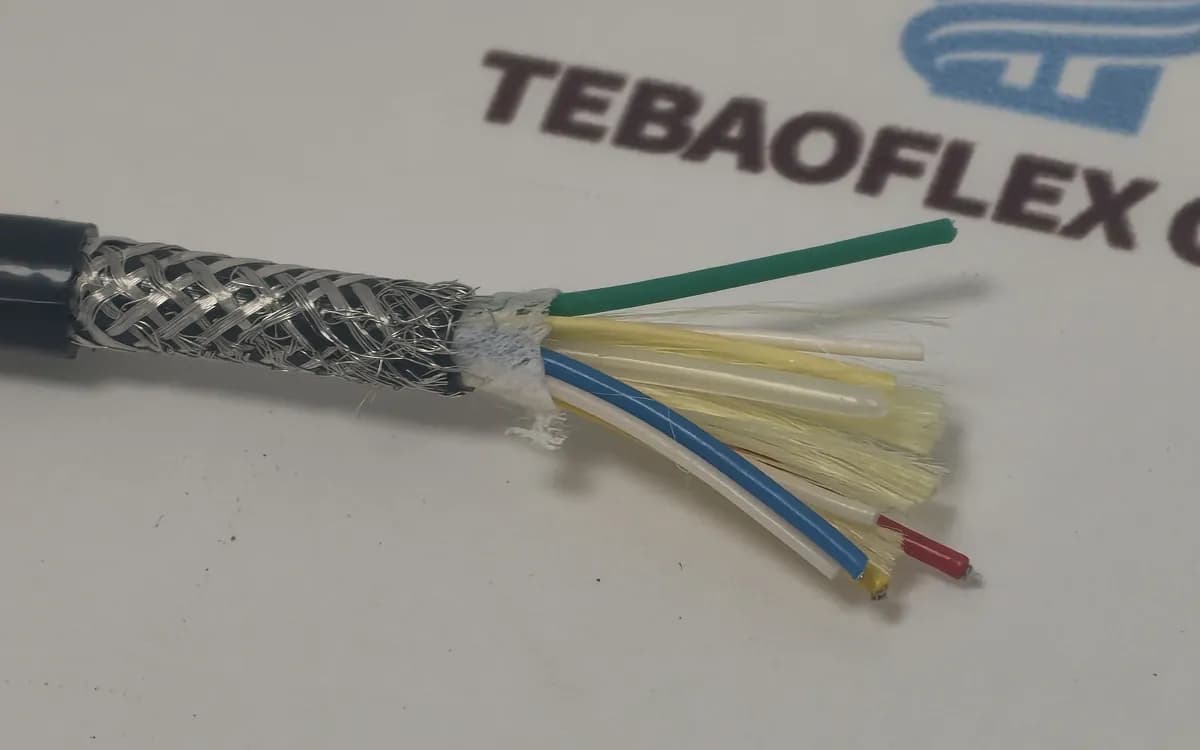
Non-collapse atmospheric capillary tube is a hollow polymer tube set on the cable neutral axis. It equalizes air pressure while resisting crush from water head and gland torque.
Layer-by-Layer Construction Breakdown
- 1. Central Capillary Tube: Material & Engineering Detail: Hollow translucent PE vent tube (1.60 mm measured OD; optional FEP/PVDF for harsh vapors) | Primary Field & Process Function: Equalizes atmospheric pressure to the back of the pressure diaphragm without collapsing
- 2. Conductors (4×0.2 mm²): Material & Engineering Detail: Finely stranded flexible tinned copper (CuSn), aligned to IEC 60228:2023 stranding practice | Primary Field & Process Function: Corrosion-resistant low-resistance 4 to 20 mA or digital transmitter signal paths
- 3. Core Insulation: Material & Engineering Detail: Color-coded Polyethylene (PE): Yellow, Green, Blue, Red in symmetrical 90° spacing | Primary Field & Process Function: Low dielectric constant, low moisture uptake, and rapid four-wire field termination
- 4. Tensile Cords & Fillers: Material & Engineering Detail: High-tenacity polyamide tensile yarns + solid polymer filler rods | Primary Field & Process Function: Absorbs vertical hanging load (~0.077 kg/m) and cushions the central vent tube
- 5. Inner Sheath & Wrap: Material & Engineering Detail: Non-woven binder/thermal separator wrap + extruded black PE inner sheath | Primary Field & Process Function: Locks round core geometry, blocks moisture ingress, and buffers core heat during extrusion
- 6. Overall EMC Screen: Material & Engineering Detail: High-coverage tinned copper (CuSn) braided shield | Primary Field & Process Function: Protects weak millivolt/milliamp level signals from VFD pump and plant EMI noise
- 7. Outer Chemical Jacket: Material & Engineering Detail: Extruded glossy black F46 (FEP) fluoropolymer (0.59 to 0.70 mm wall; 6.99 to 7.11 mm OD) | Primary Field & Process Function: Resists strong acids, alkalis, vapors, and -40 °C to +70 °C continuous immersion
Explore our full instrumentation cable product range, control and signal cable portfolio, and high-temperature fluoropolymer wire category.
4. Digital Caliper FAT, Inline Video Walkthrough, and Vented Cable Selection
Pre-shipment dimensional caliper FAT is a shop check taken across multiple cuts before drum release. It records cable outer diameter, outer jacket wall thickness, and open vent bore size.
Before packing the 1,000 m trial lot, TEBAOFLEX QC staff ran multi-point caliper checks per IEC 60811-202 non-metallic sheath thickness rules. They also filmed a 29-second inline jacket-marking inspection video.
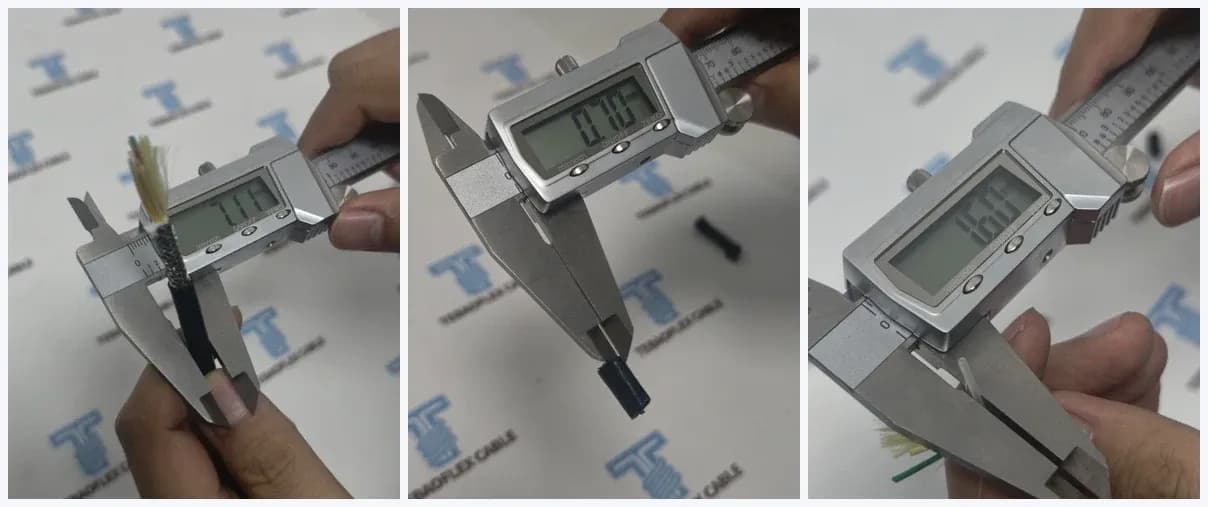
Worked Dimensional Tolerance Margin and Concentricity Audit
Tight diameter control lets stainless or PTFE glands seal tightly without crushing the center air tube. For example, audit all three digital caliper sets from the 1,000 m lot against the 6.90 to 7.30 mm spec:
1. Finished overall outer diameter (spec: 6.90 to 7.30 mm; nominal midpoint 7.10 mm):
   Measured readings = 6.99 mm, 7.10 mm, 7.11 mm -> Mean = 7.07 mm (total spread 0.12 mm)
   Lower margin = 6.99 - 6.90 = +0.09 mm inside spec; Upper margin = 7.30 - 7.11 = +0.19 mm inside spec.

2. Stripped F46 (FEP) outer sheath wall thickness (IEC 60811-202 audit):
   Measured readings = 0.59 mm, 0.68 mm, 0.70 mm -> Mean = 0.657 mm (0.66 mm)
   Wall-thickness uniformity ratio = 0.59 mm / 0.657 mm = 89.8% concentricity.

3. Post-extrusion PE capillary vent tube diameter check:
   Measured OD = 1.60 mm circular bore verified open with zero thermal collapse or ovalization.
Inline Production & Jacket-Marking Video Walkthrough (00:00 to 00:29)
The companion 1280×720 (29-second) shop video records live inline marking and finish quality across the 1,000 m trial run:
- 00:00 to 00:13 (Twin Inline Print-Head Run): The black F46 (FEP) cable feeds past twin inkjet heads. Crisp white legend and sequential meter marks (0296M visible at 00:12 to 00:13) bond cleanly onto the slick fluoropolymer surface without smearing.
- 00:14 to 00:15 (Guide Pulley & Meter Wheel Check): Close-up at the aluminum guide pulley and blue meter-counting wheel confirms steady line tension and a smooth, ripple-free outer wall.
- 00:16 to 00:23 (Close-Up Print Legibility Audit): Hand inspection stabilizes the running cable to verify sharp contrast on the approved legend: TEBAOFLEX 4*0.2 + Capillary Tube Combined Shielded Cable 0296M.
- 00:24 to 00:29 (Upstream Stainless Cooling Trough & Wiper Run): The camera tracks back along the stainless water-cooling trough and foam wiper assembly, confirming continuous defect-free jacket extrusion.
Comparing TEBAOFLEX Vented Level Sensor and Chemical FEP Cable Series
Choosing between PUR/TPU vented cables, hybrid PE + F46 (FEP) vented cables, and all-FEP control cables hinges on fluid pH, temperature, and venting needs:
- Custom Belarus 4×0.2 Vented F46 (FEP) (This Case): Construction & Venting: 4×0.2 mm² CuSn + 1.60 mm PE vent tube + PE inner sheath + CuSn braid | Outer Jacket & Thermal Limit: Black F46 (FEP) (-40 to +70 °C; 6.9 to 7.3 mm OD) | Electrical & Standard Basis: Shielded instrumentation (IEC 60228 / IEC 60811-202) | Primary Field Duty: Corrosive acid/alkali hydrostatic level transmitters in cold climates
- 02-250V6 Vented PUR Sensor Cable: Construction & Venting: 22/24 AWG CuSn cores + central atmospheric vent tube | Outer Jacket & Thermal Limit: Subsea PUR sheath (-30 to +80 °C; 6×OD) | Electrical & Standard Basis: 300 V; IEC 60770 / EN 50288 | Primary Field Duty: Freshwater boreholes, reservoirs, and marine depth/level probes
- Vented TPU Water Quality Cable: Construction & Venting: 22/24 AWG CuSn cores + central atmospheric vent tube | Outer Jacket & Thermal Limit: Hydrolysis-stabilized TPU (-30 to +80 °C; 6×OD) | Electrical & Standard Basis: 300 V; ISO 15839 / IEC 60770 | Primary Field Duty: Municipal water-quality monitoring, CTD probes, and lift stations
- Vented Armoured Submersible Sensor Cable: Construction & Venting: Tinned copper + PP insulation + vented power/signal assembly | Outer Jacket & Thermal Limit: Mechanically armored PUR (order-specific depth rating) | Electrical & Standard Basis: Order-specific instrumentation specification | Primary Field Duty: Abrasive deep wells, rocky sumps, and mechanically exposed shafts
- DIN VDE 6Y Multi-Core 205 °C FEP Cable: Construction & Venting: Class 5 CuSn + extruded FEP (6Y) insulation (non-vented) | Outer Jacket & Thermal Limit: Chemical-proof FEP (-100 to +205 °C fixed; 10×OD) | Electrical & Standard Basis: 300/500 V; 2.5 kV AC test; ≥ 1,000 MΩ·km | Primary Field Duty: High-temperature hot chemical zones and oven control wiring
- UL AWM 21618 (TD 833 CF) Screened FEP: Construction & Venting: Stranded Cu + FEP insulation + ≥ 85% CuSn braid (non-vented) | Outer Jacket & Thermal Limit: White chemical-proof FEP (-70 to +200 °C fixed) | Electrical & Standard Basis: 300 V; 2.0 kV AC test; UL AWM Style 21618 | Primary Field Duty: Cleanrooms, semiconductor wet benches, and high-temp shielded lines
Browse related hubs for underwater and ocean exploration cables, industrial automation cables, and oil and gas process cables. You can also read our high-temperature wire types guide and BS 5308 instrumentation cable guide.
5. Commissioning Safeguards and Six-Point RFQ Checklist for Vented Capillary Cables
Even a well-built F46 (FEP) vented cable will fail early if crews pinch the air bore or leave the dry end open to wet winter air. Follow three core field rules during probe install:
- Mount a dry breather capsule on the panel end. Never seal the vent tube shut, and never leave it open in a wet box. A sintered PTFE vent filter blocks water drops that freeze at -40 °C while passing dry air freely.
- Use torque-controlled glands rated for slick FEP. F46 (FEP) has low surface grip like PTFE. Fit a soft multi-seal gland sized to 6.9 to 7.3 mm OD. Never over-torque rigid glands until the 1.60 mm air tube flattens.
- Hang vertical cable weight on a strain-relief grip above the flange. Anchor the 0.077 kg/m drop on a woven mesh grip or matched clamp. This keeps hang tension off the sensor neck seal.
Six-Point Pre-Order RFQ Checklist for Chemical Vented Sensor Cables
Before ordering custom vented capillary cables, lock six site inputs so tooling and QC align on the first lot:
- Fluid mix, strength, and vapor type. Name exact acids, alkalis, or solvents to pick PE, PP, FEP, or PVDF vent tubing and outer jacket grade.
- Temperature range and cold-bend spec. State lowest winter temperature (-40 °C vs -25 °C) and verify cold-bend and tensile tests per IEC 60811-504:2012 and IEC 60811-501:2012.
- Core size, color code, and screen. Set copper gauge (4×0.2 mm² or 22/24 AWG), wire colors, twisted pairs, and CuSn braid for 4 to 20 mA or RS-485 loops.
- Outer diameter window and bore size. Share exact probe gland limits (such as 6.9 to 7.3 mm) and required capillary tube ID/OD.
- Max tank depth and tensile cord rating. Give full depth so external water pressure and polyamide tensile yarn load margins are sized safely.
- Print legend, flame test, and FAT checks. Lock meter marks (0001M to 1000M), vertical flame checks per IEC 60332-1-2:2025 if needed indoors, and caliper photo/video release.
Editorial Note: Jyen (Instrumentation & Submersible Sensor Cable Engineering Desk, TEBAOFLEX) verified every drawing and caliper value in this report against the 1,000 m Belarus trial order files and shop video. Referenced standards (IEC 60228, IEC 60529, IEC 60811-202, IEC 60811-501, IEC 60811-504, IEC 60332-1-2) set test methods. List any required third-party certificates in your purchase order. Visit our About TEBAOFLEX factory and testing page or contact our engineering desk with your probe drawing.
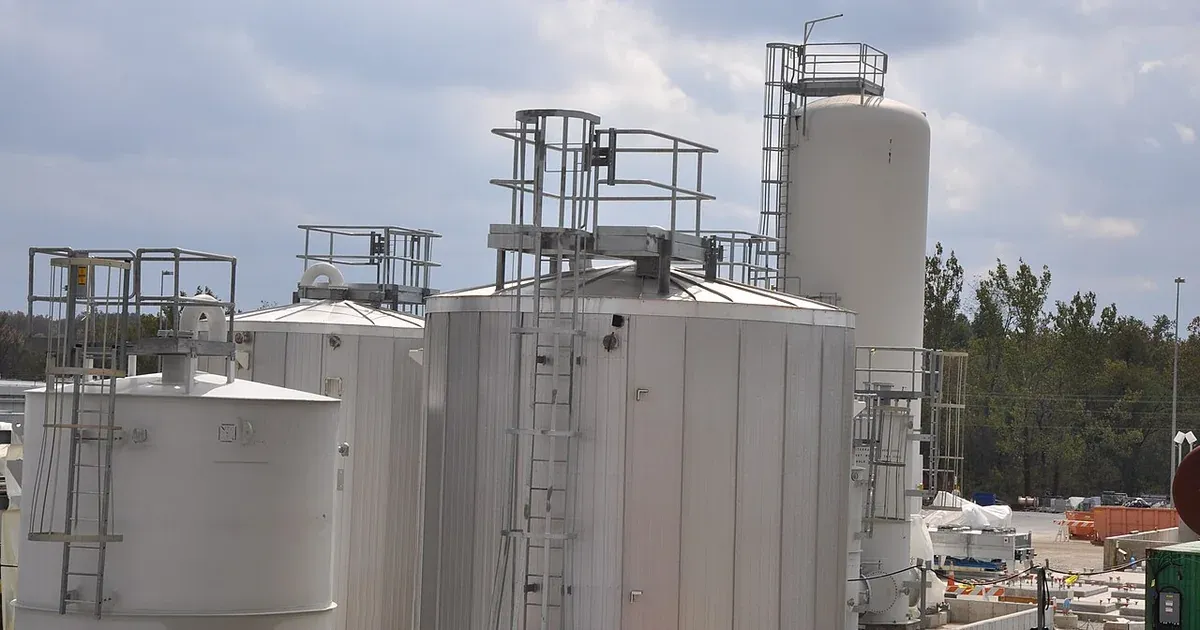
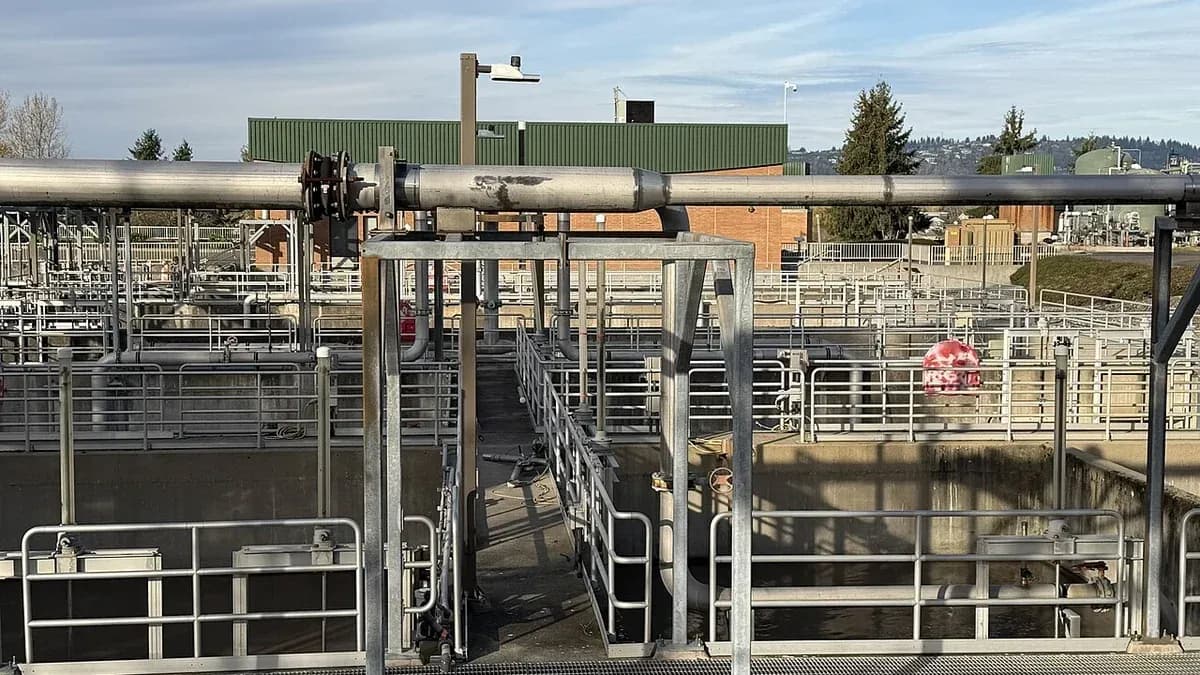
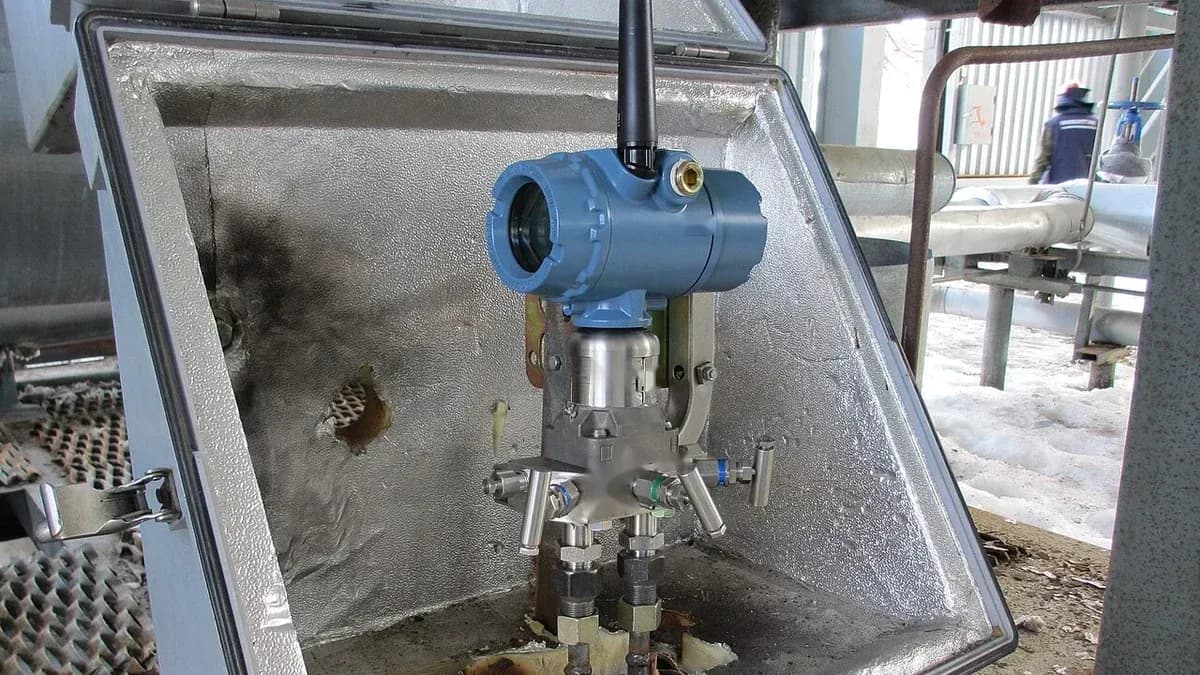
Image Credits: Hero cover photo "Blue Grass Chemical Agent-Destruction Pilot Plant Bulk Chemical Storage Area (8455272547).jpg" by PEO ACWA (CC BY 2.0). Process basin photo "Gresham Wastewater Treatment Plant aeration basins 2025.jpg" by PortlandAppraisalBlog (CC BY-SA 4.0). Cold-climate pressure transmitter enclosure photo "Датчик давления.JPG" by Weberman2010 (CC BY-SA 4.0). Stripped 7-layer specimen photo, three-panel digital caliper FAT plate, and 29-second inline jacket-marking inspection video produced by TEBAOFLEX.
Frequently Asked Questions
Why does a submersible hydrostatic level transmitter require a built-in capillary vent tube?
A submerged level probe reads total pressure, which adds liquid head plus local air pressure. The hollow vent tube feeds live ambient air to the back of the sensor diaphragm. Without venting, a normal 25 hPa weather shift causes over 25 cm of false error in water.
Why use a black F46 (FEP) outer sheath over PE insulation instead of standard PUR?
Standard PUR or TPU sheaths work well in clean fresh water. In strong acids and caustic alkalis, however, PUR swells, cracks, or breaks down. Pairing low-capacitance PE cores and a PE inner sheath with an F46 (FEP) outer jacket delivers acid/alkali resistance from -40 °C to +70 °C at lower cost than all-fluoropolymer cables.
How does TEBAOFLEX prevent PE cores and the hollow capillary tube from melting during F46 (FEP) extrusion?
F46 (FEP) extrudes at much higher heat than PE. TEBAOFLEX guards the PE cores and 1.60 mm air tube using a thermal wrap, a heat-spreading CuSn braid, tuned die tooling, and rapid water cooling. Cut tests confirm a round, open capillary bore after extrusion.
Why did TEBAOFLEX change the client drawing from adjacent Yellow/Red cores to a symmetrical four-quadrant layout?
Placing two cores side by side creates uneven radial force when tank glands tighten or when the cable bends. Spacing all four 0.2 mm² cores evenly with fillers and polyamide tensile yarns balances side load. This keeps the center capillary vent tube from pinching shut.
What finished dimensions were verified on the 1,000 m Belarus trial lot before shipment?
Pre-shipment digital caliper checks recorded cable outer diameters of 6.99 mm, 7.10 mm, and 7.11 mm (mean 7.07 mm). All three fall well inside the 6.9 to 7.3 mm spec window. Stripped F46 (FEP) jacket thickness measured 0.59 to 0.70 mm, and the open PE vent tube measured 1.60 mm OD.
How should technicians protect the open capillary tube end inside a cold-climate control cabinet?
Always connect the dry vent tube into a hydrophobic PTFE breather filter or dry capsule inside a vented box. Never crimp or glue the vent tube shut. Never leave the bare tip open to damp air where moisture can freeze solid at -40 °C.