

Hero image: “Container Cranes @ Port of Oakland” by Daniel Ramirez (jdnx), CC BY 2.0, cropped and resized. This is an illustration, not a photograph of a cable under test or a TEBAOFLEX project.
Key Takeaways
- IEC (International Electrotechnical Commission) 60794-1 has separate mechanical test methods that a specification can call up for cable that is pulled, twisted, bent or coiled. None of the previews we read mentions festoon, reeling or crane service. We did not read the product-level parts of the series, so we cannot say whether a product standard exists.
- The test numbers changed. Since IEC 60794-1-2:2021, E-numbered methods have been moving into single-subject documents: E1 became IEC 60794-1-101 and E7 became -1-107. For E6 repeated bending and E8 flexing we found only drafts.
- "No change in attenuation" has a number. IEC 60794-1-1:2023 treats any value within ±0.05 dB (single-mode) or ±0.2 dB (multimode A1) as no change; the previews do not show which limit each method applies.
- Hybrid communication cables sit in a separate series. The IEC webstore description of IEC 62807 says its current-carrying conductors are not intended as a power mains supply, so, by our reading, a power-plus-fiber reeling cable needs its power part named separately.
- The compendium is partially replaced. IEC lists successor documents for IEC 60794-1-21:2015. Withdrawal of a European adoption and an IEC stability date describe different things; neither alone establishes withdrawal of the whole IEC edition. Name the governing edition in the order.
Last checked against IEC previews and issuer or national-body listings: 16 October 2026 (UTC).
This article covers what we could check from previews and listings: the IEC 60794-1 mechanical test methods we found previews for, their new numbering, the "no change in attenuation" definition and the IEC 62807-1 hybrid cable listing. See our fiber-optic cable range.
Sources and Limits
This article uses IEC preview PDFs hosted by VDE Verlag and public records from the IEC and national standards bodies. Previews show contents, forewords, scopes and some opening clauses, not the full method requirements. Use the full specified edition for contractual parameters and acceptance criteria. The TEBAOFLEX Russia port-crane video page supports the 6/10 kV, 24-fiber construction example only; it is not evidence of laboratory qualification.
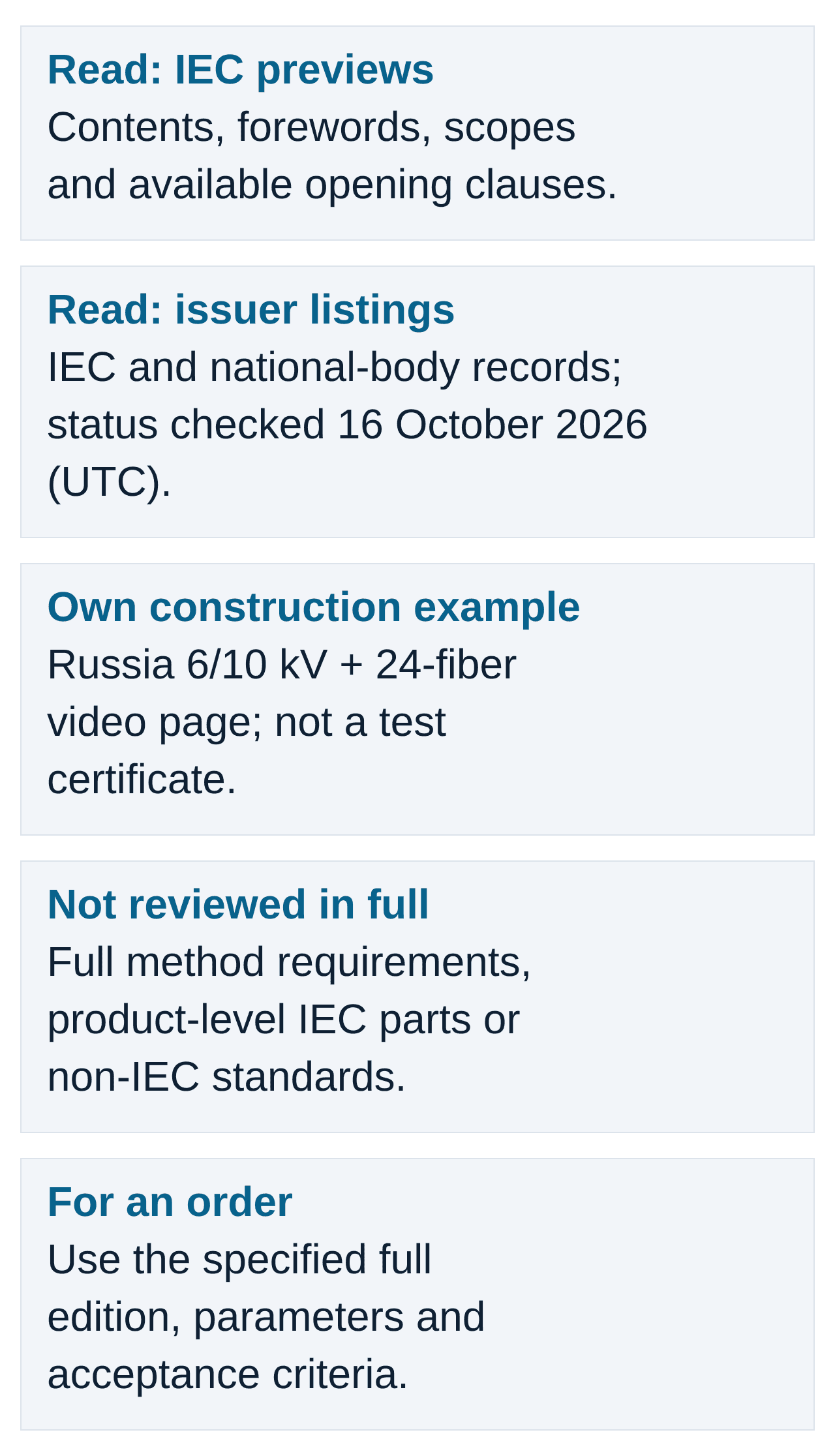
Figure 1. Sources and limits. Preview and catalogue information does not replace full standards or construction-specific test reports.
Two status distinctions matter when specifying an edition:
- E6 and E8. The EVS records checked for prEN IEC 60794-1-106:2025 (E6 repeated bending) and prEN IEC 60794-1-108:2026 (E8 flexing) are drafts. We did not establish a final published edition from the records reviewed. A draft listing or development forecast is not proof that a final edition has or has not been published; verify current issuer status before ordering.
- The 2015 compendium. The IEC record for IEC 60794-1-21:2015 identifies it as partially replaced and lists successor documents. EVS reports withdrawal of the European adoption from 15 July 2026; this does not establish withdrawal of the whole IEC edition. The amendment record’s 2028 stability date is a review horizon, not an expiry date or proof of current applicability. Specify the document and edition required by the project.
How IEC 60794-1 Is Organized
IEC 60794-1-1:2023 is the generic specification. IEC 60794-1-2:2021 gives general guidance for all the test methods.
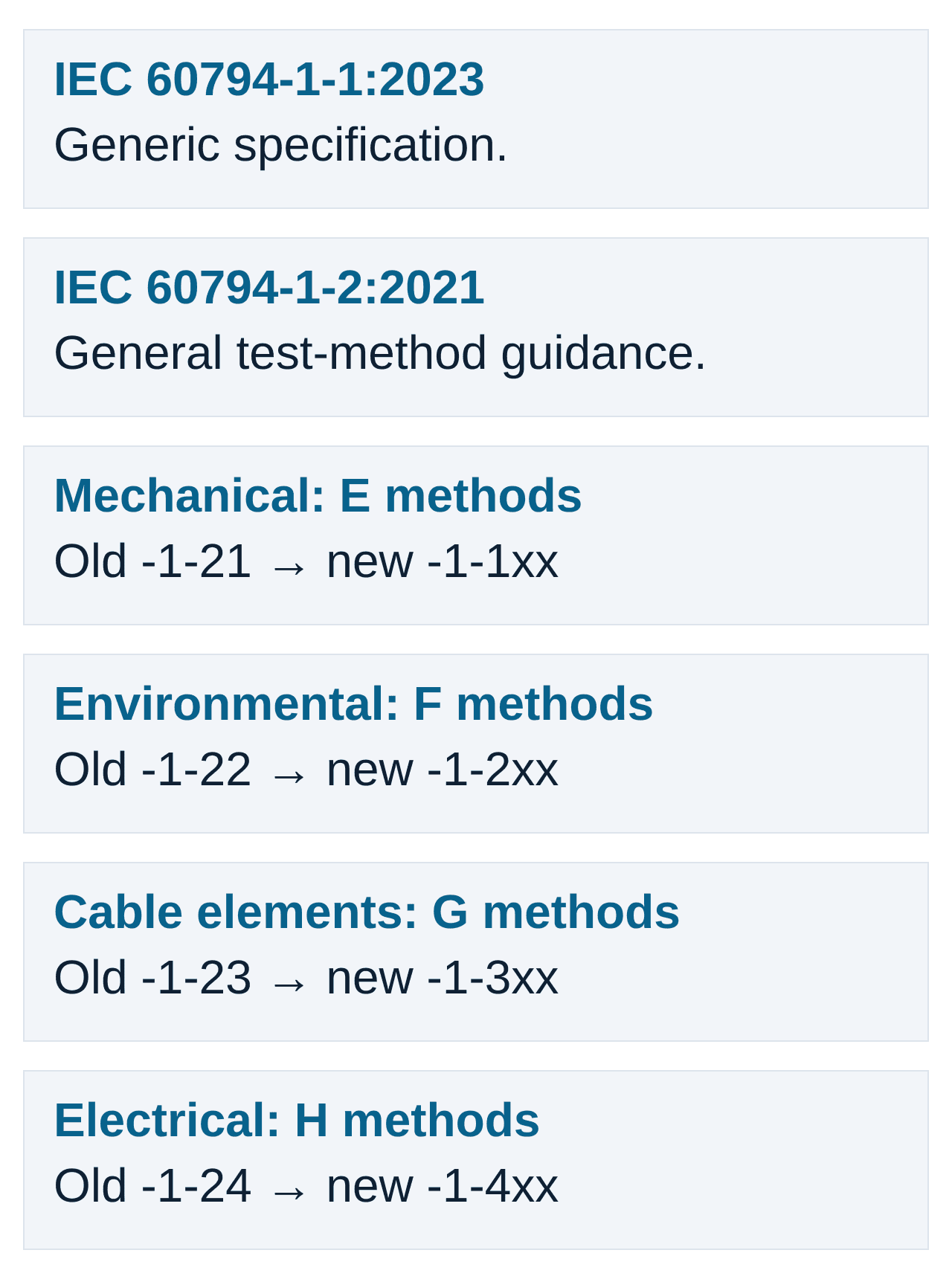
Figure 2. The IEC 60794-1 structure. The compendia and their new number ranges are from Table 1 of IEC 60794-1-2:2021, which says they continue in force until all their methods are revised; the top two boxes come from the covers.
The mechanical methods, labeled E, sit in the compendium IEC 60794-1-21:2015+AMD1:2020 (the 2015 edition plus Amendment 1), whose contents run from E1 to E34. Its scope includes "cables having a combination of both optical fibres and electrical conductors".
Test Numbers Changed
The introduction to IEC 60794-1-2:2021 says a decision has been reached to reorganize the test methods "into single-subject documents". The new format is IEC 60794-1-Xnn, where X is the second digit of the old two-digit reference and nn is the old method number (new methods take the next number in that category), so E1 (tensile) becomes IEC 60794-1-101.
Stand-alone documents have followed since 2023. The May 2024 tensile and impact previews describe a planned withdrawal of the 2015 compendium. For status, use the current IEC listing, which identifies partial replacement rather than treating that earlier future-tense statement as a completed withdrawal.
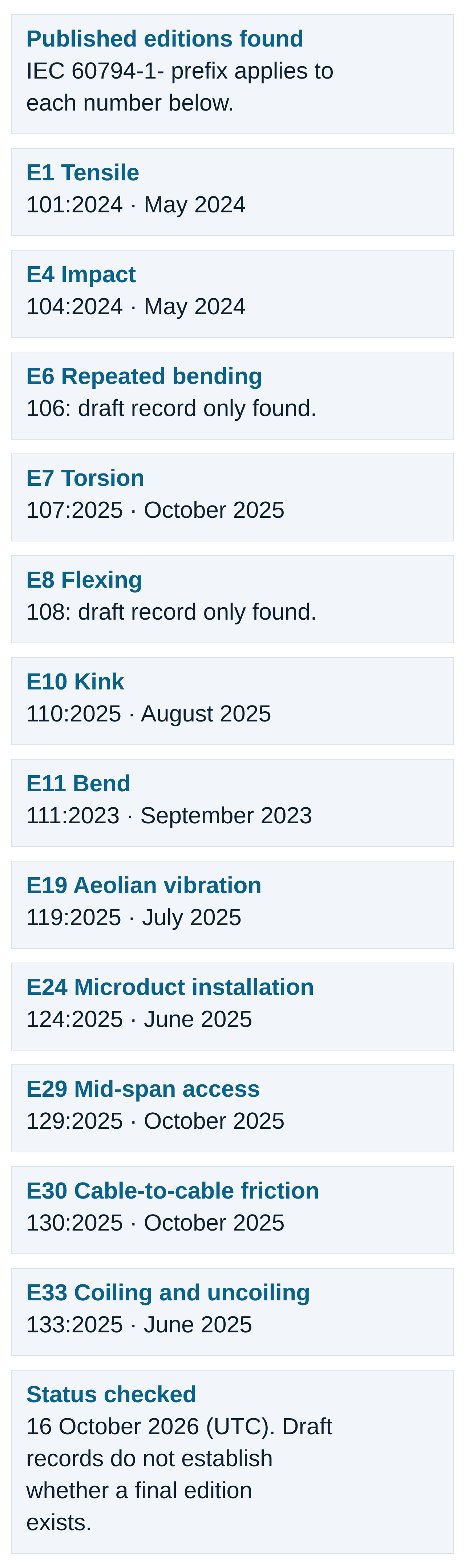
Figure 3. Twelve selected mechanical methods, not the whole series. Ten published editions were found; E6 and E8 were found as draft records. Checked 16 October 2026 (UTC); verify current issuer status before specifying an edition.
Previews read: IEC 60794-1-101, IEC 60794-1-104, IEC 60794-1-107, IEC 60794-1-110, IEC 60794-1-111, IEC 60794-1-119, IEC 60794-1-124, IEC 60794-1-129, IEC 60794-1-130 and IEC 60794-1-133.
Mechanical Methods a Specification Can Call Up
The comparison below is our selection from IEC 60794-1-21: the methods closest to repeated movement. In the previews we read, only E8 (elevator cable or the like, in a draft) and E33 (mobile rapid or multiple deployment) are tied to a duty, and neither names reeling or festoon service. The specification decides which methods a cable needs.
- Method: E1 Tensile performance; Where it lives now: IEC 60794-1-101:2024; What the text says: Wording from IEC 60794-1-21, because the -1-101 preview does not show the method text: examines attenuation and/or fiber elongation strain "as a function of the load on a cable which may occur during installation and operation"
- Method: E6 Repeated bending; Where it lives now: IEC 60794-1-21; only a draft record found for -1-106; What the text says: Title only in the contents we read
- Method: E7 Torsion; Where it lives now: IEC 60794-1-107:2025; What the text says: Establishes "the ability of a fibre optic cable to withstand mechanical twisting", measuring attenuation change and checking for physical damage
- Method: E8 Flexing; Where it lives now: IEC 60794-1-21; -1-108 found only as a draft; What the text says: EVS draft scope: "a specialized test intended for specific types of cable, such as elevator cable or the like"
- Method: E10 Kink; Where it lives now: IEC 60794-1-110:2025; What the text says: Checks that no kink occurs when bending to a specified minimum loop diameter; the text warns of limited reproducibility
- Method: E11 Bend; Where it lives now: IEC 60794-1-111:2023; What the text says: Tests the ability to withstand bending around a test mandrel; measures attenuation change and checks for damage
- Method: E33 Multiple cable coiling and uncoiling performance; Where it lives now: IEC 60794-1-133:2025; What the text says: Coiling and uncoiling on a specified diameter of cable reel; "primarily intended" for cables for mobile rapid or multiple deployment
The previews give no bend radii, cycle counts or loads for repeated bending or flexing. By our reading, the specification or order supplies them, because the general method format in IEC 60794-1-2:2021 lists object, sample, apparatus, procedure, requirement, "details to be specified" and details to be reported. Our reeling cable selection and festoon cable guides cover the cables that carry these loads.
What "No Change in Attenuation" Means
Clause 3.1 of IEC 60794-1-1:2023 defines "no change in attenuation". For single-mode fiber (class B), the total uncertainty of measurement is set at ≤ ±0.05 dB (or ±0.05 dB/km for the attenuation coefficient), and any measured value within that range is considered "no change in attenuation". For multimode category A1 the figure is ≤ ±0.2 dB (or ±0.2 dB/km for the attenuation coefficient); for plastic optical fiber (category A4) it is ≤ 2% of the maximum specified attenuation in IEC 60793-2-40:2021.
For single-mode and multimode A1 fiber, the clause also lets customer and supplier agree to accept a minor deviation "at some low frequency, for example less than 10 %"; the preview does not say what the 10 % is a share of. Even then, mechanical tests allow no deviation above 0.15 dB (single-mode) or 0.5 dB (A1), and environmental tests none above 0.10 dB/km (single-mode) or 0.5 dB/km (A1). The previews did not show any method's requirements clause, so we cannot say which limit a given method applies.
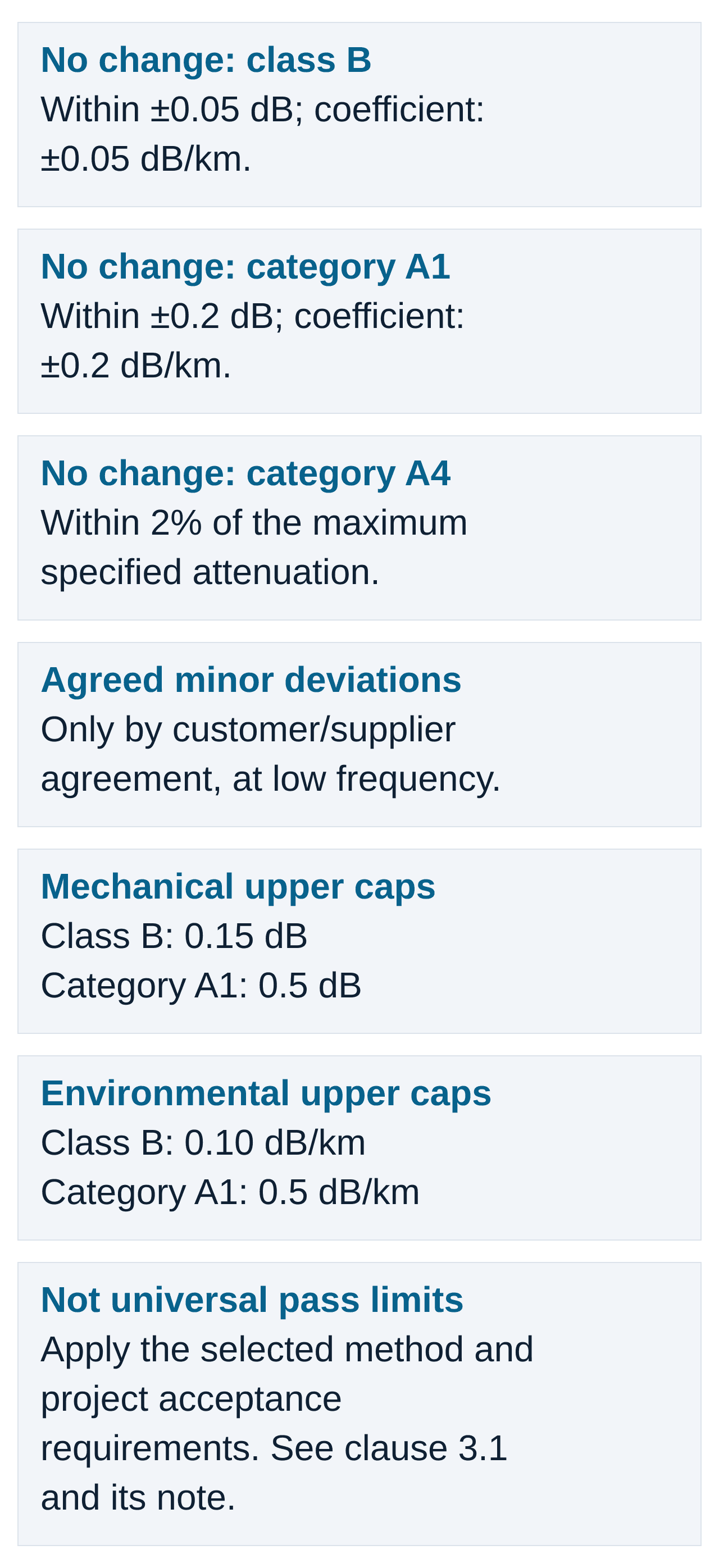
Figure 4. IEC 60794-1-1:2023, clause 3.1 and its note: no-change values are distinct from upper caps on minor deviations agreed at low frequency. These are not unconditional pass limits for every method.
Hybrid and Composite Cables
IEC 60794-1-1 says hybrid communication cables are specified in the IEC 62807 series. The IEC webstore page for IEC 62807-1:2017 says it applies to hybrid cables with any combination of optical fibers, twisted pair or quad, coaxial and current-carrying electrical conductor elements. Such a design, it adds, "retains the option of supplying electrical current to remote equipment". It also says that in IEC 62807 (all parts) "the current carrying conductors are not intended to be used as power mains supply", and that the optical fiber element's performance requirements follow the IEC 60794 series.
The IEC listing explicitly says the current-carrying conductors are not intended as a mains supply. Our engineering interpretation for a power-plus-fiber reeling cable is to specify the power requirements separately from the optical test methods, then qualify the actual construction and movement duty. This is not a complete qualification rule derived from the preview. See our cable standards pages. Our Russia port-crane video page shows a 6/10 kV composite reeling cable with 24 optical fibers; the page is a construction example, not a test certificate.
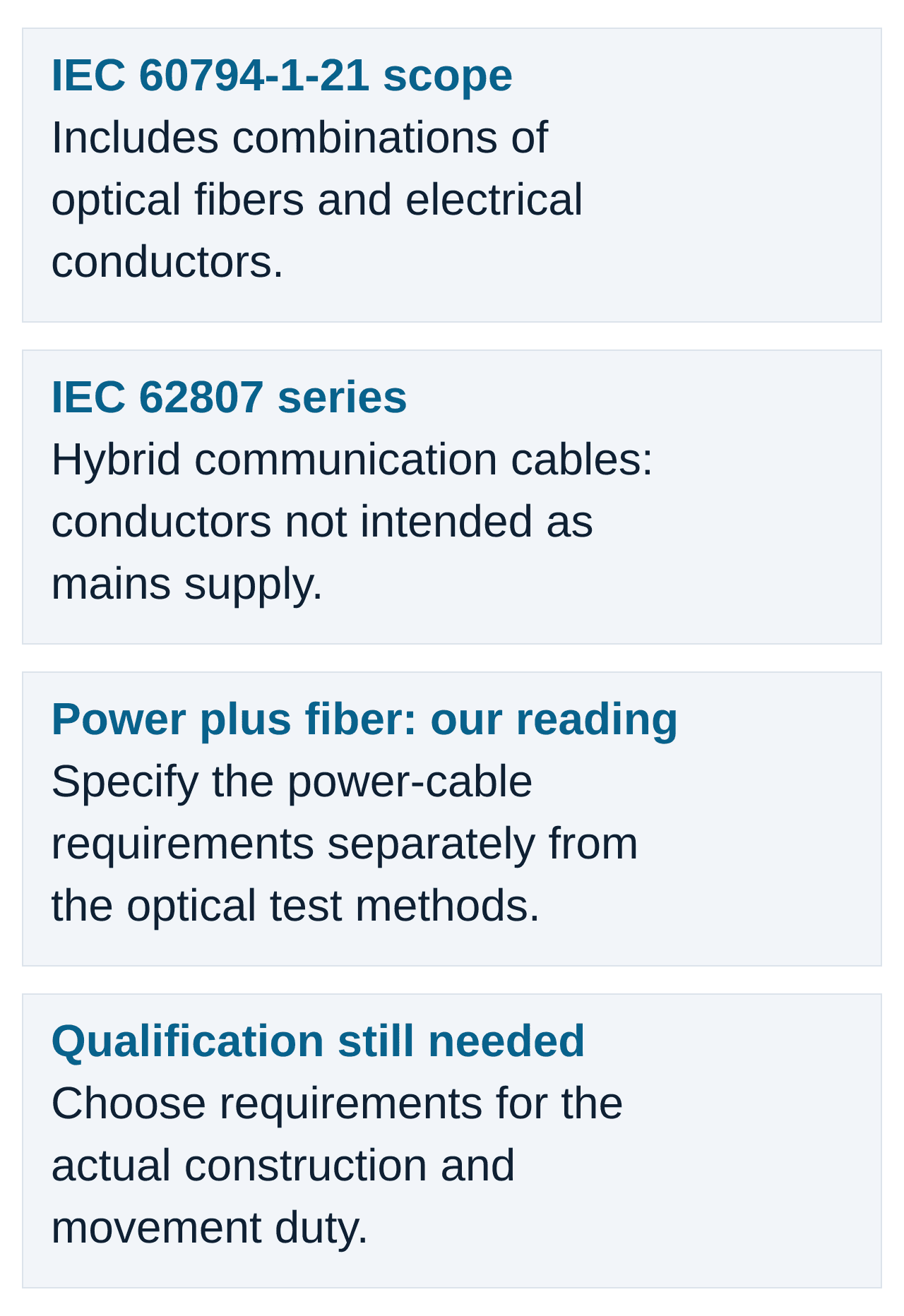
Figure 5. IEC optical methods and hybrid communication cables. Separating power requirements from optical methods is our engineering interpretation for power-plus-fiber cable, not quoted qualification wording.
What to Write into the Order
- Name the methods by letter and title, for example "E7 torsion".
- Cite the document and edition, for example "IEC 60794-1-107:2025". For E6 and E8, name the IEC 60794-1-21 edition and date and agree in writing which text governs.
- Give the parameters each method lists under "details to be specified", for example sample length, loop diameter or reel diameter. The previews do not show those lists.
- State the fiber: single-mode (class B) or multimode (category A1).
- State the acceptance limit for each method; the specification may use the "no change in attenuation" definition in IEC 60794-1-1:2023 clause 3.1.
- Split a composite cable (our reading, not a standard's wording): power part to a power-cable standard, fiber part to the IEC 60794-1 methods.
- Ask for test reports on the supplied construction.
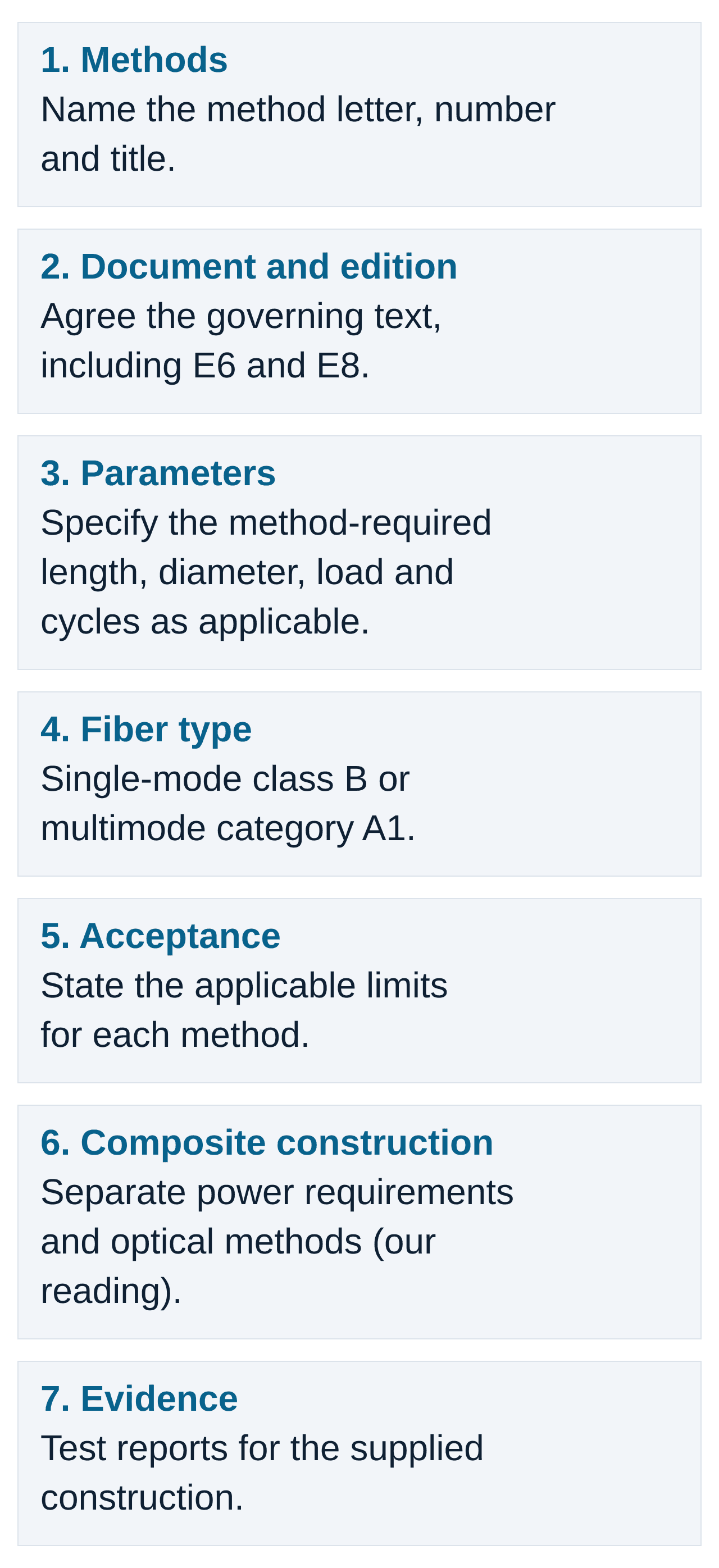
Figure 6. The seven items an order for fiber-optic cable on moving equipment should state.
Illustrative example. A reeled composite cable with a power part and 24 multimode (A1) fibers. Items 1 and 2 name E1 per IEC 60794-1-101:2024, E7 per IEC 60794-1-107:2025 and E11 per IEC 60794-1-111:2023, and, for E6 and E8, the IEC 60794-1-21 edition the specification names. It is a generic illustration, not a project record.
Frequently Asked Questions
Is there an IEC standard for fiber-optic cable on reels or festoons?
We found none written for reeling or festoon service in the IEC 60794-1 previews or the IEC 62807-1 listing we read. IEC 60794-1-133 (E33) tests coiling and uncoiling on a cable reel, but is aimed at cables for mobile rapid or multiple deployment. We did not read the product-level parts of IEC 60794, so check the IEC webstore before concluding none exists.
What happened to methods E6 and E8?
They are the repeated bending and flexing methods in IEC 60794-1-21. Under the new numbering they become -1-106 and -1-108, which we found only as drafts.
What does "no change in attenuation" mean?
A change within ±0.05 dB (single-mode) or ±0.2 dB (multimode A1) per IEC 60794-1-1:2023 clause 3.1. In mechanical tests, agreed deviations may not exceed 0.15 dB or 0.5 dB. The previews do not show which limit each method applies.
Does IEC 62807 cover power-plus-fiber reeling cable?
Its IEC webstore description says the current-carrying conductors are not intended as a power mains supply, so by our reading it is not intended for mains-level power cable. Name the power part and the fiber tests separately.
Discuss Your Fiber-Optic Cable Project
For fiber-optic or composite cable on a reel, festoon or other moving system, send us the movement profile, fiber type, length and the test methods your specification calls for. WhatsApp +86 185 9591 3361 or info@tebaoflex.com. See also our certifications and contact pages.