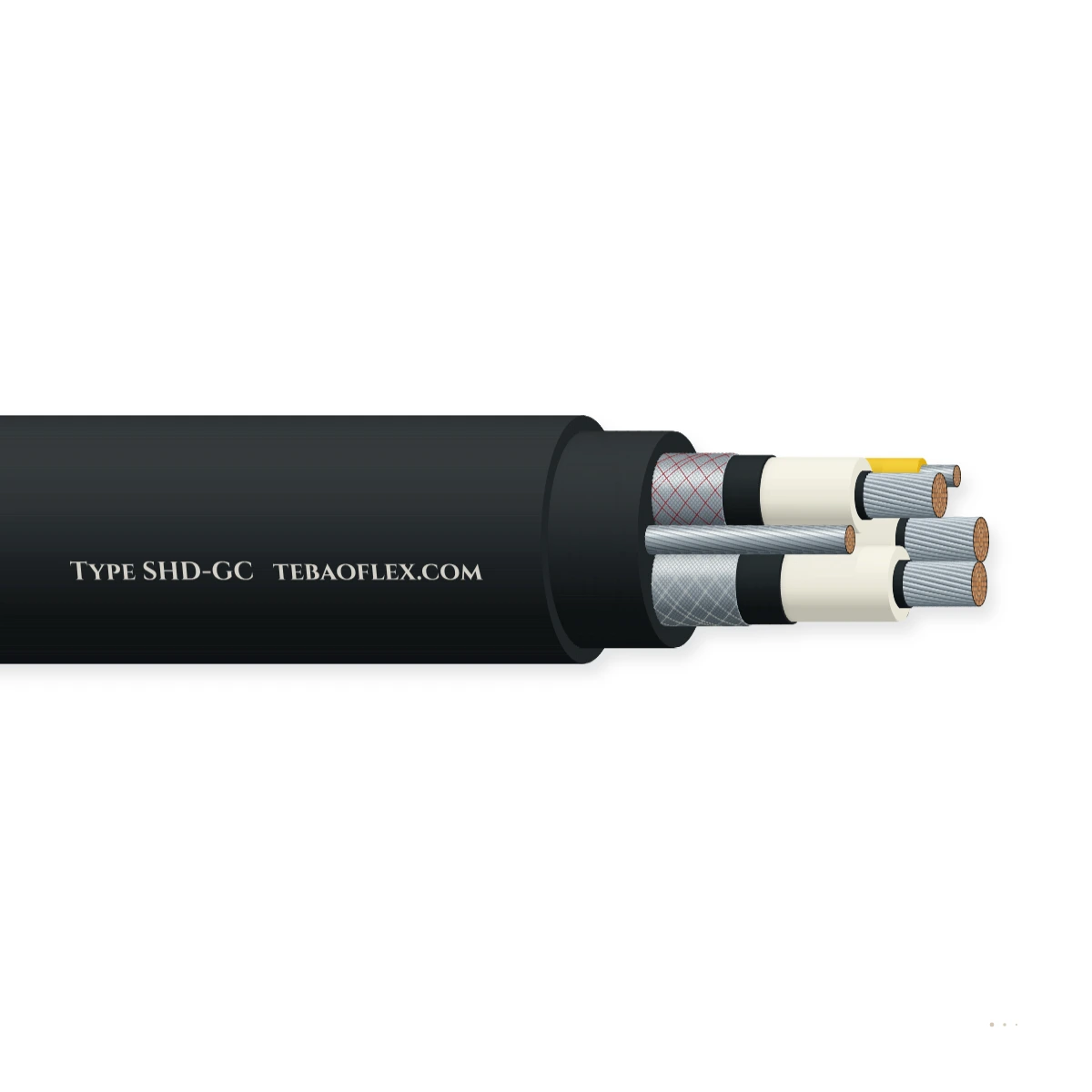
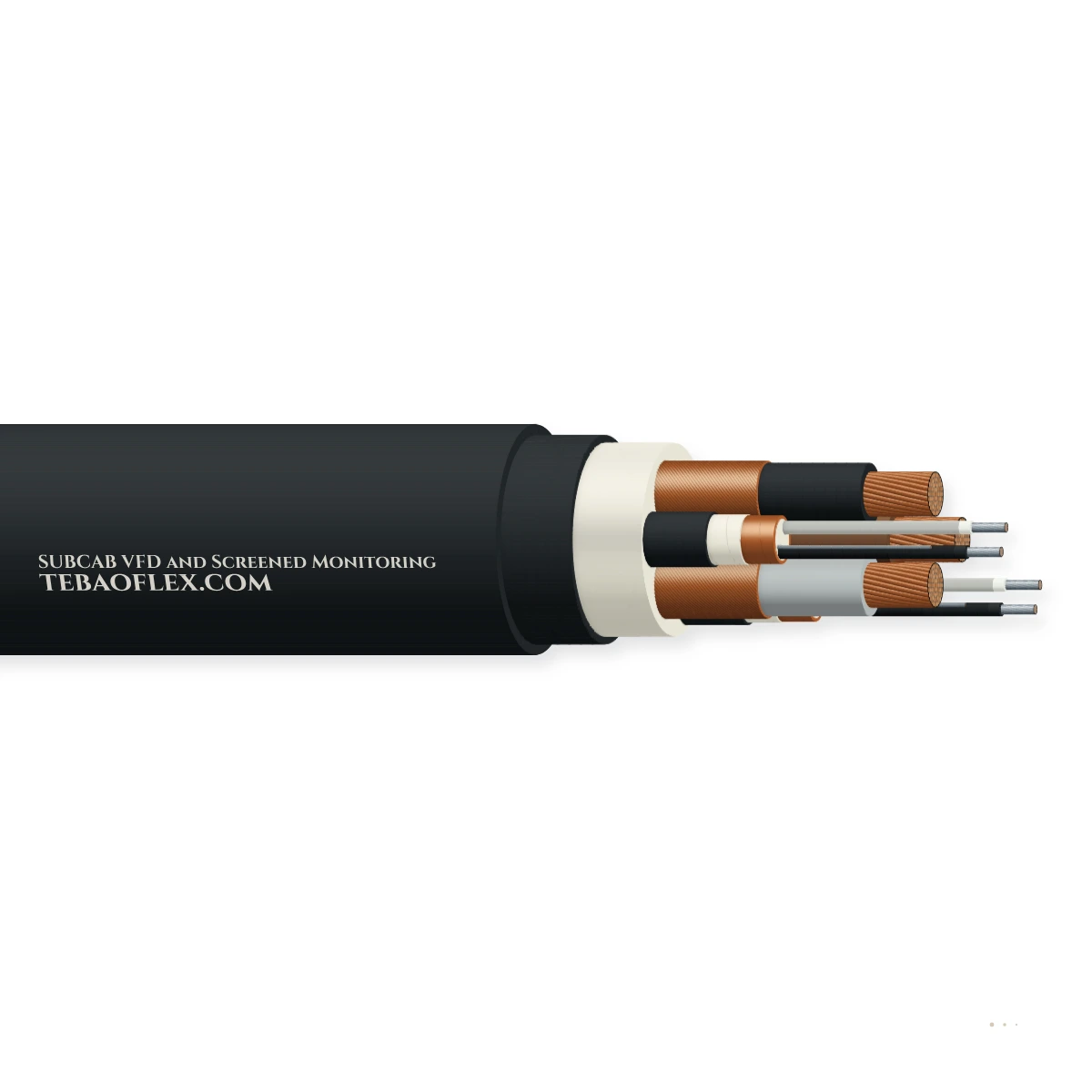
Medium-voltage submersible pump cable specifications require five verified parameters before extrusion. Engineers must lock maximum outside diameter for the pump grommet, phase and sensor screening, and per-phase VFD capacitance and inductance. Every continuous joint-free length must also pass submerged partial-discharge testing.
Contractors building municipal intake stations, mine dewatering shafts, and industrial water facilities in Central Asia and Europe frequently replace OEM medium-voltage pump drops. Standard reeling datasheets rarely list compression-grommet tolerances or wet dielectric acceptance gates. Reviewing every mechanical and electrical boundary before release prevents junction-box flooding and premature insulation breakdown.
Why Maximum Outside Diameter Governs Pump Entry Sealing
A submersible pump cable-entry grommet is a precision elastomeric compression sleeve inside the motor terminal housing that deforms radially against the outer cable jacket to block high-pressure water ingress. Unlike open crane glands that tolerate broad diameter bands, heavy submersible pump entries seal only within a narrow bore range.
If a replacement cable arrives oversize, mechanics cannot slide the jacket through the gland follower without shaving the outer rubber. Shaving destroys the vulcanised skin of the polychloroprene sheath and creates a capillary leak path straight into the stator chamber. Conversely, an undersize outer diameter leaves insufficient radial compression when hydrostatic head builds up.
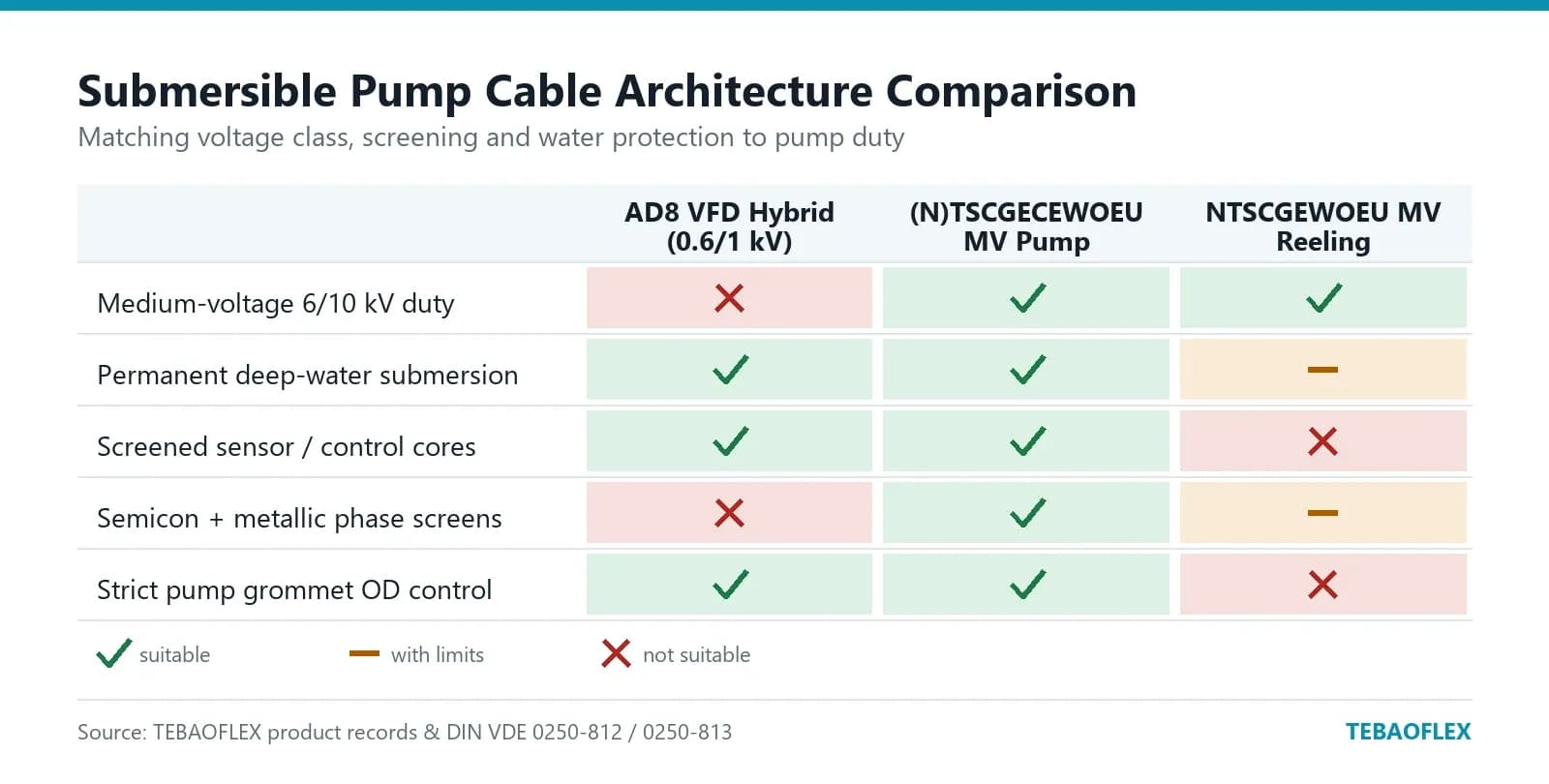
Architecture differences between 0.6/1 kV AD8 hybrid VFD cables, 3.6/6 to 12/20 kV submersible pump cables and MV reeling cables.
Comparison matrix — text version
For each criterion below, values are listed in this order: AD8 VFD Hybrid (0.6/1 kV); (N)TSCGECEWOEU MV Pump; NTSCGEWOEU MV Reeling.
- Medium-voltage 6/10 kV duty: not suitable; suitable; suitable.
- Permanent deep-water submersion: suitable; suitable; suitable with limits.
- Screened sensor / control cores: suitable; suitable; not suitable.
- Semicon + metallic phase screens: not suitable; suitable; suitable with limits.
- Strict pump grommet OD control: suitable; suitable; not suitable.
When preparing submersible pump cable specifications for a replacement drop, engineers should establish four dimensional rules on the signed datasheet:
- State the hard maximum finished outside diameter rather than a nominal figure with an open positive tolerance.
- Require one continuous factory length on a single drum without vulcanised field splices or jacket patch repairs in the submerged zone.
- Specify minimum, average, and maximum laser-measured outside diameters on the pre-shipment Factory Acceptance Test (FAT) report.
- Match low-voltage wet-well drops up to 500 m depth (50 bar AD8) with our 0.6/1 kV AD8 VFD submersible pump hybrid cable or AD8 submersible pump power and monitoring cable. For NTSCGEWOEU 6/10kV class pump motors, step up to 3.6/6 to 12/20 kV (N)TSCGECEWÖU MT PLUS submersible cable.
Split Earths, Copper Braid Screens and Monitoring Pairs
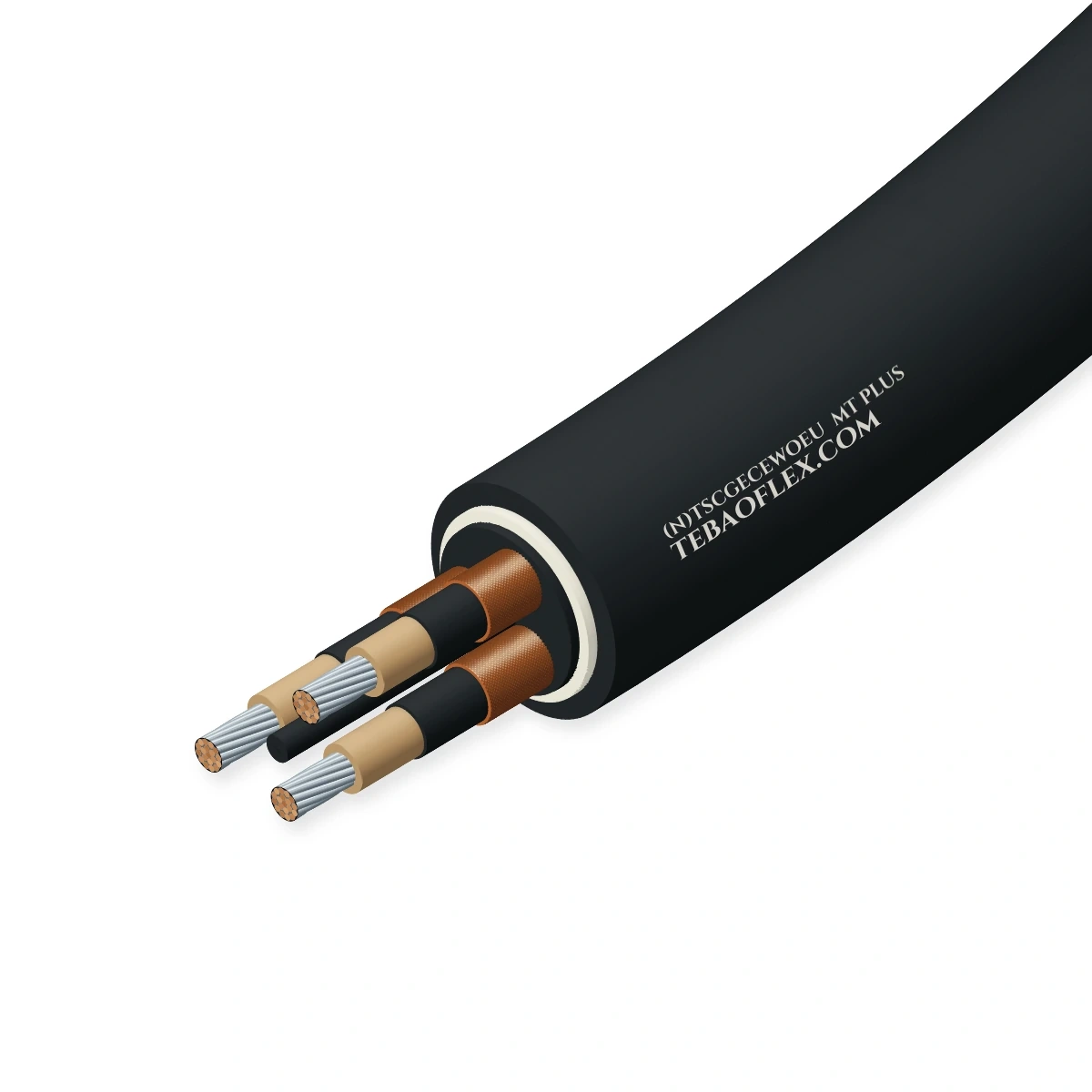
A hybrid medium-voltage submersible cable is a composite power-and-telemetry construction. It houses triple-extruded medium-voltage phase cores, split protective-earth conductors, and individually screened twisted control pairs inside one water-resistant elastomer jacket. A standard NTSCGEWOEU cable (DIN VDE 0250-813 NTSCGEWÖU medium-voltage reeling cable) uses semiconductive field control with three interstitial earths. By contrast, VFD-driven pumps with PT100 thermistors and moisture probes need metallic screening.
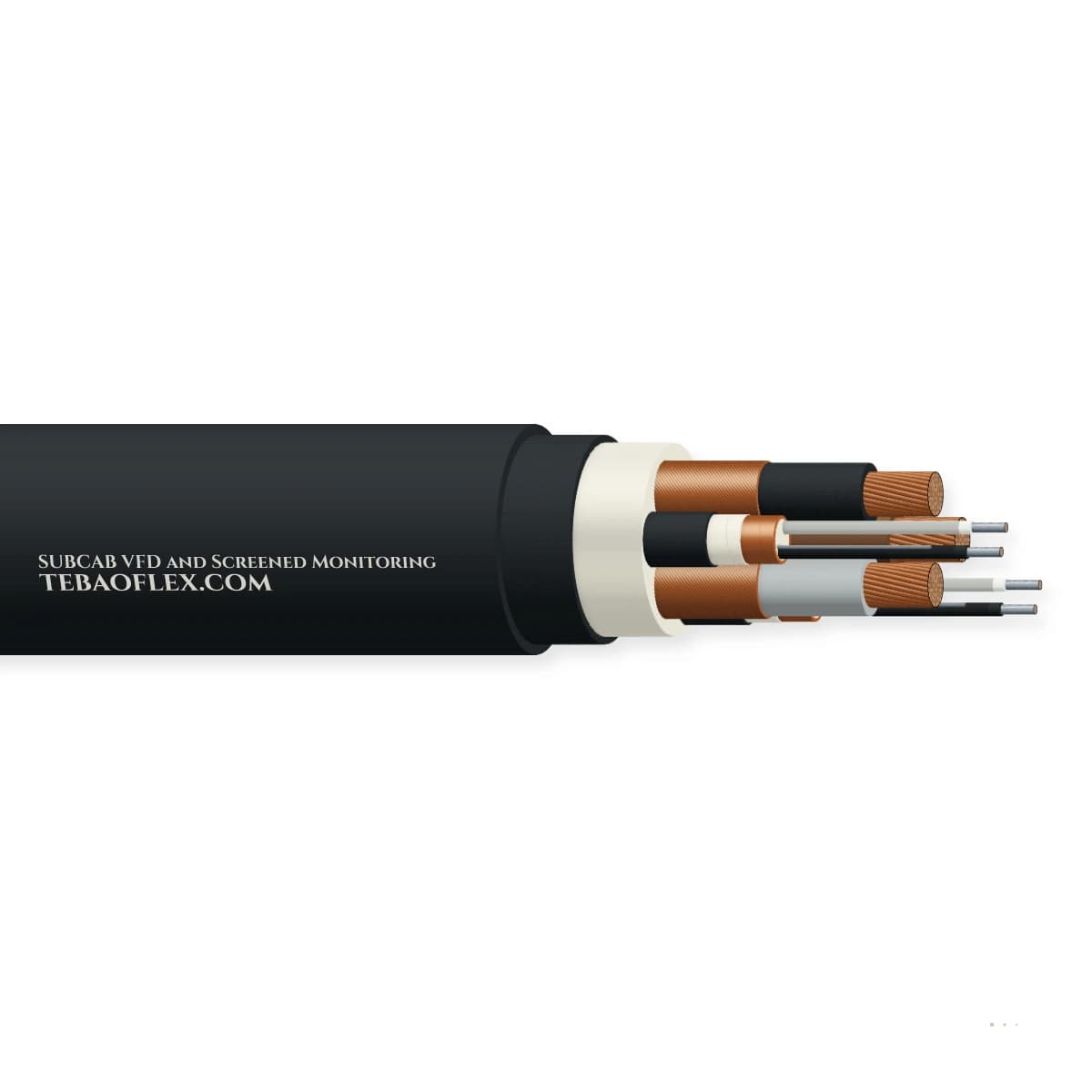
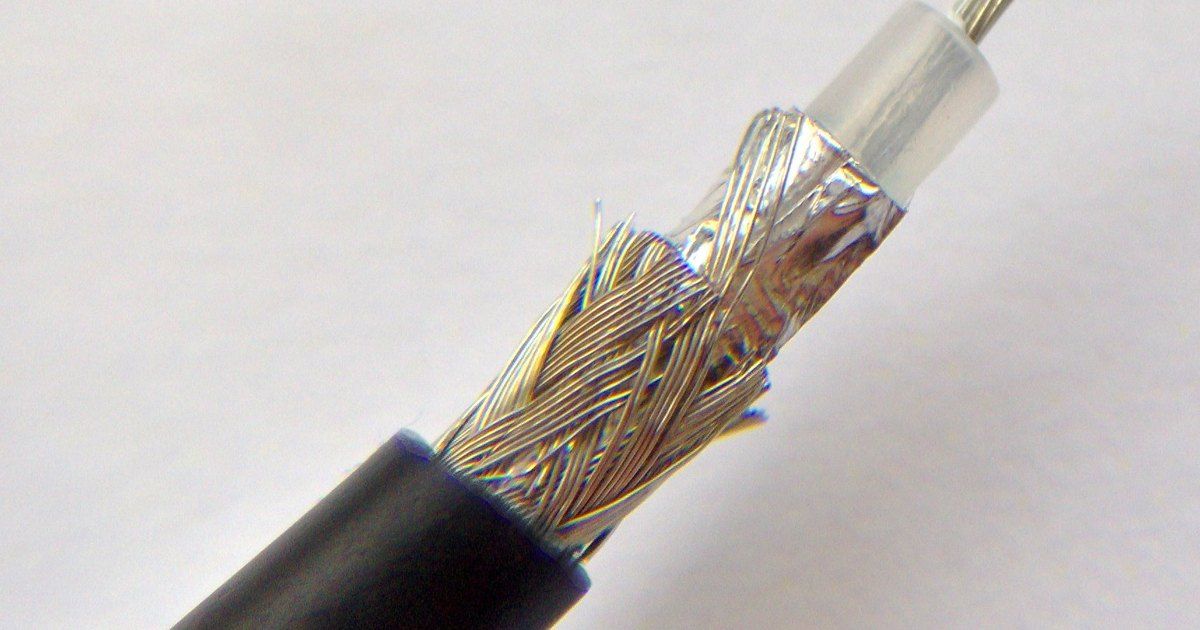
Stepped cutaway of a screened hybrid submersible pump cable isolating sensor pairs from VFD switching noise.
To coordinate earth-fault protection and protect low-voltage monitoring circuits, check three structural elements:
- Split protective-earth cross-section: Verify how total protective-earth area divides across symmetrical interstitial cores. Symmetrical splitting keeps the profile compact enough to fit the entry bore.
- Control-pair screening: Specify twisted monitoring pairs under a tinned-copper wire braid screen with at least 80% to 85% coverage. Confirm the routine AC test voltage on the control cores, such as 1.5 kV for 1 minute or 2.0 kV for 5 minutes.
- Overall metallic braid and 1-second fault rating: State minimum optical coverage, wire count, strand diameter, and the 1-second earth-fault current rating (+90 °C to +250 °C). Multi-screened designs like (N)TSCGECECWÖU 3.6/6 to 12/20 kV cable combine phase screens, screened control cores, and an overall monitoring screen.
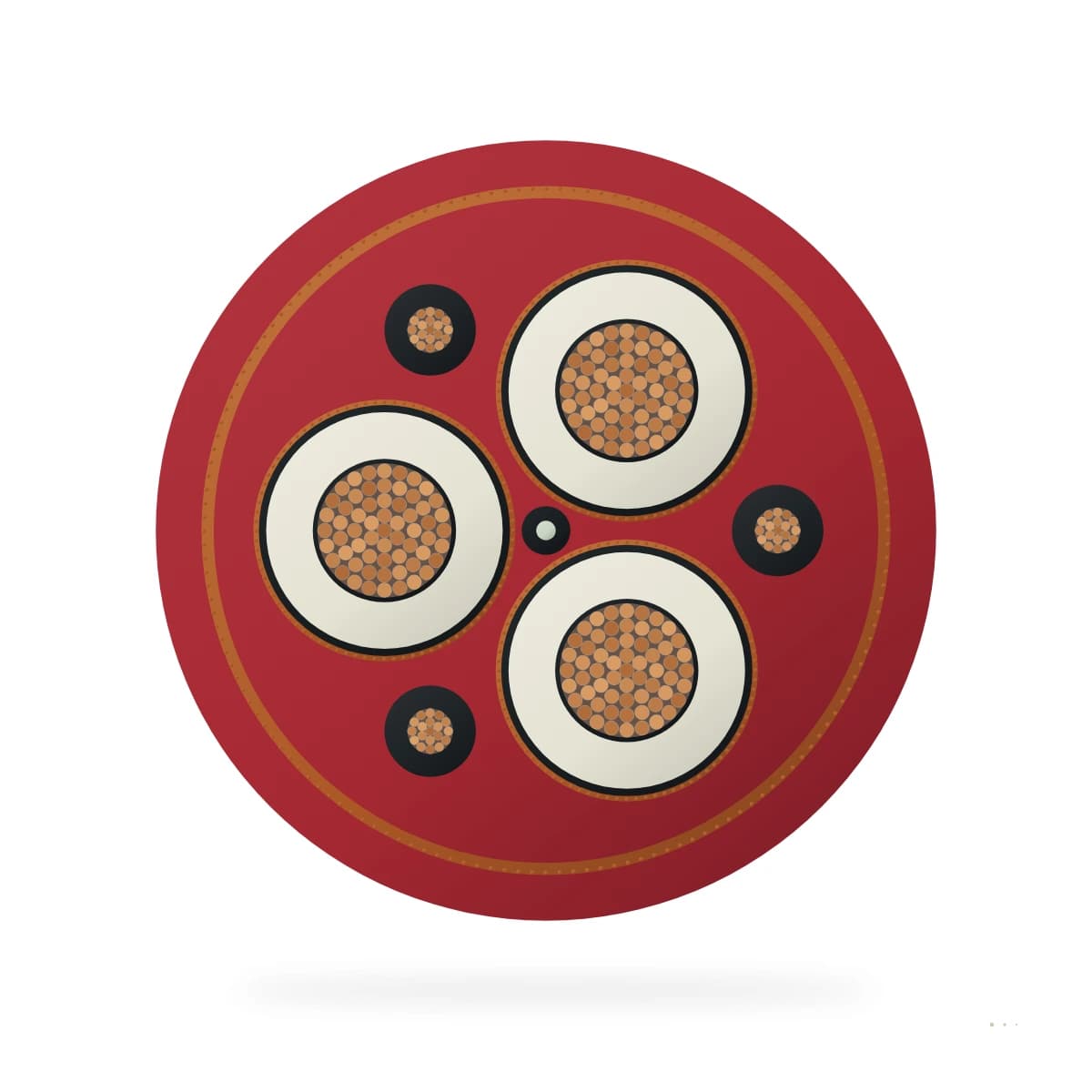
Symmetrical three-phase medium-voltage core layup with screened control elements and double elastomeric sheathing.
VFD du/dt Filter Parameters and Cold-Climate Sheath Limits
Feeding a 3.6/6 kV or 6/10 kV submersible pump motor from a medium-voltage variable-frequency drive (VFD) introduces steep PWM voltage pulses and high-frequency capacitive charging currents. Drive engineers sizing output du/dt filters or sine-wave filters need per-phase cable capacitance (in µF/km) and per-phase inductance (in mH/km) stated explicitly on the cable datasheet. Our VFD cable reflected-wave and dv/dt calculation guide explains how surge impedance and feeder length interact at the motor terminals.
Low-capacitance 3GI3 ethylene-propylene rubber (EPR) insulation limits charging current over long vertical risers and intake runs. Always confirm on the datasheet whether published capacitance and inductance figures are expressed per phase so filter resonant frequencies are modelled accurately.
Cold-climate surface routing matters just as much as submerged water rating. Treatment plants and open-pit pump stations often unreel cables outdoors in sub-zero winter air before lowering the pump into warmer water. Under DIN VDE 0250-813, heavy-duty 5GM3 and 5GM5 polychloroprene sheaths support -25 °C to +90 °C in flexing duty. Fixed installations allow -40 °C to +90 °C, or down to -50 °C on halogen-free PUR variants. Confirm both fixed operating and cold-handling limits to prevent jacket cracking on the reel.
Pre-Shipment Partial Discharge and Water-Immersion FAT
Partial discharge (PD) extinction testing is a non-destructive medium voltage cable test per IEC 60885-3 and IEC 60502-2. It detects microscopic voids or semicon protrusions inside extruded insulation before breakdown occurs. While DIN VDE 0250-813 sets a general limit of 40 pC, submerged pump specifications often tighten acceptance to 20 pC or 10 pC at 1.73 U0.
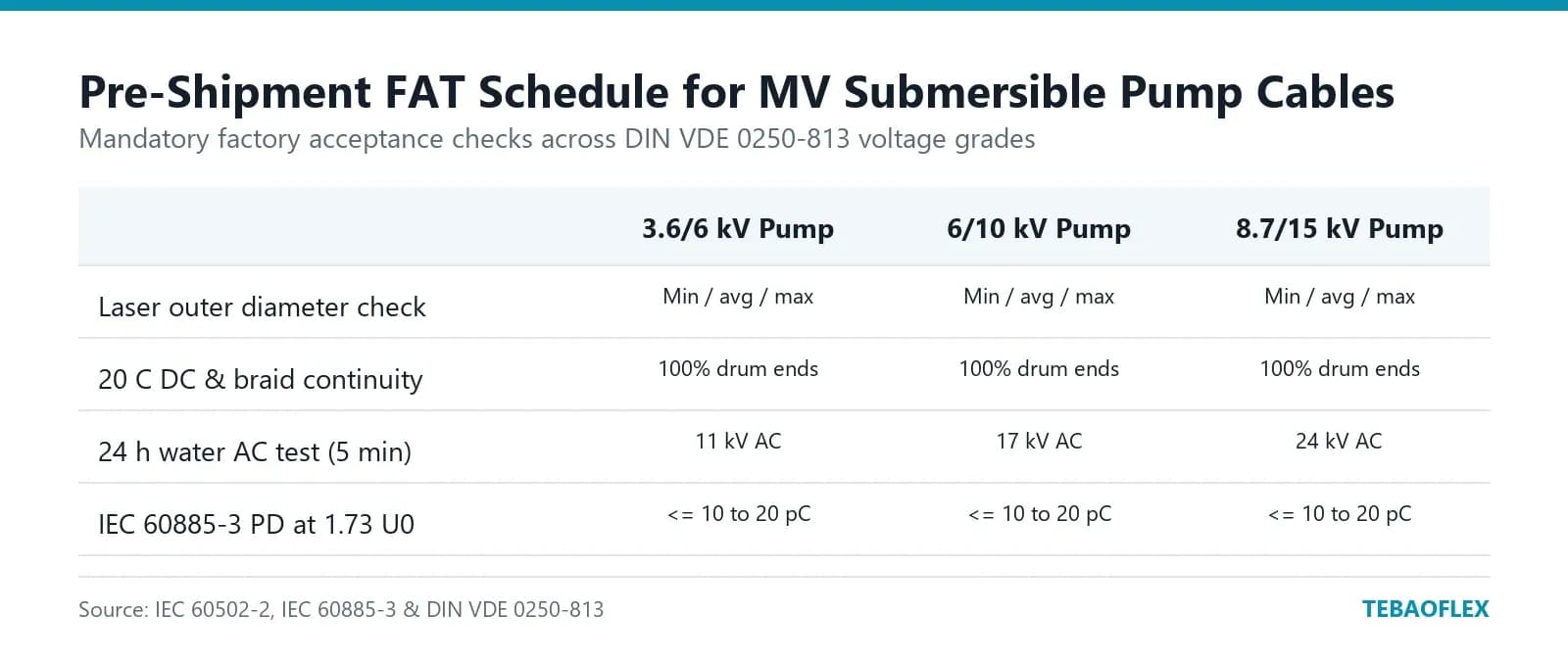
Mandatory pre-shipment FAT checks across 3.6/6 kV, 6/10 kV and 8.7/15 kV submersible pump cables.
FAT test schedule — text version
For each criterion below, values are listed in this order: 3.6/6 kV Pump; 6/10 kV Pump; 8.7/15 kV Pump.
- Laser outer diameter check: Min / avg / max; Min / avg / max; Min / avg / max.
- 20 °C DC & braid continuity: 100% drum ends; 100% drum ends; 100% drum ends.
- 24 h water AC test (5 min): 11 kV AC; 17 kV AC; 24 kV AC.
- IEC 60885-3 PD at 1.73 U0: max. 10 to 20 pC; max. 10 to 20 pC; max. 10 to 20 pC.
Before releasing balance payment on a custom medium-voltage pump cable, require a drum-specific FAT report covering:
- Measured minimum, average, and maximum outside diameters across the finished drum.
- Conductor DC resistance at 20 °C for power cores, split protective earths, and control pairs, plus continuity resistance of both the control-pair screen and overall copper braid.
- 24-hour clean-water immersion followed by a 5-minute AC withstand test with zero breakdown. DIN VDE 0250-813 specifies 11 kV for 3.6/6 kV, 17 kV for 6/10 kV, and 24 kV for 8.7/15 kV cables.
- Partial-discharge measurement at 1.73 U0 confirming apparent charge within the agreed pC ceiling, alongside our mining cable partial-discharge report checklist and AD7/AD8 water-immersion testing guide.
What to Send for a Cable Recommendation
When requesting submersible pump cable specifications and a factory test plan for an OEM pump replacement, share these details with our engineering team:
- Motor rated voltage (U0/U), power (kW), full-load current, and whether a VFD with a du/dt or sine-wave filter drives the pump.
- Exact core make-up: phase cross-section, split earth configuration, and screened or unscreened thermal/leakage sensor pairs.
- Maximum permitted cable outside diameter for the original pump entry grommet, plus continuous joint-free length required.
- Maximum immersion depth, fluid chemistry (clean water, sewage, seawater, or mine slurry), and minimum winter installation temperature.
- Required FAT acceptance limits (AC test voltage, immersion duration, and maximum pC level at 1.73 U0).
Send your pump nameplate or cable schedule via WhatsApp at +86 185 9591 3361 or email info@tebaoflex.com for a verified cross-section drawing and FAT protocol.
Frequently Asked Questions
Why must medium-voltage submersible pump cable hold a strict maximum outside diameter for the pump cable entry grommet?
Submersible pump terminal housings seal against water pressure by compressing a precision rubber grommet around the cable sheath. An oversize cable cannot enter the gland bore without damaging the outer jacket, whereas an undersize cable loses radial sealing force under hydrostatic head. Always specify a hard maximum outside diameter and verify min/avg/max measurements at FAT.
What electrical parameters and screening are required when feeding a medium-voltage submersible pump from a VFD with a du/dt filter?
Drive engineers require per-phase capacitance (µF/km) and per-phase inductance (mH/km) to tune the VFD output du/dt filter and avoid reflected-wave overvoltage. The cable should combine semiconductive stress control layers, a high-coverage tinned-copper overall screen, and a separate tinned-copper braid screen (at least 80% coverage) over twisted sensor pairs to block PWM switching noise.
What partial discharge and water-immersion withstand tests verify a medium-voltage submersible pump cable before shipment?
A complete pre-shipment FAT immerses the finished drum in clean water for 24 hours and applies a 5-minute power-frequency AC voltage test (such as 17 kV AC on 6/10 kV rated cores) with zero breakdown. Partial-discharge testing per IEC 60885-3 at 1.73 U0 then confirms apparent charge stays below the specified 10 pC or 20 pC ceiling.
How are copper braid screen coverage, screen continuity, and one-second earth-fault current specified in medium-voltage pump cables?
Specify minimum optical braid coverage (typically 80% to 85% tinned copper), strand count and wire diameter, and the adiabatic 1-second earth-fault current rating across the +90 °C to +250 °C short-circuit temperature rise. At the factory, technicians strip both drum ends to measure DC loop resistance and verify end-to-end electrical continuity on both the control-pair screen and overall screen.
What minimum operating and installation temperatures apply to rubber outer sheaths on submersible pump cables in cold climates?
Under DIN VDE 0250-813, polychloroprene outer sheaths (Types 5GM3 and 5GM5) typically allow -40 °C to +90 °C in fixed service and -25 °C to +90 °C during flexing. Specialized halogen-free PUR sheaths reach -50 °C in fixed service. State both fixed and cold-handling limits on the datasheet when uncoiling drums outdoors in winter.