A JIS C 3410 cable covers low-voltage shipboard power (0.6/1 kV, such as DPY, TPY, FPY, DPYC, TPYC and HF-DPYC) and control circuits (150/250 V, such as MPYC and HF-MPYCS). When a vessel requires medium-voltage power from 3.6/6 kV up to 18/30 kV, engineers specify radial-field cables to IEC 60092-354 or shore-power reeling cables to IEC/ISO/IEEE 80005-1.
A marine buyer in East Asia recently asked whether we manufacture Japanese standard shipboard cables alongside medium-voltage marine power cables. Japanese shipyards, fleet operators and repair yards frequently combine JIS C 3410 low-voltage hull distribution with IEC 60092 medium-voltage main propulsion or high-voltage shore connection (HVSC) feeders on the same vessel. Knowing how the two standards divide voltage grades and type codes makes technical specification straightforward.
How to Decode a JIS C 3410 Cable Designation
Published through the Japanese Industrial Standards Committee (JISC) and aligned with IEC 60092-353:2024, the JIS C 3410 standard uses a letter code to identify core count, insulation, sheath, armour and screening:
- Prefix HF- or FA- / FR-: HF- denotes a halogen-free, low-smoke shipboard cable using an SHF1 zero-halogen polyolefin outer sheath (tested to IEC 60754 and IEC 61034). FA- indicates bunched flame-retardant construction to IEC 60332-3-22 Category A, and FR- indicates fire-resistant mica-taped circuit integrity.
- Core count letter (S, D, T, F, 5, 6, M): S = single core, D = 2 cores (double), T = 3 cores (triple), and F = 4 cores (four). 5 and 6 denote 5 and 6 cores, while M denotes multi-core control (2 to 60 cores).
- Insulation letter (P): Ethylene-propylene rubber (EPR / HEPR) core insulation rated for a maximum continuous conductor temperature of +90 °C and a short-circuit temperature of +250 °C.
- Inner sheath (Y): Flame-retardant marine PVC bedding/sheath (or halogen-free polyolefin on HF- series).
- Wire braid armour (C): Galvanized steel wire braid armour for mechanical crush, vibration and rodent protection. Single-core AC cables use copper-alloy wire braid to limit eddy-current losses.
- Outer protective sheath (Y) and screen (S): A trailing Y (as in DPYCY, TPYCY or HF-DPYCY) adds an extruded outer sheath over the wire braid armour. A trailing S (as in HF-MPYCS or HF-MPYCYS) adds a lapped copper tape electrostatic screen against electromagnetic interference.

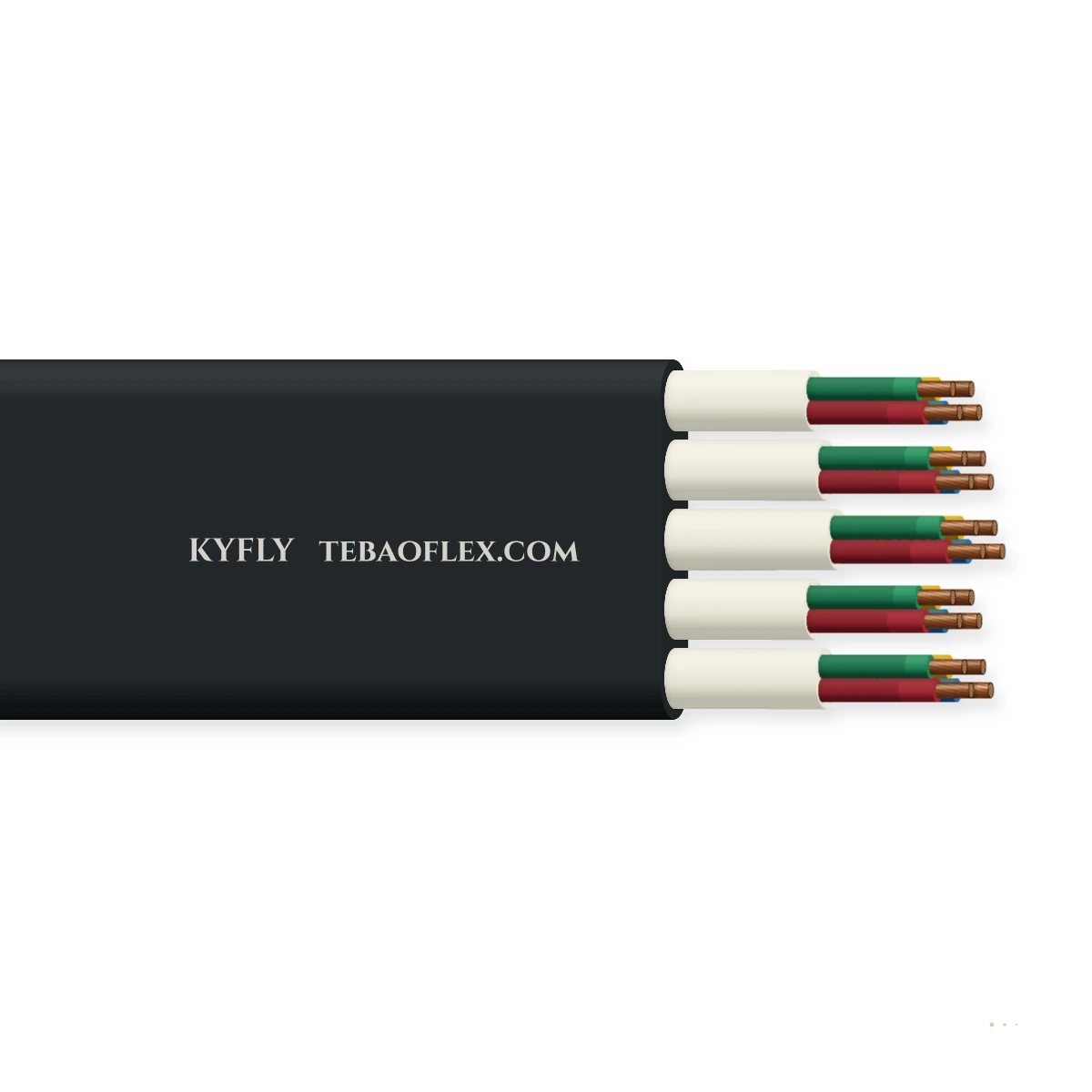
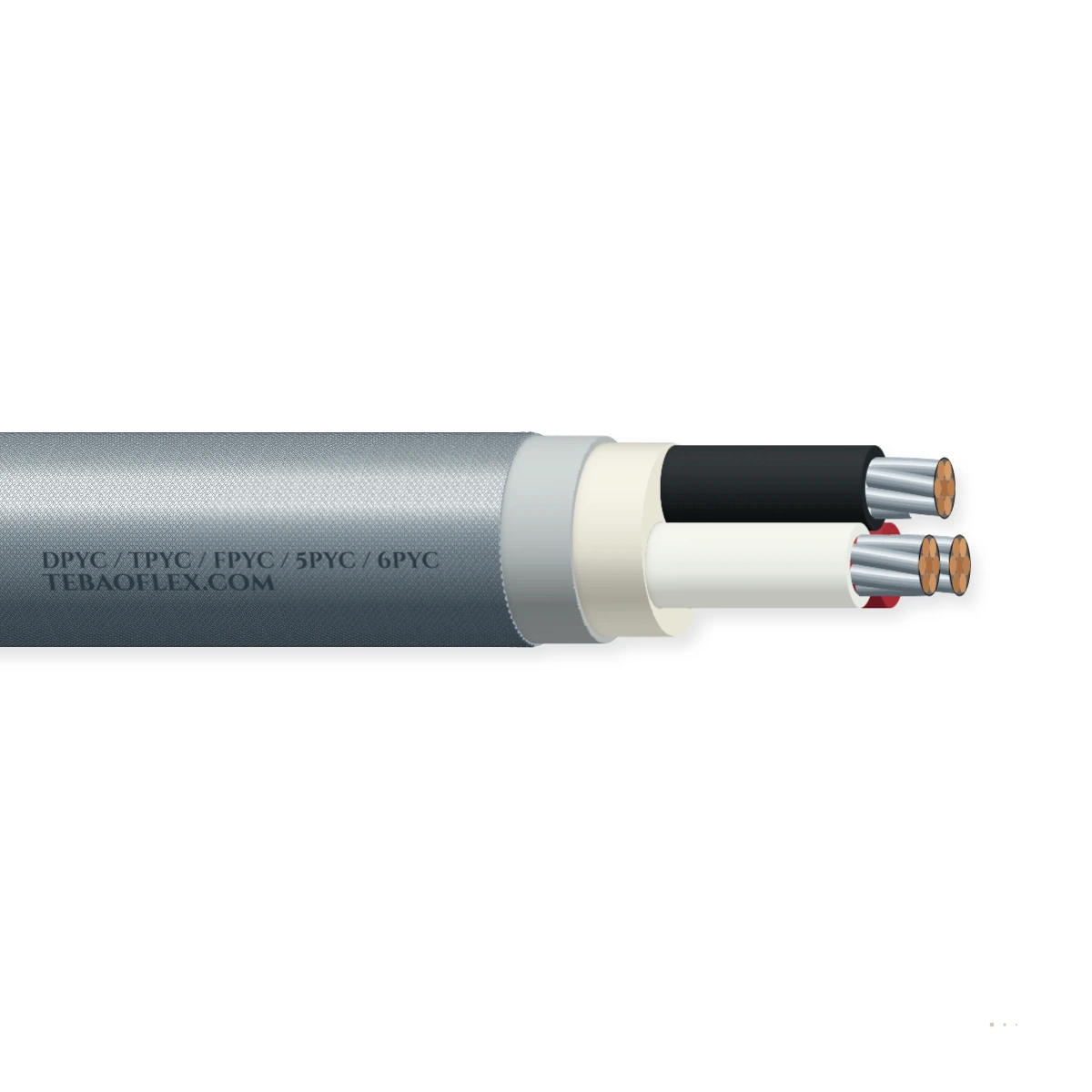
Horizontal cutaway of JIS C 3410 0.6/1 kV DPYC / TPYC / FPYC wire-braid armoured shipboard power cable
Low-Voltage JIS C 3410 Shipboard Families (150/250 V and 0.6/1 kV)
Across engine rooms, pump rooms, accommodation decks and bridge consoles, JIS C 3410 cable types fall into four main product families on tebaoflex.com:
- Unarmoured 0.6/1 kV shipboard power and lighting (DPY / TPY / FPY / 5PY / 6PY): Uses circular stranded annealed copper conductors (JIS C 3410 Class 2), +90 °C EPR insulation and a black flame-retardant PVC sheath for fixed protected runs. Typical ratings include a −25 to +90 °C operating range, a 3,500 V AC 5-minute dielectric test, and a 4 × D to 6 × D fixed bending radius. See DPY / TPY / FPY JIS unarmoured shipboard power cable.
- Wire-braid armoured 0.6/1 kV shipboard power (DPYC / TPYC / FPYC / 5PYC / 6PYC): Adds a galvanized steel or copper wire braid armour with protective anti-corrosive paint (or an oversheath on DPYCY / TPYCY). It is used on engine-room ladders and bulkhead penetrations with a 6 × D fixed bending radius. See DPYC / TPYC / FPYC JIS braid-armoured shipboard cable.
- Halogen-free 0.6/1 kV shipboard power (HF-DPYC / HF-DPYCY / HF-SPYC / HF-TPYC): Combines annealed tinned stranded copper, 90 °C halogen-free EPR/XLPE insulation, wire braid armour, and an SHF1 zero-halogen outer jacket rated from −40 to +90 °C. See HF-DPYC & HF-DPYCY 0.6/1 kV JIS C 3410 halogen-free shipboard cable.
- Halogen-free 150/250 V multi-core control (HF-MPYC / HF-MPYCY / HF-MPYCS / HF-MPYCYS): Provides 2 to 60 number-printed tinned copper control cores (such as 1.0, 1.25, 1.5 or 2.5 mm²). Optional copper tape screening (S) and steel wire braid armour (C) protect shipboard automation and navigation lines. See HF-MPYC & HF-MPYCYS 250 V JIS C 3410 shipboard control cable.

Comparison of JIS C 3410 low-voltage shipboard power and control cables with IEC 60092-354 medium-voltage marine cables
Comparison matrix — text version
For each criterion below, values are listed in this order: DPYC / TPYC / FPYC; HF-DPYC / HF-TPYC; HF-MPYC / MPYCS; IEC 60092-354 MV.
- Governing standard: JIS C 3410; JIS C 3410 / IEC 60092-353; JIS C 3410 / IEC 60092-376; IEC 60092-354.
- Rated voltage U0/U: 0.6/1 kV; 0.6/1 kV; 150/250 V; 3.6/6 to 18/30 kV.
- Halogen-free SHF1 outer sheath: no; yes; yes; yes.
- Wire-braid mechanical armour (C): yes; yes; yes; yes.
- 2 to 60 control & signal cores: no; no; yes; no.
- Medium-voltage propulsion & HVSC: no; no; no; yes.
Medium-Voltage Marine & Shore-Power Cables (3.6/6 kV to 18/30 kV)
JIS C 3410 primarily addresses 150/250 V control and 0.6/1 kV power distribution. For medium-voltage marine switchboards, bow thrusters, electric propulsion drives and shore-power reels, specifications transition to international IEC standards:
- Fixed shipboard and offshore MV power (IEC 60092-354): IEC 60092-354:2020 governs single-core and three-core radial-field shipboard cables for fixed installations. Each core uses extruded conductor and insulation screens, +90 °C EPR or XLPE insulation, and a metallic screen inside a halogen-free SHF1 or elastomeric outer sheath. Standard rated voltages are 3.6/6 (7.2) kV, 6/10 (12) kV, 8.7/15 (17.5) kV, 12/20 (24) kV and 18/30 (36) kV.
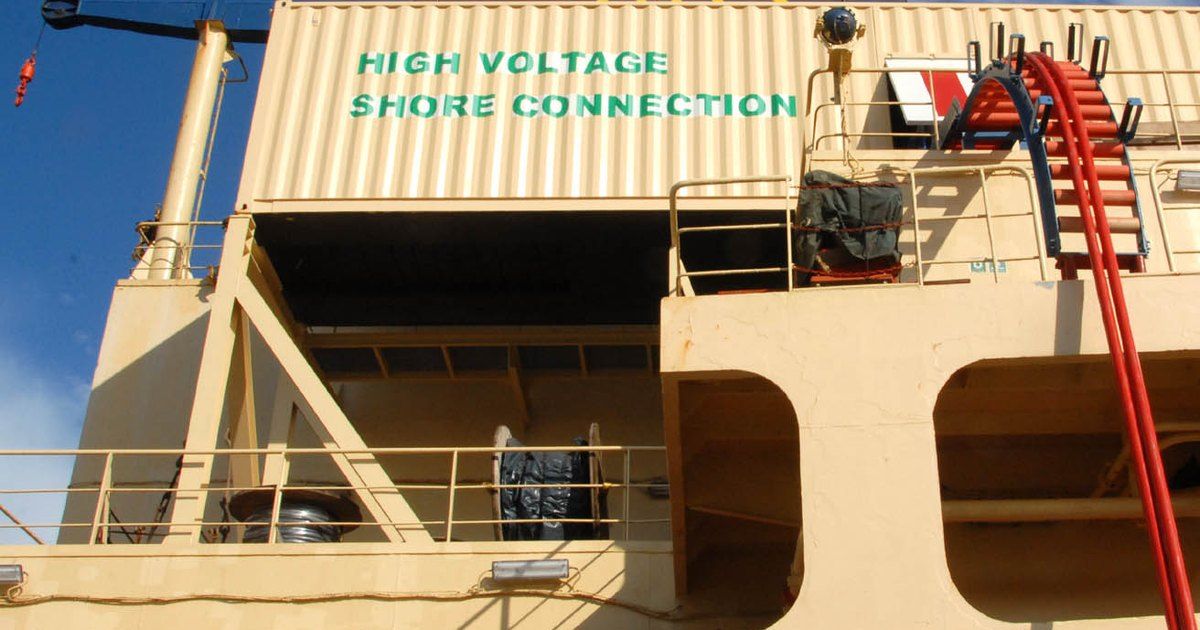
- High-voltage shore connection (HVSC) reeling cables (6/10 kV): When container vessels, cruise ships or LNG carriers connect to quayside shore power under IEC/ISO/IEEE 80005-1, fixed shipboard cables cannot handle dynamic reeling and tidal heave. Instead, specify (N)TSCGEW11Y 6/10 kV shore power cable with fibre optics. It combines three Class 5 tinned copper phase cores (70 to 185 mm², triple-extruded EPR tested at 21 kV AC), two split earths, an 8 × 2.5 mm² screened pilot bundle, 12 OM1 optical fibres, and AD8 submersible 11Y TPU sheaths.
For a complete breakdown of recent edition updates across IEC 60092 and IEC 61892, read Marine and Offshore Cable Standards: An Overview and Shore Power Cables: IEC/IEEE 80005-1 and the 2030 Rules.

Horizontal cutaway of HF-DPYC / HF-DPYCY 0.6/1 kV JIS C 3410 halogen-free shipboard power cable
What to Include in a Marine or Shipboard Cable Inquiry
To match your vessel build or dry-dock retrofit list accurately, include these details when requesting a quotation:
- Standard and type code: State the exact JIS C 3410 code (DPY, TPYC, FPYCY, HF-DPYCY, HF-MPYCYS) or IEC 60092 part (IEC 60092-353 for 0.6/1 kV and 1.8/3 kV; IEC 60092-354 for 3.6/6 kV to 18/30 kV).
- Rated voltage U0/U: Specify 150/250 V, 0.6/1 kV, 3.6/6 kV, 6/10 kV or 8.7/15 kV.
- Core count and cross-section (mm²): Give the number of power or control cores and nominal conductor area.
- Fire and halogen performance: Confirm whether standard PVC (-PYC / -PYCY), bunched flame-retardant (IEC 60332-3-22 Cat. A), low-smoke zero-halogen (HF- / SHF1), or fire-resistant mica-tape (FR- / IEC 60331) is required.
- Fixed vs reeling installation: Indicate fixed bulkhead/tray routing vs quayside HVSC drum reeling.

Selection flow for Japanese JIS C 3410 and IEC 60092 shipboard and shore-power cables
Selection flowchart — text version
- Is the circuit rated above 1 kV (such as 3.6/6 kV, 6/10 kV or 8.7/15 kV)? If yes: Use IEC 60092-354 fixed MV cable or (N)TSCGEW11Y 6/10 kV shore-power reeling cable.
- Is it a 150/250 V multi-core shipboard control or instrumentation circuit? If yes: Choose JIS C 3410 MPYC / MPYCS or halogen-free HF-MPYC / HF-MPYCYS (2 to 60 cores).
- Does the 0.6/1 kV shipboard specification require low-smoke zero-halogen SHF1? If yes: Choose HF-DPYC / HF-TPYC / HF-FPYC (or PVC-sheathed DPYC / TPYC where permitted).
Otherwise: Specify core count (S, D, T, F, M), wire braid armour (C) and protective outer sheath (Y).
Explore our DPYC / TPYC / FPYC JIS braid-armoured shipboard cable, HF-DPYC 0.6/1 kV halogen-free shipboard cable and (N)TSCGEW11Y 6/10 kV shore power cable pages, or contact TEBAOFLEX via WhatsApp at +86 185 9591 3361, email at info@tebaoflex.com, or our contact form.
Frequently Asked Questions
How do JIS C 3410 cable types and IEC 60092 standards divide low- and medium-voltage shipboard power cables?
JIS C 3410 covers Japanese low-voltage shipboard cables, including 0.6/1 kV power cables (such as DPY/TPY/FPY, braid-armoured DPYC/TPYC/FPYC, and halogen-free HF-DPYC/HF-TPYC) and 150/250 V multi-core control cables (MPYC and HF-MPYCYS). Those low-voltage series align with IEC 60092-353 and IEC 60092-376. For medium-voltage marine circuits from 3.6/6 kV up to 18/30 kV, shipbuilders specify radial-field screened power cables under IEC 60092-354 or flexible 6/10 kV HVSC reeling cables under IEC/ISO/IEEE 80005-1.
What do the letters D, T, F, M, P, Y, C and S mean in a JIS C 3410 cable code?
In JIS C 3410, the first letter indicates the core count: S = 1 core, D = 2 cores, T = 3 cores, F = 4 cores, and M = multi-core control (up to 60 cores). P stands for +90 °C ethylene-propylene rubber (EPR) insulation, and the first Y stands for the inner sheath. C denotes braided galvanized steel or copper wire armour, a second Y (as in TPYCY) denotes an outer protective sheath over the armour, and S denotes a copper tape electrostatic screen.
What is the difference between DPYC and HF-DPYCY shipboard cables?
DPYC is a 0.6/1 kV two-core shipboard cable with EPR insulation, a flame-retardant PVC inner sheath, and an exposed painted galvanized steel wire braid armour (C). HF-DPYCY is the low-smoke zero-halogen version (HF-). It replaces PVC with halogen-free compounds and adds an extruded SHF1 zero-halogen polyolefin outer sheath (Y) over the wire braid armour for enclosed vessel spaces.
Why do single-core JIS C 3410 armoured cables (SPYC / HF-SPYC) use copper-alloy braid instead of steel wire braid?
When alternating current flows through a single-core cable, a magnetic field surrounds the conductor. If a magnetic galvanized steel wire braid were used on a single-core AC cable, the alternating magnetic flux would induce heavy eddy currents and hysteresis heating in the armour. Using non-magnetic copper-alloy wire braid on SPYC and HF-SPYC prevents armour overheating while preserving mechanical protection.