

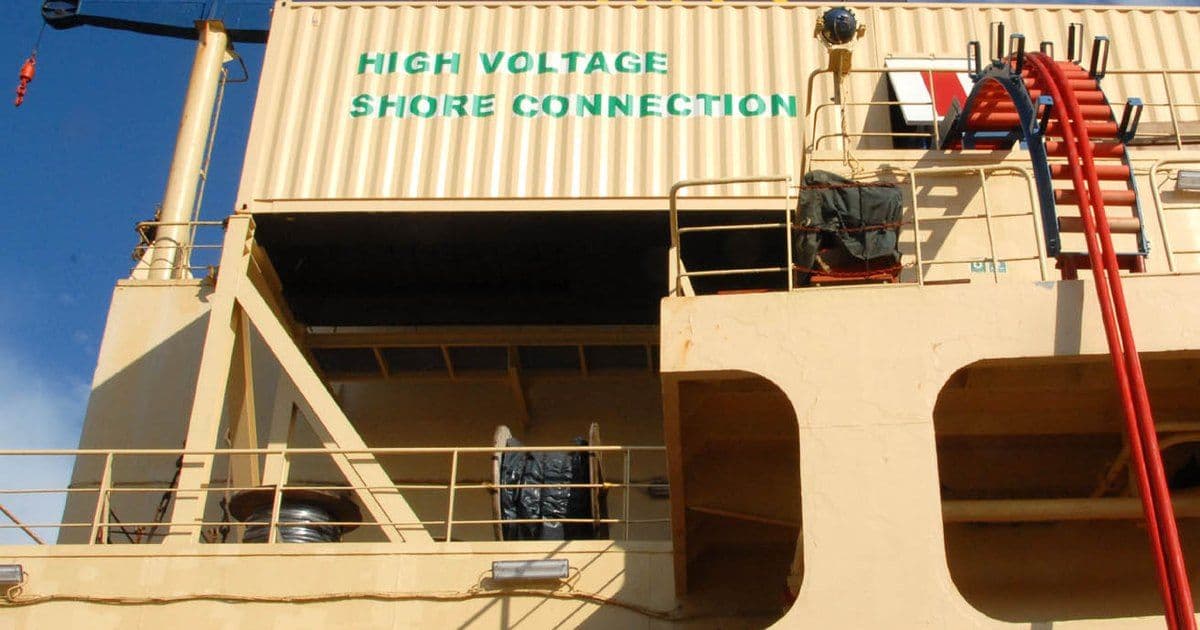
A shore power cable links a ship at berth to the shore grid, so the ship can shut down its generators. IEC/IEEE 80005-1, from the International Electrotechnical Commission (IEC) and the Institute of Electrical and Electronics Engineers (IEEE), covers high-voltage shore connection (HVSC) systems. Its 2019 text calls connecting to shore power during port stays "an increasingly common requirement". It adds that receiving power and other utilities from shore is historically known as "cold ironing".
In the EU, the Alternative Fuels Infrastructure Regulation (AFIR) is Regulation (EU) 2023/1804 (OJ L 234, 22.9.2023). Its Annex II requires shore-side electricity for seagoing ships to meet at least IEC/IEEE 80005-1:2019/AMD1:2022 for high-voltage shore connections. The same annex requires high-voltage plugs, socket-outlets and ship couplers to meet at least IEC 62613-1:2019.
Key Takeaways
- IEC/IEEE 80005-1 sets performance-based cable requirements in its informative Annex A and saw no need, at the time, for a separate shore connection cable standard.
- By 31 December 2029, AFIR Article 9 requires Trans-European Transport Network (TEN-T) maritime ports to supply shore power for at least 90 % of calls in each qualifying container or passenger ship group.
- As of October 2026, FuelEU Maritime requires container and passenger ships above 5 000 gross tonnes at the quayside in AFIR Article 9 ports to connect to shore power from 1 January 2030.
- Low-voltage shore connection is covered by IEC/IEEE 80005-3, Edition 1.0, published on 8 December 2025 for ships needing up to 1 MVA at berth.
- California's At Berth regulation has required per-visit controls for container, reefer and cruise vessels since 1 January 2023 and adds tankers at all regulated terminals on 1 January 2027.
Shore Power at a Glance
Shore connections come in two classes: HVSC under IEC/IEEE 80005-1 and low-voltage shore connection (LVSC) under IEC/IEEE 80005-3. Entries were checked against the linked records on 6 October 2026.
- Topic: Standard and edition — High-voltage shore connection (HVSC): IEC/IEEE 80005-1, Edition 2.0 — Low-voltage shore connection (LVSC): IEC/IEEE 80005-3, Edition 1.0
- Topic: Ships it suits — High-voltage shore connection (HVSC): Expected to suit ships needing 1 MVA or more, or with a high-voltage main supply — Low-voltage shore connection (LVSC): Applies to ships needing up to 1 MVA at berth; excludes inland navigation vessels
- Topic: Voltage or current scope — High-voltage shore connection (HVSC): No range in the scope text; normative reference IEC 60092-503 covers ship AC systems above 1 kV up to and including 15 kV — Low-voltage shore connection (LVSC): Three-phase systems rated 250 A and above, at 400 V AC to 1 000 V AC
- Topic: Plugs and sockets — High-voltage shore connection (HVSC): IEC 62613-1 and IEC 62613-2, up to 12 kV and 500 A — Low-voltage shore connection (LVSC): IEC 60309-5, with an earth contact and four pilot contacts
- Topic: Publication date — High-voltage shore connection (HVSC): 18 March 2019 — Low-voltage shore connection (LVSC): 8 December 2025
The 2019 scope excludes power supply during docking periods, such as dry docking. The European Maritime Safety Agency (EMSA) notes that onshore power supply (OPS) has "already gained decades of experience, particularly with low-voltage supply". Article 3 of FuelEU Maritime, Regulation (EU) 2023/1805 (OJ L 234, 22.9.2023), defines OPS to cover both classes, supplying ships at berth "at low or high voltage, alternate or direct current".
The IEC/IEEE 80005 Family in 2026
Three parts of IEC/IEEE 80005 cover shore power in 2026: Part 1 for HVSC, Part 2 for data communication and Part 3 for LVSC. AFIR cites Part 1 as IEC/IEEE 80005-1:2019/AMD1:2022, a reference that does not name Amendment 2.
Edition 2.0 of March 2019, a triple-logo IEC, ISO and IEEE publication, replaced the first edition of 2012. IEC published Amendment 1 on 2 February 2022 and Amendment 2 on 31 August 2023.
IEEE lists the standard as an "Active Standard", with amendments 80005-1a-2021 and 80005-1b-2023. Its summaries say Amendment 1 centres on phase rotation in the cruise annex, and Amendment 2 adds an Annex G for vehicle carriers. IEEE approved a revision project, P80005-1, on 12 February 2026 to supersede the 2019 edition.
The 2019 contents list shows normative Annexes B, C and D, with added requirements for roll-on roll-off (ro-ro) ships, cruise ships and container ships. Annexes E and F, for liquefied natural gas carriers and tankers, are informative. The 2019 changes to the cruise annex include "all cruise ships shall use 4 cables in all cases".
IEC/IEEE 80005-2, Edition 1.0 of 27 June 2016, covers data communication between shore and ship. IEC/IEEE 80005-3 followed on 8 December 2025 for LVSC. In 2023, interim guidelines from the International Maritime Organization (IMO) said low-voltage procedures should be revised once an international low-voltage standard was published.
Inside a Ship-to-Shore Connection Cable
According to the 2019 contents list, Annex A of IEC/IEEE 80005-1 covers screening, earth conductors, a pilot element rated 150/250 (300) V and optical fibres. It also covers tests on complete cables. Annex A "is considered informative" and "contains performance-based requirements for shore connection cables". IEEE's summary of Amendment 1 says communication requirements, such as fibre optics, should be kept outside 80005-1.
After three IEC committees were consulted, the 2019 text judged existing cable standards usable "at this time", with "no need to develop a separate standard for shore connection cables". Its main body, which applies to all HVSC systems, also has a clause 7.5 titled "Ship-to-shore connection cable". Among the 2019 changes, A.2.1 now says "a metallic shield shall be installed at least on the power cores or common on pilot wires".
Fixed ship wiring is a different duty. IEC 60092-354, Edition 4.0 of 6 February 2020, covers ship power cables from 3.6/6 (7.2) kV to 18/30 (36) kV that "are intended for fixed installations". For marine and offshore cable standards in fixed wiring, see our NEK 606 vs IEEE 1580 comparison.
Our page describes the (N)TSCGEW11Y 6/10 kV shore power cable as an HVSC harbour-grid link for container ships, cruise ships and mobile harbour equipment. Its datasheet lists IEC/ISO/IEEE 80005-1 and DIN VDE 0298-3 and -4 as design references, not certifications, and gives bend radii for free movement and reeling as well as fixed laying. It gives tinned Class 5 copper main cores with triple-extruded ethylene propylene rubber (EPR) insulation between inner and outer semiconductive screens, plus a ground conductor with a semiconductive layer. The datasheet lists eight screened pilot cores with EPR insulation and thermoplastic polyurethane (TPU) inner and outer sheaths.
Plugs, Sockets and Couplers
High-voltage plugs, socket-outlets and ship couplers fall under IEC 62613-1, and the low-voltage side under IEC 60309-5. AFIR defines shore-side electricity supply as power provided "through a standardised fixed or mobile interface" to ships moored at the quayside. IEC 62613-1 Edition 2.0, published on 24 May 2019, covers accessories rated up to 500 A and 12 kV at 50/60 Hz. It also extended the scope to an unlimited number of pilot contacts, "previously limited to 3".
The IEC 62613-1 preview describes these accessories as mainly for outdoor use in a seawater environment, to be connected only to copper or copper alloy cables. Its normative references include IEC 60092-354, and its contents include a clause on flexible cables and their connection.
IEC 62613-2 covers accessories "up to 12 kV, 500 A, 50/60 Hz and with up to seven pilot/auxiliary contacts". For LVSC, IEC 60309-5, Edition 1.0 of 24 January 2017, applies to three-phase accessories "with an earth contact and with four pilot contacts".
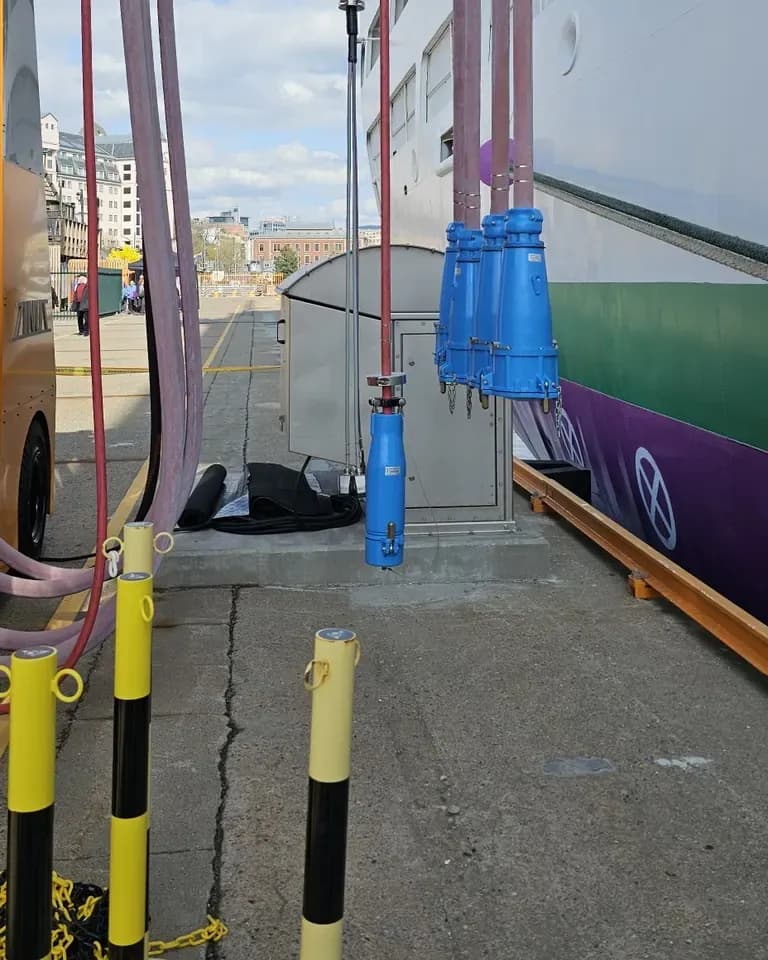
High-voltage shore connection plugs ready to be attached to a ship in the Port of Oslo. Photo: "IEC ISO IEEE 80005-1 plugs ready to be attached to a Ship in the Port of Oslo" by Back ache, CC0, via Wikimedia Commons, cropped.

Cable Management Systems
IMO MSC.1/Circ.1675 defines a cable management system (CMS) as "all the equipment designed to control, monitor and handle the flexible power and control cables and their connection devices". The circular, dated 27 June 2023, gives interim OPS safety guidelines for ships on international voyages.
In the 2019 contents list, clause 7.2 of 80005-1 covers the CMS, with subclauses on monitoring cable tension and cable length, equipotential bond monitoring and slip ring units. A 2019 addition to the container ship annex says "the supply point on shore can be fixed or movable".
At a ship's first call at a shore supply point, IMO's integration tests include a function test of the cable management system; the cable voltage test and the other tests specified in paragraph 2.1.3 apply only when either the ship-side or shore-side installation has been out of service or unused for more than 30 months. During connection, the procedures call for cable monitors that "automatically observe the cable tension and length", adjusting as necessary.
Port cranes use motorised cable reels. Our HVR and HVR-D reeling cable page lists 3.6/6 to 12/20 kV ratings for container cranes and ship unloaders. It gives minimum bend radii of 12, 15 and 20 x D for the reel, deflection pulleys and S-type changes. Our NTSCGEWÖU reeling cable page gives DIN VDE 0250-813 as its basis, and both sit within our reeling cable range.
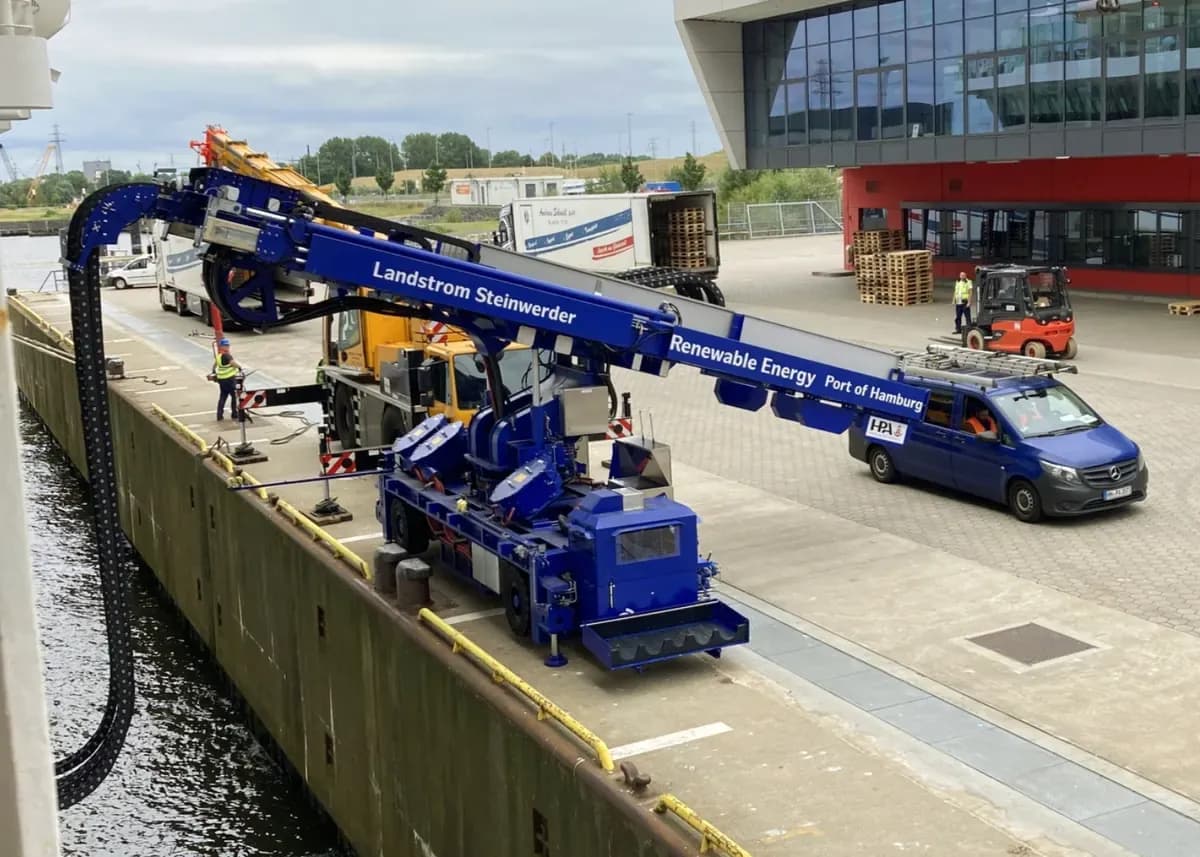
A mobile shore power cable crane at the Steinwerder cruise terminal in Hamburg, with the cable guided in a chain towards the ship. Photo: "Landstrom HH" by Pedemann, CC BY-SA 4.0, via Wikimedia Commons, resized.

Pilot Loops, Fibre Links and Equipotential Bonding
The pilot loop is the HVSC safety circuit, and opening it must trip both the ship and the shore circuit breakers. The 2019 edition of 80005-1 requires that trip "in a maximum time of 200 ms" and sets a minimum safety-circuit current of 50 mA. It also made safety circuits mandatory in all annexes. For container ships, the pilot circuit voltage "shall be less than 60 V DC or 25 V AC".
IMO guidance says an equipotential bonding "between the ship hull and shore grounding electrode should be established". Its connection procedures include a simulation of the "safety circuit pilot loop operation" by both sides, to confirm the appropriate breakers trip. The first-call tests also include an "equipotential bond monitoring test or equivalent".
IEC/IEEE 80005-2 covers the data side, with shore and ship data interfaces and step-by-step procedures for "non-emergency functions". On the cable side, our shore cable's datasheet lists a 12-fibre G62.5/125 OM1 element to IEC 60793-2-10 for communication and data.
EU 2030 Rules: AFIR and FuelEU Maritime
As of October 2026, two EU regulations set the 2030 rules: AFIR requires Member States to equip ports, and FuelEU Maritime requires ships to connect.
AFIR: Shore Power in TEN-T Ports
AFIR has applied since 13 April 2024, and its Article 9(1) covers TEN-T core and comprehensive maritime ports. Where a ship group's annual calls, "averaged over the last three years", exceed its threshold, the port must be equipped by 31 December 2029. It must then be able to supply shore-side electricity for "at least 90 %" of that group's calls.
- Seagoing container ships above 5 000 gross tonnes: more than 100 calls.
- Seagoing ro-ro passenger ships and high-speed passenger craft (HSC), each above 5 000 gross tonnes: more than 40 calls combined.
- Other seagoing passenger ships above 5 000 gross tonnes: more than 25 calls.
Article 9(2) leaves some FuelEU-exempt calls, such as stays under two hours, out of the count. Article 9(3) defers the targets for island, outermost-region, Ceuta and Melilla ports without a mainland or neighbouring grid link, until a link or enough local non-fossil generation exists.
For example, a TEN-T port averaging 80 container and 30 cruise calls a year has no container target. Cruise ships are other passenger ships, so it must be equipped for at least 27 of the 30.
The Commission's review under Article 24, due by 31 December 2026, must assess "a possible decrease of the gross tonnage threshold". The chart compares the call thresholds.

Annual port calls, averaged over the last three years, above which a TEN-T core or comprehensive maritime port must offer shore-side electricity for at least 90 % of calls by that ship group by 31 December 2029: container ships above 5 000 gross tonnes (more than 100 calls), ro-ro passenger ships and high-speed passenger craft above 5 000 gross tonnes (more than 40) and other passenger ships above 5 000 gross tonnes (more than 25). Source: Article 9(1) of Regulation (EU) 2023/1804 (AFIR). Retrieved October 2026.
Chart data (readable on mobile):
- Container ships above 5,000 gross tonnes: more than 100 annual port calls.
- Ro-ro passenger ships and high-speed passenger craft above 5,000 gross tonnes: more than 40 annual port calls combined.
- Other passenger ships above 5,000 gross tonnes: more than 25 annual port calls.
Thresholds use annual calls averaged over the previous three years, subject to Article 9 exclusions. Qualifying TEN-T core and comprehensive maritime ports must provide capacity for at least 90% of calls in the relevant ship group by 31 December 2029. These are port-call thresholds, not electrical power ratings.
FuelEU Maritime: Ships at the Quayside
Article 6 of FuelEU Maritime covers container and passenger ships above 5 000 gross tonnes. From 1 January 2030, those moored at the quayside in ports covered by AFIR Article 9 must connect to OPS and use it for all their electrical power demand at berth. From 1 January 2035, the duty extends to other ports where the quay has available OPS. Member States may also apply it to ports outside Article 9 from 2030.
Article 6(5) exceptions include stays under two hours, zero-emission technologies that meet Annex III and unavailable OPS connection points. An update dated 18 December 2025 on the Commission's FuelEU page says Norwegian and Icelandic ports count as third-country ports until FuelEU is incorporated into the European Economic Area (EEA) Agreement.
California, the US and China
California and China already regulate ships at berth, ahead of the EU's 2030 ship duty. Under the California Air Resources Board (CARB) At Berth regulation, per-visit controls started on 1 January 2023 for container, reefer and cruise vessels. On 1 January 2025, ro-ro vessels followed at all regulated terminals, as did tankers at the ports of Los Angeles and Long Beach. Tankers at all regulated terminals join on 1 January 2027.
Each visit to a regulated terminal must use a CARB Approved Emission Control Strategy (CAECS), unless an exception or alternative compliance option applies. CARB reports that the US Environmental Protection Agency (EPA) authorisation of its 2020 regulation was published in the Federal Register on 20 October 2023. Nationally, the EPA's 2022 update of its shore power assessment counts ten ports using high-voltage systems for cruise, container and reefer vessels.
China's Ministry of Transport rules on shore power for ports and ships took effect on 1 February 2020 and were amended a second time on 13 May 2025. Article 11 applies to ships fitted to receive shore power, except liquid cargo ships. They must use it when berthing for over 3 hours at a coastal berth that can supply it, or over 2 hours at such an inland berth. Military ships, fishing vessels and sports vessels fall outside the rules (Article 33).
Ships that use effective alternative measures are exempt. Article 31 defines these as using electricity, liquefied natural gas (LNG) or other clean energy at berth, or shutting down auxiliary engines. Exceptions also cover temporary faults, mismatched equipment, severe weather and emergencies. Berths able to supply shore power must provide it to these ships.
How to Specify a Shore Power Cable
Specify a shore power cable from the system outward, in the seven checks below.
- System and edition. Name the system standard and edition, such as IEC/IEEE 80005-1:2019/AMD1:2022 or 80005-3 for LVSC, and say whether Amendment 2 of 2023 applies. FuelEU's incompatibility exception, Article 6(5)(f), applies only if the ship's shore-connection installation is certified to AFIR Annex II.
- Ship-type annex. Confirm which 80005-1 annex applies: B (ro-ro), C (cruise) or D (container), or informative E or F for LNG carriers and tankers. Amendment 2 adds Annex G for vehicle carriers.
- Voltage class and cores. Match the rating to the system voltage, then list the power, earth, pilot and fibre elements. Our shore cable's datasheet gives a 6/10 kV rating, a 6.9/12 kV maximum AC voltage and a 21 kV AC test, in configurations from 3x70+2x35/2+1x(8x2.5)C+FO to 3x185+2x95/2+1x(8x2.5)C+FO.
- Plug and socket interface. Name IEC 62613-1 for HVSC or IEC 60309-5 for LVSC. Check the plug's cable entry against the cable diameter, about 66 to 77 mm on our shore cable's datasheet.
- CMS and handling. Give the reel or crane data, cable length and working tension; our reeling cable selection guide covers tension, bend radius and drum derating. Our shore cable's datasheet gives minimum bend radii of 6 x D fixed, 10 x D in free movement and 12 x D on a reel. For the largest configuration, at up to 77 mm across, 12 x D means a reel bend radius of at least 924 mm. The tensile limit is 25 N/mm² per conductor.
- Environment. State immersion, ultraviolet (UV), oil and temperature exposure. Our datasheet rates the shore cable for permanent immersion up to 10 bar (protection class AD8), and lists halogen-free construction with resistance to oil, UV and ozone.
- Tests, documents and jurisdiction. List required tests and documents, and the rules at each port of call, such as AFIR, FuelEU, CARB or China's rules.
Frequently Asked Questions
What is a shore power cable?
A shore power cable is the flexible link that carries electricity from the quay to a ship at berth, so the ship can shut down its generators. For high-voltage systems, Annex A of the 2019 text of IEC/IEEE 80005-1 sets performance-based requirements covering screening, earth conductors and a pilot element.
Is shore power mandatory in the EU from 2030?
Yes, as of October 2026, for container and passenger ships above 5 000 gross tonnes at the quayside in AFIR Article 9 ports. FuelEU Maritime Article 6 requires them to connect to OPS from 1 January 2030, unless an exception applies, such as a stay under two hours. Other quays with available OPS follow from 1 January 2035.
Which standard covers low-voltage shore power?
IEC/IEEE 80005-3 covers it: Edition 1.0 was published on 8 December 2025. It applies to ships needing up to 1 MVA at berth, on three-phase systems of 250 A and above at 400 V AC to 1 000 V AC. The linked accessory standard is IEC 60309-5, for three-phase accessories with an earth contact and four pilot contacts.
What does a cable management system do?
A cable management system controls, monitors and handles the flexible power and control cables and their connectors, as IMO MSC.1/Circ.1675 defines it. IMO's procedures have it observe cable tension and length automatically and adjust as necessary. The 80005-1 contents list also covers slip ring units and equipotential bond monitoring.
Does IEC/IEEE 80005-1 include a cable standard?
No, not as a separate document. Its main body has a clause 7.5 on the ship-to-shore connection cable, and its informative Annex A sets performance-based cable requirements. Fixed ship cables follow standards such as IEC 60092-354, for cables "intended for fixed installations".
What is cold ironing?
Cold ironing is an older name for shore power, the supply of electricity from shore to a ship at berth. The 2019 text of IEC/IEEE 80005-1 gives it as the historical term for receiving power and other utilities from shore. EMSA lists cold ironing and Alternate Marine Power as other common names for onshore power supply.
Enquire About Shore Power Cable
To discuss a project, send our engineering team the system voltage and standard, ship types, plug interface, reel or CMS data and cable length through the contact page. Add pilot and fibre needs, the environment and the rules that apply. For other cables on ships and offshore units, see our marine and offshore cable range.
About the Author
Jyen is a technical and operations engineer at TEBAOFLEX, responsible for the company's online platforms. This guide draws on IEC and IEEE publication records, EU regulations and European Commission and EMSA pages, IMO guidance, CARB, US EPA and China Ministry of Transport documents and TEBAOFLEX product datasheets. The product pages cited are TEBAOFLEX's own; requirements quoted from standards bodies and regulators describe their scope, not certification of our products.
Cover photo: "Port of San Diego Celebrates Shore Power Installation", Port of San Diego (photo: Dale Frost), CC BY 2.0, via Wikimedia Commons, cropped.
