What the video shows
Watch our 68-second (N)SHTOU (CRANE-VS) 4x16 mm2 0.6/1 kV crane reeling cable video: 6-layer DIN VDE 0250-814 cutaway, 4K sample cut, and VDE 0298-4 ampacity.
Watch the 68-second video, then explore the construction views, scene guide and reeling cable information below.
The video illustrates a sample, process, or operating context. Final product construction, suitability, standards, and test acceptance criteria are confirmed against the ordered specification.
By TEBAOFLEX Jyen
PRODUCT VIDEO · Duration: 1:08 (68s) · Page Path: /videos/nshtou-crane-vs-4x16-crane-reeling-cable/.
TL;DR: This 68-second (1:08) product video presents our 0.6/1 kV TEBAOFLEX (N)SHTOU (CRANE-VS) 4x16 mm2 heavy-duty crane reeling cable built to DIN VDE 0250-814 (2026). It pairs schematic 3D crane reel and 6-layer cutaway animations (0:03 to 0:54) with real 4K 60fps sample macro footage (0:00 to 0:03 and 0:54 to 1:02). Four 16 mm2 Class 5 copper cores (IEC 60228, 2026), 3GI3 EPR insulation, and a central rubber cradle sit inside double yellow 5GM3 sheaths (27.2 mm nominal OD). An open polyamide anti-torsion braid (+/-25 deg/m, 20 N/mm2 pull per DIN VDE 0250-814, 2026) supports reeling up to 120 m/min.
On rail-mounted gantry cranes, portal cranes, and container handling reels, flexible power cables face constant axial tension and reverse S-bending over guide rollers. This video page examines our 0.6/1 kV (N)SHTOU (CRANE-VS) 4x16 mm2 cable through a 68-second 1080p walkthrough, a 6-layer structural strip-back, and real 4K 60fps bench inspection footage. Below, you can watch the full video, check the scene-by-scene log, review DIN VDE 0298-4 reel derating curves, and use our crane cable selection checklist. This technical video page was reviewed by the TEBAOFLEX editorial engineering board.
What Happens in Each Scene of the 68-Second Product Video?
The 68-second video combines two distinct visual formats so engineers can verify both system kinematics and real physical build quality. First, it shows real physical production sample 4K 60fps macro footage (0:00 to 0:03 and 0:54 to 1:02). Second, it shows schematic 3D crane reel and 6-layer CAD cutaway animations (0:03 to 0:54 and 1:02 to 1:08). The table below logs every scene by timestamp.
Timestamp
0:00 - 0:03
- Video Scene & Visual Mode: Opening Cover Card (Real sample + reel backdrop).
- Key Technical Details Shown on Screen: Shows a real yellow sample printed
TEBAOFLEX (N)SHTOU (CRANE-VS) 0.6/1kV 4x16mm2 VDE 0250-814 Cand aREAL 4x16 mm2 CROSS-SECTIONinset over a monospiral reel.
0:03 - 0:08
- Video Scene & Visual Mode: 01 / Cross-Section & Model Reveal (Schematic 2D/3D).
- Key Technical Details Shown on Screen: Displays the 4-core layout (brown, black, grey, green/yellow PE) around the central support core and rotates the stepped 3D model.
0:08 - 0:12
- Video Scene & Visual Mode: 02 / Crane Reeling Overview: Shot A (Schematic 3D).
- Key Technical Details Shown on Screen: Shows the yellow
(N)SHTOU (CRANE-VS)cable feeding0.6/1 kVpower along a gantry crane runway trench at 120 m/min (20 N/mm2load).
0:12 - 0:15
- Video Scene & Visual Mode: 02 / Trench Pit to Reel: Shot B (Schematic 3D).
- Key Technical Details Shown on Screen: Labels the
FIXED GROUND POWER FEED (Center Trench Power Junction Pit)andMOVING CRANE REELING DRUM (Motorized Monospiral Crane Reel).
0:15 - 0:18
- Video Scene & Visual Mode: 02 / Dynamic Reeling Cycle: Shot C (Schematic 3D).
- Key Technical Details Shown on Screen: Shows
CRANE RETURNING LEFT · DRUM TAKING UP CABLE UNDER TENSIONwith synchronized spiral winding.
0:18 - 0:21
- Video Scene & Visual Mode: 02 / Guide Roller Torsion Zone: Shot D (Schematic 3D).
- Key Technical Details Shown on Screen: Zooms into the deflection roller zone, showing how the polyamide braid resists twisting (
+/-25 deg/m,R >= 6 x D).
0:21 - 0:40
- Video Scene & Visual Mode: 03 / 6-Layer Strip-Back (06 to 01) (3D CAD cutaway).
- Key Technical Details Shown on Screen: Strips back
06 5GM3 Outer Sheath,05 Polyamide Braid,04 5GM3 Inner Sheath,03 Central Core,02 3GI3 EPR, and01 Class 5 Copper.
0:40 - 0:48
- Video Scene & Visual Mode: 04 / 3D & 2D Construction Summary (Schematic 3D/2D).
- Key Technical Details Shown on Screen: Combines all 6 numbered layer callouts (
01 to 06), a4x16 CROSS-SECTION REFERENCEinset, and a 6-column spec bar (+90 deg Cconductor).
0:48 - 0:54
- Video Scene & Visual Mode: 05 / Key Technical Specifications (Engineering card).
- Key Technical Details Shown on Screen: Summarizes
0.6/1 kV AC(3,500 V ACtest),4x16 mm2 Cu,+/-25 deg/m 20 N/mm2,120 m/min,-25 deg C to +80 deg C, and27.2 mm Nom. OD.
0:54 - 0:58
- Video Scene & Visual Mode: 06 / Real Sample End-Face (01 of 02) (Real 4K 60fps macro).
- Key Technical Details Shown on Screen: Inspects the razor-cut
4x16 mm2sample end-face, showing 4 Class 5 copper cores,3GI3EPR insulation, center cradle, and double yellow5GM3sheath.
0:58 - 1:02
- Video Scene & Visual Mode: 06 / Real Sample Body (02 of 02) (Real 4K 60fps macro).
- Key Technical Details Shown on Screen: Pans vertically along the upright
27.2 mmnominal OD yellow5GM3rubber specimen on our TEBAOFLEX inspection mat.
1:02 - 1:08
- Video Scene & Visual Mode: Closing Brand Card (Graphic summary card).
- Key Technical Details Shown on Screen: Displays
Jiangsu Tebaoflex Special Cable Co., Ltd.contact details (tebaoflex.com,info@tebaoflex.com,+86 185 9591 3361).
Video Scope Note: The gantry crane runway, motorized monospiral reel, deflection guide rollers, and 6-layer strip-back animations (0:03 to 0:54) are schematic engineering views, not site footage, and are not to scale. Real physical production sample 4K 60fps macro footage appears at 0:00 to 0:03 and 0:54 to 1:02. No live high-voltage laboratory benches appear in this clip; all electrical and mechanical values represent official design ratings under DIN VDE 0250-814, IEC 60228, and DIN VDE 0298-4.
Case at a Glance: Video & Sample Technical Summary.
The table below lists the verified specifications shown in the video and defined by DIN VDE 0250-814 (2026).
Parameter
Commercial Model.
- Verified Video & Standard Specification:
TEBAOFLEX (N)SHTOU (CRANE-VS) 4x16 mm2(product family range3G1.5 to 4G120).
Reference Standards.
- Verified Video & Standard Specification: DIN VDE 0250-814, IEC 60228 Class 5, DIN EN 50363-2-1.
Rated & Test Voltage.
- Verified Video & Standard Specification:
U0/U = 0.6/1 kV AC(max operating1.2 kV AC); routine dielectric test 3,500 V AC (DIN VDE 0250-814, 2026).
Conductor Construction.
- Verified Video & Standard Specification: 4 x 16 mm2 Class 5 fine-stranded copper (
1.21 Ohm/kmplain /1.24 Ohm/kmtinned max at 20 deg C per IEC 60228, 2026).
Core Insulation & Colors.
- Verified Video & Standard Specification:
3GI3cross-linked EPR compound (DIN VDE 0207-20); 4-core color code (brown, black, grey, green/yellow PE).
Core Cradle & Inner Sheath.
- Verified Video & Standard Specification: Central elastomeric support cradle + extruded
5GM3yellow polychloroprene rubber inner sheath.
Anti-Torsion Braid.
- Verified Video & Standard Specification: Integrated open high-tenacity polyamide braid rated for +/-25 deg/m twist and 20 N/mm2 dynamic pull (
1,280 Ntotal).
Outer Sheath & Diameter.
- Verified Video & Standard Specification: Heavy-duty
5GM3yellow rubber (DIN VDE 0207-21); 27.2 mm nominal OD (25.1 to 29.1 mmtolerance).
Speed, Bend Radius & Temp.
- Verified Video & Standard Specification: Up to 120 m/min reeling speed;
R >= 6 x D(163.2 mm);-25 deg C to +80 deg Cflexing (-40 deg Cfixed,+90 deg Cconductor).
How Does the Video Illustrate Motorized Gantry Crane Reeling Duty?
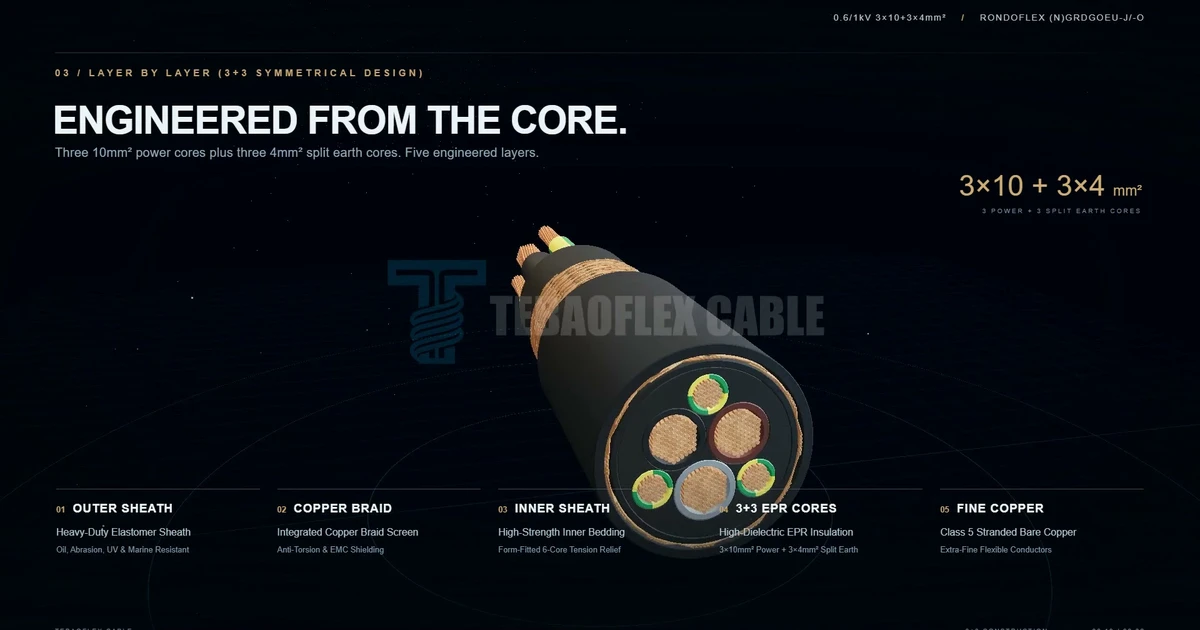
An (N)SHTOU (CRANE-VS) crane reeling cable is a 0.6/1 kV heavy-duty flexible rubber power cable built to DIN VDE 0250-814 that integrates an open polyamide anti-torsion braid between double vulcanized 5GM3 rubber sheaths for motorized crane reels.
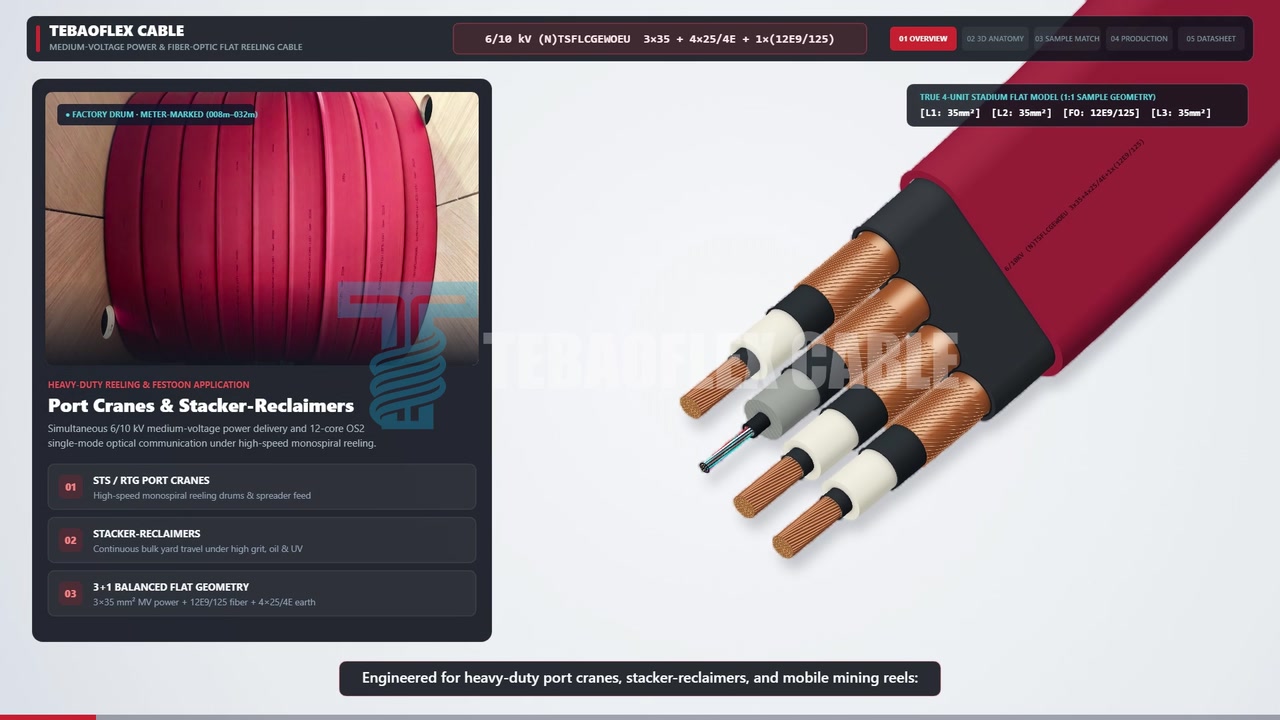
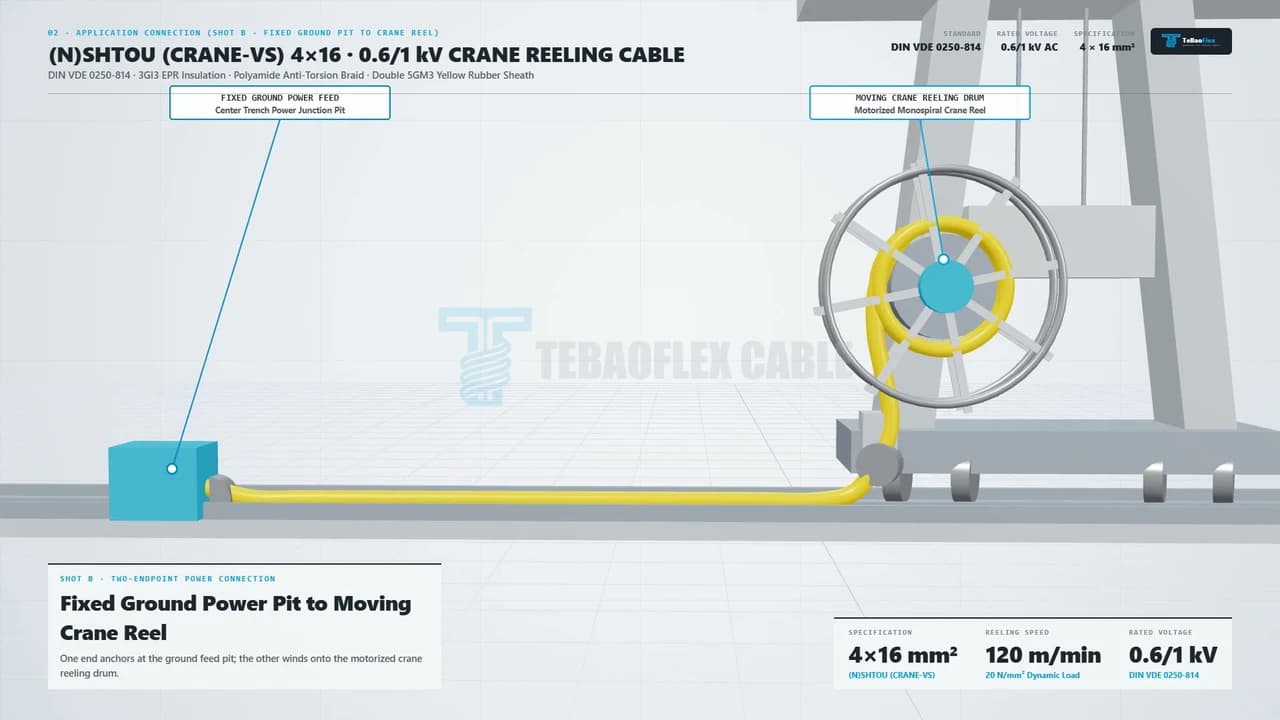
In Section 02 (0:08 to 0:21), a four-shot 3D animation shows how our 4x16 mm2 (N)SHTOU (CRANE-VS) cable works along a gantry crane runway trench.
- High-Visibility Trench Feed (
0:08 to 0:12). First, the bright yellow5GM3jacket stands out clearly against dark steel crane girders and concrete runway slots. This visual contrast helps yard drivers spot the moving cable during night shifts. - Center Pit to Monospiral Reel (
0:12 to 0:15). Second, power enters from theFIXED GROUND POWER FEED (Center Trench Power Junction Pit)and rises to theMOVING CRANE REELING DRUM (Motorized Monospiral Crane Reel). - Synchronized Pay-Out and Tensioned Take-Up (
0:15 to 0:18). Third, as the crane travels at up to 120 m/min (DIN VDE 0298-3, 2026), the torque-controlled reel keeps pulling stress below 20 N/mm2 (1,280 Nacross64 mm2of copper). - Deflection Guide Roller & Torsion Zone (
0:18 to 0:21). Finally, as shown below, the cable bends over deflection guide rollers (R >= 6 x D) where reverse S-bending and axial twisting (+/-25 deg/m) peak simultaneously.
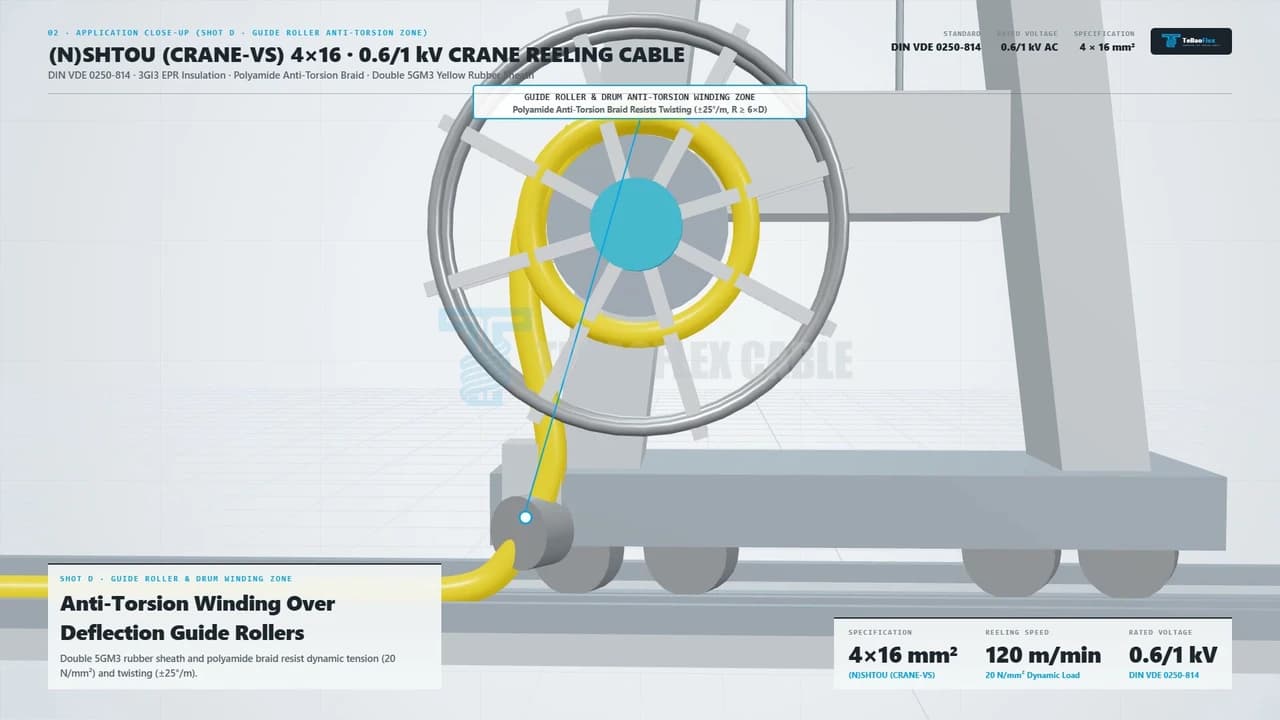
A motorized monospiral crane reel is an automated cable drum on a traveling crane portal that winds flexible power cable in a single vertical spiral plane between a ground pit and the crane drive bay.
For example, when an unreinforced single-sheath rubber cable passes over deflection rollers at 120 m/min, its inner cores slip inside the jacket and form permanent corkscrew twists. To compare our full range of crane reeling and festoon cables, see our reeling cable product hub, our festoon cable category page, and our port crane cable solutions.
How Does the 6-Layer DIN VDE 0250-814 Architecture Prevent Corkscrewing?
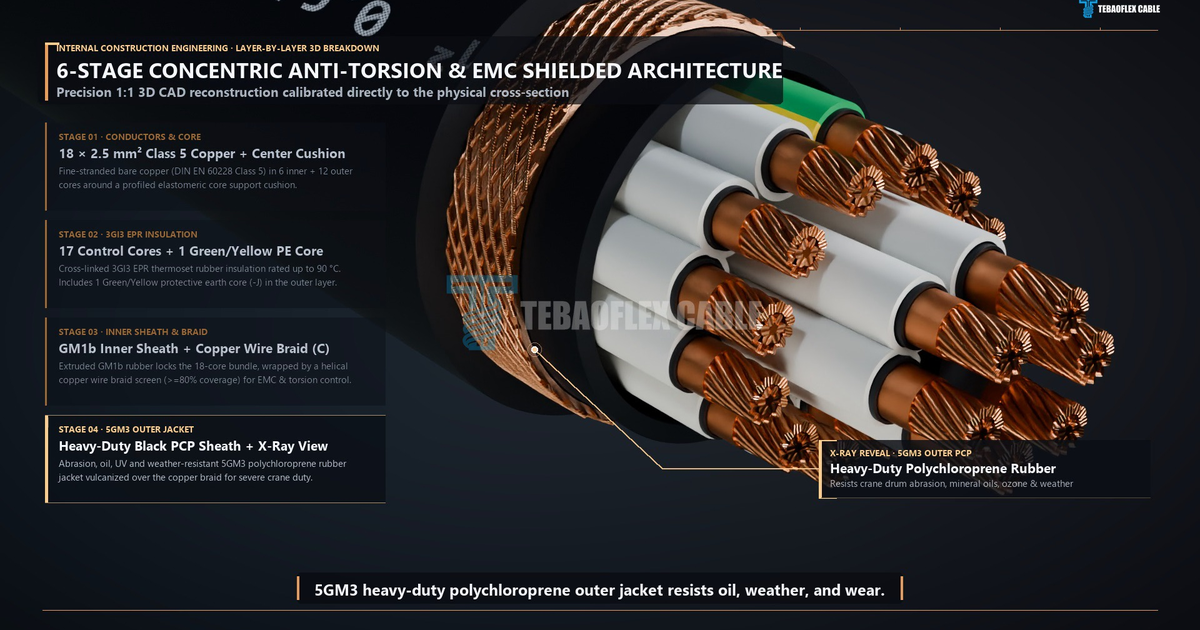
In Section 03 (0:21 to 0:40) and Section 04 (0:40 to 0:48), the video strips the (N)SHTOU (CRANE-VS) 4x16 mm2 cable from its outer surface (Layer 06) down to its copper conductors (Layer 01).
DIN VDE 0250-814 is the German VDE standard governing EPR-insulated, dual-sheathed flexible rubber reeling and festoon cables engineered for high mechanical stress on cranes and material-handling equipment (VDE Verlag, 2026).
You can browse related German rubber cable specifications in our VDE / DIN cable standards catalog.
Layer 06 & Layer 05: 5GM3 Heavy-Duty Yellow Outer Sheath & Open Polyamide Braid (0:21 to 0:27).
5GM3 polychloroprene (PCP) is a heavy-duty synthetic rubber sheath compound defined in DIN VDE 0207-21 and DIN EN 50363-2-1 that resists drum abrasion, mineral oils (IEC 60811-404), UV weather, and flame spread (IEC 60332-1-2).
Immediately inside Layer 06 sits Layer 05, an open high-tenacity polyamide anti-torsion braid. It resists axial twisting up to +/-25 deg/m and absorbs 20 N/mm2 of dynamic pulling load (1,280 N total across 4 x 16 mm2 copper per DIN VDE 0250-814, 2026).

Layer 04 & Layer 03: 5GM3 Yellow Inner Sheath & Central Elastomeric Support Core (0:27 to 0:33).
Underneath the polyamide braid, we extrude Layer 04, a pressure-vulcanized 5GM3 yellow rubber inner sheath that locks the four 16 mm2 cores into a compact round bundle. At the center of the four cores sits Layer 03, a central elastomeric support cradle. When the cable pulls tight over deflection sheaves at 1,280 N, radial crushing forces press the four cores inward. The central rubber cradle supports the inner valleys so the cable keeps its concentric 27.2 mm round profile.

Layer 02 & Layer 01: Smooth 3GI3 EPR Insulation & 4 x 16 mm2 Class 5 Copper (0:33 to 0:40).
3GI3 ethylene propylene rubber (EPR) is a cross-linked thermoset dielectric compound defined in DIN VDE 0207-20 and DIN EN 50363-1 rated for 90 deg C continuous conductor operation and 250 deg C short-circuit heat (DIN VDE 0250-814, 2026).
Core identification follows DIN VDE 0293-308 (brown, black, grey, and green/yellow PE). Inside each core, Layer 01 uses four 16 mm2 Class 5 fine-stranded copper conductors per IEC 60228 (max strand diameter 0.41 mm).
Engineering Note on Plain vs. Tinned Copper in the Video: Viewers inspecting the video will notice that the cover (0:01) and real sample end-face (0:55) show tinned Class 5 copper strands (TINNED COPPER). By contrast, the 3D CAD cutaway (0:37 to 0:47) renders bare copper color (Class 5 Copper Conductors). Under IEC 60228 (2026), both plain copper (1.21 Ohm/km max at 20 deg C) and tinned copper (1.24 Ohm/km max at 20 deg C) are compliant. We supply tinned copper for coastal ports and high-humidity yards, and plain or tinned copper to order for inland gantry cranes.

Layer No.
Layer 01.
- Structural Component: Power & PE Conductors (
4 x 16 mm2). - Compound / Standard Code: Class 5 plain or tinned copper (IEC 60228).
- Primary Mechanical & Electrical Function: Carries three-phase
0.6/1 kVcrane drive power plus protective earth with low bending stiffness.
Layer 02.
- Structural Component: Core Insulation (
Brown, Black, Grey, G/Y). - Compound / Standard Code: Cross-linked EPR compound
3GI3(DIN VDE 0207-20). - Primary Mechanical & Electrical Function: Withstands 3,500 V AC routine test voltage and +90 deg C continuous conductor heat.
Layer 03.
- Structural Component: Central Core Cradle.
- Compound / Standard Code: Elastomeric central support profile.
- Primary Mechanical & Electrical Function: Fills the center valley between the 4 cores to prevent pinching under radial drum crushing loads.
Layer 04.
- Structural Component: Extruded Inner Jacket.
- Compound / Standard Code: Heavy-duty polychloroprene
5GM3(DIN VDE 0207-21). - Primary Mechanical & Electrical Function: Forms a solid circular mechanical bedding around the four
16 mm2cores.
Layer 05.
- Structural Component: Anti-Torsion Reinforcement.
- Compound / Standard Code: Open polyamide braid (
+/-25 deg/m,20 N/mm2). - Primary Mechanical & Electrical Function: Counteracts axial twisting over guide rollers and absorbs 1,280 N dynamic reeling pull.
Layer 06.
- Structural Component: Heavy-Duty Outer Jacket.
- Compound / Standard Code: High-visibility yellow
5GM3rubber (DIN VDE 0207-21). - Primary Mechanical & Electrical Function: Protects against oil, crane track abrasion, UV weather, and flame spread (27.2 mm nominal OD).
For applications requiring copper-screened EMC reeling cables or flat festoon cables, compare our NGFLCGOEU screened flat festoon cable, NGFLGOEU rubber flat festoon cable, and PUR-C-HF EMC shielded festoon cable.
What Key Technical Specifications Are Confirmed at 0:48 to 0:54?
In Section 05 (0:48 to 0:54), the video summarizes the six governing design ratings for (N)SHTOU (CRANE-VS) 4x16 mm2.

[UNIQUE INSIGHT] When sizing monospiral crane reels, mechanical engineers must check both the nominal outer diameter (27.2 mm) and the tolerance window (25.1 to 29.1 mm) shown in Panel 06 at 0:49 (DIN VDE 0250-814, 2026). On a monospiral drum, radial flanges keep every turn stacked in a single vertical plane. Machining the flange gap solely for 27.2 mm without clearing the 29.1 mm upper limit causes the yellow 5GM3 jacket to wedge against the drum cheeks. However, a gap wider than 1.5 x D_min (37.6 mm) lets adjacent turns slip sideways and jam. Therefore, we recommend a clear monospiral flange spacing of 30.5 to 33.0 mm and an M40 compression gland (22 to 32 mm clamping range).
Spec Panel (0:49)
01 / RATED VOLTAGE.
- Rated Value on Screen: 0.6/1 kV AC (
3,500 V ACtest). - Engineering & Design Significance: Rated for
600/1,000 Vsystems (1.2 kVmax operating), verified by a 3.5 kV AC 5-minute routine dielectric test.
02 / CONDUCTOR SPEC.
- Rated Value on Screen: 4x16 mm2 Cu (
Class 5IEC 60228). - Engineering & Design Significance: Four equal
16 mm2cores (3 phase + 1 green/yellow PE), giving 64 mm2 total copper area.
03 / ANTI-TORSION BRAID.
- Rated Value on Screen: +/-25 deg/m, 20 N/mm2.
- Engineering & Design Significance: Allowing
20 N/mm2across64 mm2of copper gives 1,280 N (~130 kgf) max dynamic pulling tension.
04 / REELING SPEED.
- Rated Value on Screen: 120 m/min (
R >= 6 x D). - Engineering & Design Significance: Supports travel up to
120 m/min(2.0 m/s) over sheaves and drums with a minimum radius of 163.2 mm (6 x 27.2 mm).
05 / OPERATING TEMP.
- Rated Value on Screen: -25 deg C to +80 deg C flexing.
- Engineering & Design Significance: Stays flexible down to
-25 deg Cin motion (-40 deg Cfixed) while3GI3EPR supports +90 deg C conductor heat.
06 / OUTER DIAMETER.
- Rated Value on Screen: 27.2 mm Nom. (
25.1-29.1 mmOD). - Engineering & Design Significance: Guides
M40cable gland selection and monospiral drum flange gap design (30.5 to 33.0 mm clear width).
What Does the Real 4K 60fps Sample Footage Verify at 0:54 to 1:02?
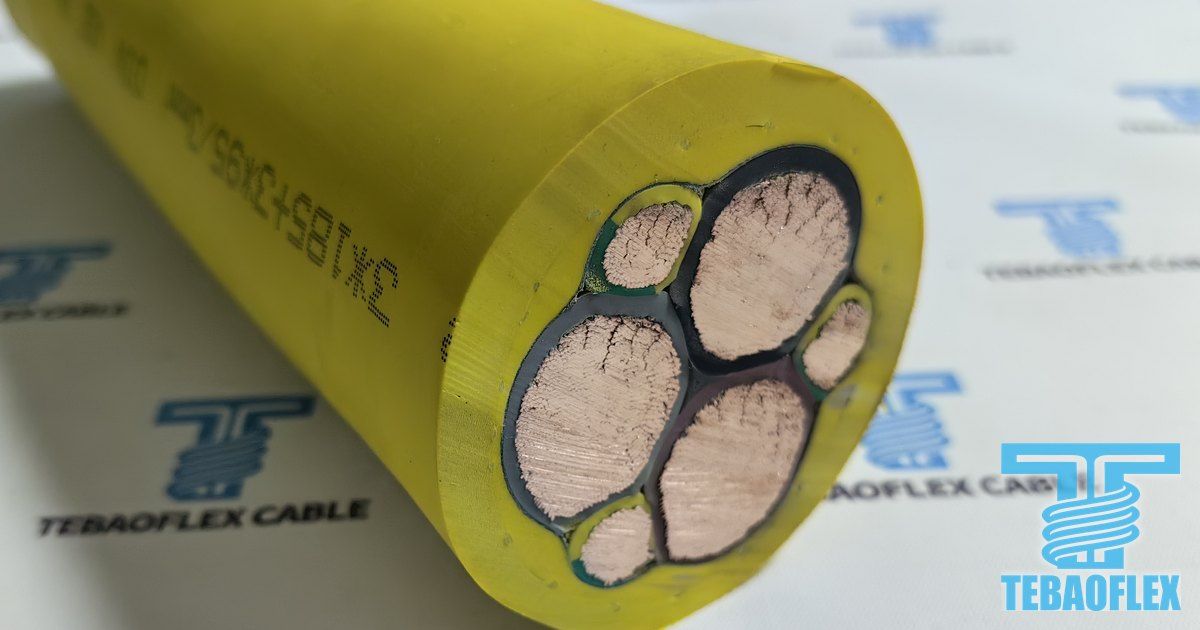
[ORIGINAL DATA] In Section 06 (0:54 to 1:02), our team analyzed a razor-cut sample of 0.6/1 kV (N)SHTOU (CRANE-VS) 4x16 mm2 using a 4K 60fps macro inspection methodology on our quality bench (TEBAOFLEX Sample Log, Oct 2026).

The first real macro clip (0:54 to 0:58, shown above) and the second real macro clip (0:58 to 1:02, shown below) confirm four physical details.
- Compact Class 5 Strand Bundles (
0:55). First, all four16 mm2conductors show tightly bunched fine-stranded copper wires with bright tinned metallic cut faces and zero loose strands. - Concentric 3GI3 EPR Insulation Rings (
0:55). Second, the brown, black, grey, and green/yellow EPR walls maintain even thickness around each core to withstand 3,500 V AC routine testing. - Void-Free Central Cradle & Double 5GM3 Bonding (
0:55). Third, the central rubber cradle and yellow5GM3inner jacket fill the core valleys completely. Meanwhile, the inner and outer sheaths bond tightly through the open polyamide braid. - Dense 27.2 mm Yellow 5GM3 Sheath Surface (
0:58). Fourth, the vertical 4K pan along the upright specimen below shows a smooth, pinhole-free yellow polychloroprene jacket. Note that this0:58 to 1:02clip films the unprinted side of the sample so engineers can inspect the raw rubber texture. The black ink legendTEBAOFLEX (N)SHTOU (CRANE-VS) 0.6/1kV 4x16mm2 VDE 0250-814 Con the opposite face appears on the opening cover at0:01.

How Do You Size 4x16 mm2 Power Cables on Crane Reels (DIN VDE 0298-4)?
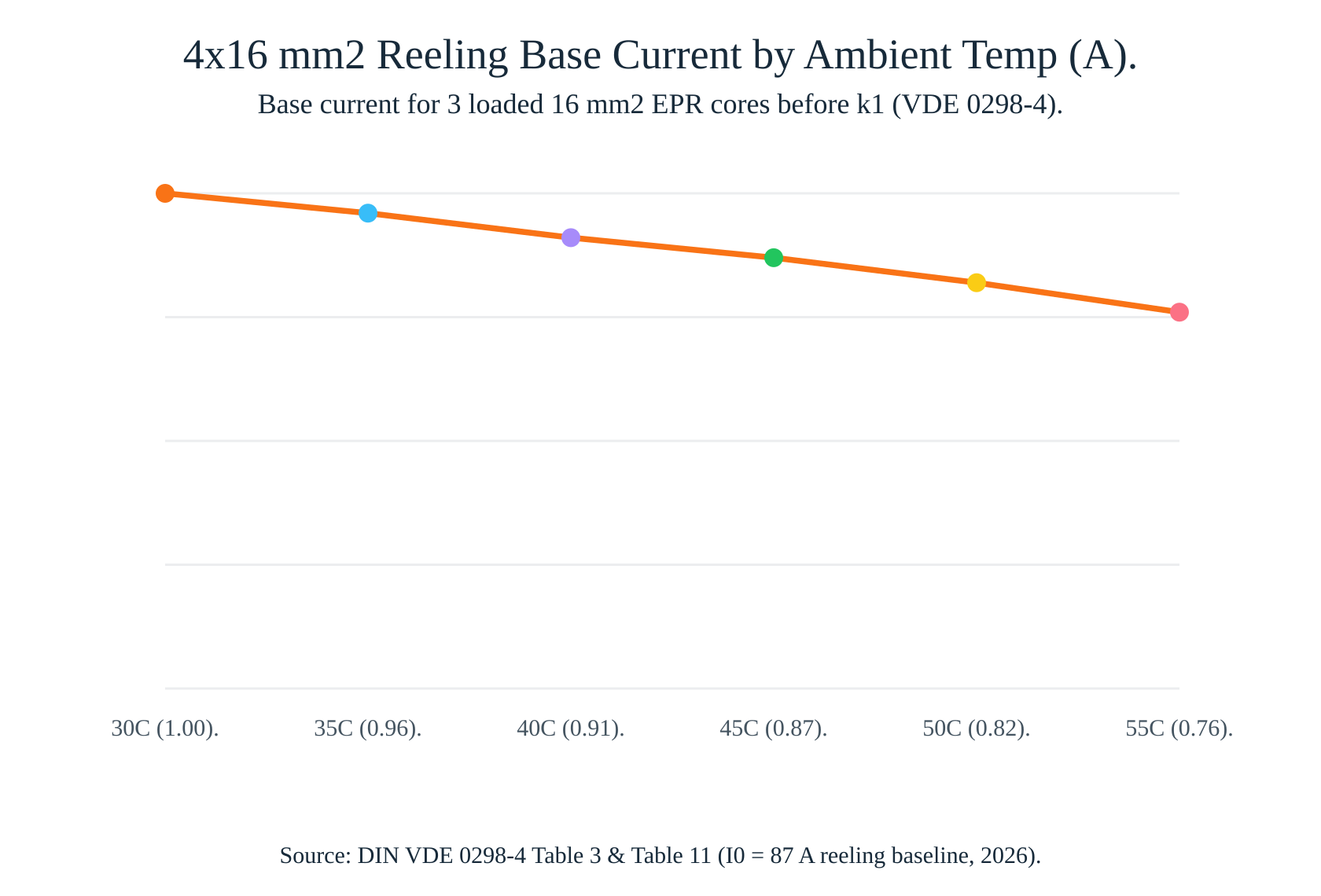
When sizing a 4x16 mm2 power cable for a crane reel, the three 16 mm2 phase cores carry load current while the fourth 16 mm2 green/yellow core serves as protective earth. Under DIN VDE 0298-4 (2026) at 30 deg C ambient temperature, a 3-loaded-core 16 mm2 heavy rubber cable has a base current rating (I₀) of 87 A on a reeling drum and 98 A in free air.
Multi-layer reel thermal derating is the thermal sizing calculation under DIN VDE 0298-4 that multiplies a cable's 3-core base current (I₀) by a drum layer factor (k₁) and an ambient temperature factor (k₂).
Iz = I₀ × k₁ × k₂.

4x16 mm2 Reeling Base Current by Ambient Temp (A). line data: 30C 87. 35C 83.5. 40C 79.2. 45C 75.7. 50C 71.3. 55C 66.1. Source: DIN VDE 0298-4 Table 3 and Table 11 Reeling Baseline 2026.
Source: DIN VDE 0298-4 Table 3 & Table 11 Reeling Ampacity, 2026.
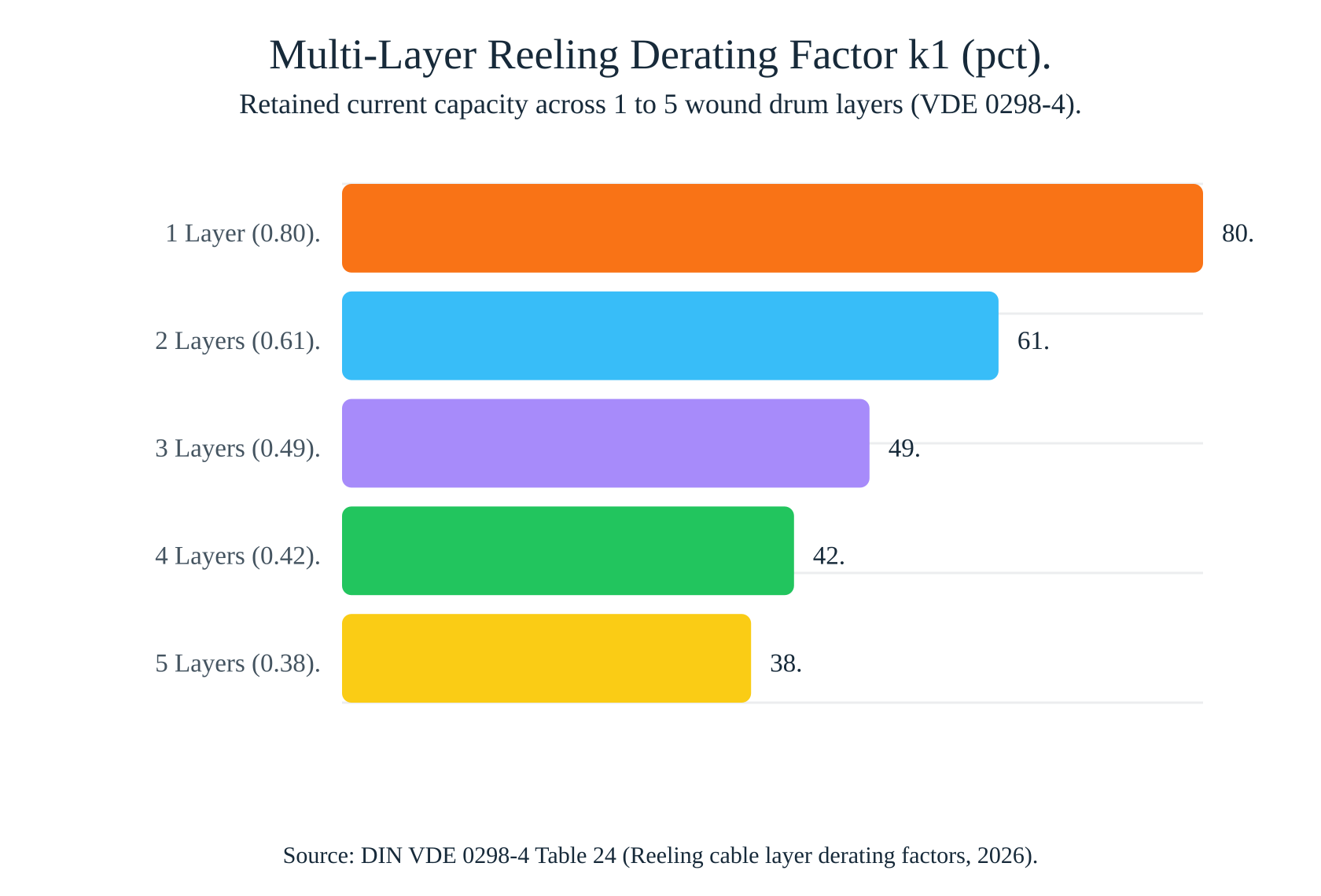
When the cable winds in multiple layers on a drum reel, apply the layer factor k₁. Under DIN VDE 0298-4 Table 24, k₁ equals 80% for 1 layer (or a ventilated monospiral reel), 61% for 2 layers, 49% for 3 layers, 42% for 4 layers, and 38% for 5 layers (DIN VDE 0298-4, 2026).

Multi-Layer Reeling Derating Factor k1 (pct). horizontal bar data: 1 Layer 80. 2 Layers 61. 3 Layers 49. 4 Layers 42. 5 Layers 38. Source: DIN VDE 0298-4 Table 24 Reeling Drum Derating 2026.
Source: DIN VDE 0298-4 Table 24 Reeling Drum Derating, 2026.
Reference Ampacity Table for 4x16 mm2 Power Cores.
Consider a rail-mounted gantry crane operating in an outdoor yard. The table below lists continuous current limits per 16 mm2 phase core under DIN VDE 0298-4 (2026).
Installation Mode
Free-Air / Festoon (I₀ = 98 A).
- Drum Factor (k₁):
1.00 - 30 deg C (k₂ = 1.00): 98.0 A.
- 40 deg C (k₂ = 0.91): 89.2 A.
- 50 deg C (k₂ = 0.82): 80.4 A.
Reeling Base (I₀ = 87 A).
- Drum Factor (k₁):
1.00 - 30 deg C (k₂ = 1.00): 87.0 A.
- 40 deg C (k₂ = 0.91): 79.2 A.
- 50 deg C (k₂ = 0.82): 71.3 A.
Monospiral / 1-Layer Reel (I₀ = 87 A).
- Drum Factor (k₁):
0.80 - 30 deg C (k₂ = 1.00): 69.6 A.
- 40 deg C (k₂ = 0.91): 63.3 A.
- 50 deg C (k₂ = 0.82): 57.1 A.
Cylindrical Reel: 2 Layers (I₀ = 87 A).
- Drum Factor (k₁):
0.61 - 30 deg C (k₂ = 1.00): 53.1 A.
- 40 deg C (k₂ = 0.91): 48.3 A.
- 50 deg C (k₂ = 0.82): 43.5 A.
Cylindrical Reel: 3 Layers (I₀ = 87 A).
- Drum Factor (k₁):
0.49 - 30 deg C (k₂ = 1.00): 42.6 A.
- 40 deg C (k₂ = 0.91): 38.8 A.
- 50 deg C (k₂ = 0.82): 35.0 A.
Cylindrical Reel: 4 Layers (I₀ = 87 A).
- Drum Factor (k₁):
0.42 - 30 deg C (k₂ = 1.00): 36.5 A.
- 40 deg C (k₂ = 0.91): 33.3 A.
- 50 deg C (k₂ = 0.82): 30.0 A.
What Should You Send Us for Crane Reeling Cable Selection?
To help our engineering team confirm the right (N)SHTOU (CRANE-VS) construction for your gantry, portal, or container crane, send us these 6 details.
- Crane Mechanism & Reel Type. State whether the cable runs on a motorized monospiral reel, a cylindrical multi-layer drum, a spring reel, or a festoon loop.
- Motor Load & Supply Voltage. Provide the three-phase voltage (
380 V,400 V,480 V, or690 V AC), continuous current (A), duty cycle (% ED), and total cable length (m). - Drum Barrel & Deflection Roller Sizes. Share the minimum drum core diameter and deflection roller diameter (
R >= 6 x D = 163.2 mmfor27.2 mmOD). Also include the monospiral flange gap (must clear the 25.1 to 29.1 mm OD tolerance). - Travel Speed, Acceleration & Lift Height. Confirm maximum travel speed (
up to 120 m/min), acceleration (m/s2), and vertical lift from the trench pit. Our engineers will verify that pulling tension stays below 1,280 N (20 N/mm2). - Conductor Tinning & Sheath Color. Specify tinned Class 5 copper (for coastal ports or corrosive air) or plain copper, and confirm whether you need high-visibility yellow or black
5GM3outer rubber. - Pre-Shipment FAT Documentation. Let us know if you require batch test reports (
20 deg CDC resistance, 3,500 V AC 5-minute dielectric test, OD caliper checks, and end-face macro photos) before dispatch.
Frequently Asked Questions (FAQ).
What does the designation (N)SHTOU (CRANE-VS) 4x16 mm2 mean under DIN VDE 0250-814?
In German VDE nomenclature, (N) indicates construction adapted to DIN VDE 0250-814, and SHT denotes a heavy-duty flexible rubber cable for hoisting gear. O signifies an open anti-torsion braid between inner and outer sheaths, while U specifies a flame-retardant polychloroprene (5GM3) jacket. 4x16 mm2 means four 16 mm2 Class 5 copper cores (brown, black, grey, and green/yellow PE).
Why does this (N)SHTOU (CRANE-VS) cable have a yellow 5GM3 outer sheath instead of black?
While 5GM3 heavy-duty rubber per DIN VDE 0207-21 can be compounded in black or yellow, a high-visibility yellow outer sheath is widely specified for container gantry cranes, steelyard portal cranes, and open-air runway trenches. It helps yard vehicle drivers and maintenance crews clearly see the moving cable in rain, fog, or night lighting.
How much dynamic pulling force can the 4x16 mm2 (N)SHTOU (CRANE-VS) cable withstand on a motorized reel?
Under DIN VDE 0250-814 and DIN VDE 0298-3 (2026), the cable is rated for a maximum dynamic tensile load of 20 N/mm2 applied across the total copper cross-section. For 4 x 16 mm2 = 64 mm2 of copper, the maximum permissible dynamic pulling tension during crane acceleration and pickup is 64 mm2 x 20 N/mm2 = 1,280 N (approx. 130 kgf).
Should I order plain copper or tinned copper Class 5 conductors for (N)SHTOU (CRANE-VS) 4x16 mm2?
Both plain and tinned Class 5 fine-stranded copper conductors comply with IEC 60228 (max wire diameter 0.41 mm, max DC resistance 1.21 Ohm/km plain or 1.24 Ohm/km tinned at 20 deg C). Tinned copper, as shown in our real sample cut at 0:55 and 0:01, is recommended for coastal ports and chemical yards to prevent salt-mist corrosion at terminations.
Does the 68-second video show live high-voltage laboratory testing or structural and sample verification?
The 68-second video combines 100% real 4K 60fps sample macro footage (0:00 to 0:03 and 0:54 to 1:02 per TEBAOFLEX Video Log, 2026) with schematic 3D animations (0:03 to 0:54). The real clips verify the razor-cut 4x16 mm2 cross-section and the 27.2 mm nominal OD yellow 5GM3 sheath. Live HV bench tests are not shown in this clip; batch FAT reports (3,500 V AC routine test and DC resistance verification) accompany production orders.
Request a Specification Check or Custom Drum Quote.
Planning a gantry crane reel replacement or new drum installation with 0.6/1 kV TEBAOFLEX (N)SHTOU (CRANE-VS) 4x16 mm2? Please contact our engineering team or browse our Reeling Cable Catalog and Port Crane Cable Solutions to get a confirmed datasheet and factory quote.
WhatsApp: +86 185 9591 3361