
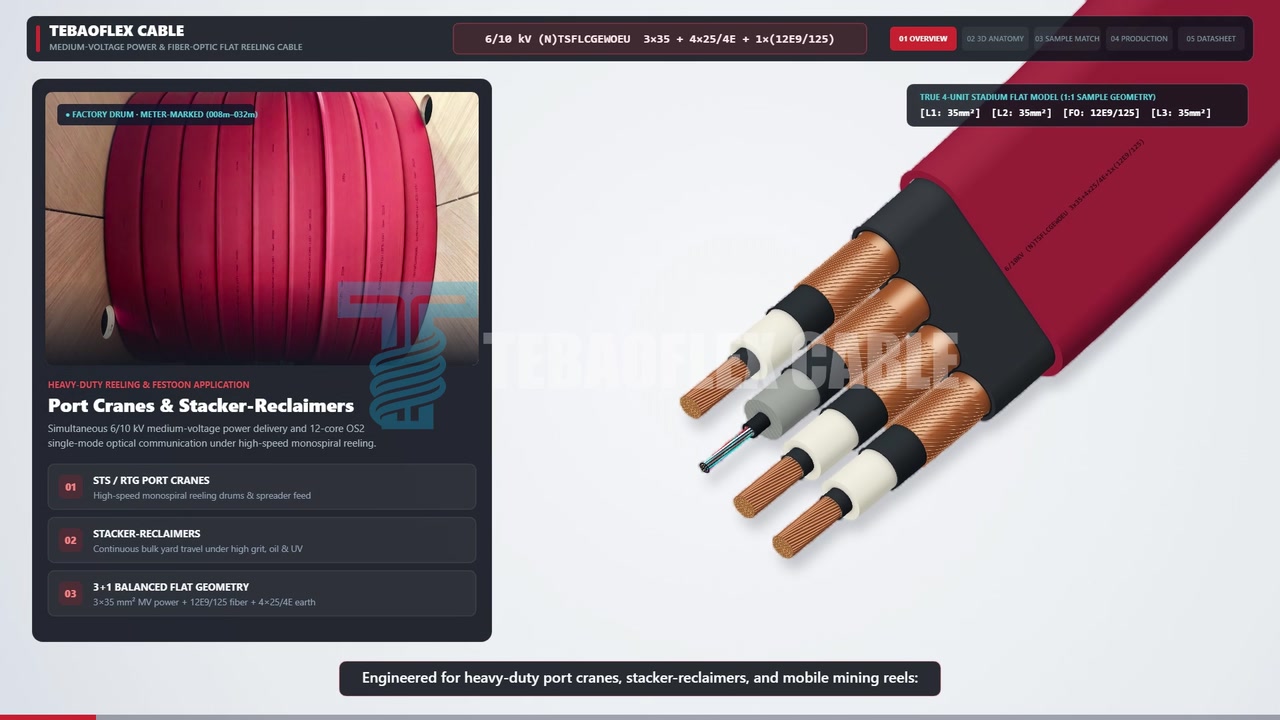
Video
What the video shows
This 40-second TEBAOFLEX video combines a 3D cutaway, sample end-face photographs and production footage for the stated 6/10 kV configuration: 3×35 + 4×25/4E + 1×(12E9/125).
The walkthrough below separates the video's construction claims from verified test results. Confirm earth-screen allocation, the actual sheath grade and machine duty on the approved drawing and order documents.
The video illustrates a sample, process, or operating context. Final product construction, suitability, standards, and test acceptance criteria are confirmed against the ordered specification.
A 40-second TEBAOFLEX video presents a 6/10 kV flat reeling cable that carries power and optical fiber in one sheath. This article walks through what the video shows, adds the technical context a buyer needs, and says plainly what the video does not prove.
Flat composite reeling cable is the video's term for a reeling cable that holds power cores and an optical fiber unit side by side in one flat sheath. The term is the video's own, not a standard's.
Key Takeaways
- The cable is a flat, single-row construction: three 35 mm² power cores and one 12-fiber single-mode unit, with split copper earth screening, inside one dark-red rubber sheath.
- The video shows a 3D model, a macro photo of a real sample end face, and factory footage of extrusion, marking and haul-off.
- Its on-screen text names AC voltage, partial discharge, OTDR (optical time-domain reflectometer) and dimensional checks. It shows no test values, certificate numbers or standard editions.
- Before ordering, confirm the earth-screen notation, the sheath compound data and the test reports you need per drum.
What the 40-second video shows
The video has English narration and on-screen captions. It combines three kinds of material. The on-screen labels, which appear in capitals, read "1:1 sample geometry" for the 3D model, "real sample macro" for the end-face photos and "factory production line footage" for the production clips. It is a product walkthrough, not a test film or an installation record.
The five on-screen chapters follow the tab bar at the top of the video.
- 0:00-0:07 Overview: Meter-marked factory drum, 3D cable, application list — What the narration says (summarised): Built for heavy-duty port cranes, stacker-reclaimers and mobile mining reels
- 0:08-0:19 3D anatomy: Seven-layer list, cable cutaway — What the narration says (summarised): Four aligned cores inside an anti-torsion flat sheath
- 0:20-0:27 Sample match: Blueprint cross-section beside a real sample end face — What the narration says (summarised): Every cross-section matches the blueprint one-to-one
- 0:28-0:34 Production: Extrusion, marking, haul-off, end-face check, drum packaging — What the narration says (summarised): Every meter is clearly marked and factory-inspected
- 0:35-0:40 Datasheet: Specification summary panel — What the narration says (summarised): Reliable medium-voltage power and optical reeling solutions
Reading the designation and the datasheet panel
The designation on screen is (N)TSFLCGEWOEU 3×35 + 4×25/4E + 1×(12E9/125), with the note "DIN VDE 0250-813 Based". DIN VDE 0250-813 is listed in the DIN/DKE catalogue as a 1985 German standard for trailing cables, and the entry shows it as current (DIN catalogue entry). Tratos lists it as covering rated voltages of 0.6/1 kV to 20/35 kV (Tratos standard summary). We did not find a primary source that says whether the standard text covers flat constructions, so "based on" is the accurate reading.
Read the core notation like this:
- 3×35: three power cores of 35 mm², with EPR (ethylene propylene rubber) insulation.
- 1×(12E9/125): one unit holding 12 single-mode fibers of 9/125 µm.
- 4×25/4E: preserve this designation exactly as shown. The video datasheet separately describes a four-split copper earth screen as 4 × 6.25 mm² (25 mm² in total). It does not establish four screens of 25 mm² each. Confirm the notation, total copper area and allocation around the units on the approved construction drawing.
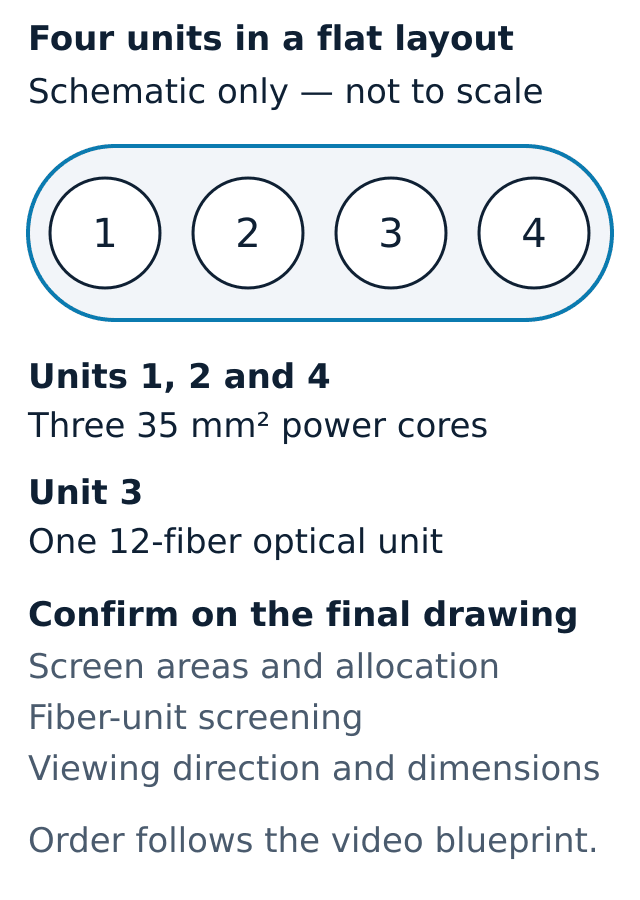
Layout schematic based on the video blueprint, not a manufacturing drawing. Screen rings are intentionally omitted because their allocation, including the fiber unit, needs confirmation. Viewing direction and dimensions are not established.
The video states U0/U = 6/10 kV, with Um = 12 kV AC. U0 denotes conductor-to-earth voltage and U denotes phase-to-phase voltage; Um is the highest system voltage for which the equipment is designed. Treat 6/10 (12) kV as the stated rating, not as permission to operate any cable continuously at 20% above its rating. Confirm system voltage and earthing conditions for the order.
- Power conductors: 3 × 35 mm², Class 5 fine-stranded bare copper
- Insulation: Triple-extruded EPR with inner and outer semiconductive layers
- Optical unit: 12 × 9/125 µm (OS2) single-mode fibers in a loose tube
- Earth screen: 4-split bare copper wire screen (4 × 6.25 mm²)
- Inner bedding: Black anti-torsion elastomer core support
- Outer sheath: Dark-red heavy-duty rubber, labelled WOEU in the video; exact material grade to be confirmed
- Mechanical and environmental: Flame-retardant; oil, UV and abrasion resistant
Two terms deserve a line each. Class 5 is a flexible-conductor class in IEC (International Electrotechnical Commission) 60228, whose contents list a clause for "flexible conductors (classes 5 and 6)" (IEC 60228 preview).
OS2 is a single-mode fiber designation. A Nexans product page describes its OS2 cable as defined in ISO/IEC 11801 and lists fiber types B1.3 and B6_a1 from IEC 60793-2-50 (Nexans OS2 product page). ITU-T G.652 is titled "Characteristics of a single-mode optical fibre and cable" (ITU-T G.652 recommendation).
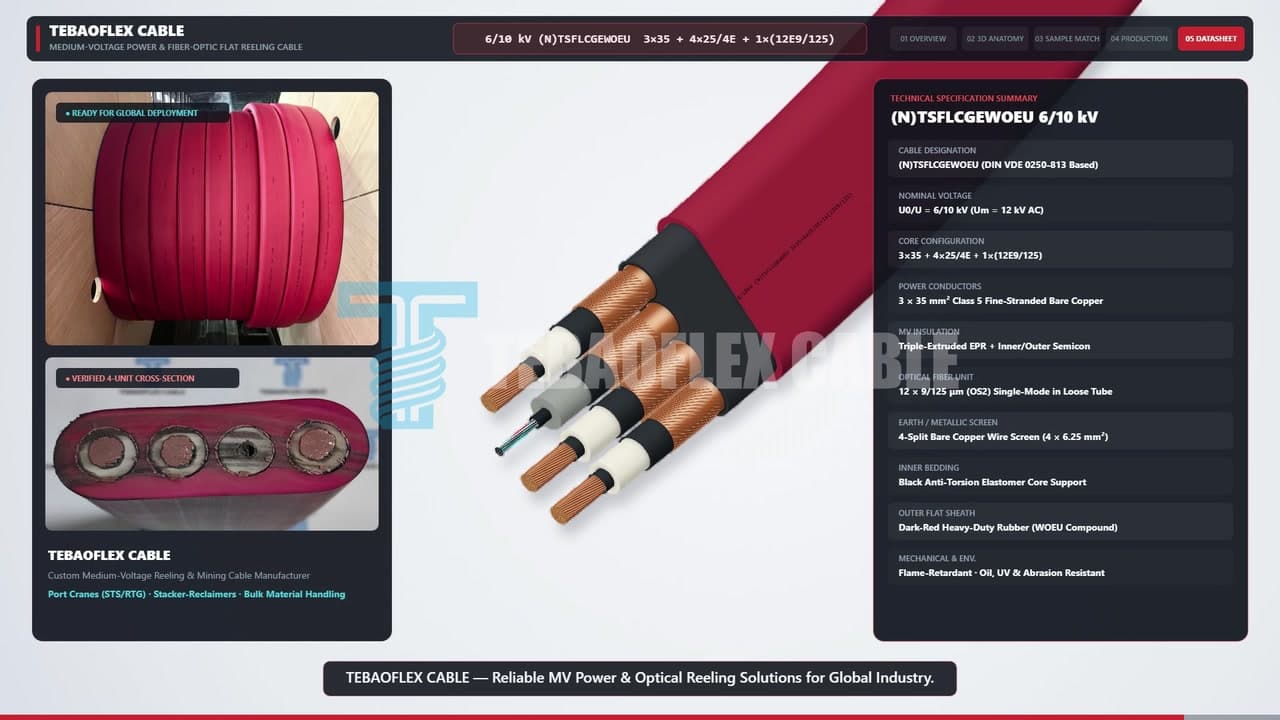
The datasheet chapter at 0:37. Every value in the table above is read from this panel. Frame from the TEBAOFLEX product video.
Construction layer by layer (0:08-0:19)
The 3D chapter names seven layers and highlights them in turn. The numbering below is the video's own. Layer 04, the fiber unit, appears in the list between the outer semiconductive screen (03) and the split copper screen (05), even though the model places it in the row with the power cores.
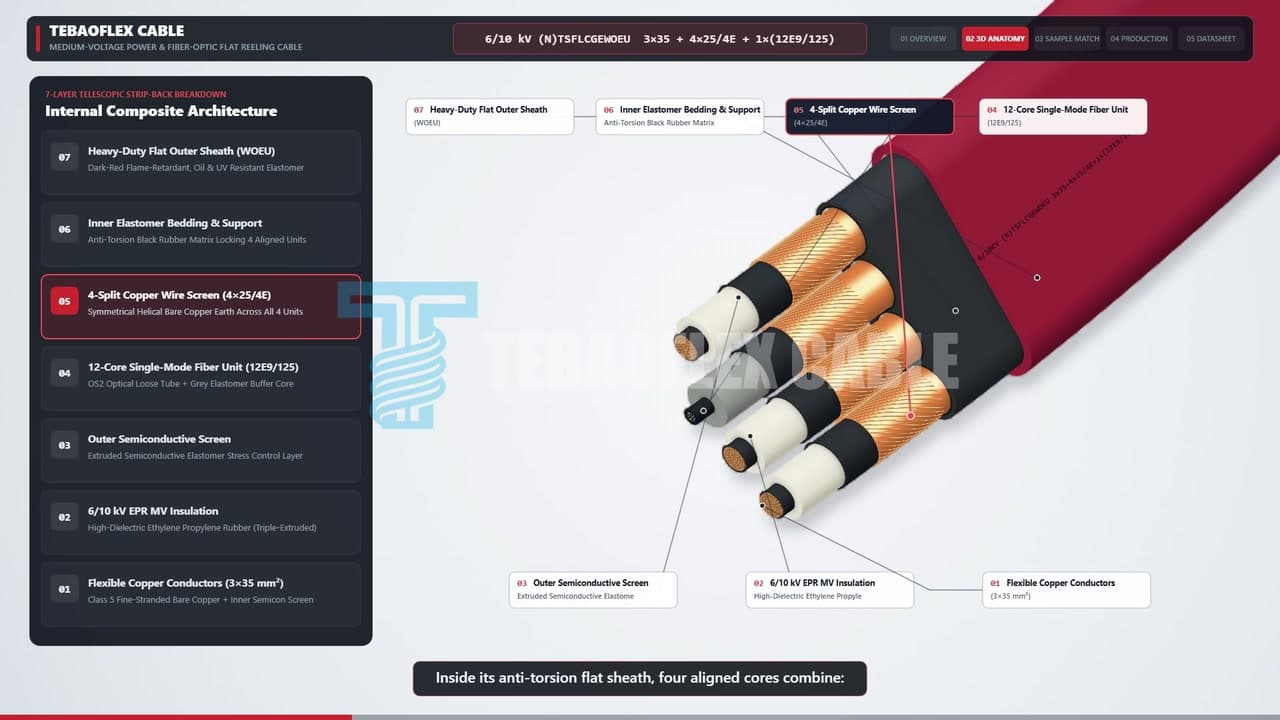
The 3D anatomy chapter at 0:11, with layer 05 (split copper wire screen) highlighted. Frame from the TEBAOFLEX product video.
- Flexible copper conductors: three 35 mm² power cores; Class 5 bare copper and inner semiconductive layer as stated in the video.
- EPR insulation: the video describes a triple-extruded insulation system for 6/10 kV.
- Outer semiconductive layer: described as an extruded elastomer stress-control layer.
- Optical unit: 12 single-mode fibers, designated 12E9/125 and OS2 in the video.
- Split copper earth screen: the video gives 4 × 6.25 mm². Allocation around individual units, including the optical unit, requires the approved drawing.
- Inner bedding: black elastomer support described as holding four aligned units.
- Outer sheath: dark-red heavy-duty rubber described as WOEU. Confirm actual compound grade and supporting resistance tests.
One manufacturer's leaflet for its PROTOLON reeling cable labels these building blocks: EPR insulation, a rubber inner sheath, torsion protection and a CR/PCP outer sheath (Prysmian leaflet). What the video says about each layer (see also the reeling cable range and the fiber-optic cable range for other constructions):
- Insulation and screens. The insulation is "high-dielectric" EPR, stated to be triple-extruded. The outer semiconductive screen is described as an "extruded elastomer stress control layer".
- Split copper earth screen. The video's text says "equalized earth screen on all 4 core units", which would include the fiber unit. The 3D frames do not show a separate screen around the fiber unit, so confirm this on the drawing.
- Anti-torsion bedding. The video describes a black rubber matrix "locking 4 aligned units".
- Flat outer sheath. The heavy-duty top layer is dark red. The video claims flame, oil, UV and abrasion resistance and shows no test method for any of them.
We did not find an independent source that explains why a flat layout suits monospiral reeling. A different manufacturer rates its own reeling cable as suitable for high mechanical stresses with mono spiral reels (Tratos product page); that page does not state the cable's geometry. The video calls the sheath anti-torsion, and its haul-off stage names "tension control" and "uniform pitch". Treat the flat-versus-round choice as a design question to settle with the construction drawing for your reel.
Sample against blueprint (0:20-0:27)
This chapter puts a blueprint-style cross-section next to a macro photograph of a real sample end face. Both show four units in one row. The blueprint labels them Phase L1, Phase L2, Fiber plus Earth, and Phase L3.
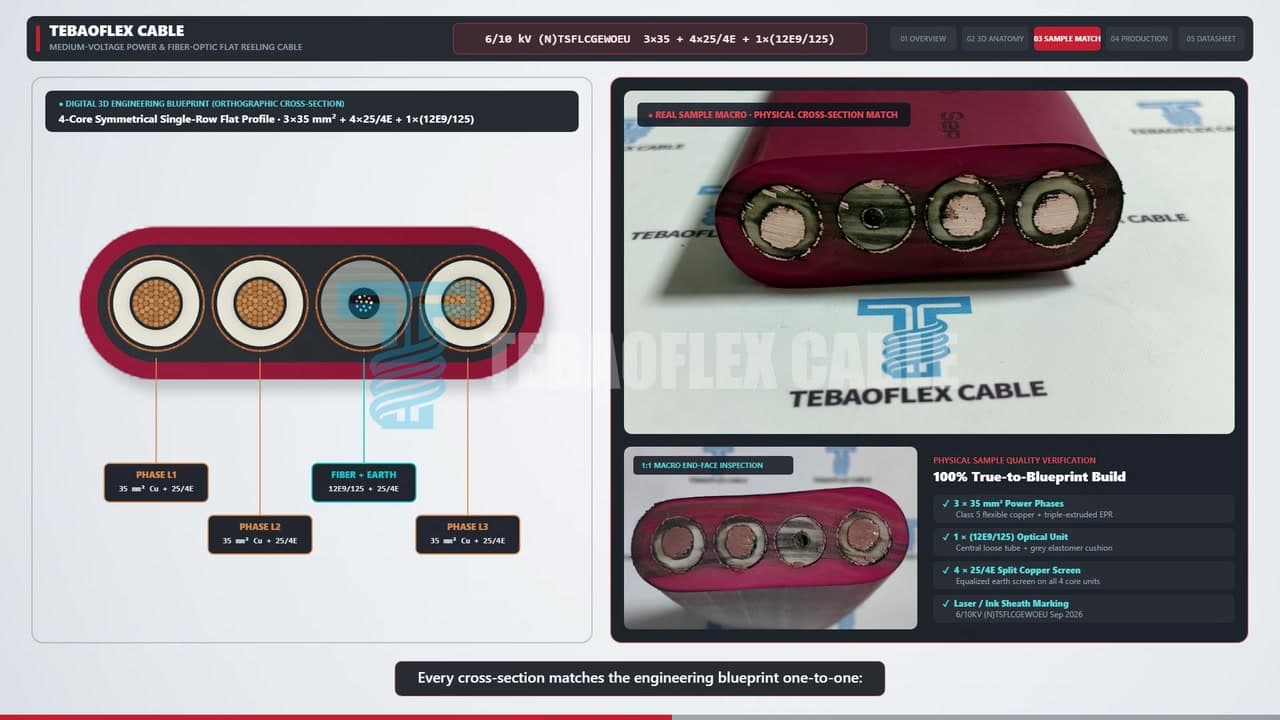
Blueprint (left) and real-sample macro (right) at 0:21, captioned "100% True-to-Blueprint Build". Frame from the TEBAOFLEX product video.
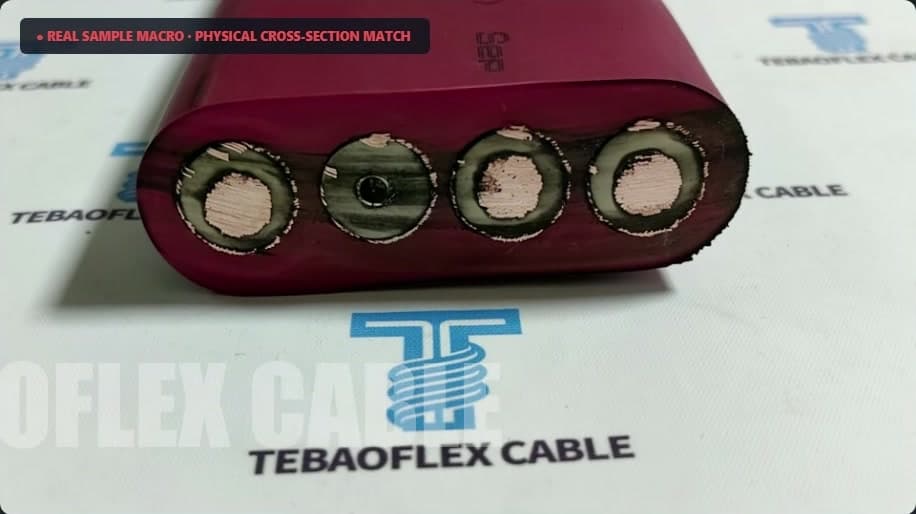
Macro of the sample end face. Three copper conductors and one dark fiber unit are visible. Frame from the TEBAOFLEX product video.
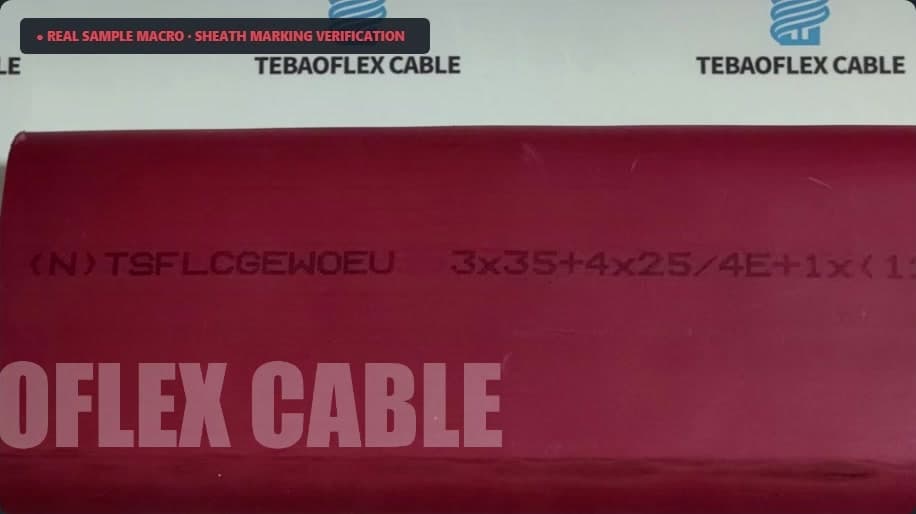
Sheath marking close-up at 0:25. The printed text starts "(N)TSFLCGEWOEU 3x35+4x25/4E+1x". Frame from the TEBAOFLEX product video.
What the photos show: a sample end face with the same unit count and row layout as the blueprint, and a sheath printed with the designation. The "real sample" status comes from the video's own label.
In the macro photo the fiber unit is second from the left, while the blueprint puts it third. The sample may be photographed from the opposite end, and the video does not say. What the photos do not show: measured conductor or wall dimensions, or that every drum matches. The video shows end-face photos at 0:21 and in the production chapter, and it gives no measurements.
Production steps and factory checks (0:28-0:34)
The production chapter numbers three stages. Each has a caption and a short description on screen.
- 1 (about 0:28-0:29): Precision flat extrusion and vulcanization water cooling — On-screen description: Controlled cooling trough stabilizes the heavy-duty red WOEU elastomer outer sheath geometry
- 2 (about 0:30-0:32): On-line specification and batch traceability marking — On-screen description: Continuous high-contrast sheath print: 6/10KV (N)TSFLCGEWOEU 3x35+4x25/4E+1x(12E9/125) Sep 2026
- 3 (about 0:33-0:34): Synchronized caterpillar haul-off and tension control — On-screen description: Zero-slip caterpillar traction maintains uniform pitch across all 3 power phases and the optical unit

Stage 1 at 0:28: water cooling after extrusion. Frame from the TEBAOFLEX product video.
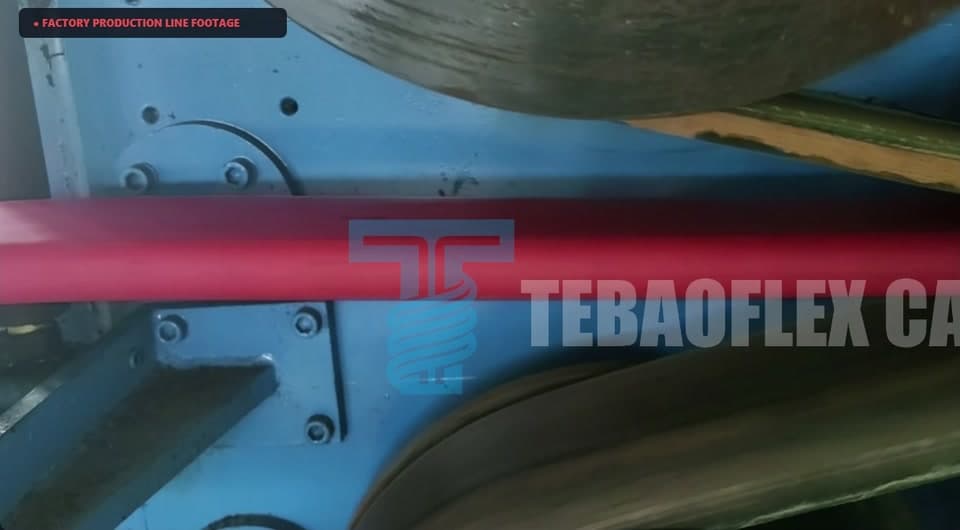
Stage 3 at 0:33: haul-off and tension control. Frame from the TEBAOFLEX product video.
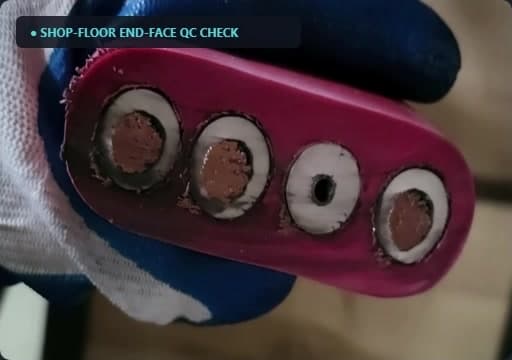
"Shop-floor end-face QC check", shown beside the production footage. Frame from the TEBAOFLEX product video.
A side panel is headed "100% Routine & Structural Factory Testing". It lists "AC voltage test", "Partial discharge", "OTDR optical attenuation check" and "Dimensional & flat bending symmetry verification before shipment".
That is a claim in the video, not a result. No voltage level, duration, discharge value, fiber loss figure or report number appears on screen. Context for the names:
- AC voltage and partial discharge (PD) tests. The cited IEC 60502-2:2014 preview lists PD and voltage routine tests in clauses 16.3 and 16.4 and a PD type test in clause 18.2.5. Its scope is fixed installations and excludes special service conditions such as mining; it is not automatic approval of this moving reeling cable. 2014 preview; 2024 amendment. Specify the applicable edition, methods, acceptance limits and drum-specific reports in the order.
- PD measurement method. IEC 60885-3 specifies PD measurements on lengths of extruded power cable (IEC 60885-3 catalogue page).
- OTDR check. The video gives no attenuation limit or wavelength.
Where the video places this cable
The overview panel is headed "Heavy-duty reeling & festoon application" and states "Simultaneous 6/10 kV medium-voltage power delivery and 12-core OS2 single-mode optical communication under high-speed monospiral reeling." It lists two uses: STS (ship-to-shore) and RTG (rubber-tyred gantry) port cranes (high-speed monospiral reeling drums and spreader feed), and stacker-reclaimers (bulk yard travel under grit, oil and UV). A third line describes the "3+1 balanced flat geometry": three 35 mm² power cores plus the fiber unit, with the 4×25/4E earth screens.
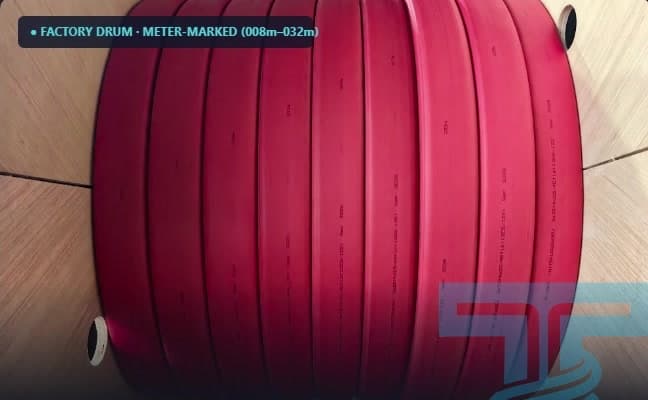
Factory drum, labelled "meter-marked (008m-032m)" on screen. Frame from the TEBAOFLEX product video.
For stacker-reclaimer duty in more depth, read our article on bucket-wheel excavator and stacker-reclaimer reeling cables. Our crane and material handling cables page lists related constructions, and a port crane project case study shows a different cable with a 24-fiber unit.
What to write into the order
The video introduces the proposed construction; the approved drawing and datasheet establish the supplied configuration. It does not provide all the machine-side design inputs. Confirm the following items in your enquiry and in the order documents.
- Full designation and standard edition: "Based on" DIN VDE 0250-813 needs the edition and any deviations listed — In the video?: Designation only
- U0/U and Um: Must match the system voltage and earthing — In the video?: Yes (6/10 kV, Um 12 kV)
- Conductor class and finish: Fixes the conductor data sheet you receive — In the video?: Stated in the video (Class 5, bare copper); confirm on the datasheet
- Earth-screen notation: Confirm what "25/4E" means per unit — In the video?: Partly (4 × 6.25 mm²)
- Fiber type, count and attenuation limit: Link budget for your system — In the video?: Type and count only
- Sheath compound and temperature range: Outdoor and cold-start duty — In the video?: Video designation only (WOEU); confirm the actual compound grade
- Minimum bending radius, reeling speed, tensile load: Reel diameter and drive design — In the video?: No
- Test plan and reports per drum: AC, PD and OTDR results as documents — In the video?: No (claim only)
- Drum length, marking and packaging: Meter marks and layered drum packing — In the video?: Marking and packaging shown
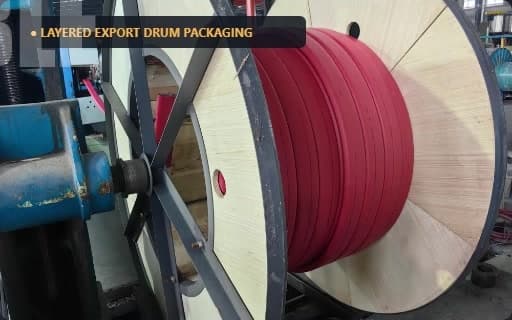
"Layered export drum packaging", shown at 0:33 beside the haul-off footage. Frame from the TEBAOFLEX product video.
Sources and limits
- Primary for the cable: the video itself. Everything in the specification table is read from its on-screen text and narration. The audio was transcribed with speech recognition and checked against the captions.
- Standards catalogue and preview pages: the DIN catalogue entry, the ITU-T G.652 page and the IEC pages linked above. They show titles, tables of contents and scopes, not the full standard text, so beyond the scope wording visible in the IEC 60502-2 preview, nothing here quotes a clause body.
- Secondary: Tratos, Prysmian and Nexans pages are manufacturer sources. They describe common practice and are not standards.
- Video-only data: the conductor finish and the sheath compound come from the video alone.
- Not verified: the meaning of each letter in (N)TSFLCGEWOEU, whether VDE 0250-813 covers flat cables, any reeling-cable test plan, and any measured values. We state none of these as fact.
FAQ
What does the designation (N)TSFLCGEWOEU 3×35 + 4×25/4E + 1×(12E9/125) tell me?
It gives the family name and the core layout: three 35 mm² power cores, a 4×25/4E earth-screen entry (the datasheet lists a 4-split screen of 4 × 6.25 mm²) and one 12-fiber unit. We have not decoded the letters of the family name from a primary source, so ask for the construction drawing.
Why is there a fiber unit inside a medium-voltage power cable?
The video describes the fiber unit only as "12-core OS2 single-mode optical communication" on its overview panel, and its narration credits the construction with "zero-interference optical control". It does not name the signals or protocols. Tell us which signals you plan to run and ask for the fiber count and attenuation limit in writing.
Does the video prove the cable passed AC, partial discharge and OTDR tests?
No. It lists the checks in a side panel and shows an end-face inspection. It shows no values, test levels or report numbers. Ask for the reports for your drums.
Which equipment is the cable shown for?
The video names STS and RTG port cranes, stacker-reclaimers and mobile mining reels. It gives no reel diameter, speed or travel length, so those need confirming for your machine.
Is this the same as the (N)TSFLCGEWOEU product page on the site?
This page describes only the configuration shown in the video: 3×35 + 4×25/4E + 1×(12E9/125). The video identifies Class 5 bare copper and describes the outer layer as heavy-duty WOEU rubber. These are video-stated details, not universal specifications for every (N)TSFLCGEWOEU cable. The linked product page describes a different listed construction, including tinned copper and a CR-based sheath. Confirm the conductor finish, actual sheath grade and fiber/screen arrangement on the approved drawing for this exact order.
Talk to us about your project
If you are choosing a medium-voltage reeling cable for a crane or reclaimer, send us the machine, voltage, reel data and the standard you work to. We will reply with a construction drawing and the test documents available for your configuration. Reach us on WhatsApp at +86 185 9591 3361 or at info@tebaoflex.com. You can also read the (N)TSFLCGEWOEU product page or contact us.