Case study
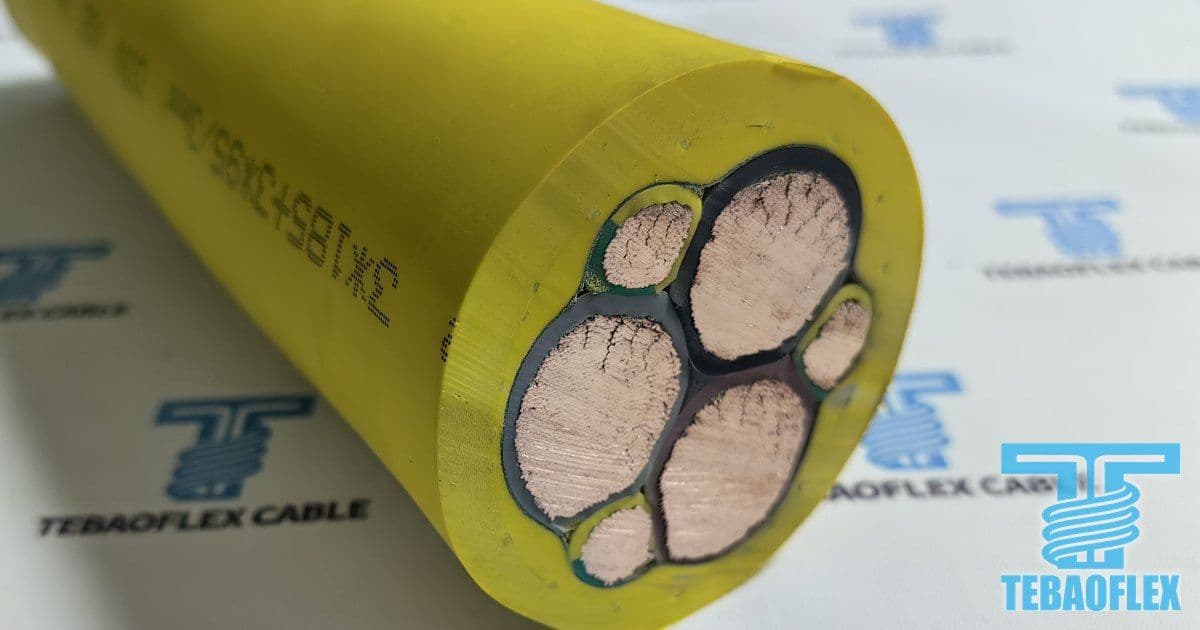
A Polish mining company runs a bucket-wheel stacker-reclaimer above ground and feeds it through a cable reel on the machine. For that reel it ordered two sizes of (N)SHTÖU-J 0.6/1 kV reeling cable from TEBAOFLEX. The company had never used our cable on site, so before ordering, its team asked how we would prove the cable's quality.
- Case at a glance: Location — Detail: Poland
- Case at a glance: Customer — Detail: A Polish mining company (end user)
- Case at a glance: Application — Detail: Cable reel of an above-ground bucket-wheel stacker-reclaimer
- Case at a glance: Cable type — Detail: (N)SHTÖU-J 0.6/1 kV reeling cable, 3×70+3×35/3 and 3×185+3×95/3
- Case at a glance: Factory acceptance test — Detail: At our plant; photos dated 27 September 2026
- Case at a glance: Status — Detail: Delivered
The Application: What a Stacker-Reclaimer Reel Asks of Its Cable
A bucket-wheel stacker-reclaimer travels on rails along a stockyard. In Metso's general description, it stacks bulk material from a yard conveyor into piles and reclaims material from the piles back onto the conveyor. WorkSafe WA guidance counts stackers and reclaimers among the mobile machines powered through trailing and reeling cables.
This customer's site is damp, the ground along the cable route has a lot of loose stone, large trucks and forklifts work nearby, and Polish winters are cold. Our guide to bucket-wheel excavator and stacker-reclaimer reeling cables covers the medium-voltage side of these machines; this reel was low voltage.
Matching Construction to Duty: Inside the Two (N)SHTÖU-J Sizes
(N)SHTÖU-J, also written NSHTOEU-J, is a reinforced 0.6/1 kV rubber reeling cable. Our NSHTÖU product page gives DIN VDE 0250-814, the 1985 German standard for NSHTÖU rubber-insulated flexible cable, as the family's construction standard. Our stacker-reclaimer reeling cable video explains the larger size: three phase conductors of 185 mm² each, with the 95 mm² protective earth split across three green-yellow cores. The "J" denotes that green-yellow earth, and the 3×70+3×35/3 cable follows the same pattern.
The construction for this order:
- Tinned copper conductors, IEC 60228 Class 5 (flexible), chosen for the damp site.
- Ethylene propylene rubber (EPR) insulation: power cores brown, black and grey; earth cores green-yellow.
- Cores laid up around a central rubber filler.
- Yellow polychloroprene (PCP) inner sheath, compound type 5GM5.
- Aramid braid between the two sheaths, which helps the cable resist twisting on the reel.
- Yellow PCP outer sheath, also 5GM5, oil and weather resistant. Yellow was used instead of black so that drivers can see the cable.

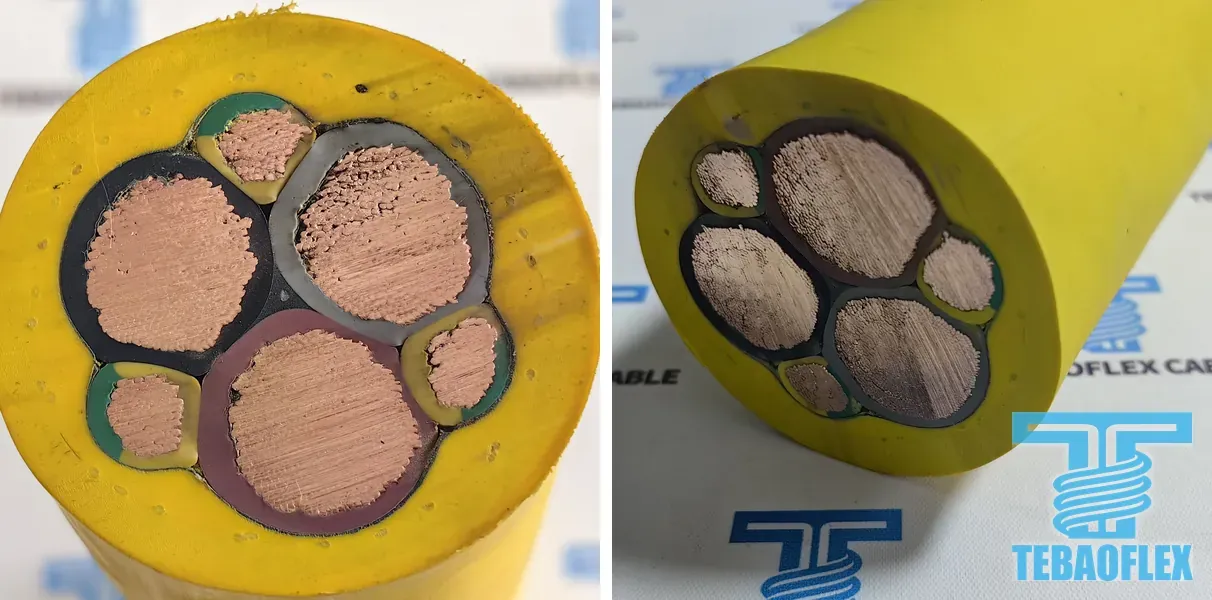
Cut ends of the two cables: 3×70+3×35/3 (left) and 3×185+3×95/3 (right), not shown to the same scale. The cut faces look copper-coloured because the tin is only a thin coat on each strand. Photos: TEBAOFLEX, September 2026.
What the Customer Needed to See Before Delivery
The customer's team sent a list of questions. Our answers follow, with factory acceptance test (FAT) evidence and published references.
Construction
The team asked for cross-section photos in which the inner and outer sheaths could be told apart. Both sheaths are the same yellow compound, so the boundary shows as a ring of cut braid yarns rather than a change of colour.
Tinned Strands
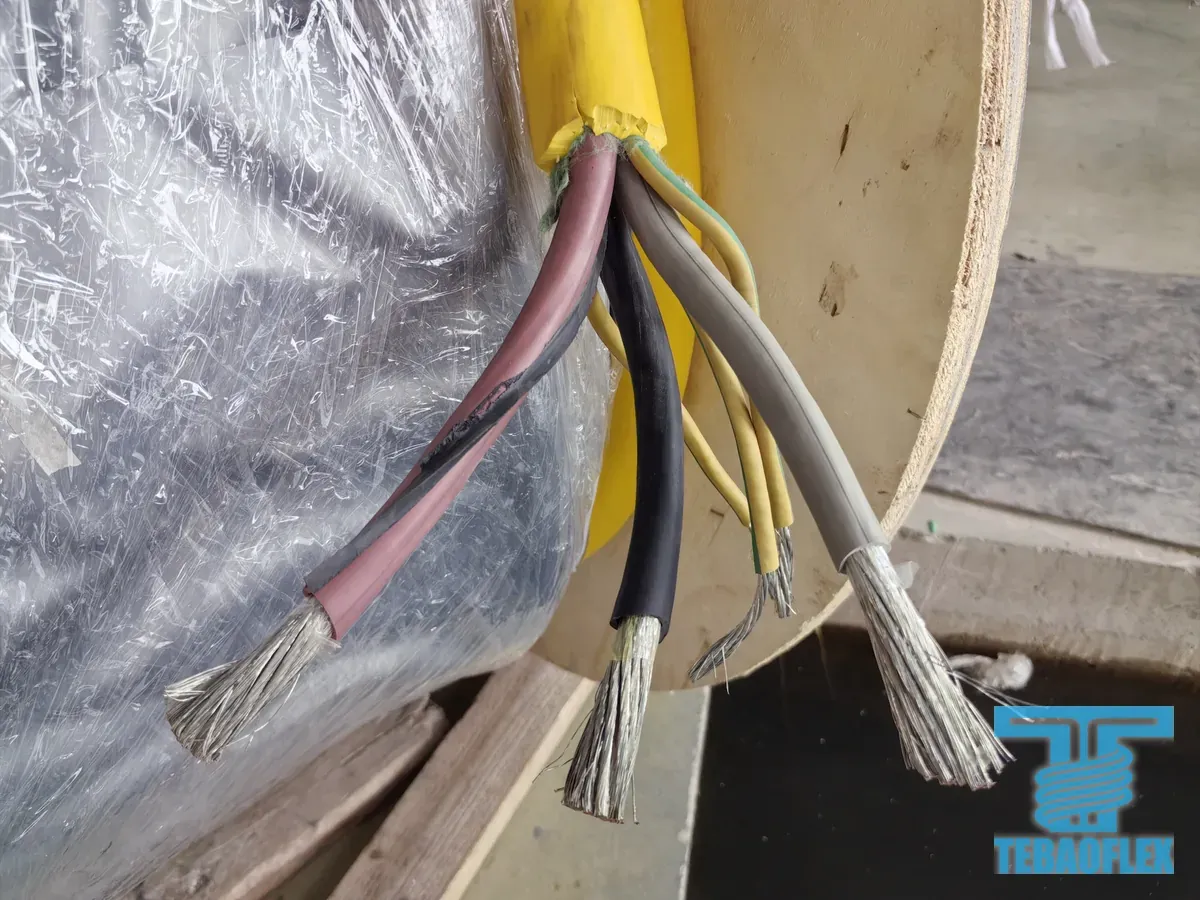
At the FAT, the cores were stripped at the drum ends, and the strands showed the silver colour of tin. A resistance test alone cannot prove tinning. A 1 m sample of a 70 mm² core measured 0.265 Ω/km at 20 °C, which is below both IEC 60228:2004 limits for that size: 0.272 Ω/km for plain wires and 0.277 Ω/km for metal-coated ones.

Stripped cores at the end of the 3×70+3×35/3 drum during the FAT. Photo: TEBAOFLEX, 27 September 2026.
No Break Along the Length
Every insulated core passed through a spark tester during extrusion, the method IEC 62230 describes for finding insulation defects. Each core then had a 3,500 V test under water. On the finished cable, QC checked every core from end to end and measured the insulation resistance. The drums then had an AC voltage test in our high-voltage bay. The display read 3,626 V and 3,657 V in two photos, above the 3.5 kV, 5-minute level our case file sets for this order, and there was no breakdown. These checks find broken cores and insulation faults, not factory joints; a buyer who cares about joints should ask in writing.

Left: the 3×185+3×95/3 drum in the high-voltage test bay. Right: the test-set display reading 3,657 V AC during a FAT voltage test. Photos: TEBAOFLEX, September 2026.
Insulation Resistance
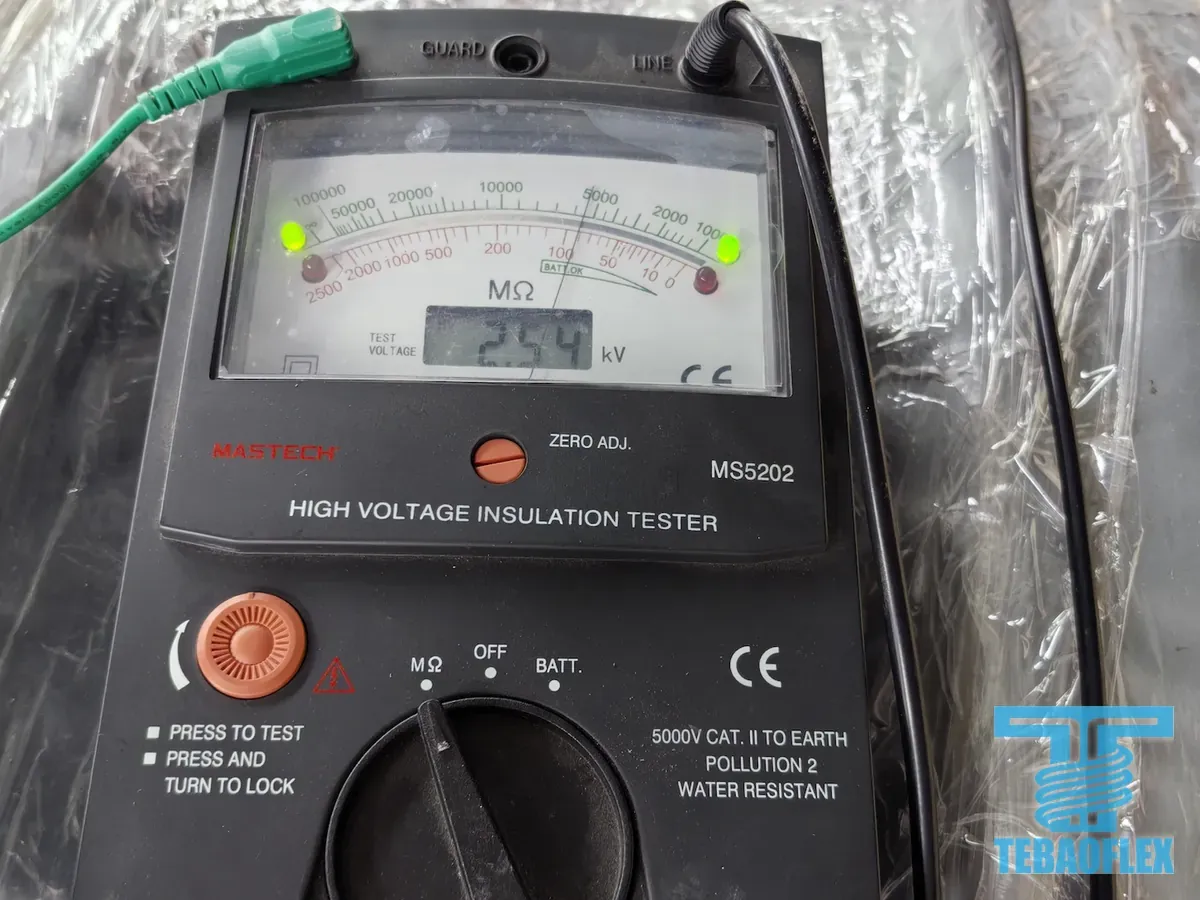
At a 2.5 kV test voltage, the tester's needle sat near 5,000 MΩ on the 3×70+3×35/3 drum and at about 8,000 MΩ in a second photo. Because the reading falls with tested length, IS 10810 (Part 43) normalises insulation resistance to length. A 5,000 MΩ reading meets the 20 MΩ·km minimum in our case file on any tested length of 4 m or more.

Insulation-resistance check on the 3×70+3×35/3 drum: 2.54 kV test voltage, needle close to 5,000 MΩ. Photo: TEBAOFLEX, 27 September 2026.
Cold Weather
Our answer was the sheath compound, made to stay elastic in the cold. For reference, our datasheet for yellow, 5GM5-sheathed NSHTÖU reeling cable gives lower limits of −25 °C for fully flexible operation and −40 °C for fixed installation. That datasheet covers 4-core sizes; this order used the same compound type for both sheaths. Poland's meteorological institute IMGW-PIB recorded a January 2026 low of −21.3 °C, at Zamość. Its January record for 1951–2026 is −35.6 °C, so each site should compare its own records with the flexing limit.
Reel Fit
The cables measured 44.45 mm and 63.23 mm overall, both within the reel's maximum cable diameter.
Transport
We size each export drum to the cable's diameter and weight, close the wound drum with boards, brace the drums inside the container and insure export orders.
Where Things Stand
Our FAT photos are dated 27 September 2026. Both cables passed the FAT and have been delivered. We do not yet have service data from the site.
The Takeaway
A first order of reel cable from a new supplier comes down to evidence the buyer can check before delivery. We gave this customer cut-end photos, a strip test, the voltage-test level, insulation resistance with its test voltage and measured diameters against the reel limit. Each of these can be documented at a FAT.
If you are sourcing reeling cable for a stacker-reclaimer or another reel-fed machine, talk it through with us before you choose a supplier. Our project case archive has other deployments, and our mining and tunnelling page lists cables for this duty.
Sources
This case draws on the order's case file and FAT photos, our NSHTÖU product page and datasheet, IEC, DIN and Indian standards records, IMGW-PIB weather data and WorkSafe WA guidance. Requirements quoted from standards bodies describe their scope, not certification or approval of our products.
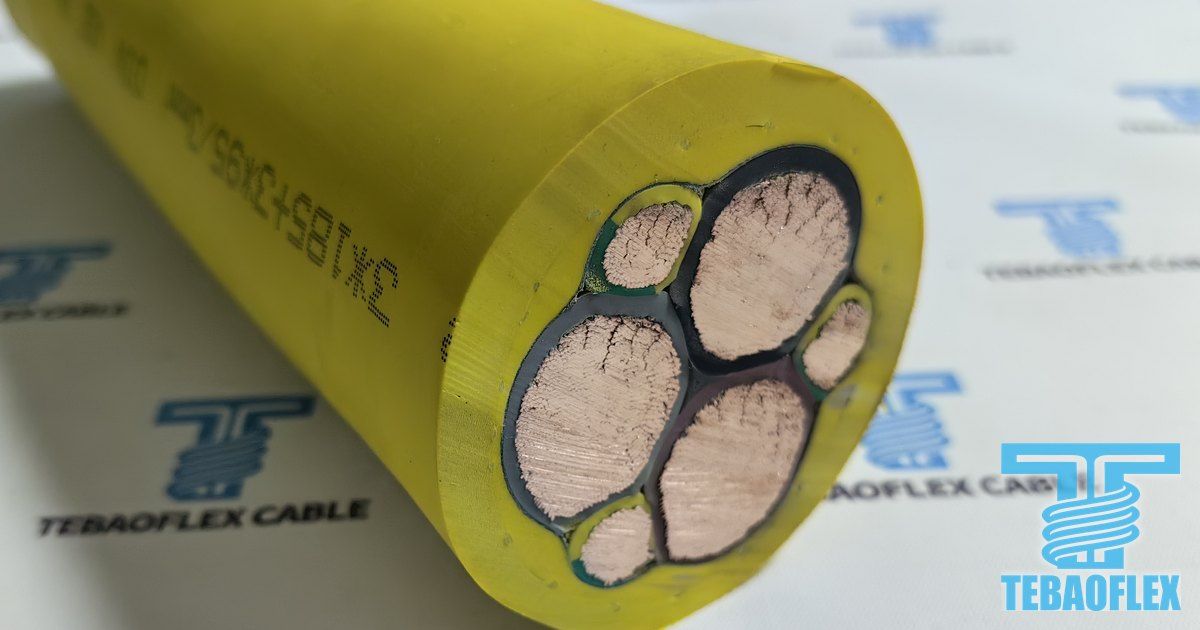
Cover photo: cut end of the 3×185+3×95/3 cable from this order. Photo: TEBAOFLEX, September 2026.