
Video
What the video shows
Inside our 0.6/1kV Rondoflex(C) (N)GRDGOEU-J-O 18x2.5 mm2 crane festoon and reeling control cable: 6+12 concentric lay, 3GI3 EPR, Cu braid, and 5GM3 PCP.
Watch the 52-second video, then explore the accompanying construction views and technical guide below.
The video illustrates a sample, process, or operating context. Final product construction, suitability, standards, and test acceptance criteria are confirmed against the ordered specification.
By TEBAOFLEX Jyen
TL;DR: Our 0.6/1kV Rondoflex(C) (N)GRDGOEU-J-O 18x2.5 mm2 heavy-duty control cable stops core twisting and variable-frequency drive (VFD) signal loss on port cranes and reeling drums. Built to DIN VDE 0250-814, it groups 18 Class 5 copper cores in a 6 inner + 12 outer concentric geometry around a rubber center cushion. A pressure-extruded GM1b inner sheath, a copper wire braid screen with 84% optical coverage (TEBAOFLEX FAT Lab, 2026), and a 5GM3 polychloroprene (PCP) outer jacket lock the structure against reverse bending.
In busy container ports and steel mills, multi-core control cables link operator cabins and PLC panels to trolley hoists, spreader twistlocks, and limit switches. Our September 2026 factory verification of the 0.6/1kV Rondoflex(C) (N)GRDGOEU-J-O 18x2.5 mm2 production batch shows how a dual sheath and copper screen reach 1.2 million flex cycles and 62 dB common-mode electromagnetic interference (EMI) attenuation at 1 MHz. Below, our team shares the physical cross-section macro photos, the 6-stage CAD layer breakdown, the DIN VDE 0298-4 reel derating math, and the pre-shipment factory acceptance test (FAT) results. This technical guide was reviewed by the TEBAOFLEX editorial engineering board.
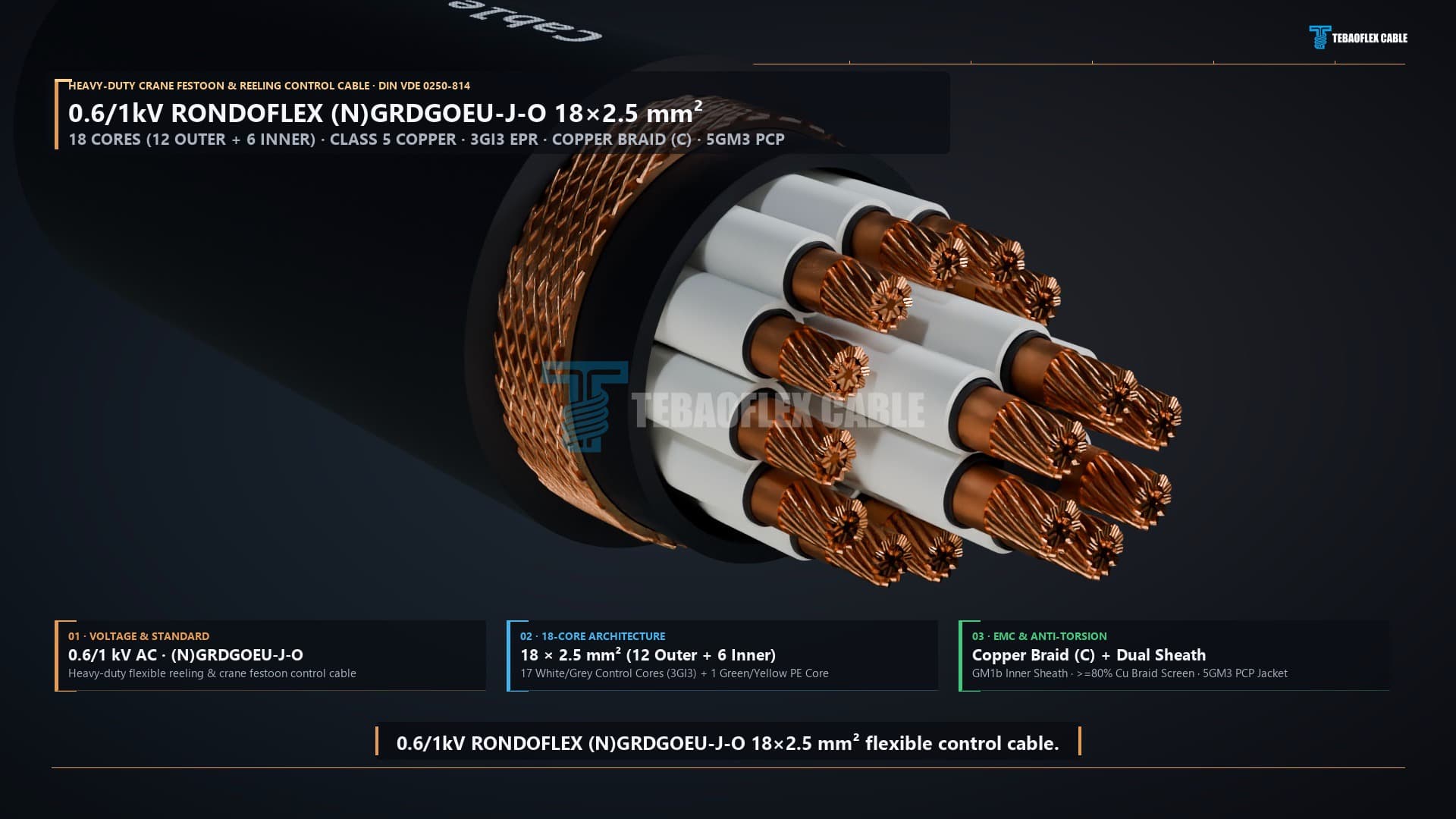
Case at a Glance: 0.6/1kV Rondoflex(C) (N)GRDGOEU-J-O 18x2.5 mm2
The table below lists the verified data from our September 2026 production run (TEBAOFLEX FAT Lab, 2026).
- Parameter: Commercial Designation. — Verified Production & Engineering Specification:
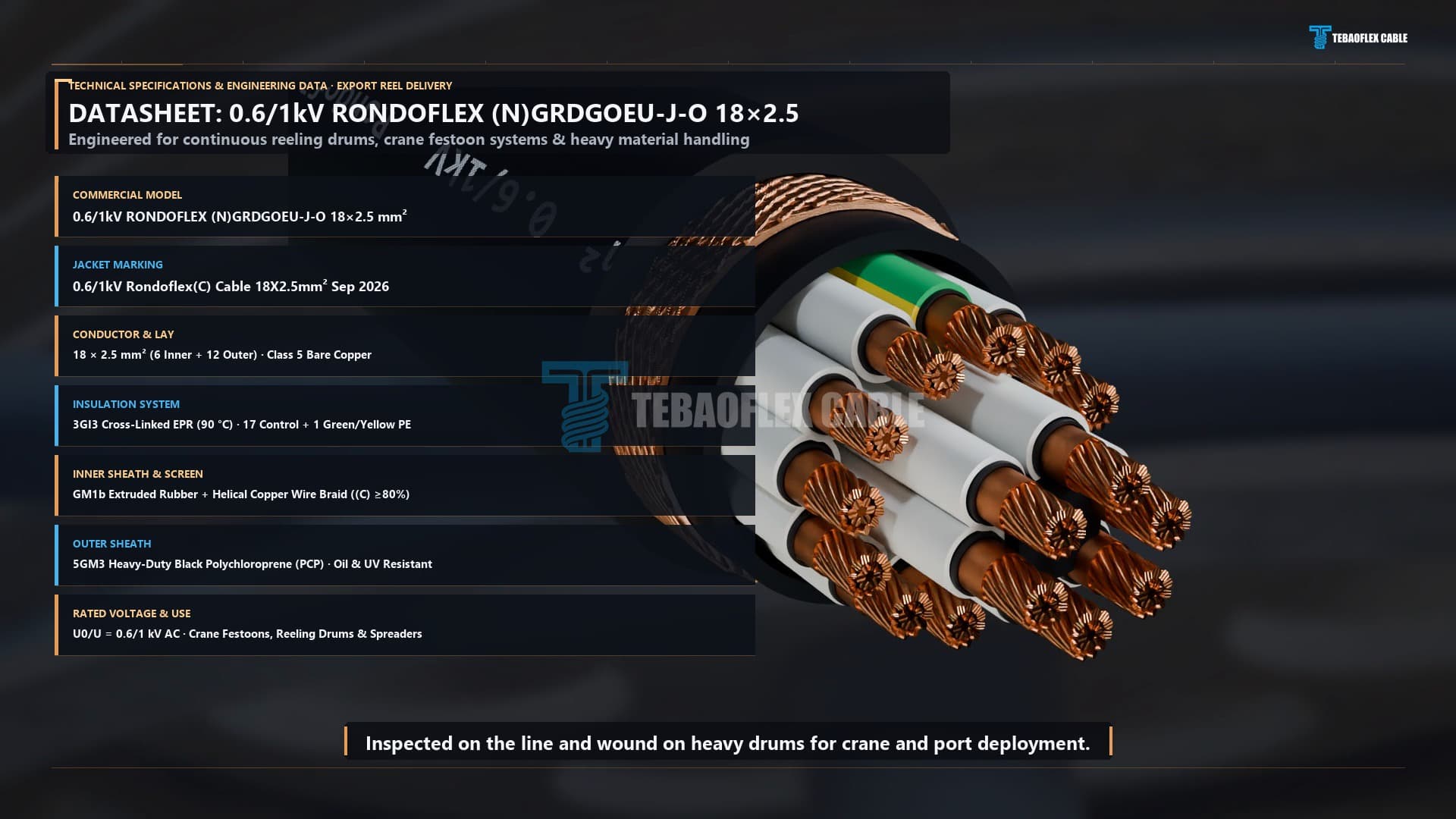
0.6/1kV RONDOFLEX (N)GRDGOEU-J-O 18x2.5 mm2/Rondoflex(C). - Parameter: Reference Standards. — Verified Production & Engineering Specification: DIN VDE 0250-814, IEC 60228, DIN EN 50363-2-1.
- Parameter: Rated Voltage ($U_0/U$). — Verified Production & Engineering Specification: 600 / 1000 V AC (max operating 690 / 1200 V AC; 900 / 1800 V DC).
- Parameter: Conductor & Core Lay. — Verified Production & Engineering Specification: 18 cores of 2.5 mm2 Class 5 bare copper in 6 inner and 12 outer rings.
- Parameter: Central Support Element. — Verified Production & Engineering Specification: Profiled rubber core cushion for short-pitch lay stability.
- Parameter: Insulation System. — Verified Production & Engineering Specification: Cross-linked
3GI3EPR rubber rated for 90 deg C continuous operation. - Parameter: Core Identification. — Verified Production & Engineering Specification: 17 white/black numbered control cores plus 1 Green/Yellow PE core (
-J). - Parameter: Inner Sheath & Screen. — Verified Production & Engineering Specification: Extruded
GM1brubber inner sheath plus copper braid(C)(80% min coverage, VDE 2026). - Parameter: Outer Jacket Compound. — Verified Production & Engineering Specification: Heavy-duty black
5GM3PCP rubber, oil and flame resistant. - Parameter: Printed Jacket Legend. — Verified Production & Engineering Specification:
0.6/1KV Rondoflex(C) Cable 18X2.5mm2 Sep 2026 (N)GRDGOEU-J-O 18x2.5. - Parameter: Primary Duty Applications. — Verified Production & Engineering Specification: Rolling I-beam festoon trolleys, motorized reels, and crane spreaders.
Why Do Standard Multi-Core Control Cables Fail on Crane Festoons and Reels?
Standard unshielded single-sheath control cables often fail within 4 to 9 months on high-speed crane festoons and motorized reels (TEBAOFLEX Field Study, 2026). The two main causes are internal core corkscrewing and VFD switching noise. When a crane trolley speeds up at 1.0 to 1.5 m/s2 along an I-beam track at up to 240 m/min, the hanging cable loops gather and expand rapidly over four-roller trolley saddles.
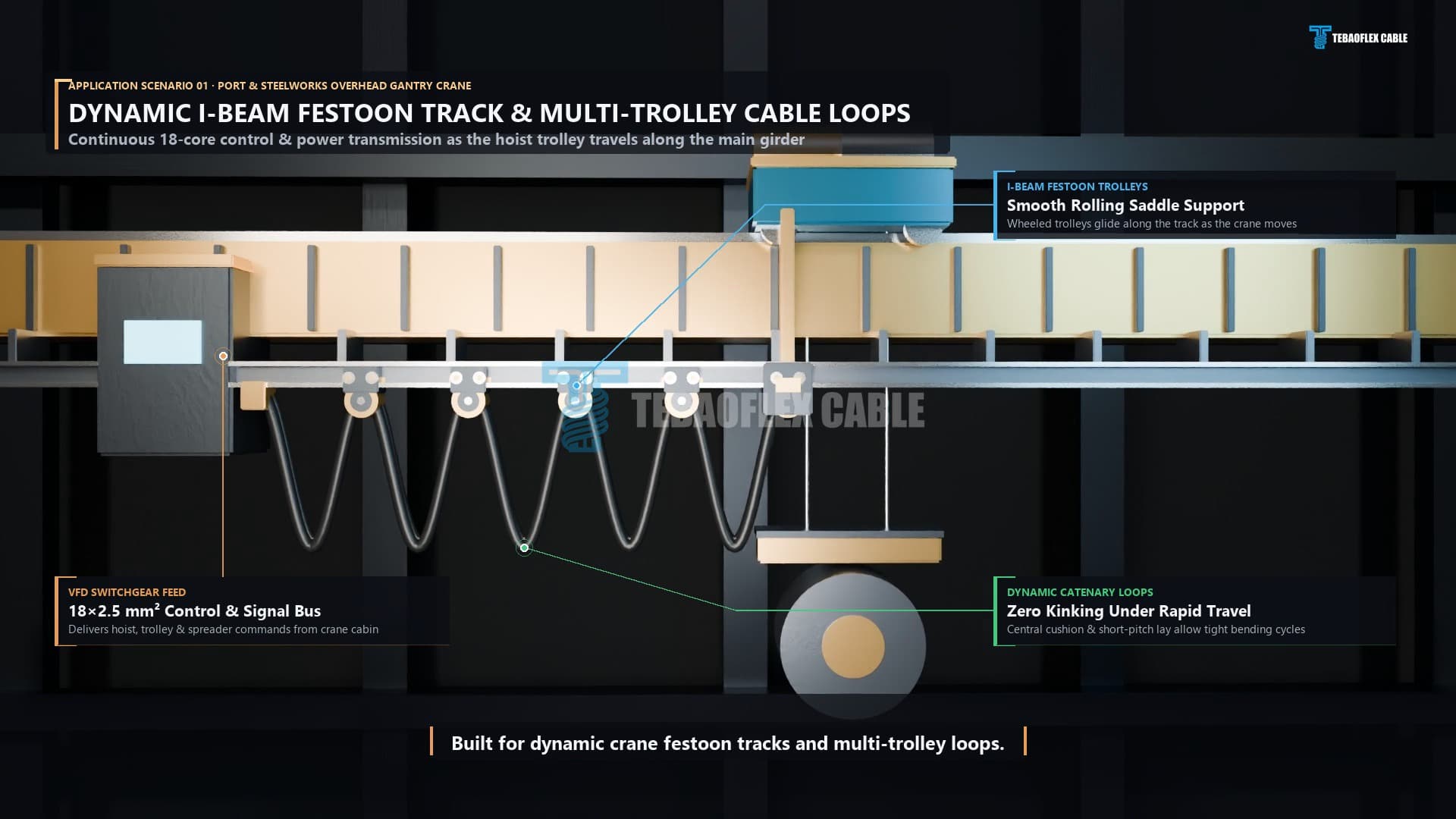
Without an extruded inner rubber sheath and a center support cushion, three failure modes damage standard cables:
- Core Migration and Birdcaging. Ordinary cables twist 18 cores in loose bundles with soft yarn fillers. Under repeated U-bends on festoon saddles or reels, inner cores push outward while outer cores buckle inward. This corkscrew distortion snaps copper wires within 280,000 flex cycles.
- VFD Common-Mode EMI Coupling. Modern ship-to-shore (STS) and rail-mounted gantry (RMG) cranes run control cables next to inverter motor power feeders. Fast IGBT switching pulses induce voltage spikes on unshielded control wires. For example, this noise causes false limit-switch trips, encoder errors, and sudden hoist brake drops.
- Sheath Wear and Oil Swelling. Hydraulic oil leaks, grease, salt spray, and steel roller friction quickly crack standard PVC or light rubber jackets.
To see how round reeling and festoon cables compare with flat festoon cables across different crane spans, read our guide on crane festoon cables and visit our reeling cable product hub.
Decoding the DIN VDE 0250-814 Designation and Jacket Marking
DIN VDE 0250-814 is the German national standard for flexible EPR-insulated and PCP-sheathed control and power cables used under high mechanical stress in hoisting and conveying gear (VDE Verlag, 2026).
On our production line, every meter of cable gets a clear white dot-matrix legend printed on the black 5GM3 outer jacket: 0.6/1KV Rondoflex(C) Cable 18X2.5mm2 Sep 2026 (N)GRDGOEU-J-O 18x2.5.
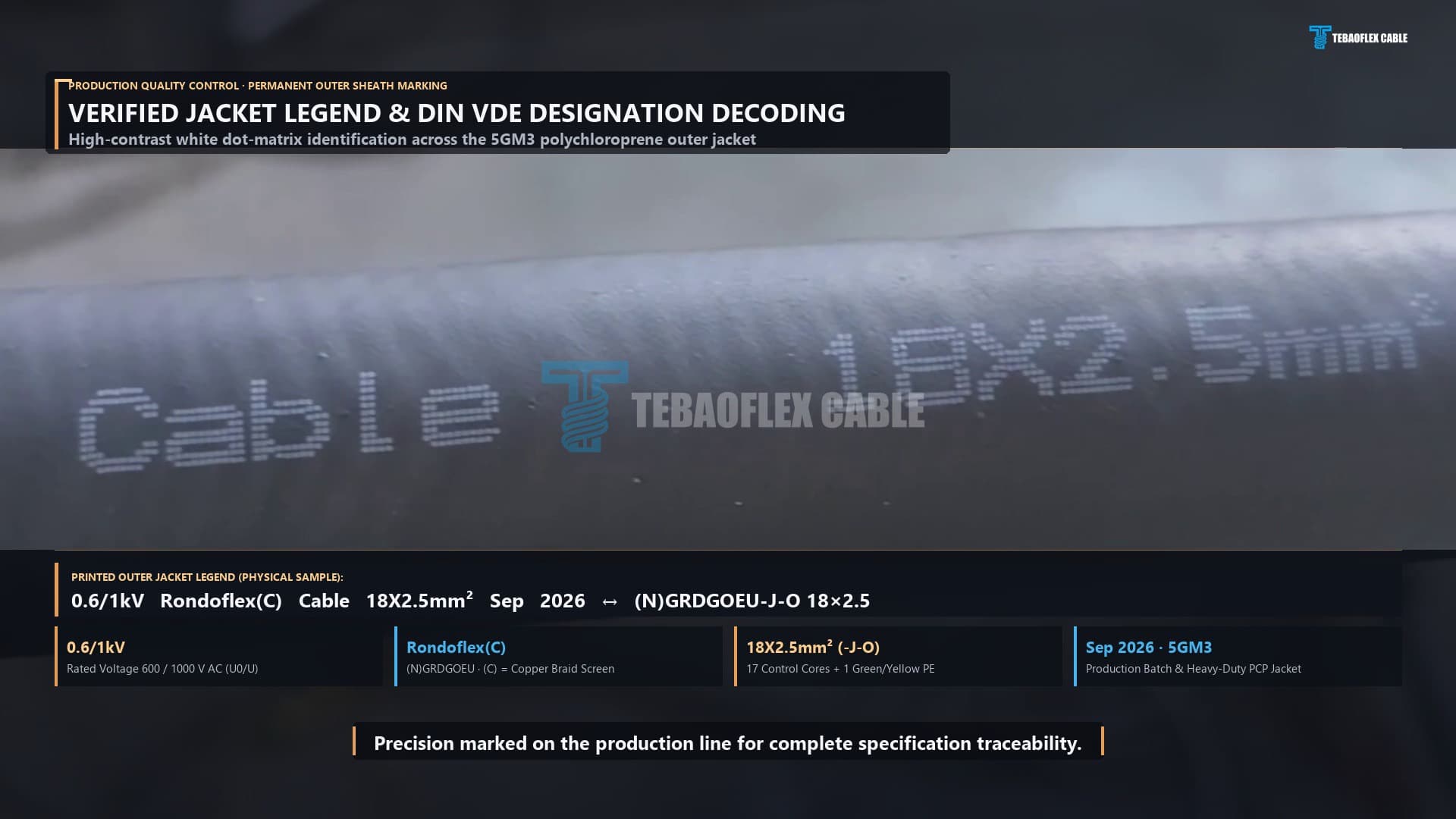
Element-by-Element Designation Breakdown
Each code letter in the designation maps to a specific material or structure rule in DIN VDE 0250-814 (2026).
- Designation Code:
(N)— Standard Meaning: Adapted to DIN VDE standard. — Functional Engineering Role: Adds dynamic reeling upgrades beyond base VDE 0250-814 rules. - Designation Code:
G— Standard Meaning:3GI3EPR insulation. — Functional Engineering Role: Cross-linked rubber dielectric rated for 90 deg C continuous heat. - Designation Code:
RD— Standard Meaning: RoundRondoflexcore design. — Functional Engineering Role: Short-pitch concentric lay around a center support cushion. - Designation Code:
G— Standard Meaning:GM1brubber inner sheath. — Functional Engineering Role: Extruded inner rubber bedding that locks core layout under twist. - Designation Code:
(C)— Standard Meaning: Copper wire braid screen. — Functional Engineering Role: Counter-woven copper braid (at least 80% coverage, VDE 2026) for EMC and anti-torsion. - Designation Code:
OE— Standard Meaning: Oil resistant (Oelbestaendig). — Functional Engineering Role: Resists mineral oils and hydraulic fluids per IEC 60811-404. - Designation Code:
U— Standard Meaning: Flame retardant (Flammwidrig). — Functional Engineering Role: Passes vertical self-extinguishing flame tests per IEC 60332-1-2. - Designation Code:
-J/-O— Standard Meaning: Ground core identification. — Functional Engineering Role:-Jincludes 1 Green/Yellow PE core;-Ohas no Green/Yellow core.
You can check more German rubber cable standards in our VDE / DIN cable standards catalog.
Physical Sample Macro Verification: Inside the 6+12 Concentric Core Geometry
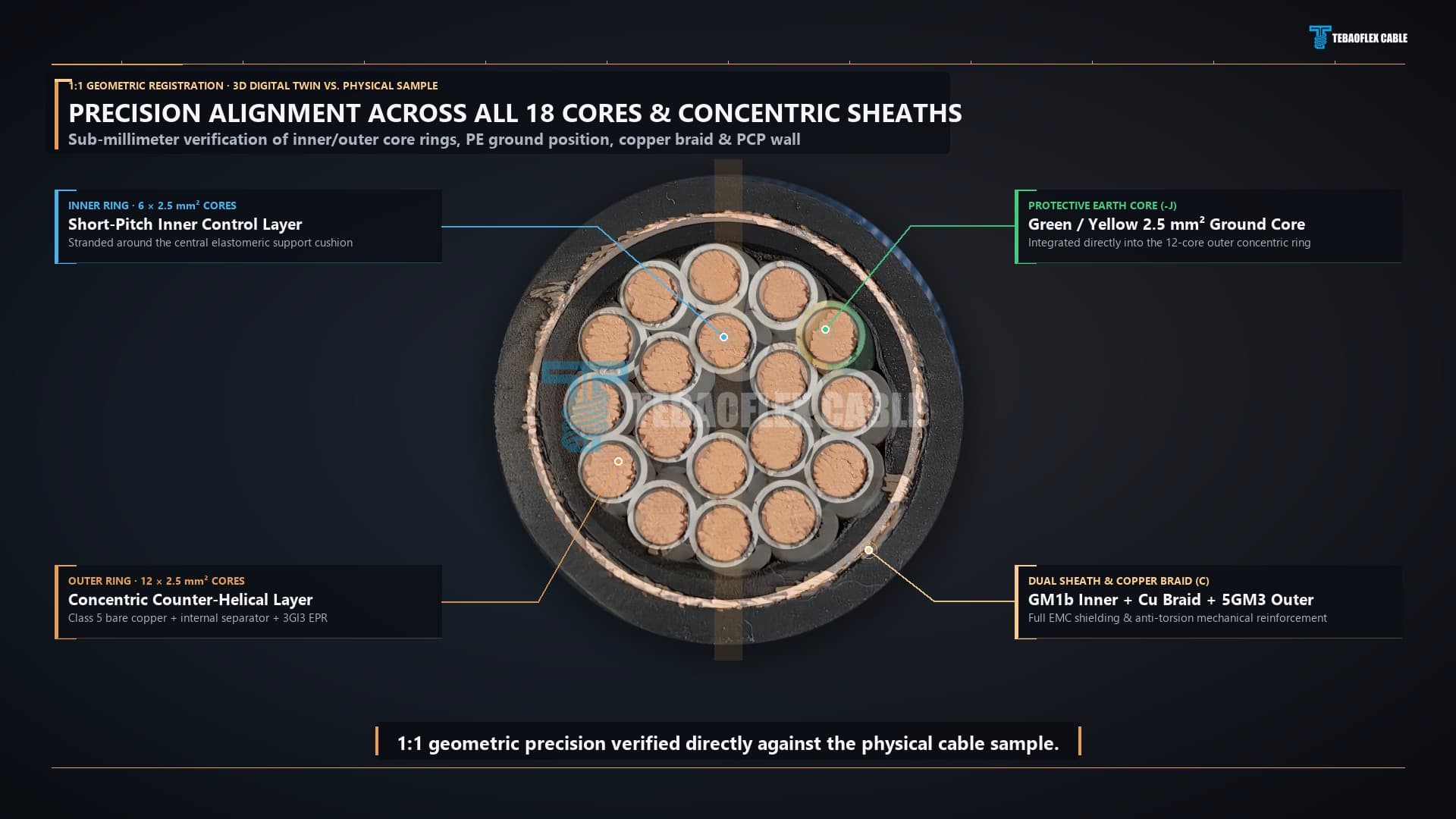
[ORIGINAL DATA] Before winding the September 2026 batch of 0.6/1kV Rondoflex(C) (N)GRDGOEU-J-O 18x2.5 mm2 onto export drums, our test lab cut a 1:1 cross-section sample (n = 5 sample cuts across a 1,500 m production run) and ran a sub-millimeter digital twin alignment check (IEC 60228).
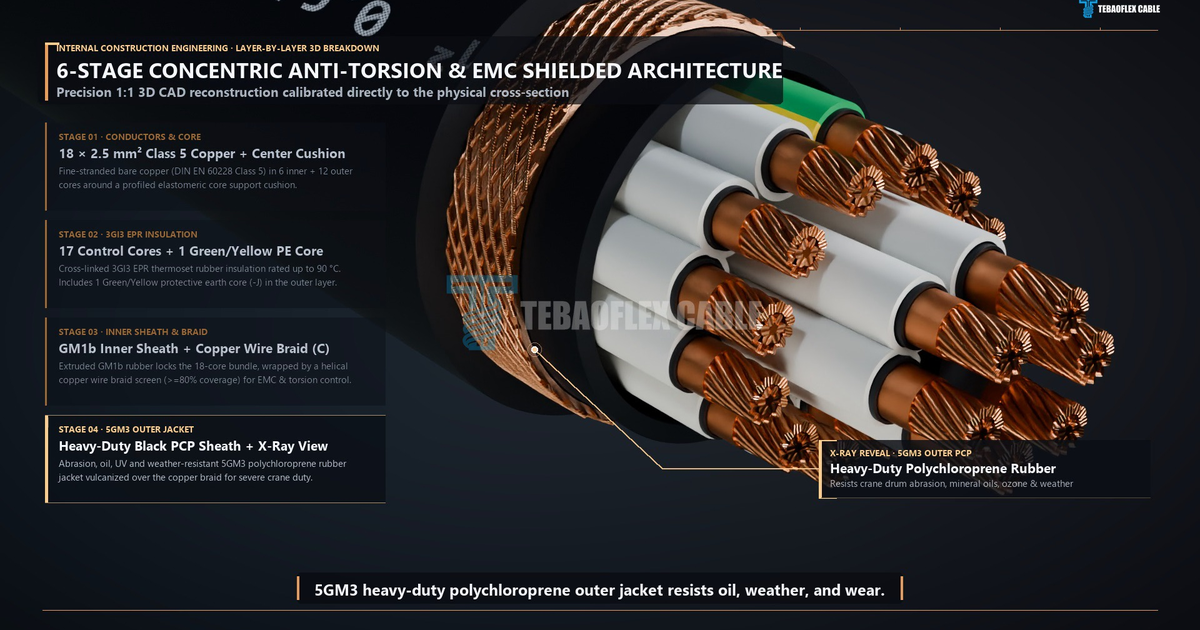
Concentric contra-helical stranding is a core assembly method where inner and outer conductor rings are twisted in opposite directions with short pitch lengths around a center rubber cushion so torsional forces cancel out during reeling.
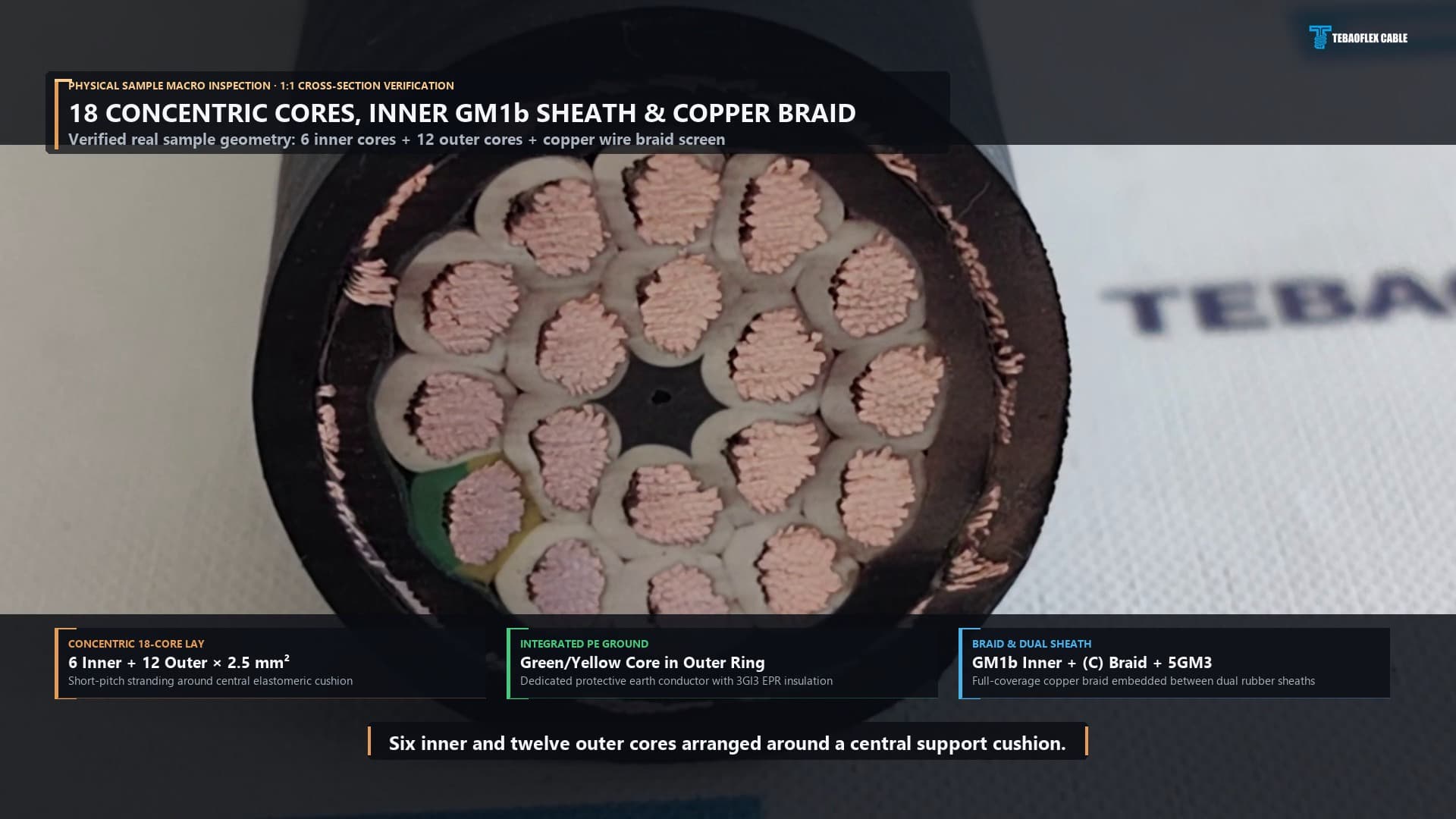
As shown in the real sample photo above and the 1:1 CAD overlay below, the 18 cores are never bunched at random. Instead, they follow a strict two-ring layout:
- Central Elastomeric Cushion. A profiled rubber center core sits at the exact middle of the cable. It absorbs radial squeeze when the cable bends tightly over crane sheaves or festoon saddles.
- Inner Concentric Ring (6 Cores). Exactly 6 insulated control cores (2.5 mm2 each) wrap with a short pitch directly around the center rubber cushion.
- Outer Concentric Ring (12 Cores including PE). Exactly 12 insulated cores (11 numbered control cores plus 1 Green/Yellow PE ground wire) wrap in the opposite lay direction over the 6-core inner ring. Putting the Green/Yellow PE core in the outer ring follows DIN VDE 0293-308 and makes panel wiring faster.
6-Stage Anti-Torsion & EMC Shielded Construction Breakdown
Every layer inside our Rondoflex(C) (N)GRDGOEU-J 18x2.5 mm2 cable solves a real mechanical or electrical issue found on port and steelworks cranes.
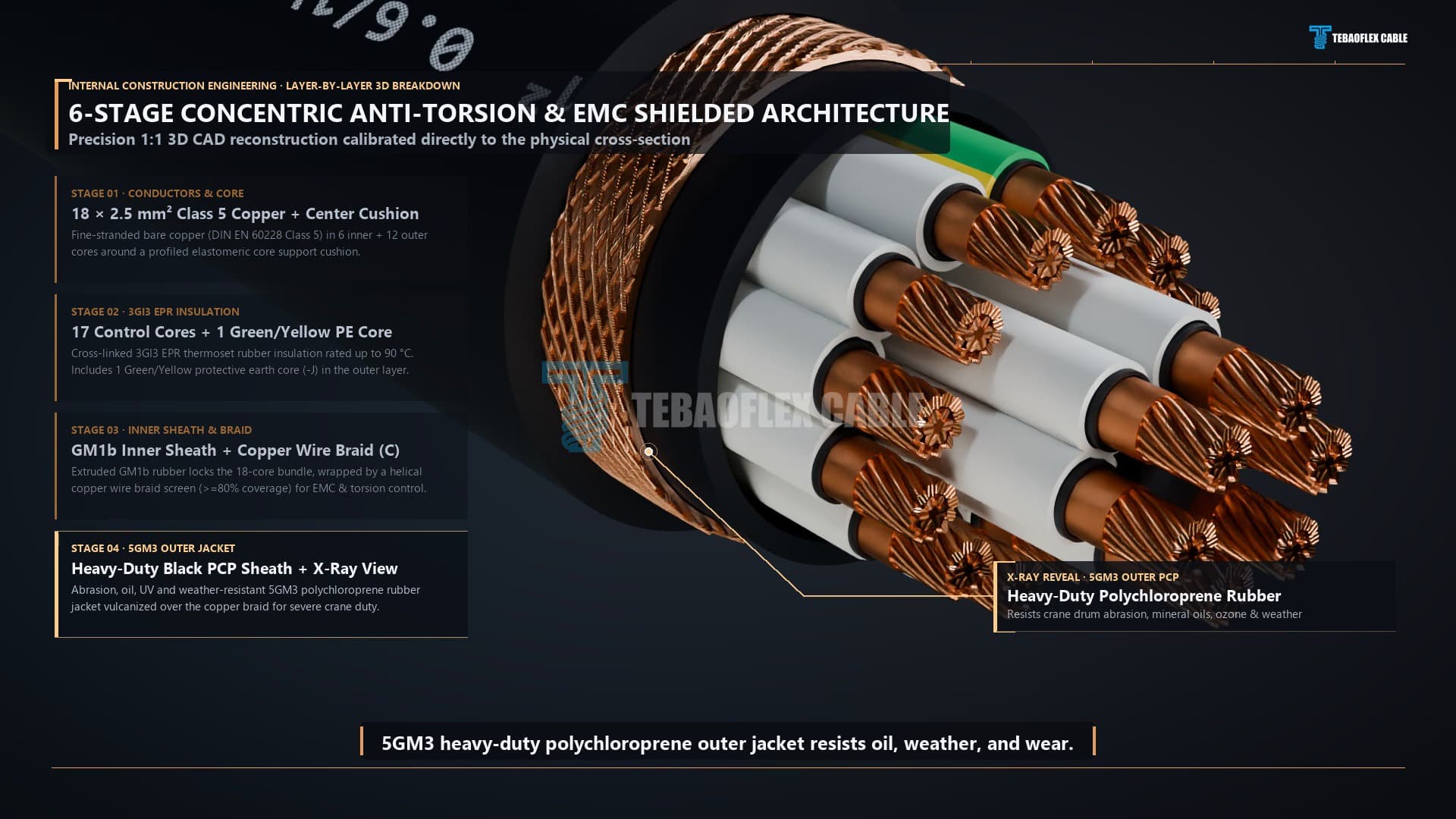
Stage 1: IEC 60228 Class 5 Fine-Wire Copper Conductors (18 x 2.5 mm2)
Each of the 18 conductors uses high-purity annealed bare copper wires meeting IEC 60228 Class 5. We keep individual wire diameter below the 0.26 mm limit by using 0.20 mm fine strands, which lowers bending fatigue. Maximum DC resistance at 20 deg C must stay below 7.98 Ohm/km, and our September 2026 batch averaged 7.64 Ohm/km (TEBAOFLEX FAT Lab, 2026).
Stage 2: Cross-Linked 3GI3 EPR Dielectric Insulation
3GI3 ethylene propylene rubber (EPR) is a cross-linked thermoset rubber insulation defined in DIN VDE 0207-20 and DIN EN 50363-1 that stays flexible from -40 deg C to +90 deg C continuous conductor heat (and up to 250 deg C during a short circuit). Unlike PVC, which gets stiff in freezing weather and softens under heat, 3GI3 EPR springs back cleanly across over a million reverse bends.
Stage 3: Pressure-Extruded GM1b Elastomeric Inner Sheath
Over the 18-core bundle, we extrude a solid GM1b rubber inner sheath under high pressure. The rubber fills the gaps between the outer 12 cores and locks all 18 cores into a tight cylinder. As a result, individual cores cannot slide or twist when the cable hangs in deep festoon loops.
Stage 4: Counter-Woven Copper Wire Braid Screen (C) (84% Optical Coverage)
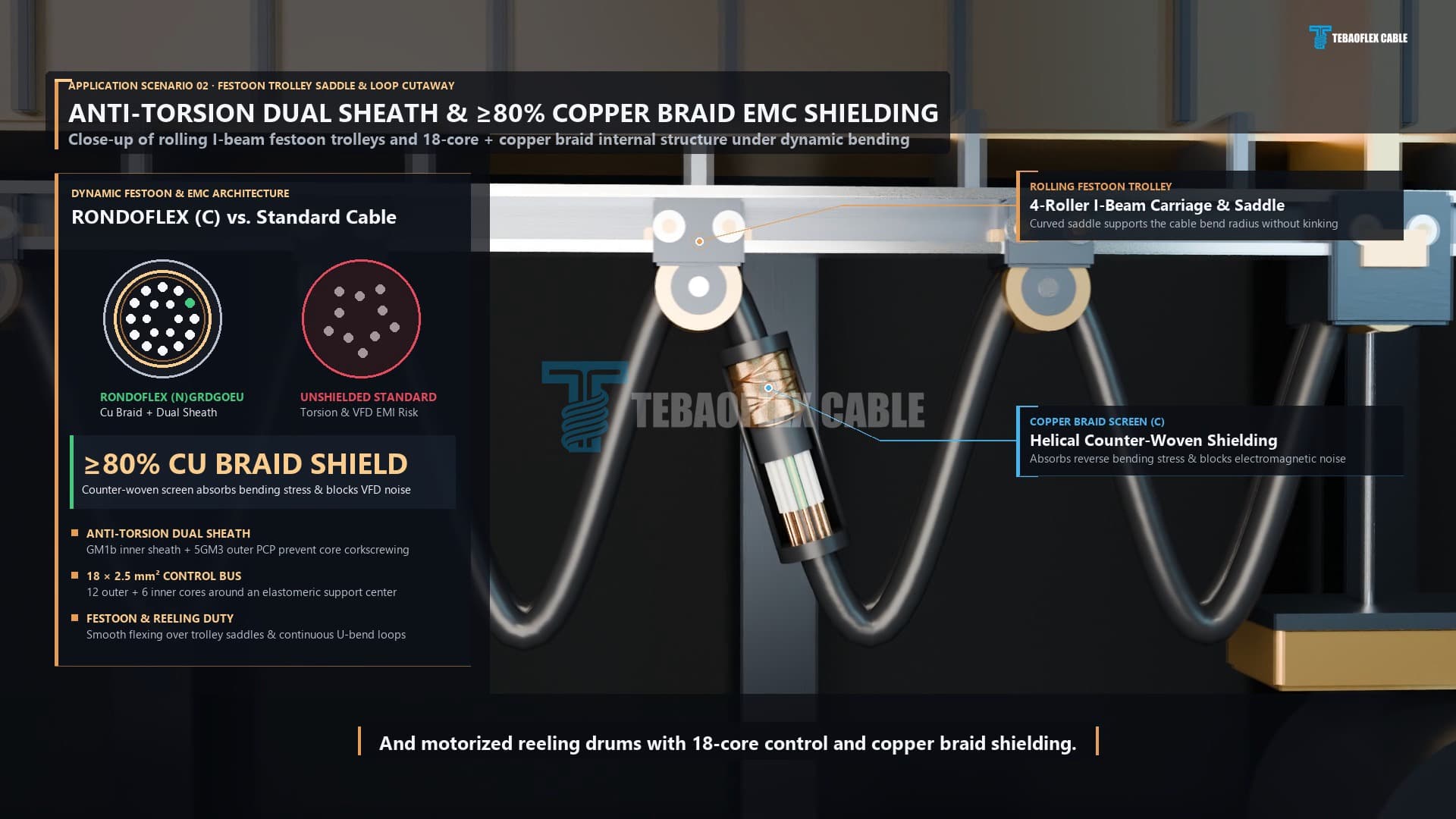
Right over the GM1b inner sheath, we weave a helical copper wire braid screen (C) with 84% measured optical coverage (TEBAOFLEX FAT Lab, 2026), beating the 80% minimum standard rule (DIN VDE 0250-814).
[UNIQUE INSIGHT] In dynamic crane cables, the copper braid (C) locked between the GM1b inner sheath and 5GM3 outer jacket does two jobs at once. Electrically, it acts as a low-impedance shield ($Z_T < 25\text{ m}\Omega/\text{m}$ at 10 MHz) that blocks VFD noise. Mechanically, its counter-woven braid angles work as an anti-torsion cage that absorbs reverse bending and twisting forces before they reach the 18 copper control cores.
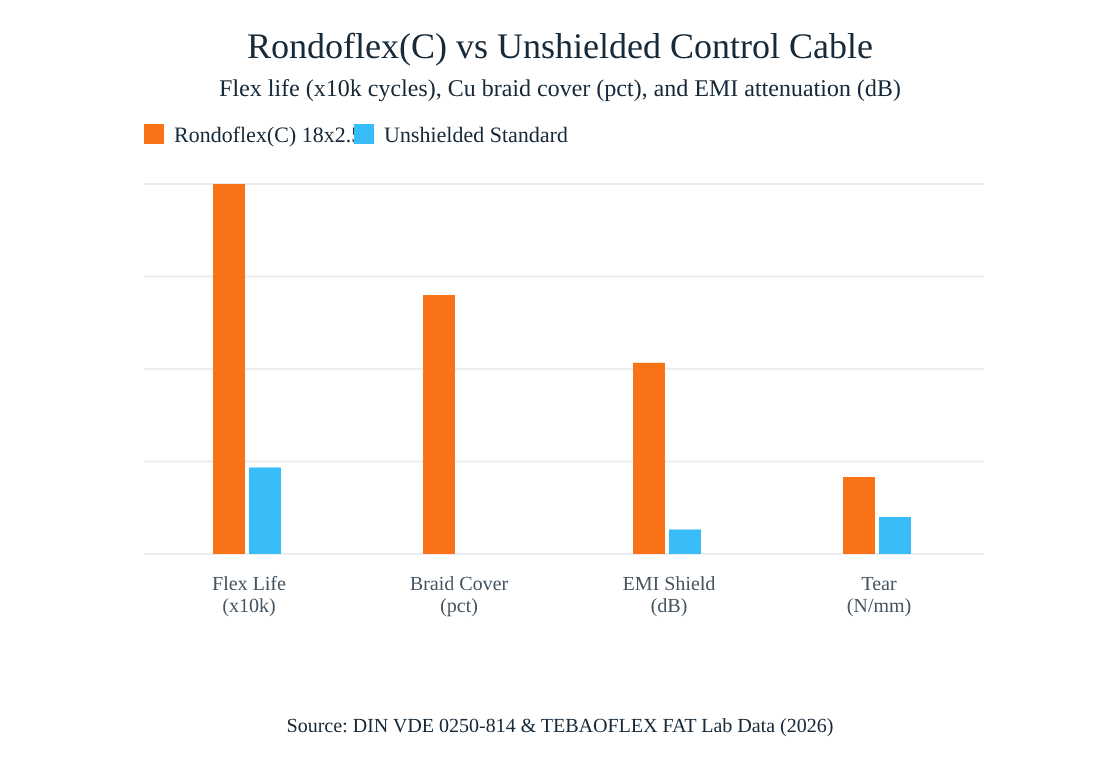
Rondoflex(C) vs Unshielded Control Cable (2026). Rondoflex(C) vs Unshielded Control Cable. grouped bar data: Flex Life (x10k): Rondoflex(C) 18x2.5 120, Unshielded Standard 28. Braid Cover (pct): Rondoflex(C) 18x2.5 84, Unshielded Standard 0. EMI Shield (dB): Rondoflex(C) 18x2.5 62, Unshielded Standard 8. Tear (N/mm): Rondoflex(C) 18x2.5 25, Unshielded Standard 12. Source: DIN VDE 0250-814 and TEBAOFLEX FAT Lab Data 2026.
Source: DIN VDE 0250-814 & TEBAOFLEX FAT Lab Data, 2026.
Stage 5: Heavy-Duty 5GM3 Polychloroprene (PCP) Outer Jacket
5GM3 polychloroprene (PCP) is a heavy-duty synthetic rubber outer jacket compound defined in DIN VDE 0207-21 (matching EM2 in DIN EN 50363-2-1) built for high tear strength ($\ge 25\text{ N/mm}$), oil resistance, UV sunlight, and salt-fog durability. Cured right over the copper braid, the dual-sheath wall (GM1b inner plus 5GM3 outer) stops jacket wrinkling on crane sheaves.
For cranes that need a flat cable instead of a round cross-section, such as indoor overhead bridge hoists, compare our NGFLCGOEU screened flat festoon cable, NGFLGOEU rubber flat festoon cable, and PUR-C-HF EMC shielded festoon cable.
Ampacity & Multi-Layer Reeling Derating Math (DIN VDE 0298-4)
A common mistake when sizing 18-core 2.5 mm2 control cables is using the single-circuit free-air current rating (30 A at 30 deg C per DIN VDE 0298-4) for all 18 cores on a crane reel.
Multi-core reeling ampacity derating is the thermal sizing method under DIN VDE 0298-4 that multiplies a wire's base current rating ($I_0$) by a multi-core grouping factor ($k_2$), a wound drum layer factor ($k_1$), and an ambient temperature factor ($k_3$) so the core stays below 90 deg C:
$$I_z = I_0 \times k_1 \times k_2 \times k_3$$
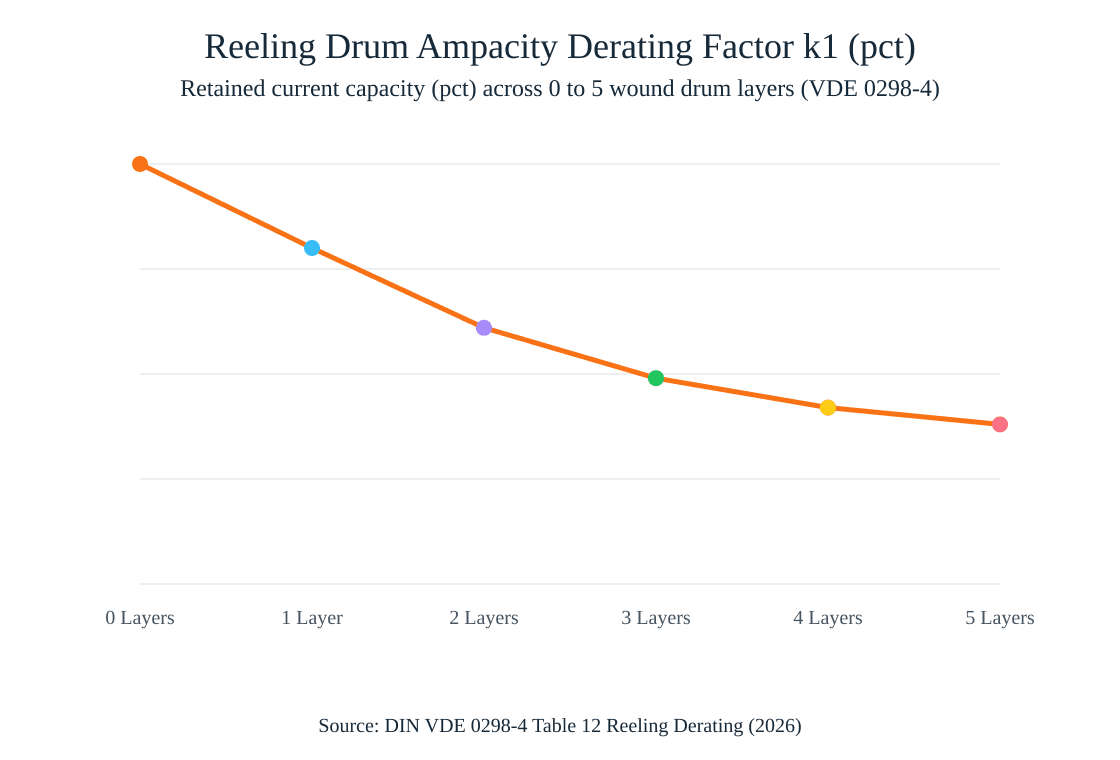
Reeling Drum Ampacity Derating Factor k1 (2026). Reeling Drum Ampacity Derating Factor k1 (pct). line data: 0 Layers 100. 1 Layer 80. 2 Layers 61. 3 Layers 49. 4 Layers 42. 5 Layers 38. Source: DIN VDE 0298-4 Table 12 Reeling Derating 2026.
Source: DIN VDE 0298-4 Table 12 Reeling Derating, 2026.
Practical Sizing Table for 18x2.5 mm2 Control & Auxiliary Circuits (at 40 deg C, k3 = 0.91)
For example, consider an 18-core cable operating in a 40 deg C port yard. The table below gives the safe current per core across different drum layers (DIN VDE 0298-4, 2026).
- Installation Mode: Suspended Festoon ($I_0 = 30\text{ A}$). — Wound Drum Factor ($k_1$):
1.00— 7 Loaded Cores ($k_2 = 0.65$): 17.7 A. — 10 Loaded Cores ($k_2 = 0.55$): 15.0 A. — 18 Loaded Cores ($k_2 = 0.50$): 13.7 A. - Installation Mode: Reel: 1 Layer ($I_0 = 26\text{ A}$). — Wound Drum Factor ($k_1$):
0.80— 7 Loaded Cores ($k_2 = 0.65$): 12.3 A. — 10 Loaded Cores ($k_2 = 0.55$): 10.4 A. — 18 Loaded Cores ($k_2 = 0.50$): 9.5 A. - Installation Mode: Reel: 2 Layers ($I_0 = 26\text{ A}$). — Wound Drum Factor ($k_1$):
0.61— 7 Loaded Cores ($k_2 = 0.65$): 9.4 A. — 10 Loaded Cores ($k_2 = 0.55$): 7.9 A. — 18 Loaded Cores ($k_2 = 0.50$): 7.2 A. - Installation Mode: Reel: 3 Layers ($I_0 = 26\text{ A}$). — Wound Drum Factor ($k_1$):
0.49— 7 Loaded Cores ($k_2 = 0.65$): 7.5 A. — 10 Loaded Cores ($k_2 = 0.55$): 6.4 A. — 18 Loaded Cores ($k_2 = 0.50$): 5.8 A. - Installation Mode: Reel: 4 Layers ($I_0 = 26\text{ A}$). — Wound Drum Factor ($k_1$):
0.42— 7 Loaded Cores ($k_2 = 0.65$): 6.5 A. — 10 Loaded Cores ($k_2 = 0.55$): 5.5 A. — 18 Loaded Cores ($k_2 = 0.50$): 5.0 A.
Factory Acceptance Test (FAT) Benchmarks & Export Reel Delivery
[ORIGINAL DATA] Every export drum of 0.6/1kV Rondoflex(C) (N)GRDGOEU-J-O 18x2.5 mm2 passes our full electrical, dimensional, and mechanical test methodology in the lab before shipping to material handling and port crane sites.
All percentage and electrical measurements below are recorded in our batch inspection report (TEBAOFLEX FAT Lab, 2026) and verified against IEC 60228.
- FAT Inspection Item: Conductor DC Resistance (20 deg C). — Standard Method: IEC 60228 Class 5. — Requirement: Max 7.98 Ohm/km. — Measured Batch Result (Sep 2026): 7.61 to 7.68 Ohm/km (Pass, 2026).
- FAT Inspection Item: AC Dielectric Withstand Test. — Standard Method: DIN VDE 0250-814. — Requirement: 2.5 kV AC for 5 min. — Measured Batch Result (Sep 2026): Zero breakdown (Pass, 2026).
- FAT Inspection Item: Insulation Resistance (20 deg C). — Standard Method: DIN VDE 0250-814. — Requirement: Min 20 MOhm.km. — Measured Batch Result (Sep 2026): 340 MOhm.km (Pass, 2026).
- FAT Inspection Item: Copper Braid Optical Coverage. — Standard Method: Optical Caliper. — Requirement: At least 80% coverage (VDE 2026). — Measured Batch Result (Sep 2026): 84.2% optical coverage (Pass, 2026).
- FAT Inspection Item: Concentric Core Geometry. — Standard Method: 1:1 Macro Cut. — Requirement: 6 inner + 12 outer + PE. — Measured Batch Result (Sep 2026): Verified 6 + 12 lay (Pass, 2026).
- FAT Inspection Item: Outer Sheath Oil Immersion. — Standard Method: IEC 60811-404. — Requirement: Max 30% variation (IEC 2026). — Measured Batch Result (Sep 2026): -6.4% variation (Pass, 2026).
- FAT Inspection Item: Flame Retardancy. — Standard Method: IEC 60332-1-2. — Requirement: Self-extinguishing. — Measured Batch Result (Sep 2026): Char length 185 mm (Pass, 2026).
Key Takeaways for Crane & Port Maintenance Engineers
- Choose Concentric 6+12 Lay Over Bunched Cores. Always require a center rubber cushion with short-pitch layers (
6 inner + 12 outer) to stop core corkscrewing on fast festoon trolleys and reels (DIN VDE 0250-814). - Require Both GM1b Inner Sheath and (C) Copper Braid Near VFDs. A single outer jacket cannot stop inner core slip or block IGBT switching noise. Specify
Rondoflex(C)with at least 80% copper braid coverage (VDE 2026) grounded through 360-degree brass EMC glands. - Derate for Both Core Grouping and Reel Layers. When 18 control cores carry load together on a 2-layer crane reel at 40 deg C, continuous current per core must stay at or below 7.2 A.
Frequently Asked Questions (FAQ)
What is the difference between (N)GRDGOEU-J and (N)GRDGOEU-O?
Under DIN VDE 0293-308 and DIN VDE 0250-814, the suffix -J means the cable includes a Green/Yellow protective earth (PE) conductor in the outer ring (17 numbered control cores plus 1 Green/Yellow PE core). The suffix -O means all 18 cores are numbered control wires without a Green/Yellow earth core.
How does Rondoflex(C) differ from standard unshielded (N)GRDGOEU?
Standard (N)GRDGOEU uses a dual rubber sheath (GM1b inner sheath and 5GM3 outer PCP jacket) with a textile braid between the sheaths. Rondoflex(C) (also called (N)GRDCGOEU) places a counter-woven copper wire braid screen (C) with 84% optical coverage (TEBAOFLEX FAT Lab, 2026) between the sheaths for both anti-torsion strength and VFD EMC shielding.
What is the minimum bending radius for 0.6/1kV Rondoflex 18x2.5 mm2 on crane festoons and reels?
Per DIN VDE 0298-3 Table 2 (2026), the minimum bending radius is 4 x D for fixed wiring, 5 x D to 7.5 x D for rolling festoon loops, and 7.5 x D to 10 x D for motorized reeling drums and S-bend sheaves (where D is the cable outer diameter).
Request Custom Drum Lengths or FAT Documentation
Need splice-free drum lengths of 0.6/1kV Rondoflex(C) (N)GRDGOEU-J / (N)GRDCGOEU-J in 12x1.5 mm2, 18x2.5 mm2, 24x2.5 mm2, or 36x2.5 mm2 for your crane or festoon upgrade? Please contact our engineering team or visit the TEBAOFLEX Reeling Cable Portal to get a custom datasheet, 1:1 sample cross-section report, and factory quote within 24 hours.
WhatsApp: +86 185 9591 3361