

Among high-temperature wire types, published wire ratings put ETFE (ethylene tetrafluoroethylene) at the bottom and mica with glass braid at the top. In aerospace wire, ETFE is rated 150 °C, or 200 °C when crosslinked on silver-coated conductors. Silicone rubber gets 180 °C under the European Standard (EN) and International Electrotechnical Commission (IEC) route, or 200 °C as braided UL appliance wiring material (AWM). UL's AWM style pages are archived: each says it "is no longer being updated" and is "for historic reference only".
FEP (fluorinated ethylene propylene) is rated 200 °C in UL style 1330. PFA (perfluoroalkoxy) and PTFE (polytetrafluoroethylene) reach 250 °C in styles 1727 and 1659, and PTFE reaches 260 °C on nickel-coated conductors in AS22759 aerospace wire. Mica with glass braid is rated 450 °C to 550 °C.
A wire's rating depends on conductor plating and the standard route, not only on the insulation. The Federal Aviation Administration (FAA) notes in advisory circular AC 43.13-1B, paragraph 11-67b, that rated temperature may rest on "either the conductor or the insulation".
Key Takeaways
- Mica sits at the top: UL style 5400 rates a mica composite with treated fibreglass braid at 550 °C.
- Resin limits are not wire ratings: Chemours defines the 205 °C continuous service temperature of FEP 100 by 50% property retention after 20,000 hours of thermal ageing.
- For aircraft wire, FAA advisory circular AC 43.13-1B, paragraph 11-77b, limits tin-coated copper to 150 °C and silver-coated wire to 200 °C.
- Silicone single-core cables to BS EN 50525-2-41 have a maximum conductor operating temperature of 180 °C.
- Circuit integrity is a separate requirement: IEC 60331-1 sets a test method for cables that must keep working under fire and mechanical shock.
High-Temperature Wire Types at a Glance
Six insulation families span published wire ratings from 150 °C for ETFE on tin-coated conductors to 550 °C for mica composite with fibreglass braid. Resin limits in the table come from resin makers, and wire ratings from UL style pages, EN standards and an AS22759 list from the National Aeronautics and Space Administration (NASA). Limiting oxygen index (LOI) values come from FAA report DOT/FAA/AR-05/14.
- Insulation: PTFE — Resin or material limit: 260 °C service (640XT X); melt peaks 344 °C initial / 326 °C second heating — Published wire ratings: 200 to 250 °C (UL styles 1199, 1659); 260 °C on nickel-coated conductors (AS22759/12) — Polymer LOI (FAA): 95 — Main trade-off: Ranked last for cut-through and abrasion
- Insulation: FEP — Resin or material limit: 205 °C service; melts at 260 °C — Published wire ratings: 200 °C (UL style 1330) — Polymer LOI (FAA): 95 — Main trade-off: Poor cut-through resistance
- Insulation: PFA — Resin or material limit: 260 °C service; melts at 305 °C — Published wire ratings: 250 °C (UL style 1727) — Polymer LOI (FAA): Not published here — Main trade-off: Not published here
- Insulation: ETFE — Resin or material limit: 150 °C (Tefzel 280); 200 °C for appliance wire (Tefzel 750) — Published wire ratings: 150 °C on tin-coated, 200 °C on silver-coated conductors (AS22759); 150 or 200 °C (UL style 10086) — Polymer LOI (FAA): 30 — Main trade-off: Some ETFE insulations fail flammability at 30% oxygen
- Insulation: Silicone rubber — Resin or material limit: Not published here — Published wire ratings: 180 °C (EN 50525-2-41, 2-83); 200 °C (UL style 3172, braided) — Polymer LOI (FAA): 32 (filled) — Main trade-off: Polymer smoke extinction area 1500 m²/kg (silica particles); poor cut-through
- Insulation: Mica with glass braid — Resin or material limit: Not published here — Published wire ratings: 450 °C (UL style 5335); 550 °C (UL style 5400) — Polymer LOI (FAA): Not published here — Main trade-off: For use where protected from mechanical abuse
For PTFE, FEP and PFA, each wire rating cited here sits at or below the resin's service figure. The same polymer can also carry two ratings, as silicone rubber does on the EN and UL routes. A cell reading "Not published here" marks a value the cited sources do not give. The chart compares published wire ratings across all six families.

Published wire ratings: ETFE 150 °C on tin-coated (AS22759/16) and 200 °C on silver-coated (AS22759/33) conductors, and PTFE 260 °C on nickel-coated conductors (AS22759/12), per the NASA NEPP AS22759 list. Silicone gets 180 °C under BS EN 50525-2-41. UL AWM styles rate FEP at 200 °C (1330), PFA and PTFE at 250 °C (1727, 1659) and braided silicone at 200 °C (3172). Mica with glass braid reaches 450 °C (style 5335) and a mica composite 550 °C (style 5400). These UL pages are archived for historic reference. Retrieved October 2026.
Chart data (readable on mobile):
- ETFE, tin-coated conductor (AS22759/16): 150 °C.
- Silicone, EN 50525-2-41: 180 °C.
- Crosslinked ETFE, silver-coated conductor (AS22759/33): 200 °C.
- FEP, UL style 1330: 200 °C.
- Silicone with braid, UL style 3172: 200 °C.
- PFA, UL style 1727: 250 °C.
- PTFE, UL style 1659: 250 °C.
- PTFE, nickel-coated conductor (AS22759/12): 260 °C.
- Mica with glass braid, UL style 5335: 450 °C.
- Mica composite, UL style 5400: 550 °C.
These are ratings for the cited constructions, not universal limits for each insulation family. The UL style pages are historical references; confirm the supplied wire rating and applicable approval.
Resin Limits vs Wire Ratings
A resin service temperature describes the polymer, while a wire rating belongs to a finished construction under a named standard. Chemours bases the 205 °C continuous service temperature of FEP 100 on accelerated heat-ageing tests. The figure marks where tensile strength and ultimate elongation keep 50% of their original values "after 20,000 hr thermal aging".
The highest UL style ratings cited here sit 5 to 10 °C below the resin figures. FEP wire gets 200 °C in style 1330, against 205 °C for the resin. PFA wire gets 250 °C in style 1727, and Chemours lists 260 °C for PFA 340 resin. PTFE shows the same gap, with 260 °C for PTFE 640XT X resin and 250 °C in style 1659.
FAA guidance explains what a wire rating measures. Paragraph 11-67b lets it rest on the conductor or the insulation withstanding "continuous operation without degradation". Paragraph 11-77d adds that it is "typically a measure of the insulation's ability" to withstand ambient temperature plus current-related conductor rise. Design to the rating of the supplied wire, not to the resin sheet.
PTFE, FEP and PFA
PTFE and PFA share the top fluoropolymer rating among the UL styles cited here, 250 °C, and FEP sits at 200 °C. Chemours gives PTFE 640XT X resin a typical melt peaks of 344 °C on initial heating and 326 °C on second heating, well above its 260 °C service limit. Daikin quotes a 260 °C continuous operating temperature for POLYFLON PTFE F resin, with an LOI of 95%.
PTFE wire is not always a 250 °C product. UL style 1199 rates extruded PTFE at 200 °C for "Internal wiring of appliances and electronic equipment". Of the four insulation systems in FAA Table 11-2b, PTFE ranks best for temperature, flammability, chemical resistance and flexibility, but worst for cut-through and abrasion. It suits hot, chemically harsh routes best where the harness protects it from cuts and rubbing.
FEP is the lower-temperature member of the group. Chemours gives FEP 100 a melting point of 260 °C, and UL style 1330 lists FEP wire at 200 °C for "Internal Wiring of Appliances". The NASA Electronic Parts and Packaging Program (NEPP) adds a caution: "FEP has poor cut through resistance".
PFA sits close to PTFE on heat. Chemours lists PFA 340 for continuous service at 260 °C, with a melting point of 305 °C, below the 326 °C second-heating melt peak reported for PTFE 640XT X. When PFA burns, Chemours says it adds heat slowly "with very little smoke".
Our datasheets for PTFE hook-up wire list NEMA HP 3 Types E, EE and ET at 200 to 260 °C, depending on construction. For FEP hook-up wire, they list NEMA HP 4 Types K, KK and KT at 150 °C or 200 °C, depending on conductor finish. A third page covers extruded PFA wire for wiring inside equipment and for building cable assemblies.
ETFE: 150 °C or 200 °C
ETFE wire carries 150 °C or 200 °C depending on resin grade and conductor plating. Chemours recommends an upper service temperature of 150 °C for Tefzel 280 resin, which melts at 255 to 280 °C and has an LOI of 30 to 32. The resin maker gives its Tefzel 750 grade a 200 °C thermal rating for appliance wire and says all other grades are lower.
UL style 10086 covers extruded ETFE at "150 or 200 deg C". For aerospace wire, SAE International's AS22759E, revised on 15 July 2024, covers fluoropolymer-insulated single conductors on tin-coated, silver-coated or nickel-coated copper or copper alloy.
The NASA NEPP list shows the plating split. It gives /16 extruded ETFE and /32 crosslinked ETFE, both tin-coated, at 150 °C, and /33 crosslinked ETFE on silver-coated high-strength copper alloy at 200 °C. Both /32 and /33 are crosslinked ETFE at 600 V, so the 50 °C step comes from the conductor. FAA Table 11-12, "Protected wiring", lists MIL-W-22759/32 and /33 at the same temperatures.
Our datasheets for ETFE aerospace wire reference the M22759/32 construction on tinned copper at 150 °C and the M22759/33 construction on silver-coated high-strength copper alloy at 200 °C. Each is a 600 V construction insulated with crosslinked modified ETFE and meant for protected harnesses in airframes and avionics. NASA's insulation guide also flags a limit for oxygen-rich spaces: "Some ETFE insulations fail flammability in a 30% oxygen environment".
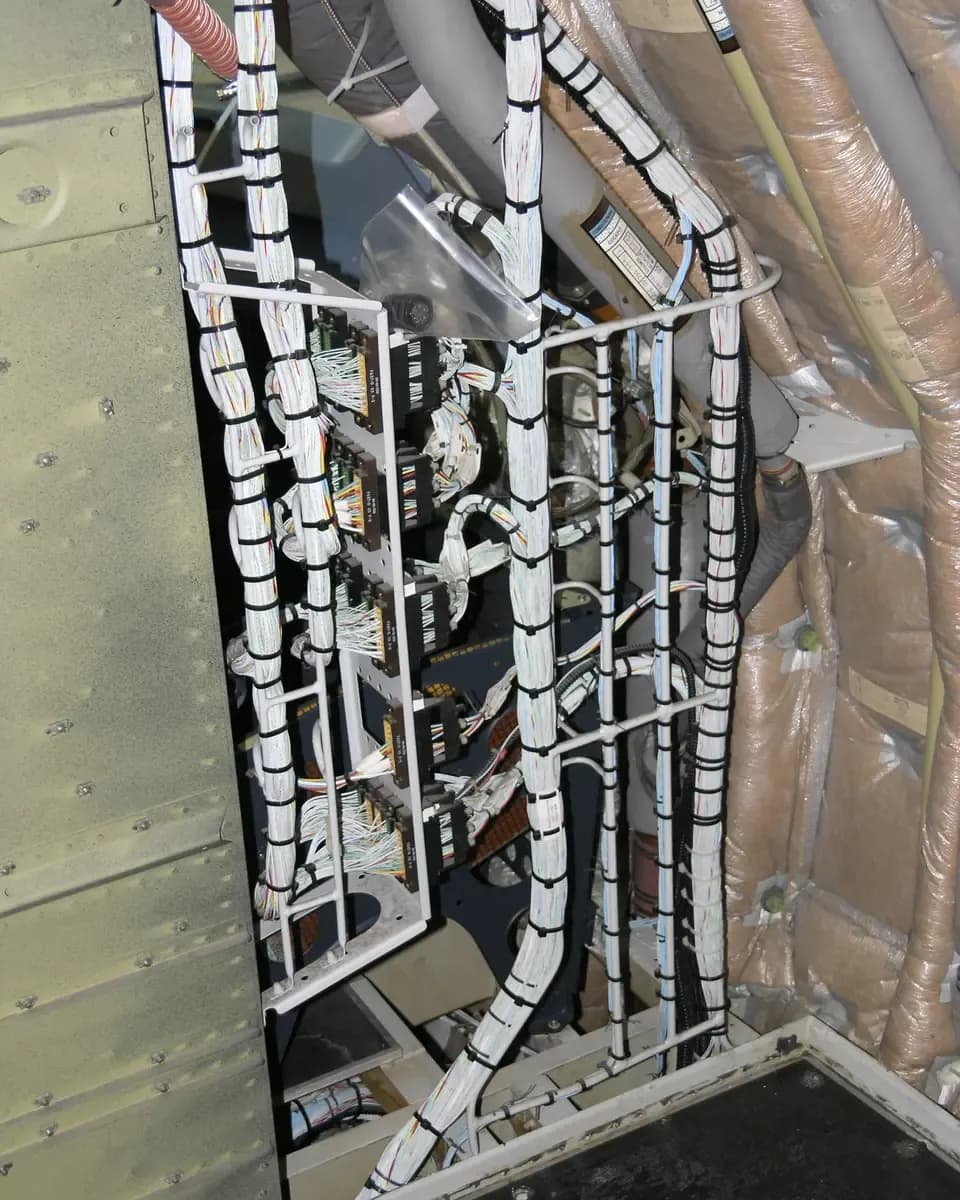
Cable groups behind the cockpit of an Airbus A320, photographed during a 10-year maintenance operation. Photo: "Kabelbaum A320" by Ikiwaner, CC BY-SA 3.0, via Wikimedia Commons, cropped.

Conductor Plating Sets a Ceiling
Conductor plating can cap a wire below what its insulation tolerates. FAA AC 43.13-1B paragraph 11-77b allows tin-coated copper "up to the limiting temperature of 150 °C" and limits silver-coated wire to temperatures that "do not exceed 200 °C". Nickel-coated wire "retains its properties beyond 260 °C", but most aircraft wire with such strands has "insulation systems that cannot exceed that temperature on long-term exposure".
NASA sources set the same steps. The AS22759 list rates nickel-coated PTFE wire, /12, at 260 °C. For crosslinked ETFE, NASA's insulation guide states "Tin Coating = 150°C Max." and "Silver Coating = 200°C Max."
The conductor can therefore be the weaker partner. In aerospace wire, a better insulation cannot lift a tin-coated conductor past 150 °C, and nickel helps only when the insulation can follow it. Specify plating and insulation together, and check that the datasheet rating names both.
Silicone Rubber: 180 °C or 200 °C
Silicone rubber wire is rated 180 °C on the EN and IEC route and 200 °C on the UL AWM route. BS EN 50525-2-41 gives single-core silicone cables a maximum conductor operating temperature of 180 °C and says they are "intended for use in fixed installations within high temperature zones". Its cables may be insulated only, insulated and braided, or insulated and sheathed. Multicore cables to BS EN 50525-2-83 carry the same 180 °C limit.
IEC 60245-3:2026, Edition 3.0, published on 13 March 2026, covers heat-resistant silicone insulated cables of rated voltage 300/500 V. Its preview includes a clause for cable with "a conductor temperature of maximum 180 °C". UL style 3172 rates extruded silicone rubber under a glass or aramid braid at 200 °C for "Internal wiring of appliances".
Our datasheets use the EN figure for harmonised types. For silicone rubber insulated wire, they reference six such constructions, including H05S-K and H05SJ-K, with a 180 °C conductor limit.
UL 66, from UL Standards & Engagement, names SF-2 and SFF-2 as fixture wire types for use under Article 402 of the National Electrical Code (NEC). For silicone fibreglass fixture wire, our datasheets reference SF-2 and SEW-2 constructions at 200 °C, and SFF-2 and SEWF-2 constructions at 150 °C. That wire carries an overall fibreglass braid, and our article explains why the braid is impregnated. Our datasheets list the SRML motor lead at 150 °C or 200 °C, depending on construction.
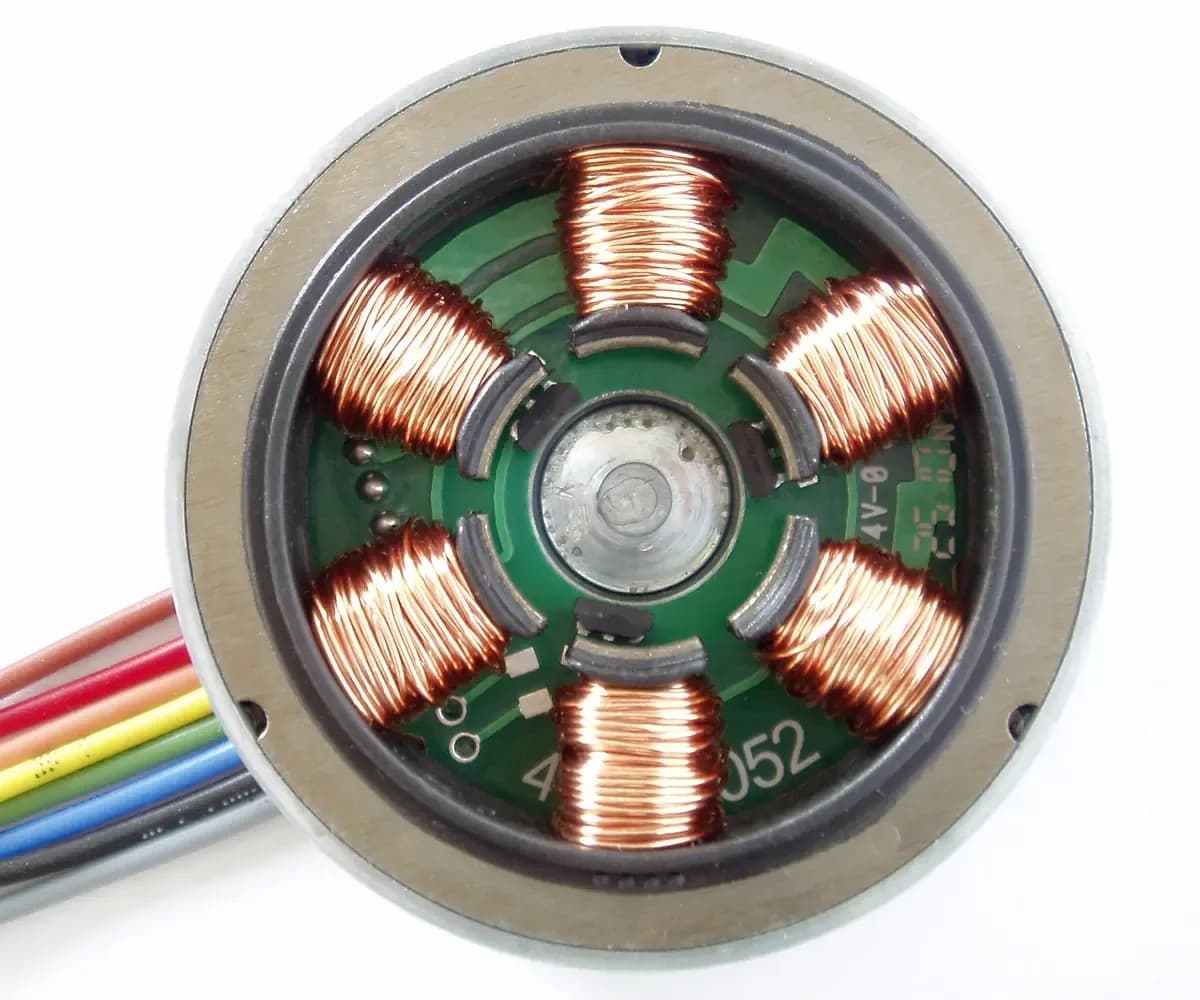
Stator winding of a small brushless DC electric motor, with its lead wires on the left. Photo: "Stator Winding of a BLDC Motor" by Medvedev, CC BY-SA 3.0, via Wikimedia Commons, resized.

Smoke data set silicone apart from PTFE. FAA report DOT/FAA/AR-05/14 gives silicone elastomers a smoke extinction area of 1500 m²/kg, against 33 for PTFE. The report calls silicones anomalous on this measure, because the particles are silica, "a complete (rather than incomplete) combustion product". NASA's guide also rates silicone "Flammable", with "Poor cut through resistance".
Mica and Glass Braid: 450 °C and Above
Mica wire with glass braid is rated 450 °C or 550 °C, the only family here above 260 °C. UL style 5335 rates it at 450 °C for "Internal Wiring where protected from mechanical abuse". Style 5400 reaches 550 °C with a mica composite under treated fibreglass braid, and it allows nickel-chromium alloy conductors.
Our mica glass wire datasheet lists MGT at 450 °C, for use in ovens, kilns, furnaces and heaters. That figure rates heat, and surviving a fire is a separate question.
Circuit integrity has its own test methods. IEC 60331-1 covers cables that must "maintain circuit integrity when subject to fire and mechanical shock", at a minimum of 830 °C for an overall diameter exceeding 20 mm. IEC 60331-2 is the companion part for smaller diameters.
FAA guidance treats the two duties separately. Paragraph 11-96z calls for high-temperature insulation, such as fibreglass or PTFE, where wires run through hot areas. Paragraph 11-124 requires fire-critical wires to come from types "qualified to provide circuit integrity after exposure to fire for a specified period". Where a circuit must survive a fire, name the circuit-integrity test in the specification.
Flame, Smoke and Toughness Trade-offs
PTFE and FEP score highest on LOI, yet neither is the toughest choice. In Table A-6 of FAA report DOT/FAA/AR-05/14, both have a polymer LOI of 95, against 32 for filled silicone rubber and 30 for ETFE. The report warns that this test "does not correlate well with other fire and flammability tests" and gives no reliable guide to real fires.
The resin sheet agrees for FEP. Chemours lists FEP 100 at an LOI above 95 with a UL 94 V-0 rating, both resin values rather than wire ratings.
FAA Table 11-2b ranks four systems from 1, most desirable, to 4, least. PI (polyimide) ranks first for smoke generation, cut-through and abrasion, but last for flexibility. PTFE nearly reverses that pattern: first for flexibility, third for smoke and last for cut-through and abrasion. ETFE ranks last for smoke but second for abrasion and flexibility, while COMP (composite) sits second for smoke and cut-through.
Table 11-2b leaves out silicone, FEP, PFA and mica, and PI and COMP fall outside the six families compared here. Where wires rub, flex or crowd together, weigh these ranks alongside the temperature rating. The chart plots the four LOI values from Table A-6.

Polymer values, not wire ratings: limiting oxygen index from FAA DOT/FAA/AR-05/14, Table A-6 (PTFE 95, FEP 95, filled silicone rubber 32, ETFE 30). The report warns that LOI does not reliably predict performance in real fires. Retrieved October 2026.
Chart data (readable on mobile):
- PTFE: LOI 95%.
- FEP: LOI 95%.
- Filled silicone rubber: LOI 32%.
- ETFE: LOI 30%.
These are polymer LOI values from the cited FAA report, not finished-wire flame-test results or circuit-integrity ratings. LOI does not reliably predict performance in real fires.
How to Choose a High-Temperature Wire
Start from the conductor's maximum temperature, then narrow the field by standard route, plating, mechanical exposure, fire behaviour, voltage and approvals. Each step can rule out a family that looked suitable on heat alone.
- Maximum conductor temperature. Add the ambient temperature to the conductor's current-related rise, as FAA paragraph 11-77d describes, and choose a rating that covers the total.
- Standard route. UL 758 covers AWM for factory-installed wiring and excludes types the NEC already covers, while UL 66 lists NEC fixture wire types. EN 50525 parts cover harmonised silicone cables, and SAE AS22759 covers fluoropolymer aerospace wire.
- Conductor plating. Tin-coated copper stops at 150 °C and silver-coated wire at 200 °C in FAA guidance for aircraft wire, and nickel-coated strands retain their properties beyond 260 °C. Match plating to the rating you need.
- Mechanical exposure. Check cut-through, abrasion and flexing along the route. PTFE ranks last for cut-through and abrasion in FAA Table 11-2b, and NASA flags poor cut-through resistance in FEP and silicone.
- Fire behaviour. Compare LOI and smoke, remembering that the FAA report calls LOI an unreliable guide to real fires. Where a circuit must work in a fire, specify a circuit-integrity test such as IEC 60331-1.
- Voltage. Match the voltage class as well as the temperature. Our PTFE datasheets, for example, split NEMA HP 3 Types by voltage: ET at 250 V, E at 600 V and EE at 1,000 V.
- Approvals and markings. Any approval or marking must appear on the product actually supplied. Our own product pages note that citing a standard as a design basis is not the same as certification.
Frequently Asked Questions
What wire insulation has the highest temperature rating?
Mica with glass braid carries the highest ratings of the six families. UL style 5400 rates a mica composite with treated fibreglass braid at 550 °C, and style 5335 rates mica with glass braid at 450 °C. Among fluoropolymers, PTFE reaches 260 °C on nickel-coated conductors in AS22759/12. Silicone and the other fluoropolymers stop at 250 °C or below.
What is the difference between PTFE and FEP wire?
PTFE wire can carry a higher rating: UL style 1659 lists PTFE at 250 °C, against 200 °C for FEP in style 1330. The resin grades also differ: Chemours reports melt peaks of 344 °C on initial heating and 326 °C on second heating for PTFE 640XT X, versus 260 °C for FEP 100. The PTFE value depends on grade and thermal history; neither melt peak is a finished wire's operating-temperature rating. On toughness, NASA's insulation guide notes that "FEP has poor cut through resistance".
Is silicone wire rated 180 °C or 200 °C?
Both, depending on the standard route. BS EN 50525-2-41 gives silicone cables a maximum conductor operating temperature of 180 °C, and IEC 60245-3:2026 includes a clause for a conductor maximum of 180 °C. UL style 3172 rates braided extruded silicone rubber at 200 °C. Check which route the purchase specification names.
Why is ETFE wire rated 150 °C or 200 °C?
In aerospace wire, the conductor plating decides. NASA's AS22759 list rates crosslinked ETFE on tin-coated copper at 150 °C (/32) and on silver-coated high-strength copper alloy at 200 °C (/33). FAA guidance sets the same plating limits. Resin grade matters too: Chemours rates Tefzel 750 at 200 °C for appliance wire and says all other grades are lower.
What does UL AWM mean?
AWM stands for appliance wiring material, the subject of UL 758 from UL Standards & Engagement. The standard covers AWM for factory-installed wiring, inside appliances and other equipment or as interconnecting cable, and excludes wire types covered by the NEC. Individual constructions appear as numbered styles, such as 3172 for silicone rubber.
Can high-temperature wire keep working in a fire?
Not reliably, unless the cable is qualified for circuit integrity, a separate property from its temperature rating. IEC 60331-1 sets a test method for cables that must maintain circuit integrity under fire and mechanical shock. FAA paragraph 11-124 requires fire-critical aircraft wires to come from types qualified for circuit integrity after fire exposure.
Enquire About High-Temperature Wire
Our engineering team can review a high-temperature wire requirement sent through the contact page. Include the maximum conductor temperature, the ambient temperature, the insulation family and the designation.
Add the voltage, size, conductor plating, length and any markings the supplied wire must carry. To compare families first, browse our high-temperature wire range.
About the Author
Jyen is a technical and operations engineer at TEBAOFLEX, responsible for the company's online platforms. This guide draws on UL, SAE, IEC and BSI publication records, FAA and NASA documents, resin makers' technical data and TEBAOFLEX product datasheets. The product pages cited are TEBAOFLEX's own; ratings quoted from UL, SAE, NASA and standards bodies describe industry constructions, not certification of our products.
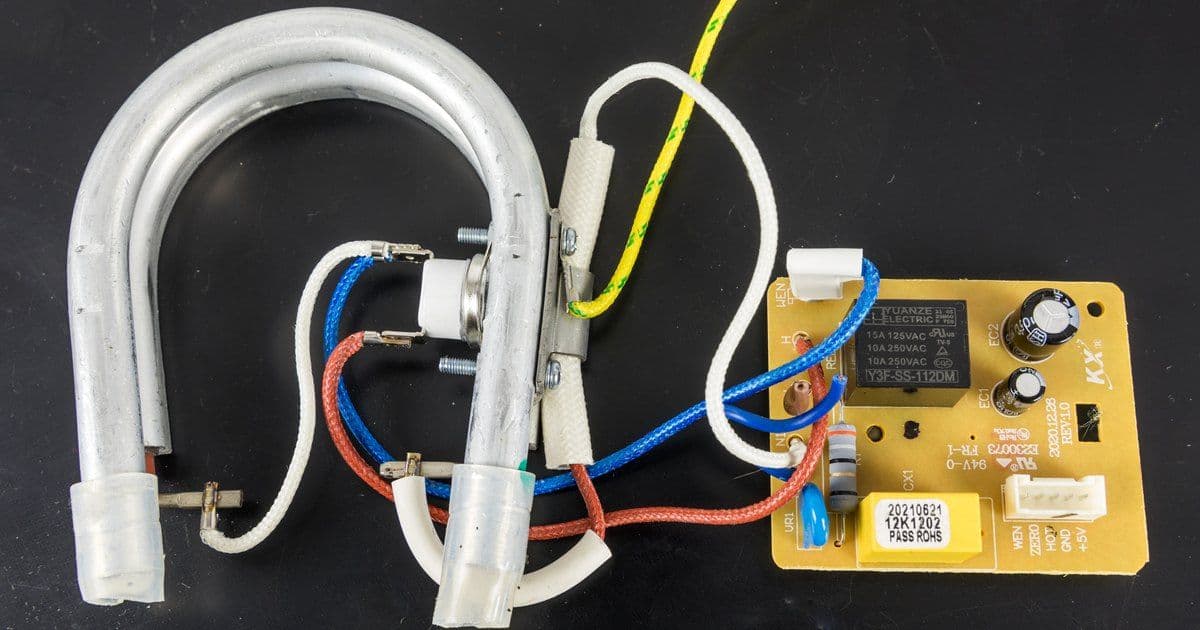
Cover photo: heating element and controller board of an Ambiano coffee machine, © Raimond Spekking, CC BY-SA 4.0, via Wikimedia Commons, cropped.
