- Location
- Philippines
- Application
- Hotel emergency voice evacuation and PAVA speaker circuits
- Cable type
- 300/500 V 2x2.0 mm2 fire-rated screened LSZH speaker cable (CU/MICA/XLPE/OS/LSZH) →
- Evidence
- 4 images
TL;DR: A Philippine hotel voice alarm (PAVA) project needed custom 300/500 V 2x2.0 mm2 LSZH speaker cable (BS 7629-1 class). Catalog vendors only stocked 1.5 mm2 or 2.5 mm2 sizes. TEBAOFLEX custom-built the 2x2.0 mm2 CU/MICA/XLPE/OS/LSZH construction and shared factory fire-test records (Test No. 2025091710: 90-minute flame plus 15-minute continuity). Our line also printed custom OEM brand and meter marks onto the slim sheath and supported fast cross-border payment.
- Project Location: Philippines (Multi-story hospitality & hotel building development).
- Buyer Profile: Project Manager & Technical Advisor at a Philippine electrical equipment and engineering service firm.
- Target System: Emergency Voice Evacuation / Public Address and Voice Alarm (PAVA) speaker circuits.
- Installation Zones: Above-ceiling plenums, metal cable trays, PVC/steel conduits across corridors, lobbies, stairways, and restaurants.
- Requested Specification: 300/500 V 2x2.0 mm2 2-core fire-rated screened LSZH speaker cable (BS 7629-1 / IEC 60331 design basis).
- Core Architecture: Stranded copper (2.0 mm2) + phlogopite mica fire tape + XLPE insulation + overall metallic screen + LSZH outer sheath.
- Pre-Order Evidence: Factory fire-resistance burning record (Test No. 2025091710: 90 min flame + 15 min post-burn pass) & cutaway inspection.
- Custom Manufacturing: Non-standard 2.0 mm2 conductor drawing, custom [Client Brand] + sequential 000M-200M sheath print, flexible FX payment.
1. Project Context: Multi-Story Hotel Voice Evacuation Duty Under Philippine Fire Safety Codes
Fire-rated voice evacuation speaker cable is a 300/500 V screened circuit-integrity cable built to keep public address and voice alarm (PAVA) speaker lines live during active fires. Standard audio twin wire melts and shorts within seconds of direct flame contact. By contrast, a fire-rated PAVA cable keeps spoken evacuation alerts clear while hotel guests move through corridors and stairwells.
In multi-story Philippine hotels, fire alarm and voice evacuation wiring falls under the Republic Act No. 9514 Revised Fire Code of the Philippines enforced by the Bureau of Fire Protection (BFP). Design teams in Manila and Cebu pair Philippine Electrical Code (PEC) conduit rules with international voice alarm codes. Most specifications reference BS 5839-8:2023 Code of Practice for Voice Alarm Systems.
On this hotel project, 2-core fire-rated speaker circuits link central voice amplifiers to ceiling and wall speakers across four occupied zones:
- Guest-room corridors and lift lobbies. Sleeping guests respond faster to clear spoken instructions than to alarm bells alone.
- Pressurized escape stairways. Vertical phased evacuation depends on steady floor-by-floor voice guidance.
- Ground-floor lobbies, restaurants, and banquet halls. When a fire alarm triggers, the panel cuts background music and broadcasts live evacuation directions.
- Above-ceiling voids, cable trays, and PVC or steel conduits. Dozens of low-voltage life-safety circuits share tight spaces above suspended ceiling tiles.

Multi-story hotel reception lobby and public lounge with recessed ceiling acoustic and life-safety zones served by LSZH voice evacuation speaker circuits.
Routing speaker wires through enclosed hotel ceilings creates two distinct fire hazards. First, room flames can breach ceiling tiles, burn open unguarded speaker loops, and silence an entire hotel wing. Second, burning polyvinyl chloride (PVC) jackets release thick black soot and hydrogen chloride (HCl) gas. That smoke hides exit signs and harms guests in corridors.
Low Smoke Zero Halogen (LSZH) sheathing is a halogen-free polyolefin outer jacket compound engineered to limit smoke and toxic acid fumes during fire exposure. Under IEC 61034-2 Smoke Density Standard (2019), LSZH compounds maintain at least 60% light transmittance, and under IEC 60754-1 Halogen Acid Gas Standard (2019) they emit below 0.5% halogen acid gas. Across our building fire safety cable portfolio, pairing mica-tape core protection with LSZH sheathing protects both circuit continuity and guest visibility.
2. Why Did the Project Specify 2x2.0 mm2 Instead of Standard 1.5 mm2 or 2.5 mm2 Speaker Wire?
The Philippine project manager opened with a direct request: "Fire rated cable, speaker wire 2 core preferred types LSZH or GP200 2mm2". That 2x2.0 mm2 cross-section immediately created a sourcing bottleneck. Standard fire-resistant alarm cables built to BS 7629-1:2015+A1:2019 Screened Fire-Resistant Cable Specification jump directly from 1.5 mm2 to 2.5 mm2. Chinese GB/T 3956 stock lines follow the same metric step, so regular cable traders do not stock 2.0 mm2.
Why do Philippine hotel drawings call for 2.0 mm2 so often? Local electrical schedules blend North American AWG tables (PEC / NFPA 70) with Asian metric habits (JIS C 3102). In AWG sizing, 14 AWG equals 2.08 mm2, while a 1.6 mm solid metric wire equals 2.01 mm2. Therefore, local consultants routinely list 14 AWG voice alarm risers on tender bills of quantities as 2x2.0 mm2.
Constant-voltage 100 V speaker line transmission is a distributed audio method that steps amplifier output up to 70.7 V or 100 V RMS across shared two-core wiring. High line voltage keeps current low across ceiling speaker taps. Under BS 5839-8 (2023) design rules, speaker loop voltage drop should stay at or below 10% (~0.91 dB loss) so voice alerts remain clear at the farthest room.
We can check why downsizing to 1.5 mm2 falls short on long hotel wings. The engineering equations below give maximum one-way run length L_max (m) for a 100 V zone at 10% voltage drop (BS 5839-8, 2023).
- Z_load = V^2 / P
- R_loop_max = 0.10 * Z_load
- L_max = R_loop_max / (2 * r_20 * 0.001)
Here r_20 is the single-core DC resistance at 20 °C in Ohm/km. Standard values are 12.1 Ohm/km for 1.5 mm2, 9.20 Ohm/km nominal for custom stranded 2.0 mm2, and 7.41 Ohm/km for 2.5 mm2.
- 2x1.5 mm2 (BS 7629-1 Stock): Nearest Gauge Equivalent: Between 16 AWG (1.31 mm2) & 15 AWG | Max DC Resistance at 20 °C (Ohm/km): 12.10 | Round-Trip Loop Resistance (Ohm/100 m): 2.42 | Max Run on 100 V / 200 W Zone (50 Ohm, <= 10% Drop): 206 m | Nominal Cable OD & Conduit Fit Impact: ~7.9 mm OD; compact fit, but 31% higher loop loss than 2.0 mm2.
- 2x2.0 mm2 (TEBAOFLEX Custom): Nearest Gauge Equivalent: 14 AWG (2.08 mm2) / 1.6 mm Metric | Max DC Resistance at 20 °C (Ohm/km): ~9.20 | Round-Trip Loop Resistance (Ohm/100 m): 1.84 | Max Run on 100 V / 200 W Zone (50 Ohm, <= 10% Drop): 271 m (+65 m reach) | Nominal Cable OD & Conduit Fit Impact: ~8.5 mm OD; matches PEC 14 AWG BOQ & fits 20 mm conduits.
- 2x2.5 mm2 (BS 7629-1 Stock): Nearest Gauge Equivalent: Between 14 AWG & 12 AWG (3.31 mm2) | Max DC Resistance at 20 °C (Ohm/km): 7.41 | Round-Trip Loop Resistance (Ohm/100 m): 1.48 | Max Run on 100 V / 200 W Zone (50 Ohm, <= 10% Drop): 337 m | Nominal Cable OD & Conduit Fit Impact: ~9.5 mm OD; 23% heavier copper mass & tighter pull in 20 mm drops.
On a 200 W hotel corridor zone at 100 V, custom 2x2.0 mm2 extends circuit reach from 206 m to 271 m. At the same time, its outer diameter stays about 1.0 mm slimmer than 2x2.5 mm2. The contractor meets the consultant's 14 AWG / 2.0 mm2 spec without crowding 20 mm ceiling conduits.
3. Inside the 300/500 V 2x2.0 mm2 Fire-Rated LSZH Cable Architecture and TEBAOFLEX Product Range
Within our fire-resistant and fire alarm cable range, we engineered a five-layer CU/MICA/XLPE/OS/LSZH build for this Philippine order. Each layer counters a specific thermal, electrical, or audio fault inside hotel ceilings.
Phlogopite mica-tape fire barrier is a mineral dielectric ribbon wrapped around each copper core that forms a rigid insulating shell above 750 °C to 850 °C. When flame heat chars the outer polymer insulation, this mineral sleeve keeps the brown and blue cores from touching. As a result, the voice alarm amplifier stays online without short-circuit tripping.
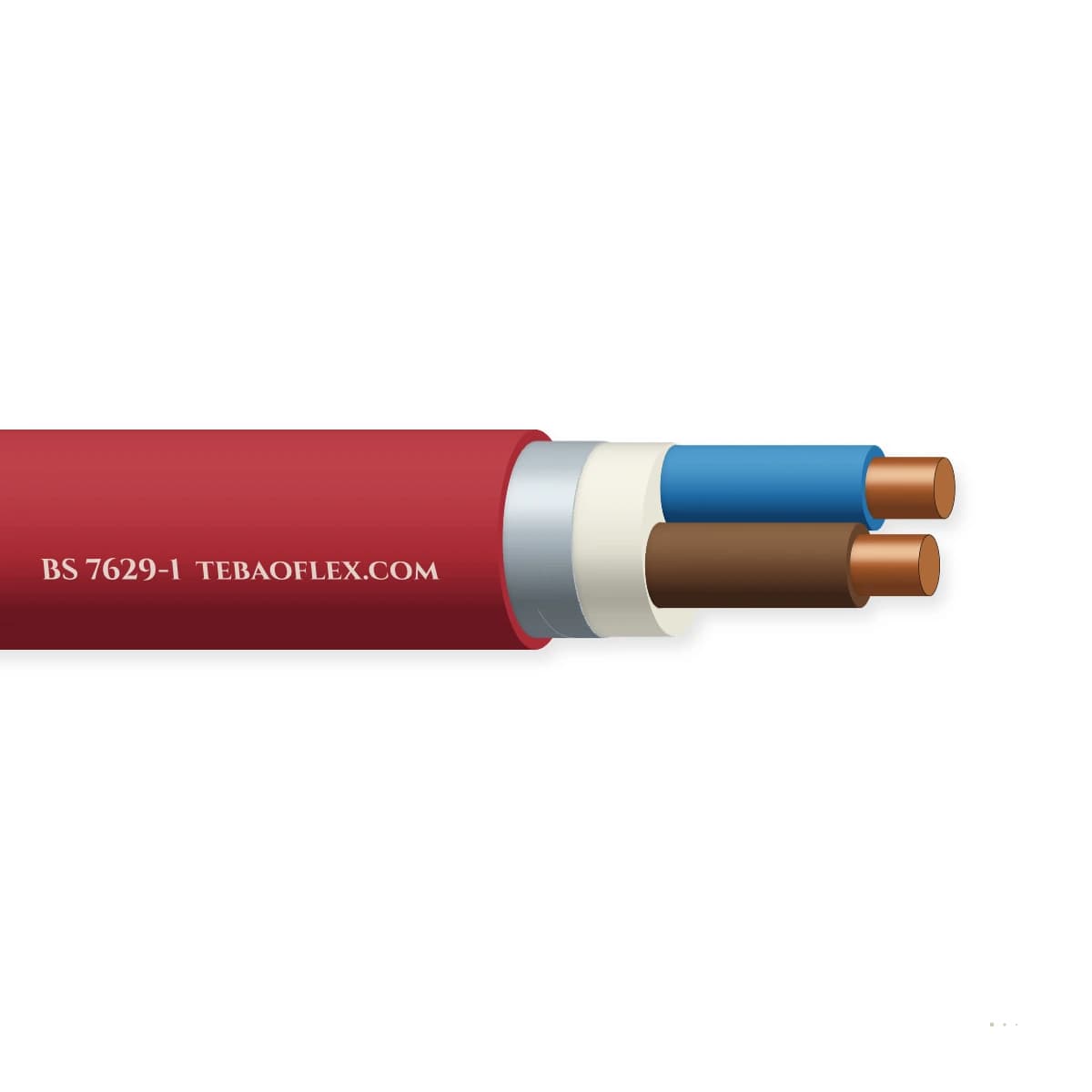
TEBAOFLEX BS 7629-1 300/500 V screened fire-resistant LSZH alarm and voice evacuation cable standard family profile cutaway showing copper cores, fire barrier insulation, metallic screen, and LSZH outer sheath.
Layer-by-Layer Construction Breakdown
- 1. Conductors: Material & Engineering Specification: 2 x 2.0 mm2 plain annealed stranded copper (custom-drawn metric 2.0 mm2) | Primary Duty Function in Hotel PAVA Circuits: Low resistive loss (~9.2 Ohm/km) plus smoother conduit pulling than stiff Class 1 solid wire.
- 2. Primary Fire Barrier: Material & Engineering Specification: Helical phlogopite glass-mica tape (>= 50% overlap wrap) | Primary Duty Function in Hotel PAVA Circuits: Maintains core-to-core dielectric separation under direct flame (830 °C+) per IEC 60331-2 principles.
- 3. Core Insulation: Material & Engineering Specification: 90 °C cross-linked polyethylene (XLPE) or ceramifying thermoset (Brown / Blue) | Primary Duty Function in Hotel PAVA Circuits: Low core-to-core capacitance to preserve high-frequency voice clarity (300 Hz to 6 kHz band).
- 4. Overall Screen (OS): Material & Engineering Specification: Laminated aluminium/copolymer tape with tinned copper drain/CPC (or >= 80% tinned copper braid option) | Primary Duty Function in Hotel PAVA Circuits: Blocks 50/60 Hz hum and VFD elevator or chiller EMI in shared hotel ceiling trays.
- 5. Outer Sheath: Material & Engineering Specification: Extruded LSZH halogen-free compound (Red, White, or project-specified Black) | Primary Duty Function in Hotel PAVA Circuits: Meets IEC 61034-2 (>= 60% light transmittance) and IEC 60754-1 (< 0.5% HCl acid gas).
Laboratory Fire-Test Record Verification (Test No. 2025091710)
Before placing the order, the buyer's technical advisor asked for fire-test documentation to pass engineering review. Honest technical submittals distinguish reference qualification specimens from custom production gauges. We provided our original factory burning test record (Test No. 2025091710, dated 2025-09-17) run on our CU/MICA/XLPE/OS/LSZH family specimen (2x1.5 mm2), along with live photos of our test rig.

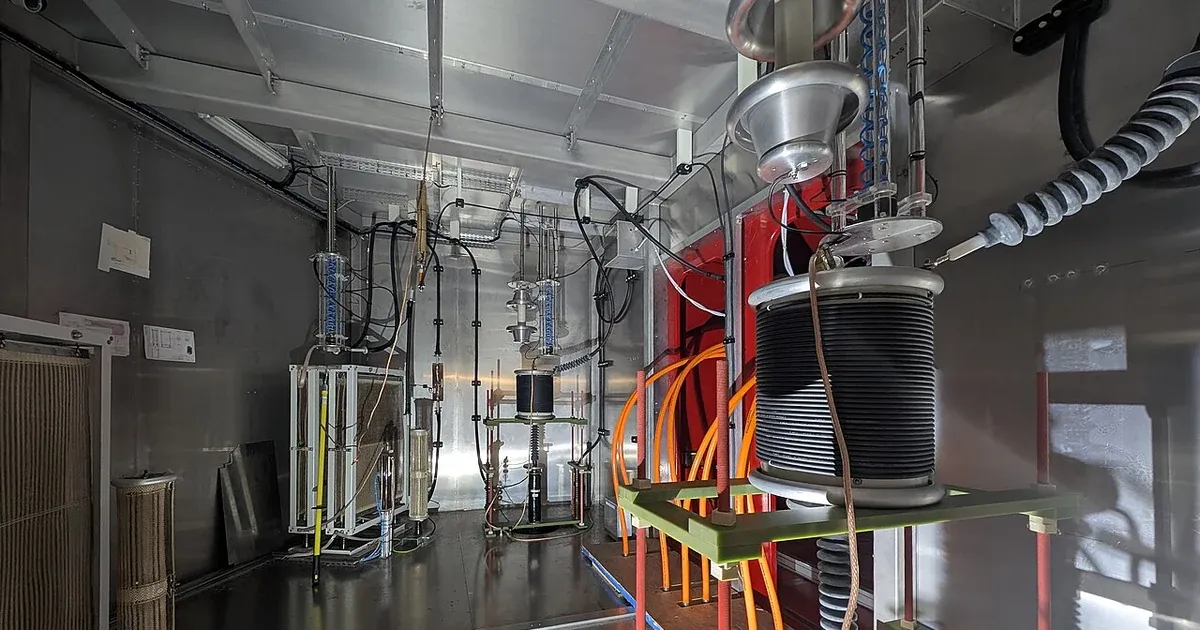
TEBAOFLEX in-house cable fire-resistance ribbon-burner test stand and horizontal ring suspension rig used for circuit-integrity burning verification.
In Test No. 2025091710, the energized cable endured 90 minutes of direct propane-air ribbon flame plus 15 minutes of post-burn power monitoring. Across the full 105-minute chart, load current held steady near 250 mA with zero fuse failure (Judgment: Pass). In global standards, circuit-integrity fire with shock on small cables (<= 20 mm OD) falls under IEC 60331-2:2018 Circuit Integrity Test for Small Cables and BS EN 50200 (PH30 to PH120). Meanwhile, IEC 60332-1-2 covers vertical single-cable flame spread. Reviewing the 105-minute voltage and current curves alongside cross-section photos gave the Philippine engineer full confidence to approve custom 2x2.0 mm2 production.
Matching TEBAOFLEX Fire-Safety & Signal Cables to Building Circuits
Hotel contractors often group PAVA speaker lines with fire alarm loops, smoke-fan feeders, and low-smoke control cables. The table below maps four TEBAOFLEX cable families to their proper building circuits.
- BS 7629-1 Screened Fire-Resistant Alarm Cable: Voltage & Size Range: 300/500 V; 2 to 19 cores (1.0 to 4.0 mm2 + custom 2.0 mm2) | Fire & Smoke Architecture: Ceramifying silicone or mica/XLPE + Al-PET screen + full CPC + LSZH (PH30 / PH120) | Recommended Building Circuit: Hotel PAVA voice evacuation speakers, addressable fire detection loops, emergency escape lighting.
- FPLP Plenum Fire Alarm Cable: Voltage & Size Range: 300 V; 18 AWG to 12 AWG (NEC Article 760) | Fire & Smoke Architecture: Low-smoke plenum fluoropolymer/LSPO insulation & jacket (NFPA 262 / UL 1424) | Recommended Building Circuit: Return-air plenum smoke detectors and notification appliances in NEC/PEC buildings (flame-retardant only).
- NHXH Halogen-Free Fire-Resistant Power Cable: Voltage & Size Range: 0.6/1 kV; 1.5 mm2 to 240 mm2 (DIN VDE 0266) | Fire & Smoke Architecture: Copper + mica tape + XLPE + LSZH (FE180 / E30-E90 system support) | Recommended Building Circuit: Fire-fighting booster pumps, stairwell pressurization fans, smoke extraction dampers.
- Custom Copper-Braid Screened LSZH Control/Audio Cable: Voltage & Size Range: 300/500 V; 2x1.5 to 2x2.5 mm2 | Fire & Smoke Architecture: Stranded Cu + mica/XLPE + 80% tinned copper wire braid (CWB) + LSZH | Recommended Building Circuit: High-EMI chiller rooms, elevator shafts, and long PAVA trunks near VFD power feeders.
For impact-prone plant rooms or basement car parks, buyers can also review armored options in our guide to mineral-insulated MIMS cables versus BS 7846 CWZ fire-resistant cables.
4. Four Engineering and Commercial Hurdles Solved Between Inquiry and Shipment
Winning and delivering an export project order requires solving manufacturing, site installation, and banking friction together. Between quote and dispatch, our team and the Philippine buyer cleared four practical hurdles.
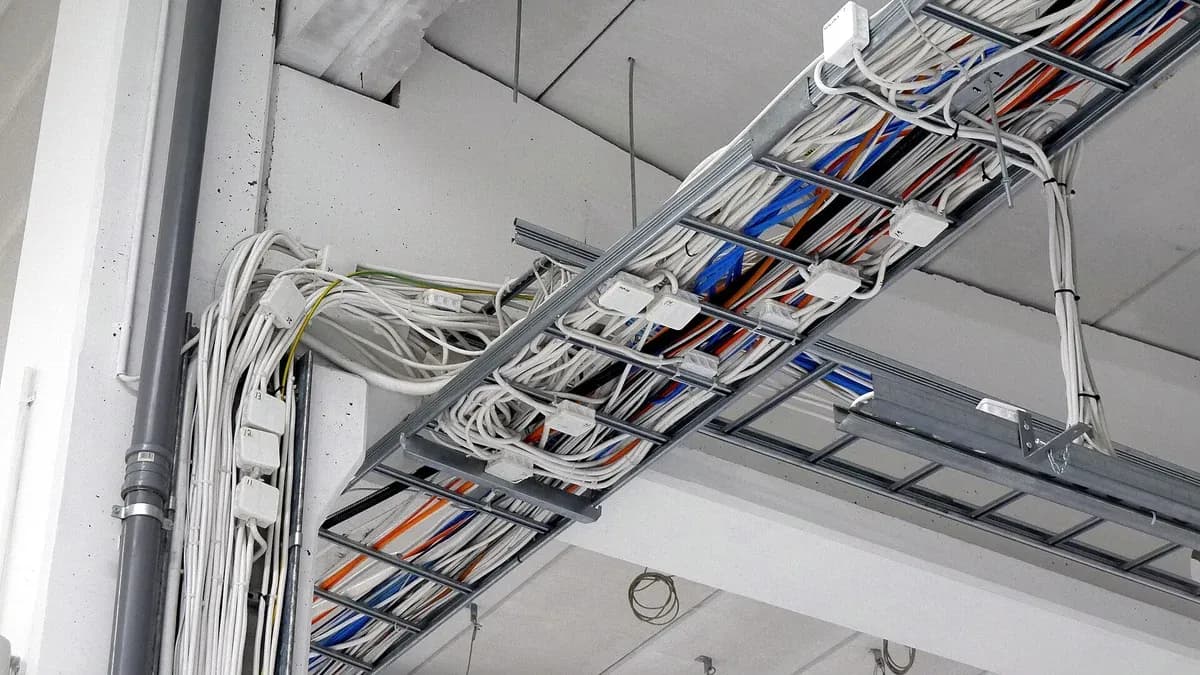
Overhead galvanized ladder cable tray, junction boxes, and rigid conduit drops installed beneath a concrete building ceiling slab.
Hurdle 1: Custom Manufacturing Non-Standard 2x2.0 mm2 Without Excessive MOQ Delay
Regular cable distributors only stock 2x1.5 mm2 and 2x2.5 mm2, leaving the buyer facing long backorders or spec changes. Because TEBAOFLEX runs in-house wire drawing, stranding, mica taping, and LSZH extrusion, we built 2x2.0 mm2 directly in 200 m project coils. We also saved the die and stranding setup so future hotel phases receive identical cable geometry.
Hurdle 2: Above-Ceiling Tray and Conduit Installation Compatibility
Site crews needed to pull the same cable across overhead trays, PVC pipes, and steel conduits into corridors, lobbies, and stairways. Stock BS 7629-1 cables (1.0 mm2 to 2.5 mm2) usually use stiff Class 1 solid copper cores that bind around tight 90-degree conduit elbows. Using stranded copper cores with a 6 x OD bend radius made conduit pulling smooth and fast. For ceiling safety, installers must secure fire cables with metal P-clips or saddles rather than plastic ties so burning trays cannot drop live speaker lines.
Hurdle 3: Precision OEM Brand and Sequential Meter Marking on a Small-OD Sheath
Southeast Asian equipment suppliers often request private-label sheath printing for site inspection traceability. However, printing a long legend onto a slim ~8.5 mm round LSZH jacket easily causes ink drift or smudging.
Our workshop normally restricts multi-field printing on sub-9 mm cables. After coordinating with our extrusion crew, we calibrated a fine-nozzle print setup and approved the client's custom legend:
- [Client Brand] 2x2.0mm2 300/500V CU/MICA/XLPE/OS/LSZH 000M 001M ... 200M
We also asked whether to add the manufacturing year code. The buyer chose to omit the year so the print line stayed clean and legible on site.
Hurdle 4: Bypassing Local Bank FX Bottlenecks with Multi-Channel Settlement
After technical sign-off, Philippine bank foreign-exchange (PHP to USD) queues threatened to delay payment by nearly a week. Meanwhile, copper prices were moving upward. TEBAOFLEX offered flexible settlement choices, including standard T/T wire transfer plus fast channels such as PayPal and Western Union. Consequently, the buyer locked pricing immediately and entered production without banking downtime.
5. Pre-Order Verification Checklist for Southeast Asian Hospitality PAVA Cable Buyers
Before ordering fire-rated speaker, alarm, or emergency lighting cables for hotels, hospitals, or high-rise towers, check five practical details:
- Separate flame retardancy from circuit integrity. Verify whether local code requires fire survival (IEC 60331-2 / BS 7629-1 with mica tape) rather than flame-retardant FPLP or IEC 60332-1-2 wire alone.
- Check 100 V speaker loop drop on the longest wing. Use 20 °C DC resistance (Ohm/km) to keep round-trip voltage loss within 10% (< 0.9 dB) at full speaker load (BS 5839-8, 2023).
- Verify LSZH smoke and acid-gas test thresholds. Specify at least 60% light transmittance (IEC 61034-2, 2019) and under 0.5% halogen acid gas emission (IEC 60754-1, 2019) in occupied spaces.
- Match core stranding and cable OD to conduit elbows. When PEC drawings call out 14 AWG (2.0 mm2), stranded 2x2.0 mm2 pulls cleaner through 20 mm conduits than solid 2x2.5 mm2.
- Lock sheath print strings and metal clips before production. Approve [Brand + Size + Voltage + 000M-200M] artwork prior to extrusion and specify metal fire-rated clips (BS 5839-1 Clause 26).
Editorial & Engineering Note: All technical specifications and test records in this case study were reviewed by TEBAOFLEX Jyen (Operations & Fire-Performance Cable Engineering Desk). Visit our About TEBAOFLEX factory and testing page to inspect our production capabilities, or contact our engineering team with your BOQ and custom print layout for a fast quotation.
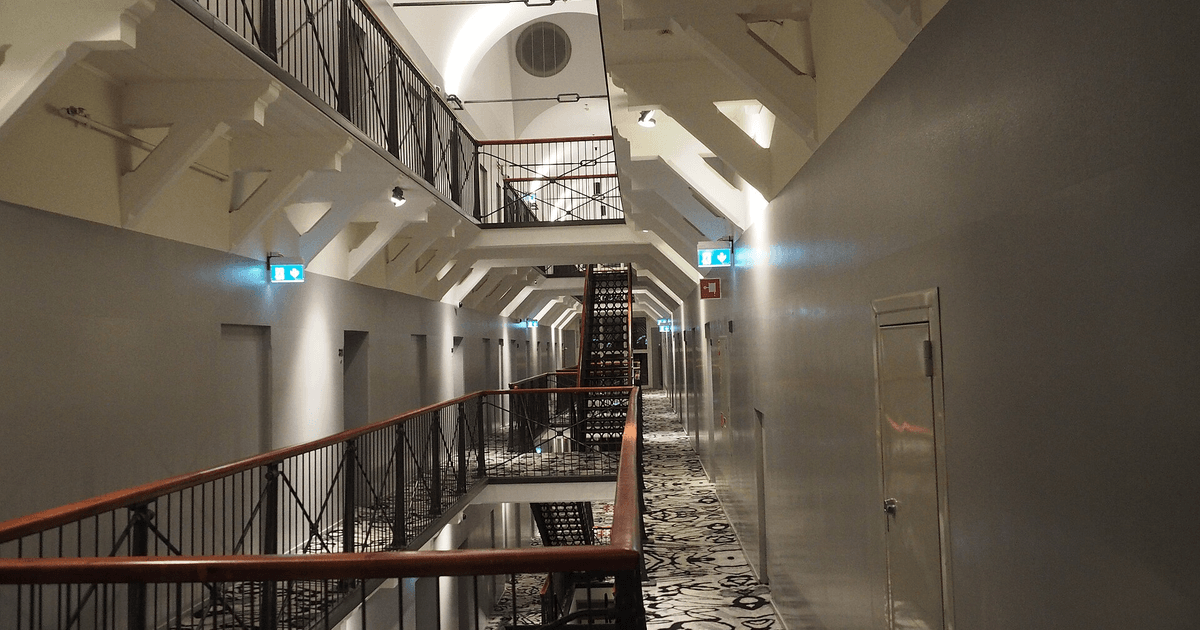
Image credits: Cover hotel corridor photo derived from "Corridor at Hotel Katajanokka" by JIP via Wikimedia Commons (CC BY-SA 4.0); hotel lounge ceiling photo derived from "Interior view of the Wangz hotel lounge" by Basile Morin via Wikimedia Commons (CC BY-SA 4.0); overhead cable tray photo derived from "Cable tray with cables 20170514" by Santeri Viinamäki via Wikimedia Commons (CC BY-SA 4.0); BS 7629-1 cutaway render and fire-test rig photo by TEBAOFLEX.
Frequently Asked Questions
Is 2x2.0 mm2 fire-rated LSZH cable suitable for hotel emergency voice evacuation systems?
Yes. A 300/500 V 2x2.0 mm2 CU/MICA/XLPE/OS/LSZH cable is built specifically for emergency voice alarm (PAVA) speaker circuits. Its mica-tape wrap preserves circuit continuity in fire, the metallic screen blocks 50/60 Hz hum, and the LSZH jacket limits smoke and halogen gas in corridors.
Can 2x2.0 mm2 speaker cable handle longer hotel corridor runs than 2x1.5 mm2?
Yes. At 20 °C, 2.0 mm2 copper has a DC resistance near 9.2 Ohm/km compared with 12.1 Ohm/km for 1.5 mm2. On a 100 V / 200 W speaker zone within the 10% drop rule (BS 5839-8, 2023), maximum circuit reach increases from 206 m to 271 m while keeping a slim ~8.5 mm outer diameter.
Can the same fire-rated LSZH cable run through ceiling voids, cable trays, and conduits?
Yes. This 300/500 V screened LSZH cable (6 x OD minimum bend radius) transitions smoothly from overhead ceiling trays into PVC or steel conduits. It feeds ceiling and wall speakers across lobbies, restaurants, corridors, and stairways when fastened with metal fire-rated clips.
Why do hospitality projects require LSZH jackets instead of PVC on indoor fire alarm cables?
Burning PVC fills hotel ceilings and corridors with dense black smoke and corrosive hydrogen chloride (HCl) gas. By contrast, an LSZH jacket verified to IEC 61034-2 (2019) and IEC 60754-1 (2019) maintains high visibility (>= 60% light transmittance) and emits less than 0.5% halogen acid gas during guest evacuation.
Can TEBAOFLEX print custom company branding and meter marks on small-diameter 2x2.0 mm2 fire cables?
Yes. Sub-9 mm round cables require fine print alignment to prevent ink smear on curved LSZH surfaces. TEBAOFLEX calibrates dedicated print nozzles to apply your company brand, 2x2.0 mm2 300/500 V rating, construction code, and sequential 000M-200M meter marks for site submittal checks.