Standard DLO cable ratings cover 2,000 V continuous operation (UL 44 Type RHH/RHW-2 and 1,000 V CSA C22.2 No. 38 Type RW90), a +90 °C wet or dry conductor temperature, and −40 °C cold-bend flexibility. Built with fine 24 AWG Class I/K tinned copper stranding, EPR insulation and an XL-CPE jacket, DLO serves single-core traction, drilling and mining power circuits from 14 AWG to 1111 kcmil.
A mining and industrial power buyer in South America recently asked us for 2 kV heavy-duty flexible DLO power cable. DLO originally stood for Diesel Locomotive Cable under Association of American Railroads (AAR) RP-585. Today, its high strand count and two-layer thermoset EPR / XL-CPE construction make it a standard single-core 2 kV feeder for electric mining haul trucks, oilfield drilling rigs, VFD motor leads, and battery energy storage busbars.
Core Construction Behind 2 kV DLO Cable Ratings
Unlike stiff Class B building wire (such as THHN or standard RHW-2), DLO 2 kV diesel locomotive cable is engineered to route through tight equipment compartments and absorb continuous engine and chassis vibration:
- Extra-flexible Class I / Class K tinned copper conductor: Annealed tinned copper is bunched or rope-lay stranded using fine 24 AWG (0.51 mm) individual wires per ASTM B33 and ASTM B172 Class I / Class K. Tinning protects the fine copper strands during rubber vulcanization. It also prevents corrosion in humid marine or mine air.
- Non-hygroscopic separator tape: A polyester or paper separator tape over the conductor allows clean stripping for compression lugs. It also lets the fine copper bundles slide without binding during tight bends.
- 90 °C thermoset EPR insulation: Ethylene propylene rubber (EPR) dielectric is formulated to ICEA S-95-658 / NEMA WC 70. It meets UL 44 Type RHH/RHW-2 (600 V / 2,000 V) and CSA C22.2 No. 38 Type RW90 (1,000 V) requirements.
- Heavy-duty XL-CPE outer jacket: Cross-linked chlorinated polyethylene (XL-CPE) thermoset outer sheath resists diesel fuel, hydraulic oils (UL 44 Oil Resistant I & II), abrasion and sunlight UV. It is tested for flame retardance under MSHA 30 CFR Part 7. Sizes 1/0 AWG and larger also meet IEEE 1202 / FT4 vertical tray flame tests.

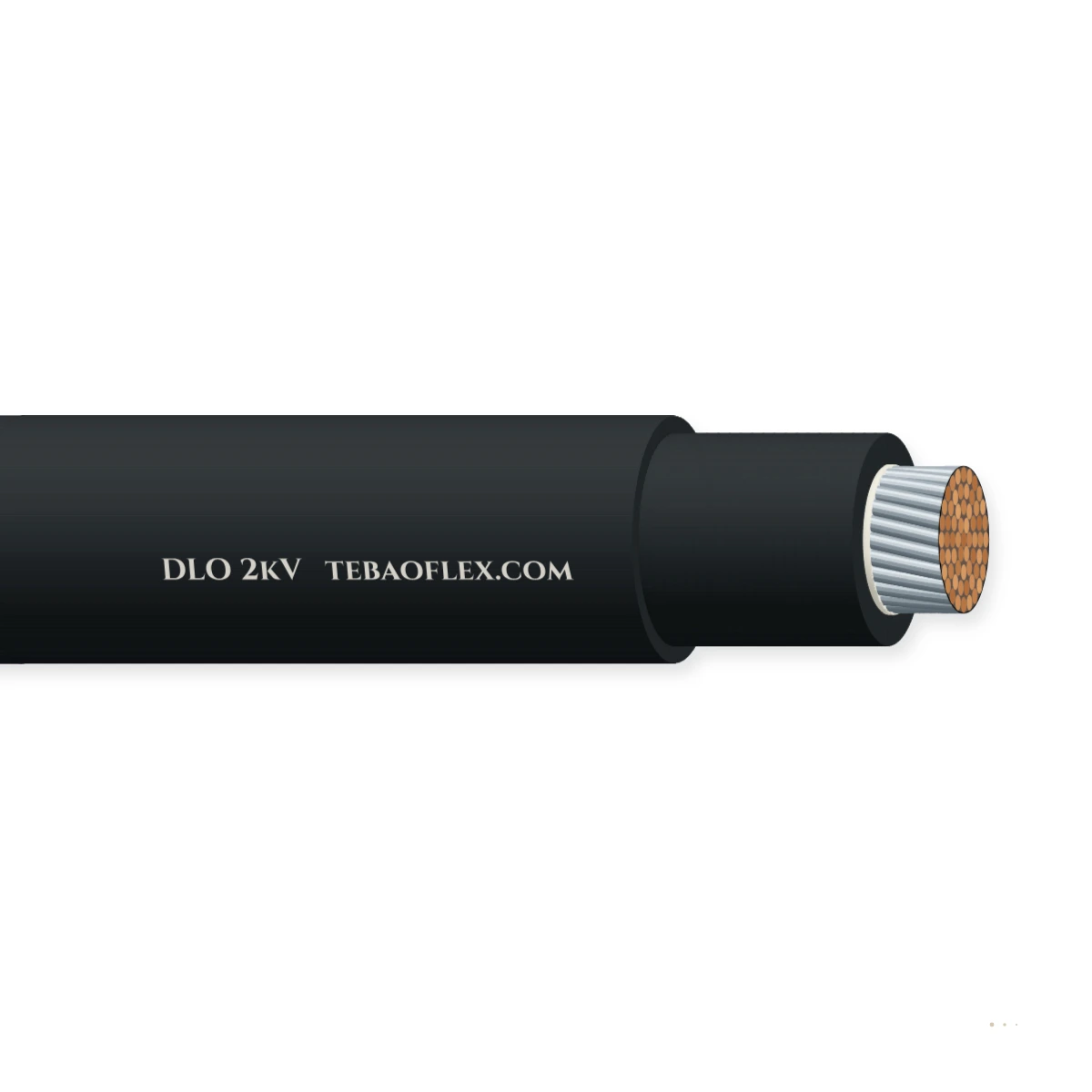
Horizontal cutaway of DLO 2 kV extra-flexible tinned copper EPR / XL-CPE power cable
Electrical, Thermal and Mechanical DLO Cable Ratings
When checking whether a 2kV DLO cable fits a switchgear bus, traction motor lead or cable tray run, verify these key ratings from our DLO 2 kV diesel locomotive cable specification:
- Voltage and dielectric test ratings: Rated 2,000 V AC (UL RHH/RHW-2) and 1,000 V AC (CSA RW90). Each production length undergoes a 5-minute AC water-tank dielectric test from 6.0 to 13.5 kV AC (by conductor size) and an in-line AC spark test from 7.5 to 15.0 kV RMS.
- Thermal envelope: +90 °C maximum continuous conductor temperature in both wet and dry locations, +130 °C emergency overload temperature, +250 °C short-circuit rating (5 s max), and −40 °C cold-bend and cold-impact performance.
- DLO cable sizes (14 AWG to 1111 kcmil): Standard production covers 21 sizes from 14 AWG (2.1 mm²) up to 1111 kcmil (563 mm²). Above 4/0 AWG, locomotive and drilling-rig kcmil sizes follow 24 AWG strand-count multiples: 262.6 kcmil (650/24), 313.1 kcmil (775/24), 373.7 kcmil (925/24), 444.4 kcmil (1100/24), 535.3 kcmil (1325/24), 646.4 kcmil (1600/24), 777.7 kcmil (1925/24), 929.3 kcmil (2300/24) and 1111 kcmil (2750/24).
- Minimum bending radius: 6 × overall cable diameter (OD) for fixed installations in cable trays or raceways, and 8 × OD for flexing or vibrating equipment leads.
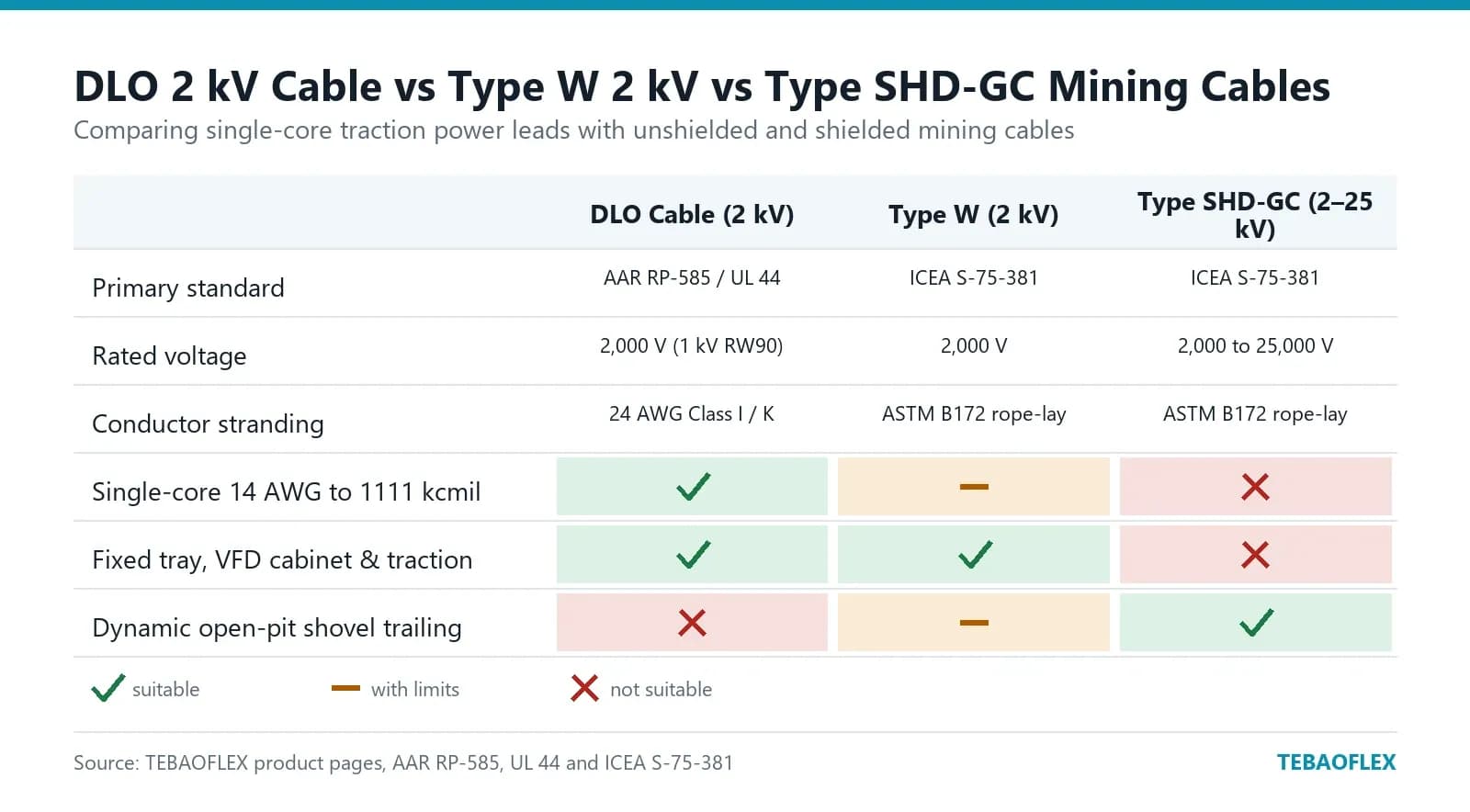
Comparison of 2 kV DLO diesel locomotive cable, Type W portable power cable and Type SHD-GC shielded trailing cable
Comparison matrix — text version
For each criterion below, values are listed in this order: DLO Cable (2 kV); Type W (2 kV); Type SHD-GC (2–25 kV).
- Primary standard: AAR RP-585 / UL 44; ICEA S-75-381; ICEA S-75-381.
- Rated voltage: 2,000 V (1 kV RW90); 2,000 V; 2,000 to 25,000 V.
- Conductor stranding: 24 AWG Class I / K; ASTM B172 rope-lay; ASTM B172 rope-lay.
- Single-core 14 AWG to 1111 kcmil: yes; limited; no.
- Fixed tray, VFD cabinet & traction: yes; yes; no.
- Dynamic open-pit shovel trailing: no; limited; yes.
DLO Cable vs Type W and Type SHD-GC: Which 2 kV Cable Do You Need?
Buyers in mining, tunnelling and oilfield drilling often compare 2 kV DLO cable with Type W 2 kV portable mining cable and Type SHD-GC shielded mining trailing cable. Choose between them based on core count and mechanical duty:
- Choose DLO 2 kV cable for single-core fixed tray, cabinet and traction wiring: DLO is a single-conductor cable with a lighter wall than portable reeling cables. It is ideal for parallel three-phase tray feeders (sizes 1/0 AWG and larger marked For CT Use), diesel-electric haul truck and locomotive traction motors, drilling-rig SCR/VFD houses, generator test banks, and battery storage cabinets.
- Choose Type W 2 kV cable for heavy portable cords and reeling drums: Built to ANSI/ICEA S-75-381 / NEMA WC 58 in 1 to 5 cores (8 AWG to 500 kcmil), Type W 2 kV portable mining cable uses a cord-reinforced two-layer extra-heavy-duty CPE jacket. That reinforced jacket withstands floor dragging, run-over crush and drum reeling.
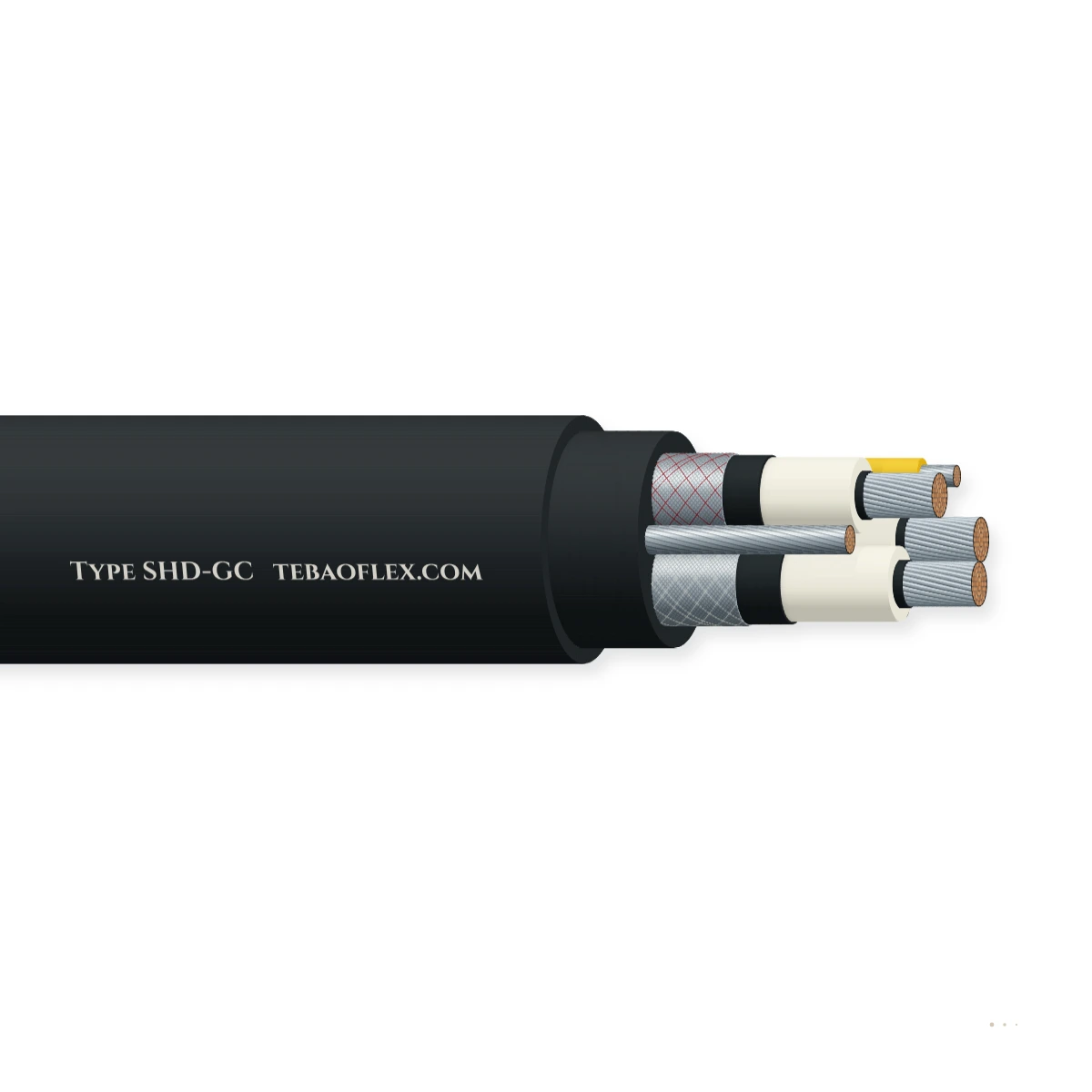
- Choose Type SHD-GC for shielded trailing feeders (2 kV to 25 kV): Where mine safety regulations or medium-voltage supplies require individual copper-braid phase shields, two interstitial grounds and a ground-check pilot (3P + 2G + 1GC), specify Type SHD-GC shielded mining trailing cable. For a detailed comparison of ICEA mining cable types, see ICEA S-75-381 Mining Cables: Type W, G-GC & SHD-GC Guide.
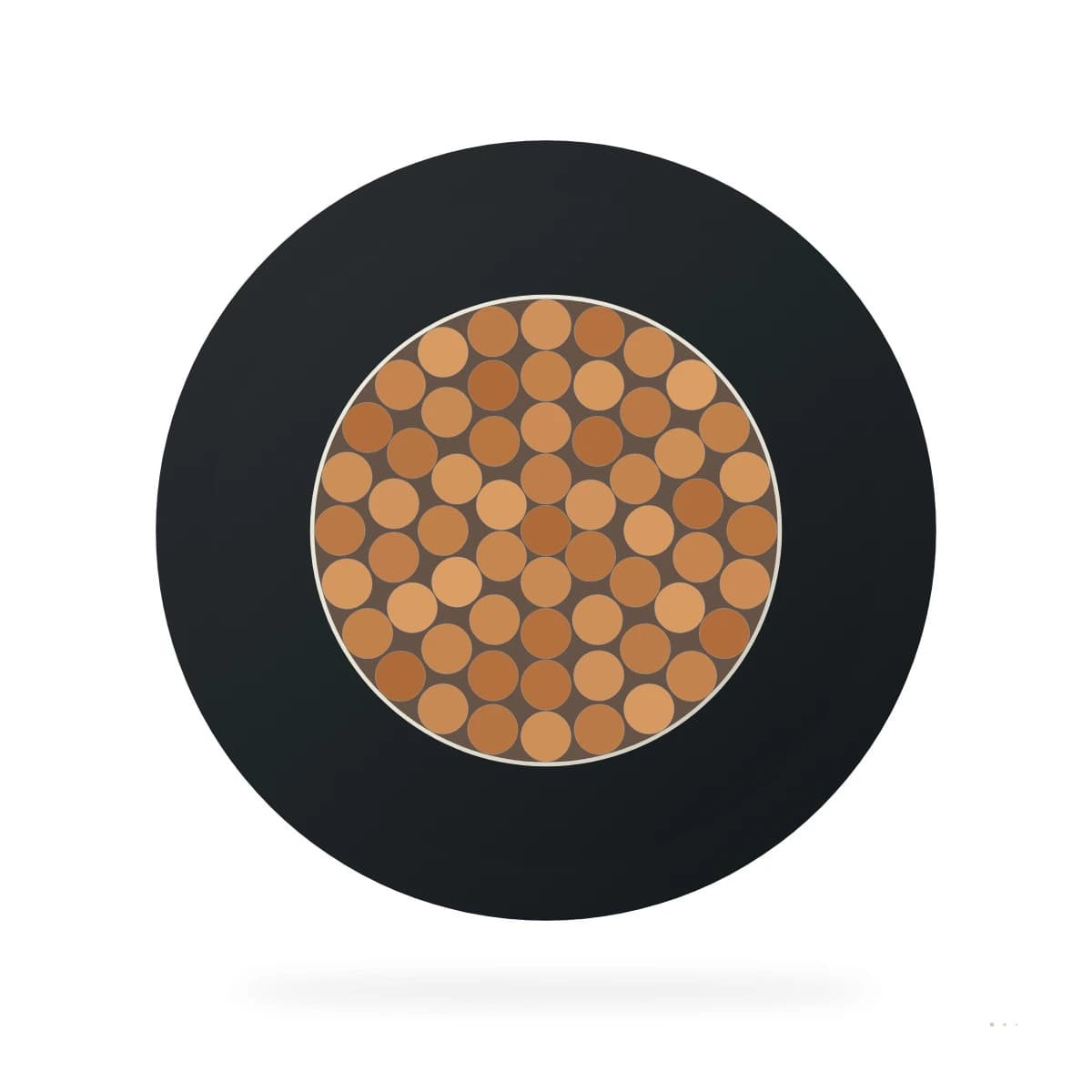
Radial cross-section of DLO 2 kV single-core power cable
Termination and Specification Checklist for DLO Cable
DLO uses fine 24 AWG Class I/K stranding (for example, 1,100 strands in 444.4 kcmil and 1,925 strands in 777.7 kcmil). As a result, its conductor bundle has a slightly larger diameter than a 37-strand or 61-strand Class B building wire of the same kcmil area:
- Use flared-entry Class I/K compression lugs: Never force a fine-stranded DLO conductor into a standard Class B mechanical or crimp lug. Use bell-mouthed (flared) tinned copper compression lugs and matched hexagonal crimping dies rated for flexible DLO / Class K stranding to prevent strand cutting and hot spots.
- Specify exact kcmil / strand count: Confirm whether the bill of materials calls for standard AWG sizes (4/0 AWG, 350 kcmil, 500 kcmil) or locomotive/drilling kcmil sizes (313.1 kcmil, 444.4 kcmil, 535.3 kcmil, 777.7 kcmil).
- Confirm tray and flame markings: For open cable tray routing, specify 1/0 AWG or larger with For CT Use, Sunlight Resistant, IEEE 1202 / FT4 and MSHA flame-test markings.
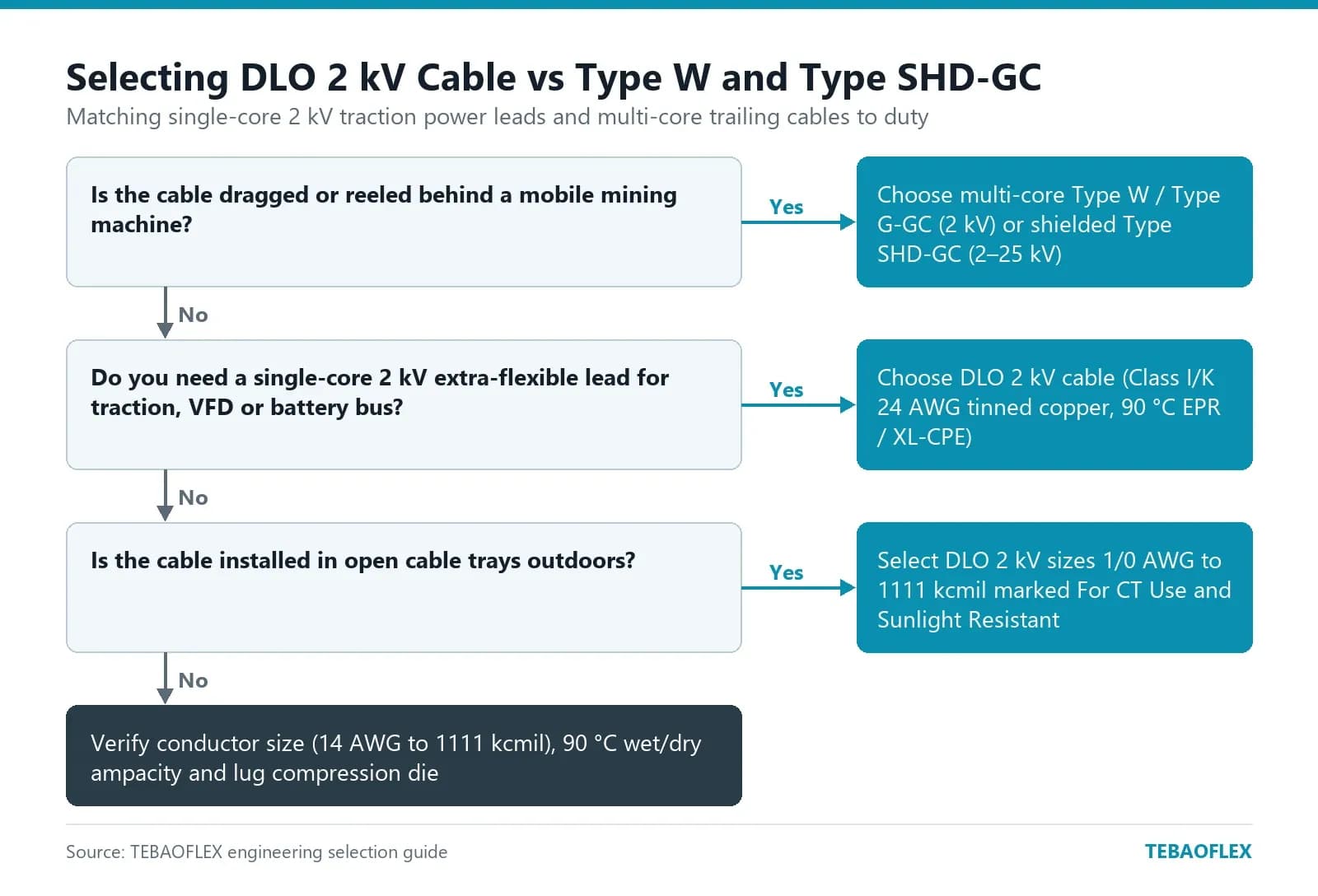
Selection flow between DLO 2 kV locomotive cable, Type W 2 kV portable cable and Type SHD-GC trailing cable
Selection flowchart — text version
- Is the cable dragged or reeled behind a mobile mining machine? If yes: Choose multi-core Type W / Type G-GC (2 kV) or shielded Type SHD-GC (2–25 kV).
- Do you need a single-core 2 kV extra-flexible lead for traction, VFD or battery bus? If yes: Choose DLO 2 kV cable (Class I/K 24 AWG tinned copper, 90 °C EPR / XL-CPE).
- Is the cable installed in open cable trays outdoors? If yes: Select DLO 2 kV sizes 1/0 AWG to 1111 kcmil marked For CT Use and Sunlight Resistant.
Otherwise: Verify conductor size (14 AWG to 1111 kcmil), 90 °C wet/dry ampacity and lug compression die.
Review full size and ampacity tables on our DLO 2 kV diesel locomotive cable and Type W 2 kV portable mining cable pages, or contact TEBAOFLEX via WhatsApp at +86 185 9591 3361, email at info@tebaoflex.com, or our contact form.
Frequently Asked Questions
What are the voltage, temperature and stranding requirements in 2 kV DLO cable ratings for mining and traction power?
Standard DLO cable ratings specify a 2,000 V continuous operating voltage under UL 44 Type RHH/RHW-2 (and 1,000 V under CSA C22.2 No. 38 Type RW90). Maximum continuous conductor temperature is +90 °C in wet or dry locations (+130 °C overload, +250 °C short-circuit), with −40 °C cold-bend flexibility. Conductors use fine 24 AWG (0.51 mm) annealed tinned copper wires stranded to ASTM B172 Class I or Class K across sizes from 14 AWG to 1111 kcmil.
What is DLO cable and what does DLO stand for?
DLO stands for Diesel Locomotive Cable, a single-conductor extra-flexible 2,000 V power cable originally standardized under AAR RP-585 for wiring diesel-electric locomotive traction motors. Because of its 24 AWG tinned copper stranding, 90 °C EPR insulation and oil-, sunlight- and flame-resistant XL-CPE jacket, DLO is widely used in mining haul trucks, oilfield drilling rigs, VFD drives and battery energy storage systems.
What is the difference between DLO cable and Type W cable?
Both are 2,000 V rated flexible rubber cables with +90 °C EPR insulation, but DLO is a single-core lead designed for fixed cable trays, cabinets and vibrating traction motor connections (6 × OD fixed bend radius). Type W is a portable reeling and trailing cable (1 to 5 cores, built to ICEA S-75-381) with a thicker two-layer cord-reinforced CPE jacket designed to withstand floor dragging, mobile reeling drums and heavy mechanical impact.
Why does DLO cable require special compression lugs?
DLO conductors are built from hundreds or thousands of fine 24 AWG (0.51 mm) tinned copper strands (such as 1,325 wires in 535.3 kcmil). That fine stranding gives the conductor a larger diameter than concentric Class B wire and causes individual strands to splay during insertion. Always use flared-barrel (bell-mouth) compression lugs and hexagonal dies specifically rated for DLO / Class K flexible stranding.