Under ANSI/ICEA S-75-381 / NEMA WC 58, the minimum phase conductor size for an 8,000 V portable mining cable is 4 AWG (21.2 mm²). Small unshielded control cores such as 1.0 mm² or 1.5 mm² cannot carry an 8 kV rating under the standard. At 8 kV, each phase requires semiconductive screens, a 3.8 mm EPR wall, and a metallic shield.
A mining buyer in South America recently asked us to quote a multi-core Class 5 copper cable with EPDM insulation and a polyurethane (PUR/TPU) outer sheath rated 8 kV to ICEA S-75-381. Inquiries like this happen when a purchase schedule mixes low-voltage control core sizes with a medium-voltage mining power standard. They also occur when a routine factory dielectric test voltage is mistaken for the continuous system voltage.
Why Small Control Cores Conflict with 8 kV ICEA S-75-381 Rules
In ANSI/ICEA S-75-381 / NEMA WC 58, portable cables rated above 2,000 V are three-phase shielded power trailing cables. The primary design is Type SHD-GC shielded mining trailing cable. Applying 8,000 V AC across small metric control conductors (such as 1.0 mm² or 1.5 mm²) creates four direct engineering conflicts with the standard:
- Minimum conductor diameter and electric stress: A 1.0 mm² copper conductor has a diameter of only about 1.3 mm. At 8 kV phase-to-phase, that tight radius concentrates radial electric field stress at the conductor surface. To keep dielectric stress within safe limits for ethylene propylene rubber (EPR) insulation, ICEA S-75-381 sets strict minimum conductor sizes. Type SHD-GC starts at 6 AWG (13.3 mm²) for 2 kV and 5 kV, and starts at 4 AWG (21.2 mm²) for 8 kV.
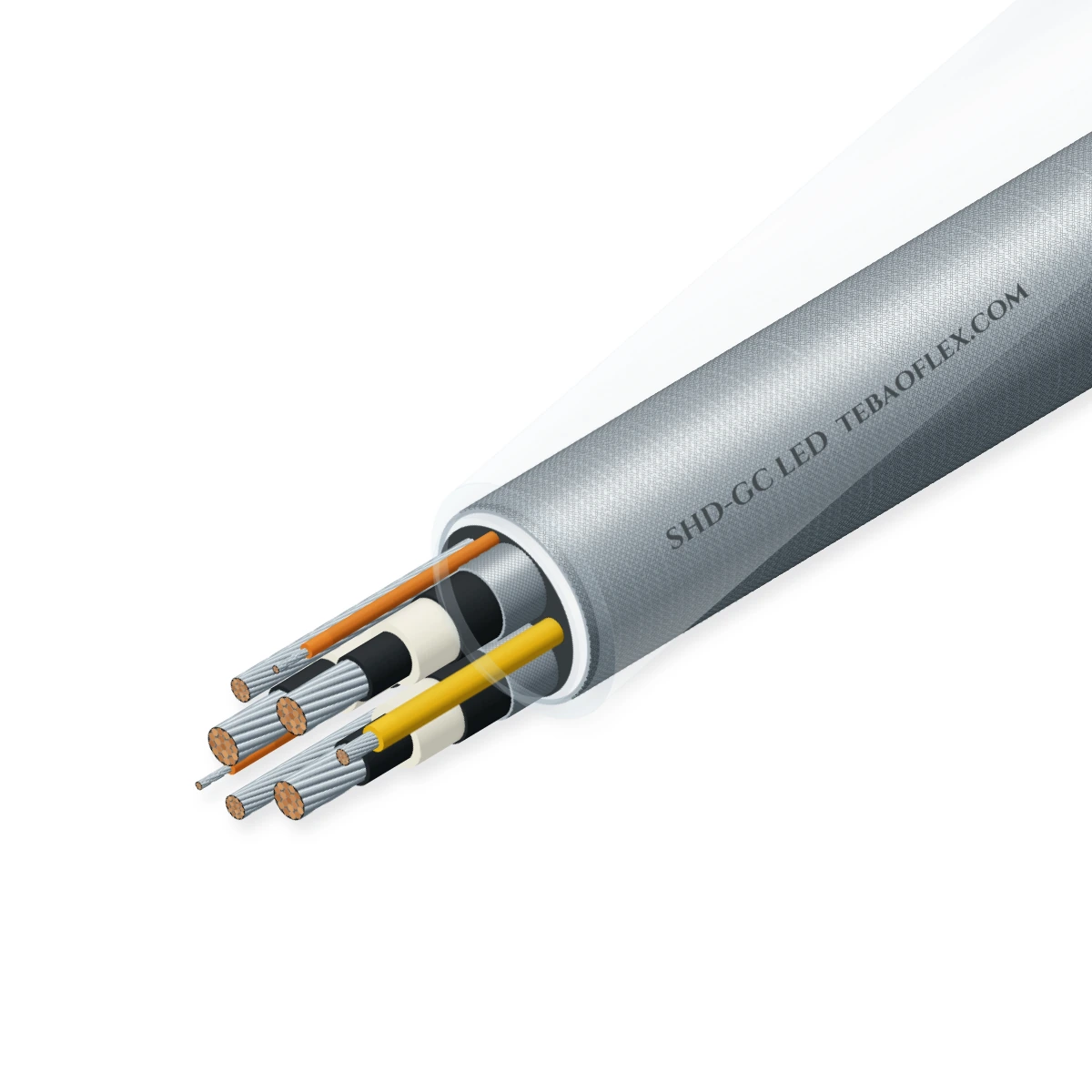
- Mandatory three-layer phase shielding: Every 8 kV phase core under ICEA S-75-381 requires an extruded semiconductive elastomer or semiconductive tape conductor screen. Over that screen sits a 0.150 in (3.8 mm) 90 °C EPR insulation wall and a semiconductive insulation screen. A tinned copper and textile composite braid shield with at least 60 % coverage completes the phase core. Extruding semiconductive screens and a 3.8 mm medium-voltage EPR wall over a 1.0 mm² wire is mechanically and electrically impractical.
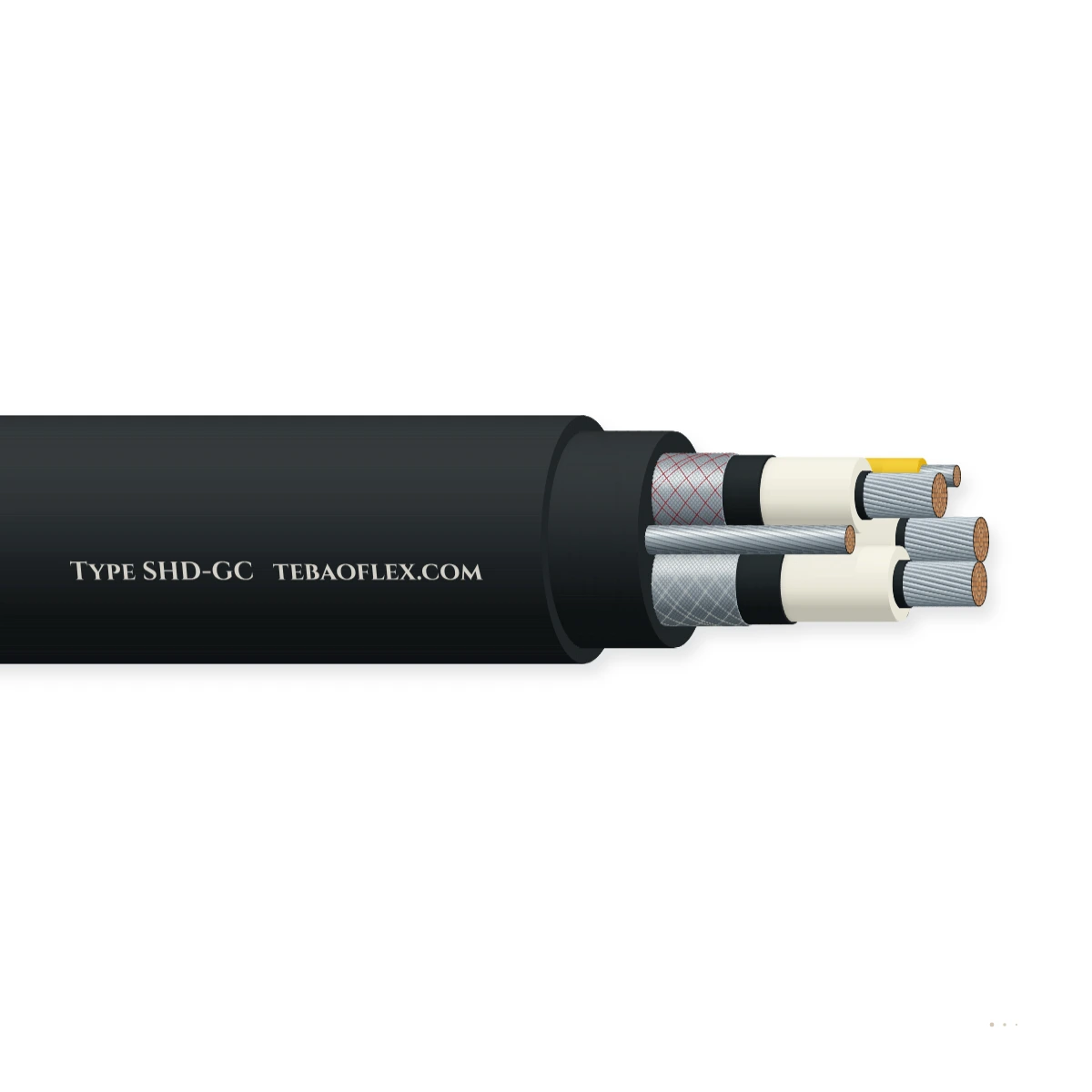
- Triad power core geometry (3P + 2G + 1GC): Standard 8 kV mining cables do not lay up six identical insulated cores. Instead, they assemble three shielded phase conductors in a triad. Two uninsulated rope-lay tinned copper grounding conductors sit in two outer interstices in contact with the phase shields. One yellow polypropylene- or EPR-insulated ground-check pilot conductor (10, 8 or 6 AWG) occupies the third interstice.
- Tensile and reeling durability: Portable mining cables must withstand dynamic pulling tension and repeated bending over sheaves. Small 1.0 mm² copper cores lack the mechanical cross-section needed to carry heavy medium-voltage shielding and jacketing without dedicated strain relief.
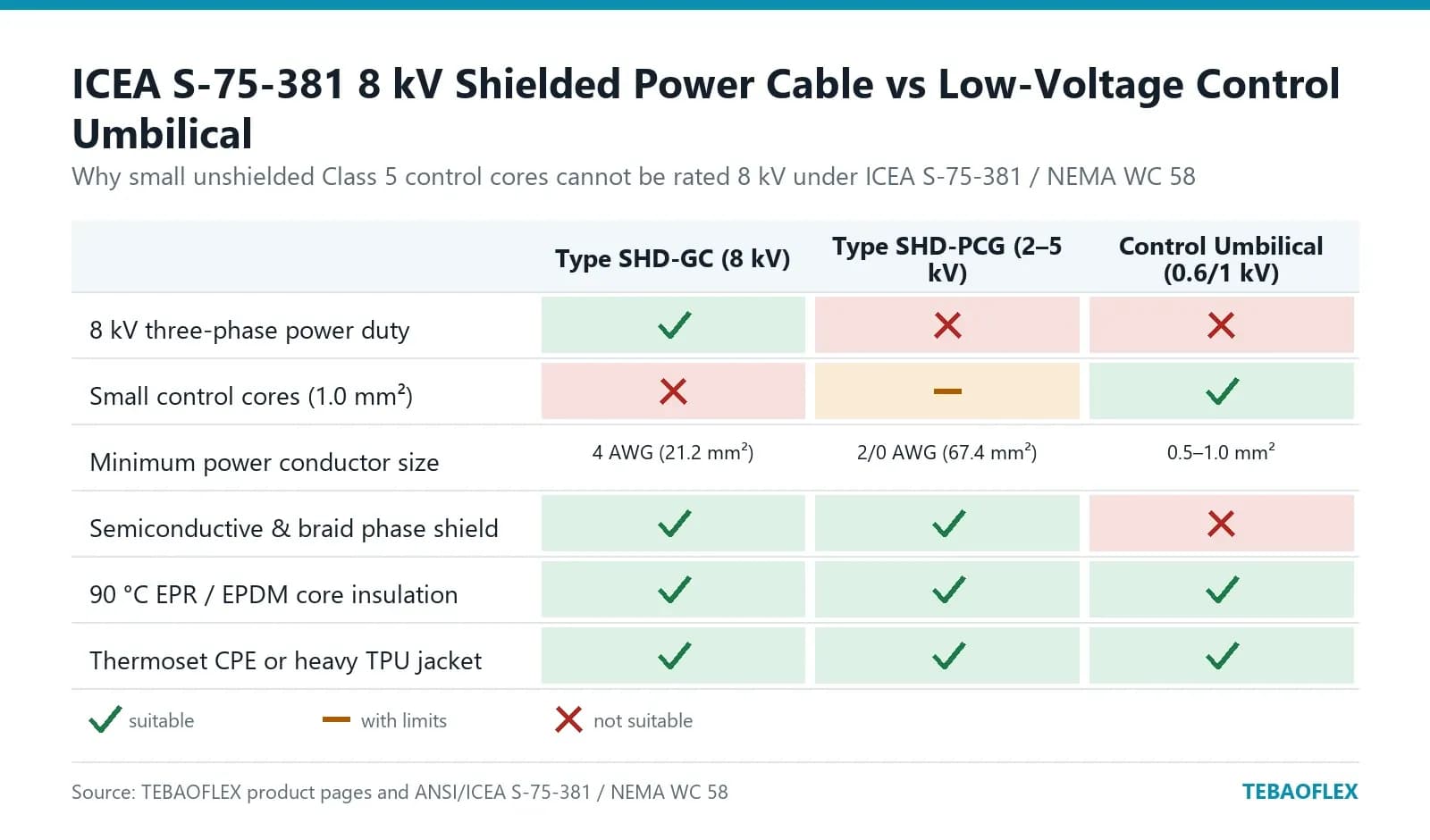
Comparison of conductor size, stranding, phase shielding, core layout and jacket options across ICEA S-75-381 8 kV Type SHD-GC, composite Type SHD-PCG and low-voltage EPDM/PUR control cables
Comparison matrix — text version
For each criterion below, the values are listed in this order: Type SHD-GC (8 kV); Type SHD-PCG (2–5 kV); control umbilical (0.6/1 kV).
- 8 kV three-phase power duty: yes; no; no.
- Small control cores (1.0 mm²): no; limited; yes.
- Minimum power conductor size: 4 AWG (21.2 mm²); 2/0 AWG (67.4 mm²); 0.5–1.0 mm².
- Semiconductive & braid phase shield: yes; yes; no.
- 90 °C EPR / EPDM core insulation: yes; yes; yes.
- Thermoset CPE or heavy TPU jacket: yes; yes; yes.
What ICEA S-75-381 Specifies for 8 kV Portable Mining Cables
When a mobile mining machine or substation feeder operates at 8,000 V AC three-phase, its construction follows the standard parameters on our Type SHD-GC shielded mining trailing cable page:
- Rated voltage grades: 2,000 V, 5,000 V, 8,000 V, 15,000 V and 25,000 V at 100 % insulation level.
- 8 kV conductor size range: 4 AWG up to 500 kcmil across three shielded phase cores. Typical free-air ampacity runs from 122 A (4 AWG) and 211 A (1/0 AWG) up to 536 A (500 kcmil) at +90 °C conductor temperature in a 40 °C ambient.
- Smallest 8 kV standard size (3 × 4 AWG): Three 4 AWG rope-lay tinned copper phase cores (259 strands), two 8 AWG uninsulated tinned copper grounds, and one 8 AWG ground-check pilot. It uses a 0.150 in (3.8 mm) EPR insulation wall and a 0.205 in (5.2 mm) thermoset CPE outer jacket. Typical nominal outer diameter is 1.94 in (49.3 mm), and typical weight is 2,308 lb/kft (3,435 kg/km).
- Conductor stranding basis: Rope-lay stranded annealed tinned copper to ASTM B172 and ASTM B33 (133 to 1,221 strands by AWG/kcmil size). Metric IEC 60228:2023 Class 5 bunch stranding is used in European and IEC control cables, not in standard ICEA S-75-381 power cores.
- Thermal and bending limits: +90 °C maximum continuous conductor temperature (dry or wet), +130 °C emergency overload, +250 °C short-circuit temperature, and −40 °C minimum operating temperature. The minimum bending radius is 12 × OD for 8 kV to 25 kV cables, compared with 8 × OD for 2 kV and 5 kV grades.
- Flame test requirements: Cables for underground and surface mine service are tested to MSHA 30 CFR Part 7 flame resistance requirements and CSA C22.2 No. 96 FT1 / FT4 vertical flame tests.
For more detail on grounding, ground-check monitoring and voltage drop calculations, read our ICEA S-75-381 Mining Cables: Type W, G-GC & SHD-GC Guide and Type SHD-GC 8kV, 15kV & 25kV Ampacity & Voltage Drop Guide.
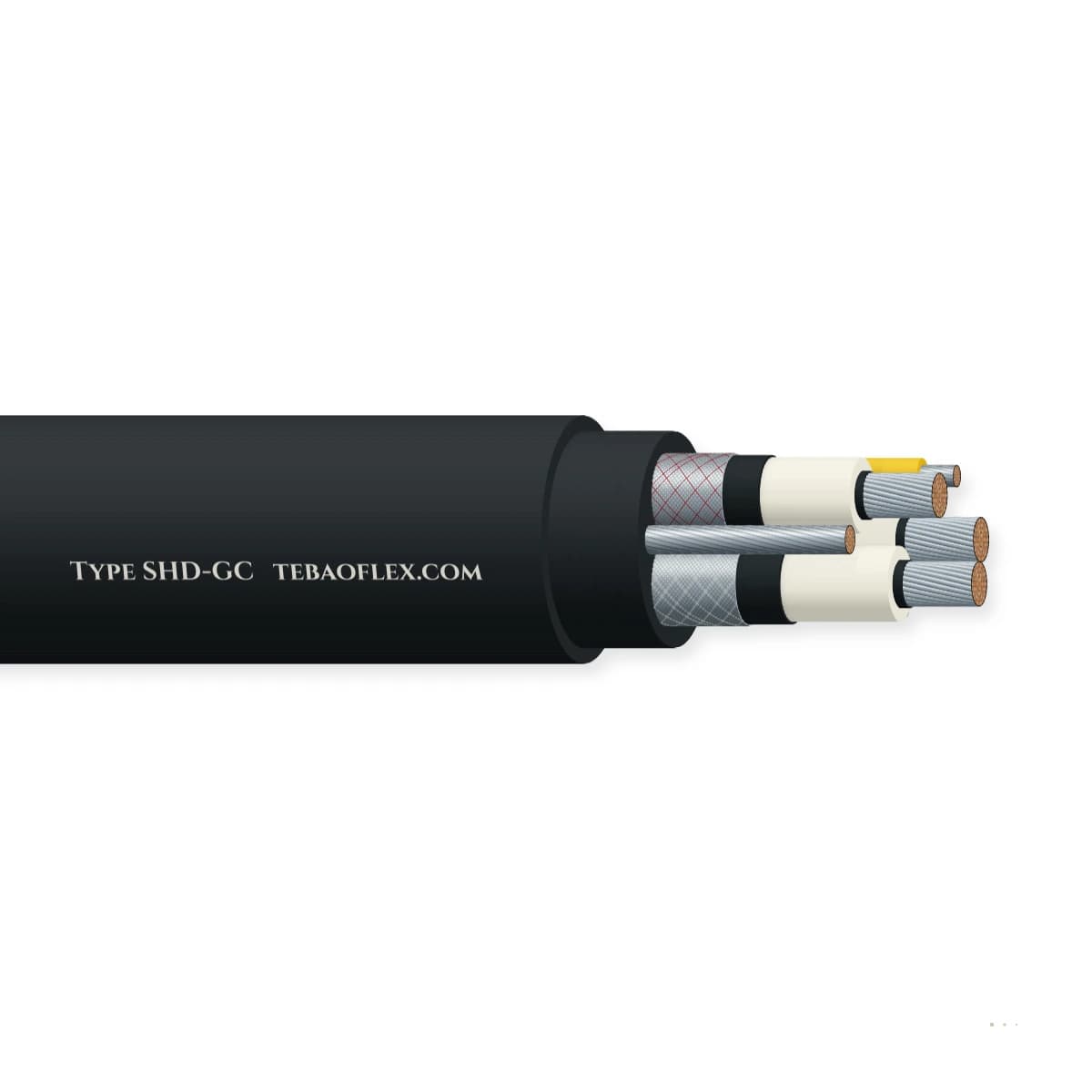
Type SHD-GC cutaway showing tinned copper phase conductors, semiconductive screens, EPR insulation, composite braid shield and heavy-duty outer sheath
Can an 8 kV ICEA S-75-381 Mining Cable Use EPDM or EPR Insulation with a Polyurethane Outer Sheath?
Buyers frequently ask whether an ICEA S-75-381 cable can combine ethylene propylene diene monomer (EPDM) or ethylene propylene rubber (EPR) insulation with a thermoplastic polyurethane (PUR / TPU) outer jacket:
- EPR / EPDM phase insulation is standard: ICEA S-75-381 specifies 90 °C ozone-resistant thermoset EPR / EPDM compounds for phase insulation from 2 kV to 25 kV. Typical nominal EPR wall thickness is 1.8 to 2.4 mm at 2 kV, 2.8 to 3.0 mm at 5 kV, and 3.8 mm (0.150 in) at 8 kV. At 15 kV and 25 kV, the EPR wall increases to 5.3 mm (0.210 in) and 6.6 mm (0.260 in).
- Thermoset CPE vs thermoplastic TPU jackets: Standard Type SHD-GC cables use a two-layer extra-heavy-duty thermoset chlorinated polyethylene (CPE) jacket reinforced with open-weave cord (3.9 to 7.5 mm radial wall). However, heavy-duty TPU outer sheaths can also be extruded over ICEA S-75-381 shielded cores. A TPU sheath is chosen where severe rock-cut, abrasion, oil exposure or high-visibility jacket colour is a priority.
- 8–15 kV TPU-jacketed trailing cables: Our SHD-GC LED 8–15 kV illuminated TPU mining trailing cable pairs EPR-insulated, copper-braid-shielded phase cores (3/C + 2G + 1GC) with a heavy-duty TPU outer jacket for −40 to +90 °C trailing service. In the 8 kV grade, typical TPU-sheathed builds include 3 × 2 AWG + 2 × 8 + 1 × 8 GC (52.8 mm nominal OD, 3,950 kg/km, 159 A). A larger 8 kV option is 3 × 1/0 AWG + 2 × 6 + 1 × 8 GC (58.4 mm nominal OD, 5,120 kg/km, 211 A).
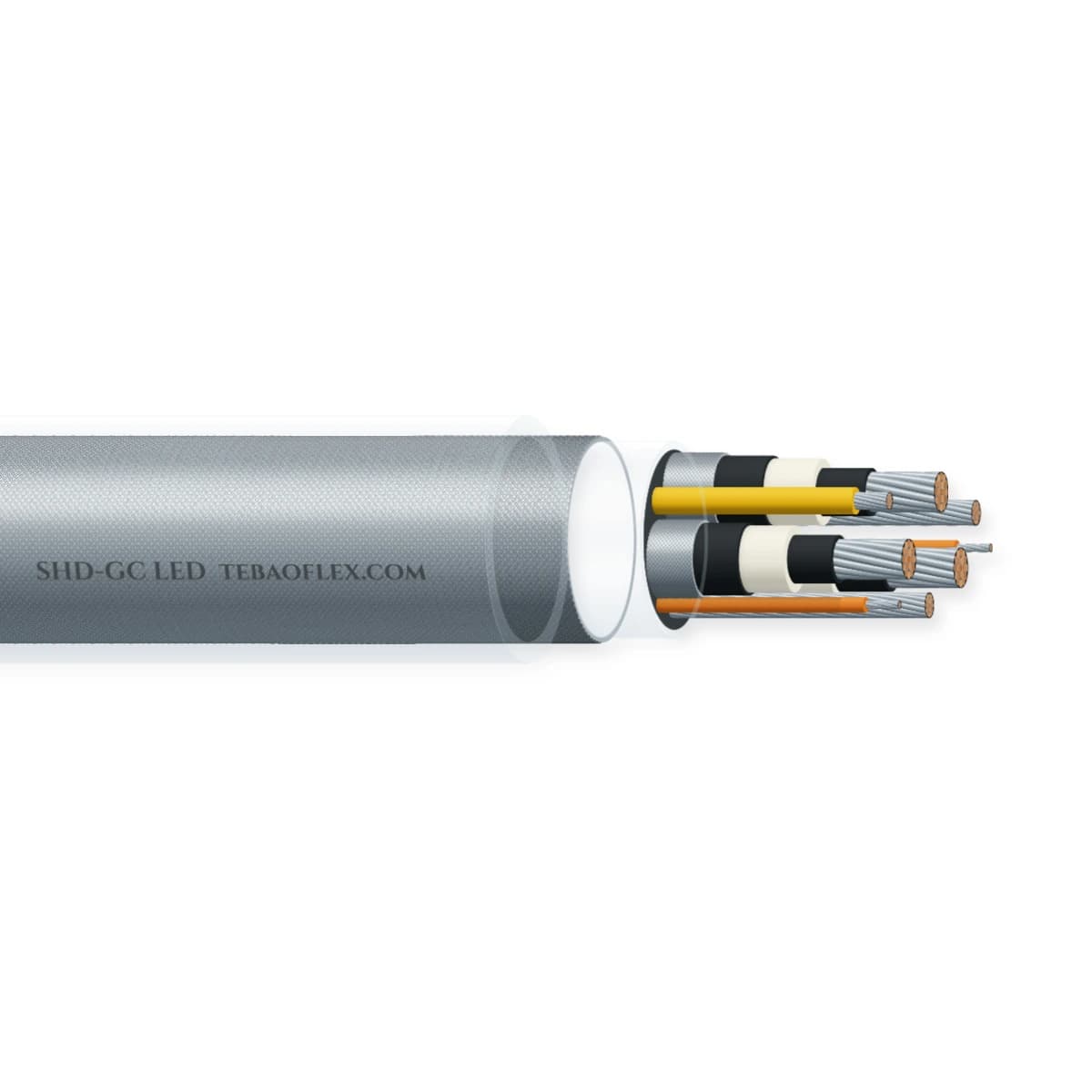
Horizontal stepped cutaway of an 8–15 kV ICEA S-75-381 cable with EPR phase insulation, tinned copper braid shields and a TPU outer sheath
Three Engineering Paths to Resolve a Mixed Specification
When an enquiry asks for small Class 5 copper cores, EPDM insulation, a PUR outer sheath and an 8 kV ICEA S-75-381 rating, clarify which of three duties the cable actually serves:
- Path 1 — Low-voltage control umbilical with an 8 kV test requirement: In many marine, subsea or industrial test systems, a multi-core Class 5 copper cable (to IEC 60228:2023) uses EPDM insulation and a coloured PUR jacket. It operates at 300/500 V or 0.6/1 kV, while the 8 kV figure is a factory DC spark test, a high-potential test, or a short pulse rating. In this case, remove the ICEA S-75-381 power-cable reference. Specify the continuous operating voltage U0/U, the required AC or DC dielectric test voltage, and the radial insulation thickness.
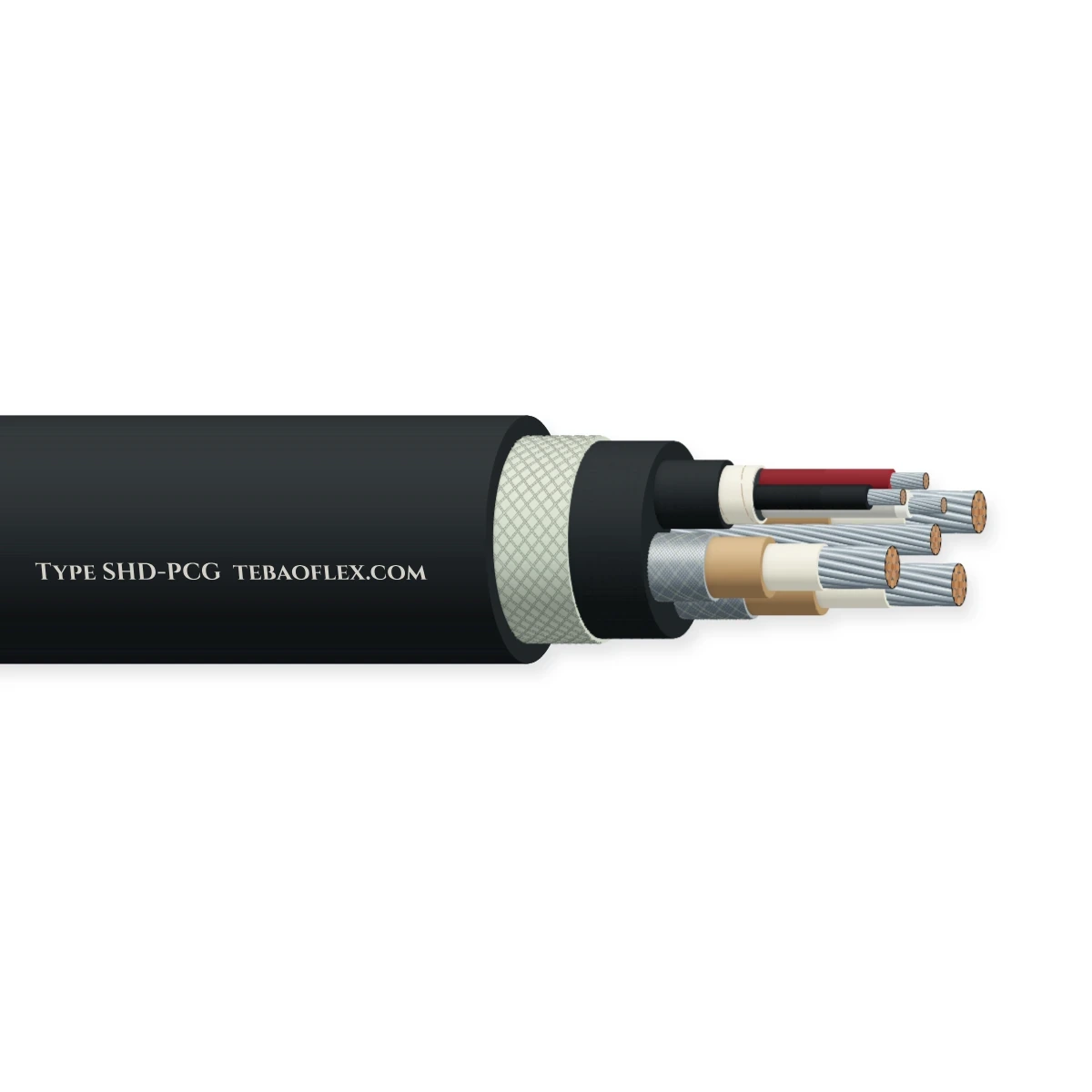
- Path 2 — Composite mining trailing cable carrying power and control cores: Some machines need three medium-voltage power phases plus auxiliary control cores inside one outer sheath. For that duty, choose a composite design such as Type SHD-PCG 2 kV / 5 kV shielded longwall mining cable with control group or a low-voltage Type G-GC 2 kV portable mining cable. Type SHD-PCG combines three shielded power cores (2/0 AWG to 350 kcmil) with a 600 V control group (3 × 8 AWG PCG) and an earth core. Inside a composite cable, the control group is rated 600 V rather than 8 kV.
- Path 3 — True 8 kV three-phase power trailing cable: If the circuit supplies 8,000 V AC three-phase power, size the phase conductors at 4 AWG or larger (such as 2 AWG or 1/0 AWG) in a 3P + 2G + 1GC layout. Use Type SHD-GC shielded mining trailing cable or SHD-GC LED 8–15 kV illuminated TPU mining trailing cable.
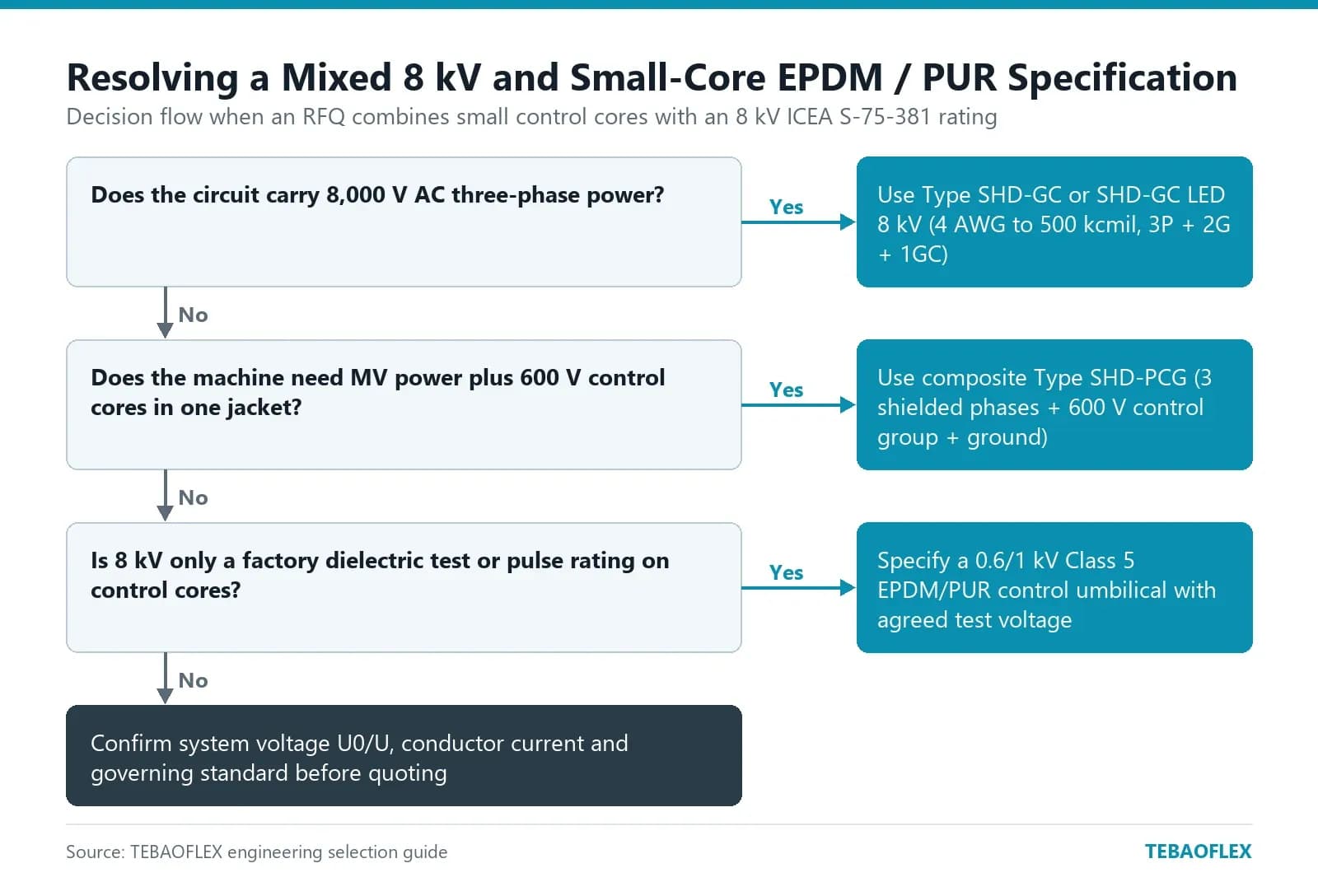
Three-step engineering decision path for resolving specifications that mix small control cores with medium-voltage mining standards
Selection flowchart — text version
- If the circuit carries 8,000 V AC three-phase power, use Type SHD-GC or SHD-GC LED 8 kV: 4 AWG to 500 kcmil, with a 3P + 2G + 1GC layout.
- If the machine needs medium-voltage power and 600 V control cores inside one jacket, consider Type SHD-PCG with three shielded phases, a 600 V control group and an earth core.
- If 8 kV describes only a factory dielectric test or pulse rating for control cores, specify a 0.6/1 kV Class 5 EPDM/PUR control umbilical and agree the test voltage.
Otherwise, confirm the continuous operating voltage U0/U, current and applicable standard before selecting the cable.
What to Send for a Custom Cable Recommendation
To get a fast technical review and datasheet for a mining or custom elastomeric cable, send these details with your inquiry:
- Voltage and system type: State whether the voltage (such as 600 V, 2 kV or 8 kV) is the continuous AC phase-to-phase system voltage, a DC rating, or a routine dielectric test voltage.
- Core arrangement and sizes: Specify whether all cores carry control signals or whether the cable uses three phase cores, two grounds and one ground-check pilot (3P + 2G + 1GC).
- Conductor stranding standard: Confirm metric mm² to IEC 60228 Class 5 or North American AWG/kcmil rope-lay tinned copper to ASTM B172 / ASTM B33.
- Shielding and screens: Indicate whether individual phase cores require semiconductive screens and metallic braid shields, an overall copper braid screen, or unscreened insulation.
- Insulation and jacket materials: Confirm 90 °C EPR / EPDM core insulation and whether the outer sheath should be thermoset CPE or thermoplastic PUR / TPU (including any required jacket colour).
- Operating environment: Give the ambient temperature, reeling or trailing duty, minimum bending radius, and required continuous length per drum.
Check our Type SHD-GC shielded mining trailing cable and SHD-GC LED 8–15 kV illuminated TPU mining trailing cable product pages, or contact TEBAOFLEX via WhatsApp at +86 185 9591 3361, email at info@tebaoflex.com, or our contact form.
Frequently Asked Questions
What is the minimum conductor size and shielding required for an 8 kV cable under ICEA S-75-381?
Under ANSI/ICEA S-75-381 / NEMA WC 58 (Tables 3-9 to 3-13), the smallest standard phase conductor size for an 8,000 V Type SHD-GC cable is 4 AWG (21.2 mm²). That size has a typical free-air ampacity of 122 A at 90 °C conductor temperature. At 2,000 V and 5,000 V, the standard starts at 6 AWG (93 A). Every 8 kV phase core requires an extruded semiconductive conductor screen, a 0.150 in (3.8 mm) EPR insulation wall, a semiconductive insulation screen, and a tinned copper composite braid shield (≥ 60 % coverage).
Can an 8 kV ICEA S-75-381 mining cable use EPDM or EPR insulation with a polyurethane outer sheath?
Yes. ICEA S-75-381 specifies 90 °C thermoset EPR / EPDM rubber for phase insulation across all voltage classes from 2 kV to 25 kV. Standard Type SHD-GC cables use a two-layer thermoset CPE outer jacket (3.9 to 7.5 mm wall). However, heavy-duty thermoplastic polyurethane (PUR / TPU) outer sheaths in custom colours or transparent compounds (as on SHD-GC LED 8–15 kV trailing cables) can be extruded over the shielded EPR core assembly for severe abrasion, rock-cut and oil resistance from −40 °C to +90 °C.
Why can't a 1.0 mm² Class 5 control conductor be rated 8 kV under ICEA S-75-381?
A 1.0 mm² Class 5 conductor has a diameter of only about 1.3 mm. At 8,000 V AC, that small radius creates excessive radial electric field stress and causes corona discharge and insulation breakdown. In addition, ICEA S-75-381 requires rope-lay tinned copper phase conductors to ASTM B172 / ASTM B33 with semiconductive screens, metallic braid shields and interstitial ground/ground-check cores. Small 1.0 mm² Class 5 EPDM/PUR cables are built as 300/500 V or 0.6/1 kV control umbilicals, not 8 kV mining power cables.
What is the difference between Type SHD-GC and Type SHD-PCG mining cables?
Type SHD-GC is a dedicated three-phase shielded power trailing cable (3P + 2G + 1GC) covered from 2 kV to 25 kV in sizes from 6 AWG (or 4 AWG at 8 kV) up to 500 kcmil. Type SHD-PCG is a 2 kV or 5 kV composite longwall trailing cable. It combines three shielded power phase conductors (such as 2/0 AWG or 4/0 AWG) and an earth conductor with an internal 600 V control group (typically 3 × 8 AWG PCG) inside one reinforced CPE jacket.
How does ambient temperature affect 8 kV Type SHD-GC cable ampacity?
Standard ICEA S-75-381 ampacity tables for 90 °C EPR-insulated mining cables are already based on a 40 °C ambient air temperature for a single cable in free air. Typical 8 kV free-air ratings are 122 A for 4 AWG, 159 A for 2 AWG, and 211 A for 1/0 AWG. No ambient temperature derating is required at 40 °C in free air, but cables operated in multiple layers on a reeling drum or in covered raceways must be derated for reduced cooling.