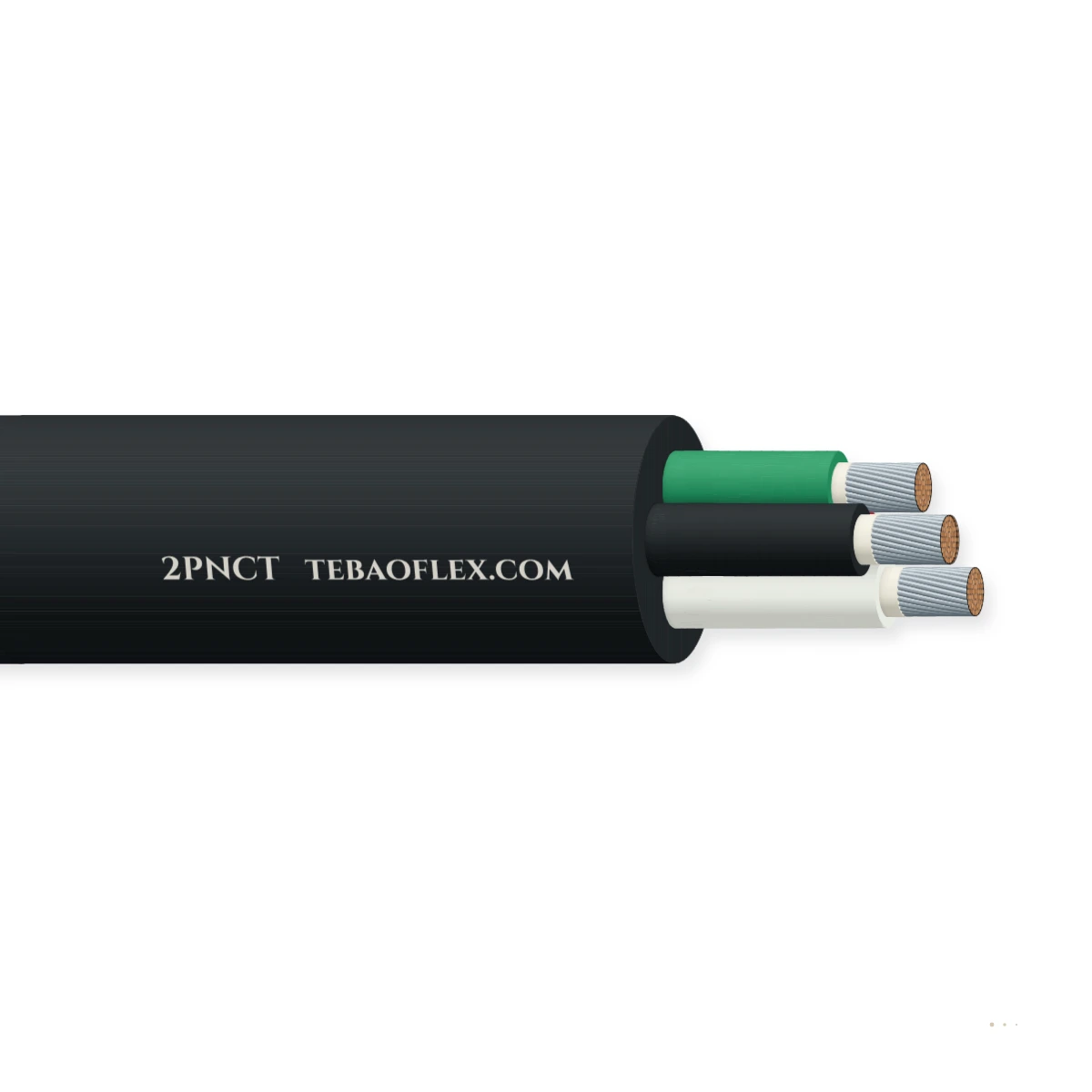
A standard 2PNCT cable specification under JIS C 3327 covers 600 V heavy-duty flexible rubber cabtyre cables. Each cable uses annealed tinned copper conductors, +80 °C ethylene-propylene (EP) rubber insulation, and a Class 2 polychloroprene (CR) outer sheath. Available configurations span power sizes from 0.75 to 325 mm² and multi-core control builds up to 30 cores.
An industrial equipment buyer in Southeast Asia recently asked us for multi-core heavy-duty 2PNCT rubber cabtyre cable for crane control and power distribution. Buyers maintaining Japanese port cranes, hoists, material-handling machinery and steel-mill transfer cars frequently need to verify which sizes JIS C 3327 covers. They also need to know when cord-reinforced 3PNCT is required and how 2PNCT compares with European DIN VDE 0250-814 reeling cables.
How JIS C 3327 Defines a 2PNCT Cable Specification
Published through the Japanese Industrial Standards Committee (JISC), JIS C 3327 governs 600 V rubber-insulated cabtyre cables for mobile industrial machinery. Each letter in the designation defines a specific layer of the cable:
- Class prefix (1, 2 or 3): Indicates the mechanical duty class of the outer sheath. Class 1 (1PNCT) is light-to-ordinary duty, and Class 2 (2PNCT) is heavy-duty unreinforced cabtyre. Class 3 (3PNCT) adds a synthetic cord reinforcing layer between inner and outer chloroprene sheaths for extra-heavy duty.
- P — EP rubber core insulation: Ethylene-propylene (EP / EPDM) thermosetting rubber insulation rated for a maximum continuous conductor temperature of +80 °C and a short-circuit temperature of +230 °C. That +80 °C rating gives 2PNCT higher current capacity and thermal margin than older +60 °C natural-rubber cabtyre cables.
- N — Polychloroprene (CR) cabtyre sheath: A black chloroprene rubber outer jacket resistant to heavy industrial oils, cutting fluids, abrasion, ozone and weather exposure.
- CT — Cabtyre construction: Flexible rope- or bunch-stranded annealed tinned copper conductors (to JIS C 3152) assembled inside a round, impact-resistant rubber jacket. This structure supports mobile trailing and festoon service.
Typical electrical and mechanical data across 120 standard sizes are listed on our PNCT / 2PNCT / 3PNCT 600 V rubber cabtyre cable product page.
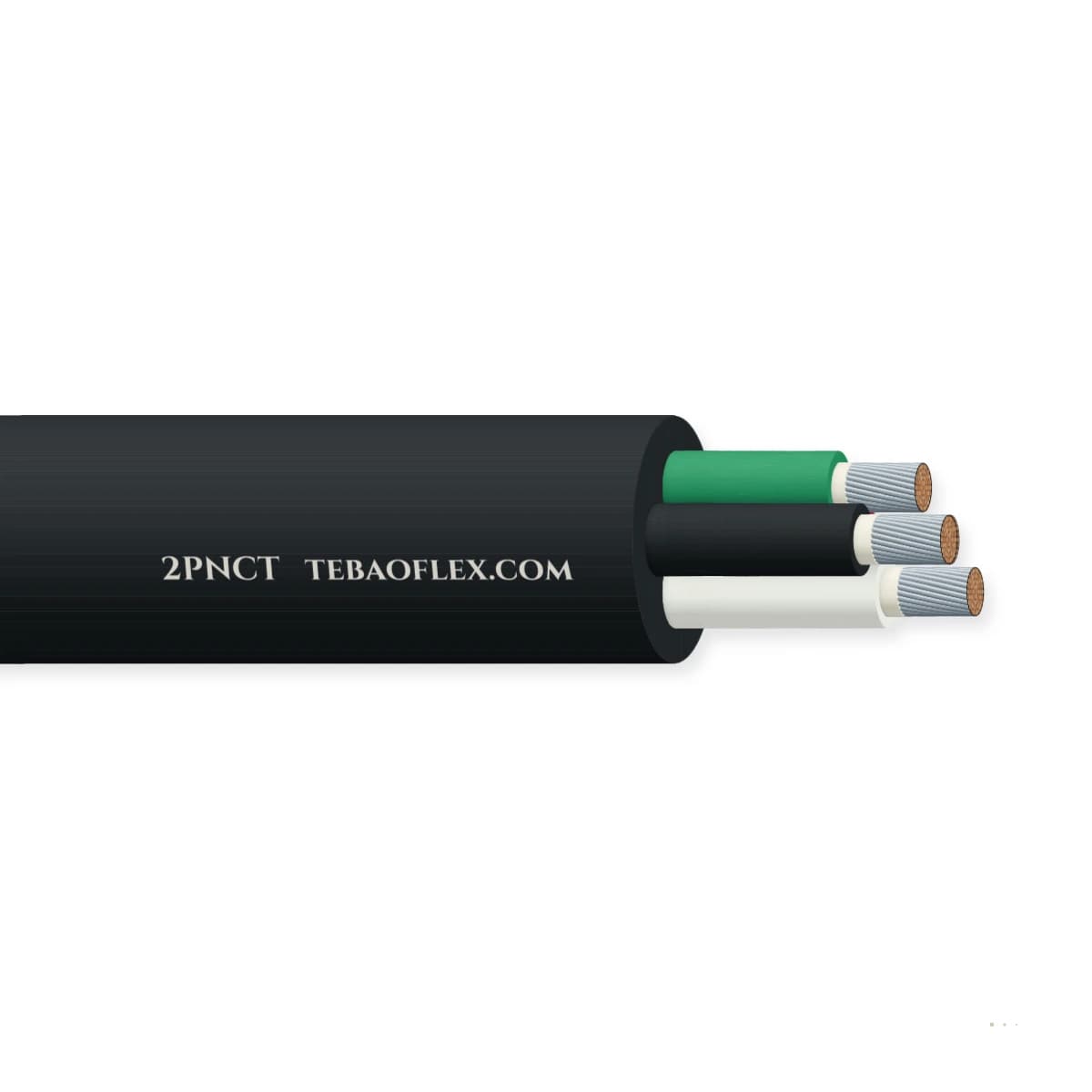
Horizontal cutaway of JIS C 3327 2PNCT / 3PNCT 600 V rubber cabtyre cable
Core Counts and Conductor Sizes in 2PNCT and 3PNCT Cables
A 2PNCT cable specification covers both high-current power feeders and multi-core control harnesses under the same 600 V AC rating. Every production length undergoes a routine 3,000 V AC 1-minute dielectric test:
- Single-core and power cables (1 to 4 cores): Standard conductor cross-sections follow the Japanese SQ (mm²) series from 0.75 to 325 mm². Standard steps are 0.75, 1.25, 2.0, 3.5, 5.5, 8, 14, 22, 30, 38, 50, 60, 80, 100, 125, 150, 200, 250 and 325 mm². Note that Japanese JIS sizes use 2.0, 3.5 and 5.5 mm² where metric IEC 60228:2023 cables use 1.5, 2.5, 4.0 and 6.0 mm².
- Multi-core crane control cables (5 to 30 cores): For festoon loops, pendant stations and spreader control, 2PNCT and 3PNCT are built in 5, 6, 7, 8, 10, 12, 16, 20, 24 and 30 cores. Standard control conductor sizes are 1.25, 2.0, 3.5 and 5.5 mm². Custom multi-core combinations with metric 1.5 or 2.5 mm² cores can also be manufactured to match existing terminal blocks.
- Core identification rules: Two-core cables use black and white, while three-core cables use black, white and red. Four-core cables add green, five-core cables add yellow, and six-core cables add blue. Assemblies with 7 to 30 cores use numbered tape identification or tracer combinations so technicians can terminate large control bundles cleanly.
- Operating temperature and current basis: Current ratings follow JCS 0168 for a single cable in free air at 30 °C ambient. Derating factors apply above 30 °C or when wound in layers on a drum. Typical ambient range is −25 to +60 °C in flexing service and −35 to +60 °C in fixed installations.
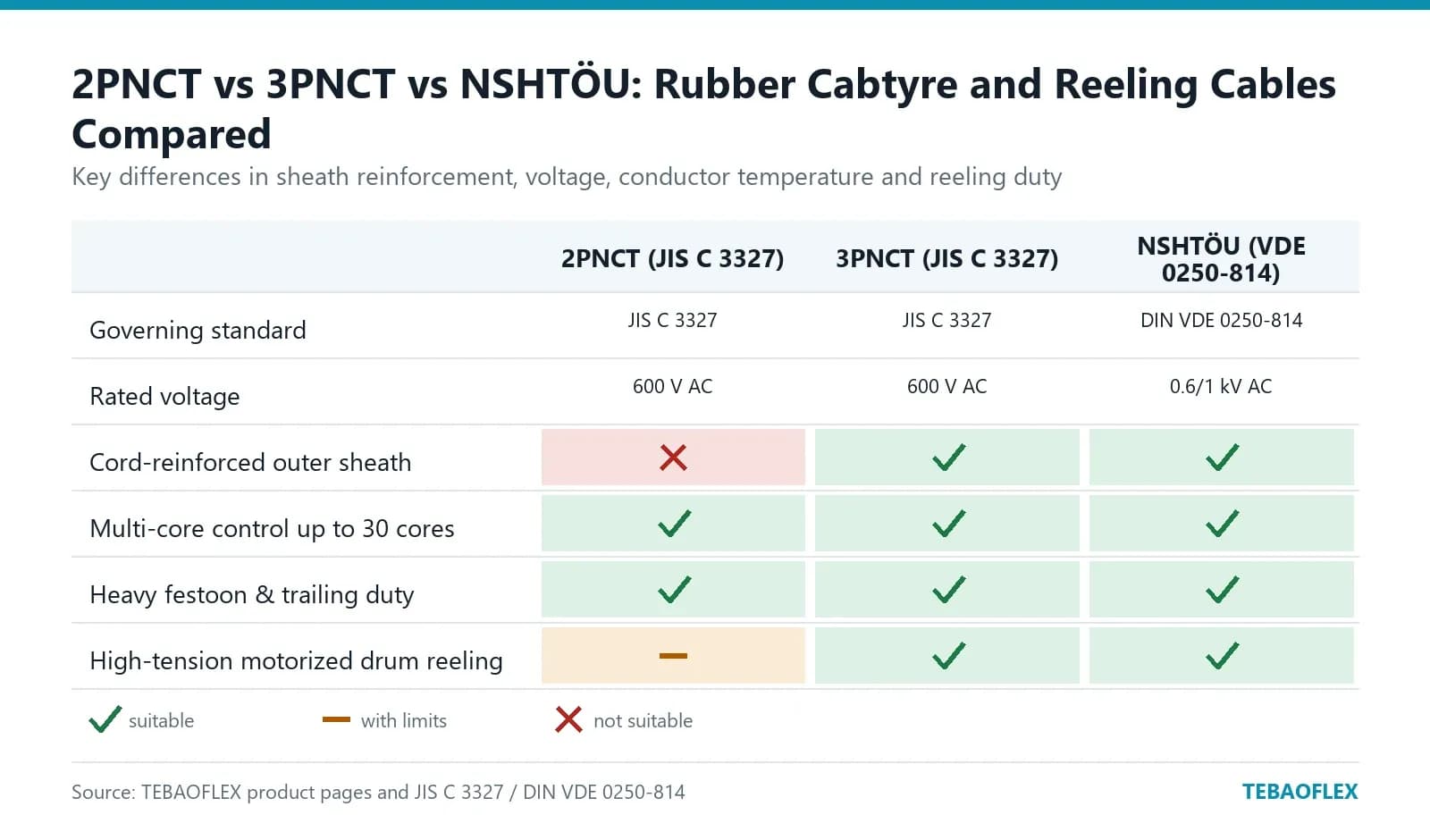
Comparison of JIS C 3327 2PNCT Class 2, 3PNCT Class 3 cord-reinforced cabtyre and DIN VDE 0250-814 NSHTÖU reeling cables
Comparison matrix — text version
For each criterion below, values are listed in this order: 2PNCT (JIS C 3327); 3PNCT (JIS C 3327); NSHTÖU (VDE 0250-814).
- Governing standard: JIS C 3327; JIS C 3327; DIN VDE 0250-814.
- Rated voltage: 600 V AC; 600 V AC; 0.6/1 kV AC.
- Cord-reinforced outer sheath: no; yes; yes.
- Multi-core control up to 30 cores: yes; yes; yes.
- Heavy festoon & trailing duty: yes; yes; yes.
- High-tension motorized drum reeling: limited; yes; yes.
2PNCT vs 3PNCT vs NSHTÖU: Which Reeling or Festoon Cable Should You Choose?
Engineers replacing cables on Japanese cranes or comparing bids across JIS and VDE standards should check three mechanical limits. That comparison decides between 2PNCT, 3PNCT cable and European NSHTÖU reeling cable:
- 2PNCT (Class 2 heavy-duty cabtyre): Uses a single-layer heavy chloroprene outer sheath without an internal reinforcing braid. It is the economical choice for crane C-rail festoons, portable welding leads and light trailing duty. Keep conductor tensile stress within 19.8 N/mm² and moving bending radius at 10 × OD or more (4 to 6 × OD fixed).
- 3PNCT (Class 3 extra-heavy cord-reinforced cabtyre): Embeds a synthetic cord reinforcing layer between inner and outer chloroprene sheaths across sizes from 1 × 2.0 to 325 mm² and multi-core builds. Choose 3PNCT when the cable runs on a spring or motorized drum reel or drags across rough quarry or shipyard floors. For frequent reeling cycles, maintain a minimum bending radius of 15 × OD.
- NSHTÖU (DIN VDE 0250-814 0.6/1 kV reeling cable): Specify NSHTÖU reeling cable when a crane reel runs at high travel speeds (up to 180–240 m/min) or needs a full 0.6/1 kV rating. Its integrated anti-torsion braid prevents corkscrewing on monospiral and level-wind drums. For further reel sizing steps, read How to Choose a Crane Reeling Cable in 7 Steps and Bucket-Wheel Excavator and Stacker-Reclaimer Reeling Cables.
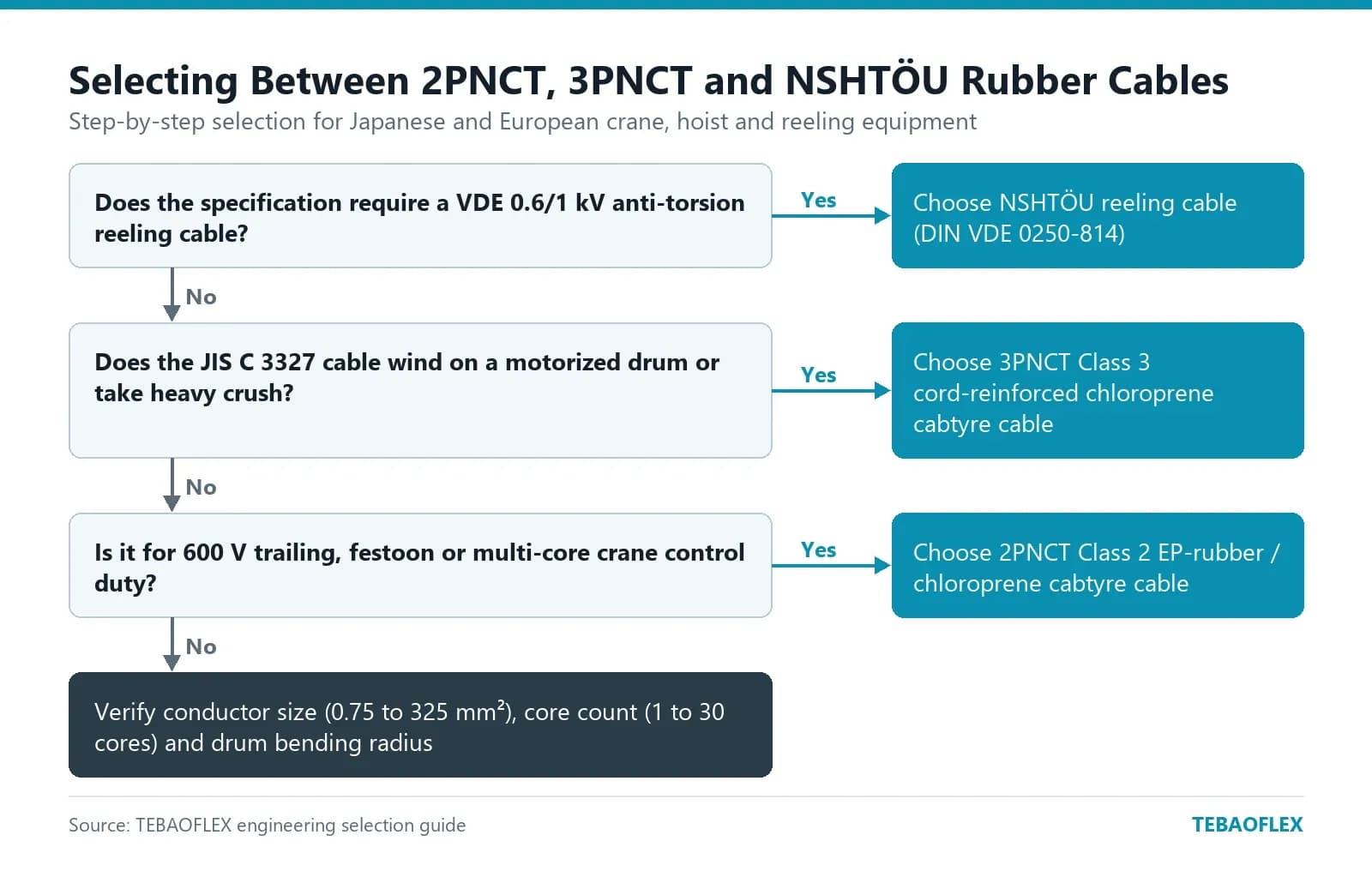
Selection flow between JIS C 3327 2PNCT, 3PNCT and DIN VDE 0250-814 NSHTÖU cables
Selection flowchart — text version
- Does the specification require a VDE 0.6/1 kV anti-torsion reeling cable? If yes: Choose NSHTÖU reeling cable (DIN VDE 0250-814).
- Does the JIS C 3327 cable wind on a motorized drum or take heavy crush? If yes: Choose 3PNCT Class 3 cord-reinforced chloroprene cabtyre cable.
- Is it for 600 V trailing, festoon or multi-core crane control duty? If yes: Choose 2PNCT Class 2 EP-rubber / chloroprene cabtyre cable.
Otherwise: Verify conductor size (0.75 to 325 mm²), core count (1 to 30 cores) and drum bending radius.
What to Check Before Ordering 2PNCT or 3PNCT Cabtyre Cable
When preparing a purchase order or replacement schedule for Japanese cabtyre cables, include these parameters:
- Class 2 vs Class 3 duty: State whether the cable hangs in a festoon loop (2PNCT) or winds under tension on a motorized drum (3PNCT or NSHTÖU).
- Core count and cross-section (SQ / mm²): Specify the exact core count (from 1 to 30 cores). Confirm whether the conductor size follows standard JIS SQ steps (such as 2.0, 3.5 or 5.5 mm²) or metric IEC steps (1.5, 2.5, 4.0 mm²).
- Support element for vertical suspension: Standard 2PNCT and 3PNCT allow up to 19.8 N/mm² conductor tensile stress. For long vertical drops or high-pull reels, request a central or twin support element, which raises permissible pull to 29.4 N/mm².
- Drum window and gland diameter: Because 3PNCT has a thicker dual-layer reinforced chloroprene sheath than 2PNCT, verify the nominal outer diameter against existing cable glands and festoon clamps.
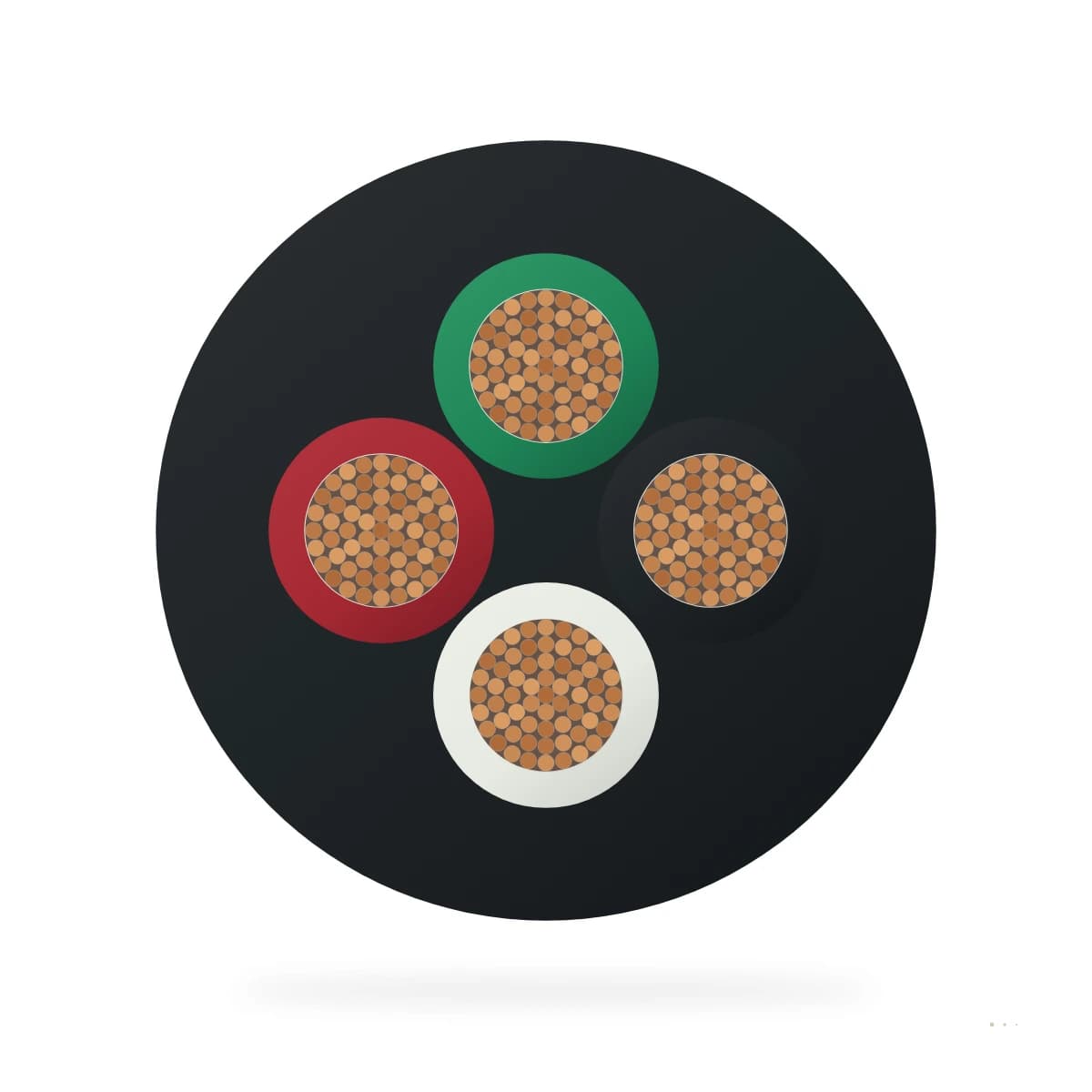
Radial cross-section of JIS C 3327 2PNCT / 3PNCT rubber cabtyre cable
Review full dimensional tables on our PNCT / 2PNCT / 3PNCT 600 V rubber cabtyre cable and NSHTÖU reeling cable pages, or send your crane specification to TEBAOFLEX via WhatsApp at +86 185 9591 3361, email at info@tebaoflex.com, or our contact form.
Frequently Asked Questions
What core counts, conductor sizes and reeling limits apply to a 2PNCT cable specification under JIS C 3327?
Under JIS C 3327, a 600 V 2PNCT cable specification covers 1 to 4 power cores from 0.75 to 325 mm² and multi-core control cables from 5 to 30 cores. Typical multi-core control sizes are 1.25, 2.0, 3.5 and 5.5 mm². It uses annealed tinned copper conductors, +80 °C EP rubber insulation, and a Class 2 chloroprene outer sheath. Minimum bending radius is 4–6 × OD fixed, 10 × OD in general movement, and 15 × OD for frequent reeling, with a 19.8 N/mm² pull limit.
What is the difference between 2PNCT and 3PNCT rubber cabtyre cable?
Both 2PNCT and 3PNCT are 600 V JIS C 3327 cables with tinned copper conductors and +80 °C EP rubber insulation, but they differ in outer sheath construction. 2PNCT is a Class 2 heavy-duty cable with a single-layer polychloroprene outer sheath for trailing leads and crane festoons. 3PNCT is a Class 3 extra-heavy-duty cable that adds a synthetic cord reinforcing layer between inner and outer chloroprene sheaths to resist crushing and drum-reeling tension.
Why do JIS C 3327 2PNCT cables use 2.0, 3.5 and 5.5 mm² sizes instead of 1.5, 2.5 and 4.0 mm²?
Japanese standard JIS C 3327 and conductor standard JIS C 3152 follow the traditional Japanese SQ cross-section series (0.75, 1.25, 2.0, 3.5, 5.5, 8, 14, 22, 30 and 38 mm²). By contrast, European and international standards follow IEC 60228 (0.75, 1.0, 1.5, 2.5, 4, 6, 10, 16, 25 and 35 mm²). Matching the original JIS SQ size on Japanese machinery ensures proper lug crimping and overload relay settings.
Can 2PNCT cable be replaced with DIN VDE 0250-814 NSHTÖU reeling cable?
In many crane and material-handling applications, yes — provided the outer diameter fits the existing cable glands and reel grooves. NSHTÖU is rated 0.6/1 kV (higher than the 600 V rating of 2PNCT) and operates up to +90 °C conductor temperature. It also includes an integrated anti-torsion braid between inner and outer polychloroprene sheaths, making it comparable to cord-reinforced 3PNCT on motorized reeling drums.