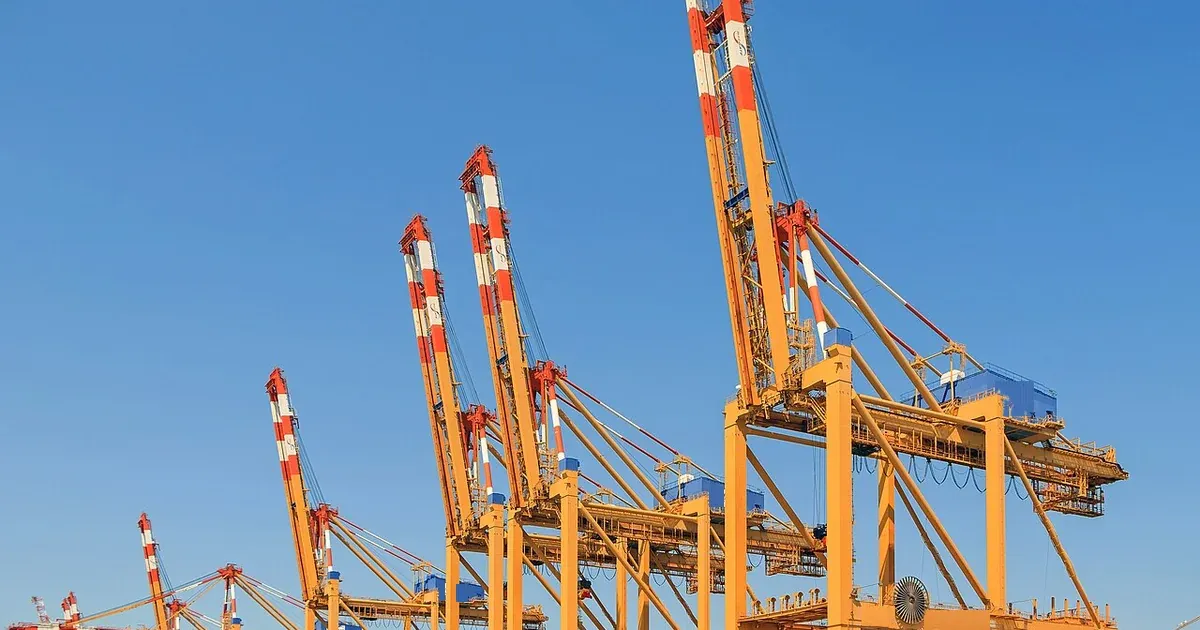
TL;DR: Crane cable replacement often stalls over field data errors rather than factory faults. Adding hoist, luffing, travel, and slewing motor plates (> 400 kW) produces > 3x400+1x240 mm² sizing that jams trolley saddles. Aged rubber also swells 5 to 6 mm, skewing caliper checks against new DIN or JIS profiles. Correct sizing isolates single-motor duty, spots NGFLGOEU vs 2PNCT visually, and adds tensile reinforcement before outdoor reeling.
- Buyer supplies total crane kW (> 400 kW) — Root Engineering Cause: Nameplate sum merges non-simultaneous drives; Consequence of Naive Substitution: Oversized > 3x400+1x240 mm² cable fails trolley clearance; Verified Engineering Resolution: Size each lead from its driven motor kW and duty cycle; Target Family: NGFLGOEU / 2PNCT
- New cable measures 5 to 6 mm thinner — Root Engineering Cause: Heat, oil mist, flexing, and voids swell old rubber; Consequence of Naive Substitution: Crews reject compliant leads and delay crane uptime; Verified Engineering Resolution: Gauge copper strand count and new 3GI3 / 5GM3 walls; Target Family: DIN VDE 0250-809
- Buyer requests JIS PNCT from German photos — Root Engineering Cause: Teams reuse old catalog names after jacket print fades; Consequence of Naive Substitution: Metric (50 mm²) vs JIS (60 mm²) mismatch seals and lugs; Verified Engineering Resolution: Check parallel shape, HD 308 colors, and wire finish; Target Family: JIS C 3312 / C 3327 / DIN
- Deploying flat festoons on outdoor reels — Root Engineering Cause: Standard 15 N/mm² festoons lack drum torque support; Consequence of Naive Substitution: Copper birdcaging and core breakage inside motorized reels; Verified Engineering Resolution: Specify reinforced flat, NSHTÖU, TRA PUR, or reeling 3PNCT-T / 3PNCT-B; Target Family: NSHTÖU / TRA PUR
Why Total Connected Crane kW Over-Sizes Replacement Feeders
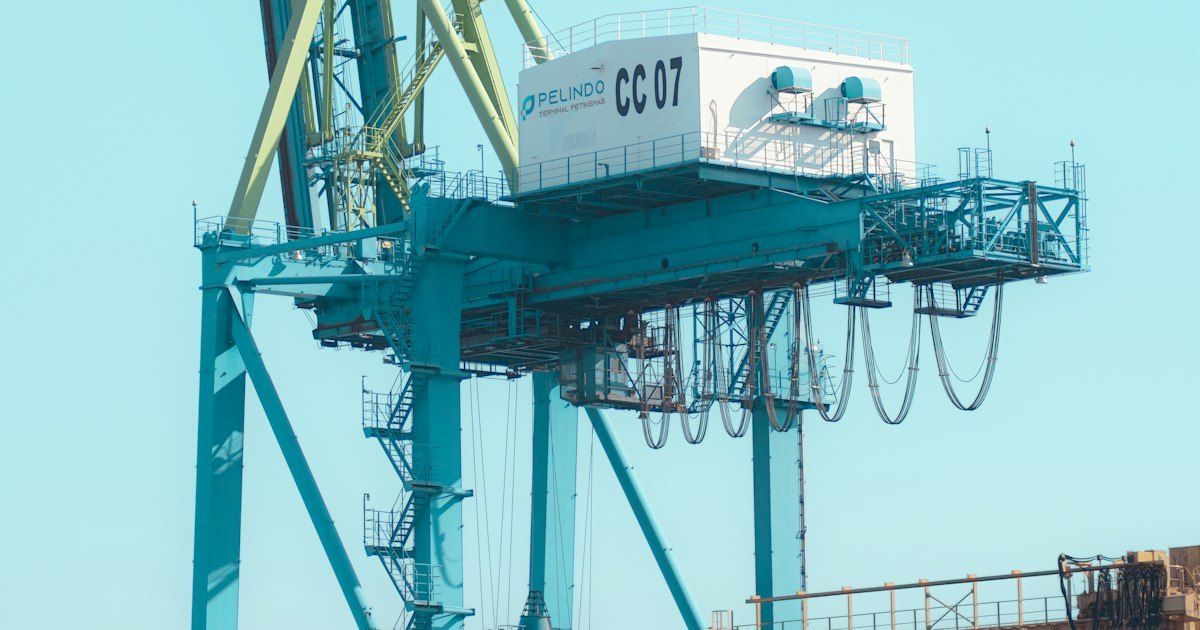
Non-simultaneous crane motor diversity is the operating principle that governs multi-axis overhead (EOT), gantry, and jib cranes under intermittent S3 duty. A crane drawing prints a combined connected load above 400 kW. Yet individual drives rarely pull peak current at the exact same instant.
During urgent repairs at Southeast Asian ports and steel yards, buyers often copy one headline kW figure from the main panel. Treating total crane power as steady single-cable demand yields oversized conductor schedules.
Take an illustrative 400 V crane with four drives totaling 430 kW. Applying I = P / (1.732 * V * cos phi * eta) at 0.85 power factor and 92% efficiency separates combined capacity from real branch load.
- Combined crane nameplate sum — Illustrative Connected Load: 430 kW combined (S1 assumption); Calculated Three-Phase Current (400 V): 793.7 A continuous demand; Approximate Flexible Copper Schedule: Twin parallel runs exceeding 3x400+1x240 mm²; Physical Fit on Existing Trolley Saddle: Impossible (> 100 mm flat or dual heavy round drums)
- Main hoist motor feeder alone — Illustrative Connected Load: 160 kW single intermittent motor; Calculated Three-Phase Current (400 V): 295.3 A full-load current; Approximate Flexible Copper Schedule: 4G95 mm² or twin parallel 4G35 / 4G50 runs; Physical Fit on Existing Trolley Saddle: Fits heavy bridge festoons when duty factor applied
- Trolley / luffing motor feeder — Illustrative Connected Load: 110 kW single intermittent motor; Calculated Three-Phase Current (400 V): 203.0 A full-load current; Approximate Flexible Copper Schedule: 4G50 mm² (212 A free-air; 192.9 A at 40 °C); Physical Fit on Existing Trolley Saddle: Fits standard 66 mm class trolley saddle clamps
- Gantry long-travel feeder — Illustrative Connected Load: 90 kW twin drive group; Calculated Three-Phase Current (400 V): 166.1 A combined drive load; Approximate Flexible Copper Schedule: 4G50 mm² or 3x50+1x25 mm²; Physical Fit on Existing Trolley Saddle: Fits existing festoon clips with ambient derating margin
- Slewing drive feeder — Illustrative Connected Load: 70 kW intermittent rotation drive; Calculated Three-Phase Current (400 V): 129.2 A full-load current; Approximate Flexible Copper Schedule: 4G35 mm² or 3PNCT 4x38 mm²; Physical Fit on Existing Trolley Saddle: Compact loop radius for slewing rings and small chains
Sizing for 793.7 A steady demand instead of a 166 A to 203 A motor branch pushes copper past 3x400+1x240 mm². Under DIN VDE 0298-4 current-carrying capacity guidelines, one +90 °C EPR 50 mm² flat lead carries 212 A at +30 °C. A 0.91 factor gives 192.9 A at +40 °C. Over-sizing to 400 mm² breaks plastic festoon trolleys and triples copper spend.
Confirm three electrical points with site electricians before choosing a wire gauge.
- Isolate the fed circuit. Confirm whether the cable feeds one hoist motor, a trolley VFD, or the main runway switch.
- Apply crane duty (S3 / ED%). Intermittent 25% to 60% duty cycles cool faster than continuous pump feeds.
- Count loaded cores (3 phases + PE). Only three phase cores carry steady load while the earth core stays cool.
Explore matched trolley options in our material handling and port crane cables guide.
Diagnosing 5 to 6 mm Caliper Swelling on Fire-Damaged Rubber Cables
Field teams frequently measure burned scrap pieces with calipers and see new DIN or JIS sheets listed 5 to 6 mm smaller. Rejecting a smaller-profile replacement based on swollen scrap delays urgent crane repairs.
Elastomer thermal swelling and compression set is the permanent expansion of aged chloroprene (CR / PCP) and EPDM jackets under heat, oil, and moisture. After 10 to 15 years on outdoor cranes, worn flat rubber cables often read 5 to 6 mm thicker than new factory limits.
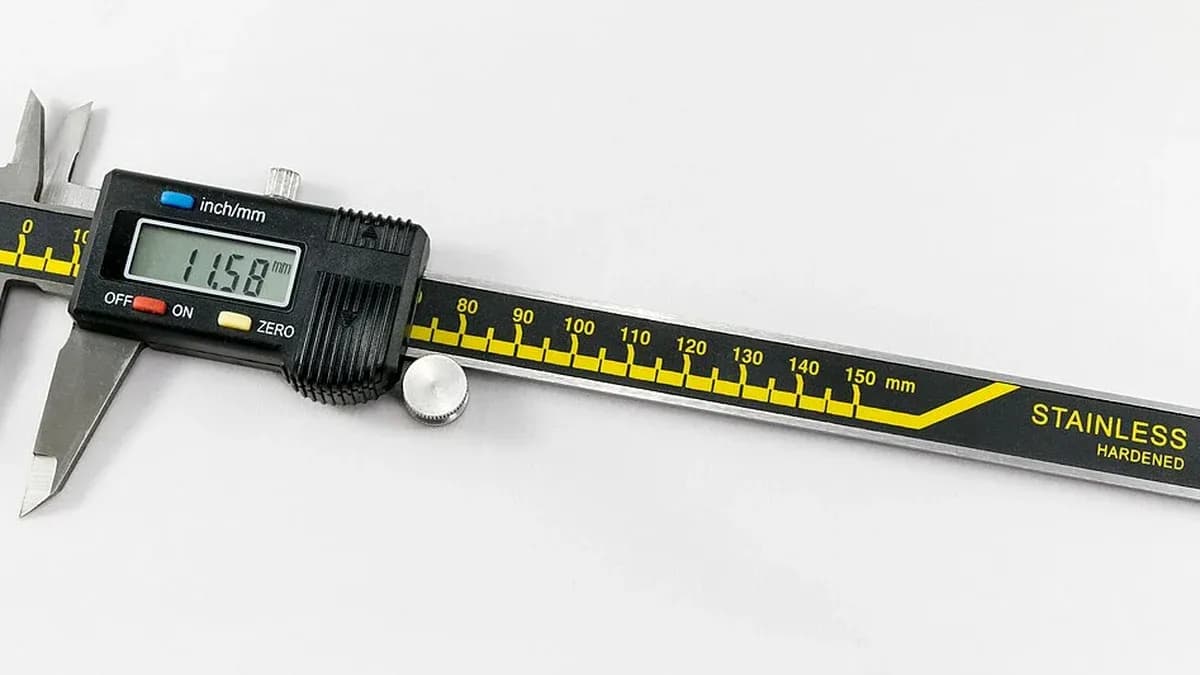
Three physical effects inflate micrometer checks on old crane cables.
- Permanent flattening under clamping fatigue. Tens of thousands of festoon passes stretch cores and flatten rubber inside steel saddle clips.
- Oil and hydrocarbon jacket absorption. Overhead gearboxes drip grease onto trolley tracks. Over ten years, fine surface cracks draw oil inward and swell the sheath.
- Moisture migration and charring voids. Prior to an arc fire, trapped steam blisters separate internal bedding from the outer rubber cover.
A new flat crane cable engineered to DIN VDE 0250-809 holds tight extrusion limits. Factory dimensions cap NGFLGOEU-J 4G50 at 19.0 x 58.0 mm and 4G70 at 21.3 x 65.2 mm. Measuring a 19 mm cable at 24 to 25 mm proves jacket swelling rather than heavier copper. Strip back 150 mm of healthy sheath to verify wire filament count first.
Photo Identification and Selecting NGFLGOEU, 2PNCT, PUR-HF, or Reeling Builds
Blind cross-section photo identification separates DIN VDE, JIS, and polyurethane crane cable families by core layout, color code, and copper plating. Buyers often submit photos labeled PNCT even when the old crane carries German DIN parts.
Surface print wears off within years on collector guides and under outdoor UV exposure. Ordering 2PNCT by name creates mismatches because JIS C 3312 / C 3327 cabtyre cables use 14, 22, 38, 60, and 100 mm² steps. European IEC cables step in 16, 25, 35, 50, 70, and 95 mm².
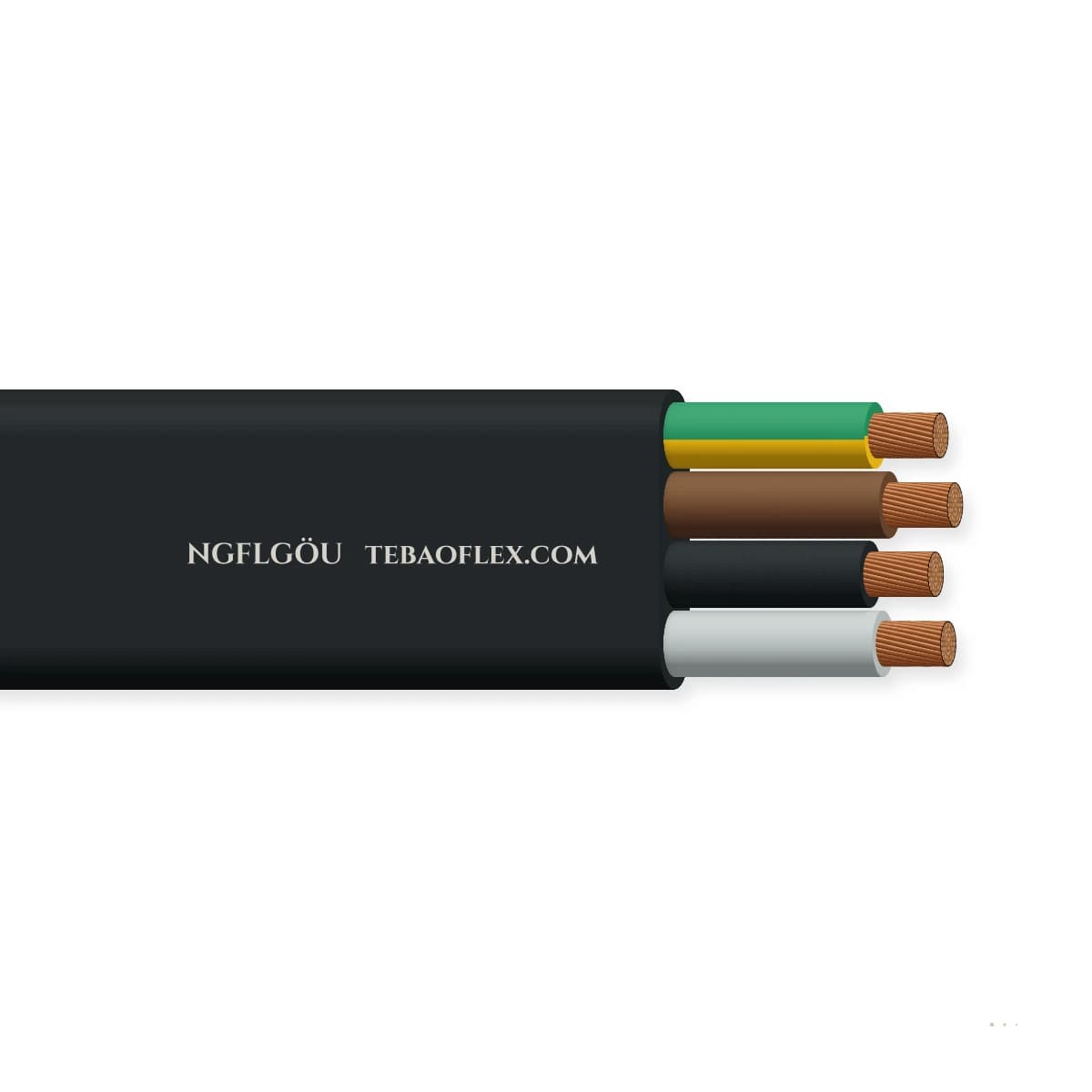
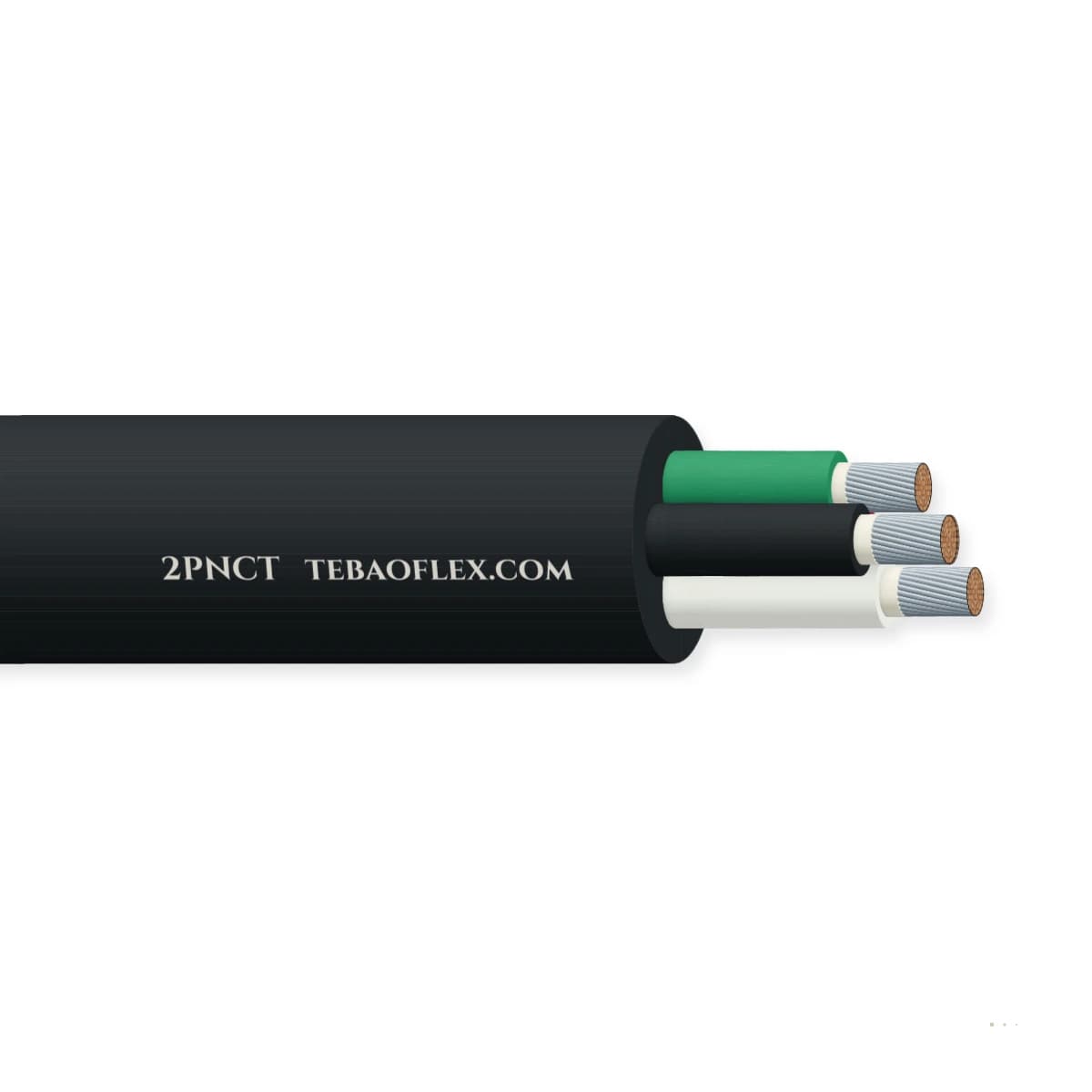
Engineers can identify an unlabeled crane lead in two minutes using these visual traits and ratings:
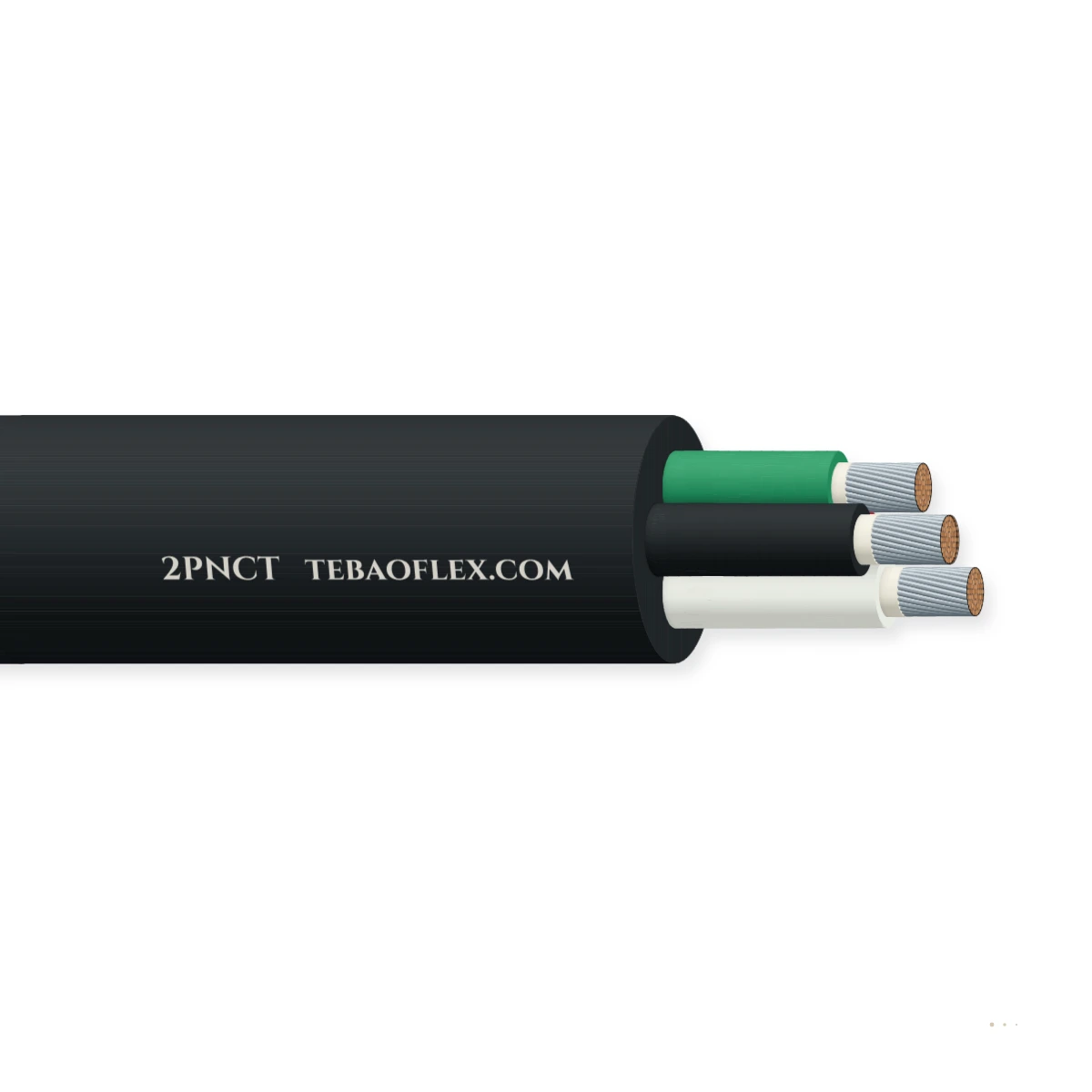
- Visual profile & cores — NGFLGOEU-J 4G50 (DIN VDE 0250-809): Flat parallel cores; HD 308 (GNYE, Brn, Blk, Grey); 2PNCT 4x60 (JIS C 3312 / C 3327 Standard): Round cabled cores; JIS (Blk, Wht, Red, Grn); 3PNCT 4x60 (JIS C 3312 / C 3327 Heavy-Duty): Round dual-sheath; visible cord layer between jackets; PUR-HF-J 4G50 (Halogen-Free PUR Festoon): Compact round black PUR; central textile strength member; NSHTÖU-J 4G50 (DIN VDE 0250-814): Heavy round black rubber; textile anti-torsion braid
- Copper finish & sizing — NGFLGOEU-J 4G50 (DIN VDE 0250-809): Bare Class 6 (<= 25 mm²) / Class 5 (>= 35 mm²) Cu (1.5 to 120 mm² standard; larger custom); 2PNCT 4x60 (JIS C 3312 / C 3327 Standard): Tinned JIS C 3152 Cu (14, 22, 38, 60, 100 mm²); 3PNCT 4x60 (JIS C 3312 / C 3327 Heavy-Duty): Tinned JIS C 3152 Cu (22, 38, 60, 100 mm²); PUR-HF-J 4G50 (Halogen-Free PUR Festoon): Tinned Class 5 Cu standard (bare option; 1.5 to 150 mm² IEC steps); NSHTÖU-J 4G50 (DIN VDE 0250-814): Tinned Class 5 Cu (1.5 to 120 mm² IEC steps)
- Rated voltage & thermal — NGFLGOEU-J 4G50 (DIN VDE 0250-809): 300/500 V (0.7/1.2 kV max); -35 to +80 °C flex (+90 °C core); 2PNCT 4x60 (JIS C 3312 / C 3327 Standard): 600 V AC; -25 to +60 °C flex (+80 °C max core); 3PNCT 4x60 (JIS C 3312 / C 3327 Heavy-Duty): 600 V AC; -25 to +60 °C flex (+80 °C max core); PUR-HF-J 4G50 (Halogen-Free PUR Festoon): 0.6/1 kV; -40 to +80 °C flex (+90 °C max core); NSHTÖU-J 4G50 (DIN VDE 0250-814): 0.6/1 kV; -25 to +80 °C flex (+90 °C max core)
- Dimensions (~50/60 mm²) — NGFLGOEU-J 4G50 (DIN VDE 0250-809): 19.0 x 58.0 mm (2,830 kg/km); 2PNCT 4x60 (JIS C 3312 / C 3327 Standard): 42.0 mm round OD (3,740 kg/km); 3PNCT 4x60 (JIS C 3312 / C 3327 Heavy-Duty): 49.0 mm round OD (4,410 kg/km); PUR-HF-J 4G50 (Halogen-Free PUR Festoon): 31.0 to 33.0 mm OD (2,400 kg/km); NSHTÖU-J 4G50 (DIN VDE 0250-814): 39.4 to 43.6 mm OD (3,500 kg/km)
- Min. bend radius & speed — NGFLGOEU-J 4G50 (DIN VDE 0250-809): 95 mm (3 to 5 x H); 180 m/min festoon; 2PNCT 4x60 (JIS C 3312 / C 3327 Standard): 252 mm (6 x OD moving; 4 x OD fixed); portable/equipment lead; 3PNCT 4x60 (JIS C 3312 / C 3327 Heavy-Duty): 294 mm (6 x OD moving; 4 x OD fixed); powered reeling requires 3PNCT-T / 3PNCT-B; PUR-HF-J 4G50 (Halogen-Free PUR Festoon): 264 mm (8 x D mobile; 6 x D fixed); 200 m/min festoon / 60 m/min reel; NSHTÖU-J 4G50 (DIN VDE 0250-814): 262 mm (6 x D); 120 m/min horizontal reel
- Permitted tensile / torsion — NGFLGOEU-J 4G50 (DIN VDE 0250-809): 3,000 N (15 N/mm²); zero torsion allowed; 2PNCT 4x60 (JIS C 3312 / C 3327 Standard): Standard portable cabtyre; not rated for continuous powered reel pull; 3PNCT 4x60 (JIS C 3312 / C 3327 Heavy-Duty): Reinforced sheath; dedicated reeling derivatives (3PNCT-T / 3PNCT-B) required for drum tension; PUR-HF-J 4G50 (Halogen-Free PUR Festoon): 3,000 N (15 N/mm²); ±25 °/m mild torsion; NSHTÖU-J 4G50 (DIN VDE 0250-814): 3,000 N (15 N/mm²); ±50 °/m drum torsion
Look at two instant visual clues in the photos above. First, a flat black sheath with green-yellow, brown, black, and grey bare copper marks DIN VDE 0250-809 (NGFLGOEU). Second, round black rubber with tinned wires in black, white, red, and solid green insulation identifies JIS cabtyre construction (2PNCT or 3PNCT). Choosing 3PNCT adds a cord-reinforced double chloroprene sheath with identical core colors, while powered crane drums require dedicated reeling derivatives (such as 3PNCT-T or 3PNCT-B) rather than standard portable cabtyre.
For width and core layout details, see our 2PNCT vs NGFLGOEU core layout comparison and our 2PNCT vs 3PNCT cabtyre selection guide.
Upgrading Outdoor Festoon Circuits to Motorized Reeling Systems
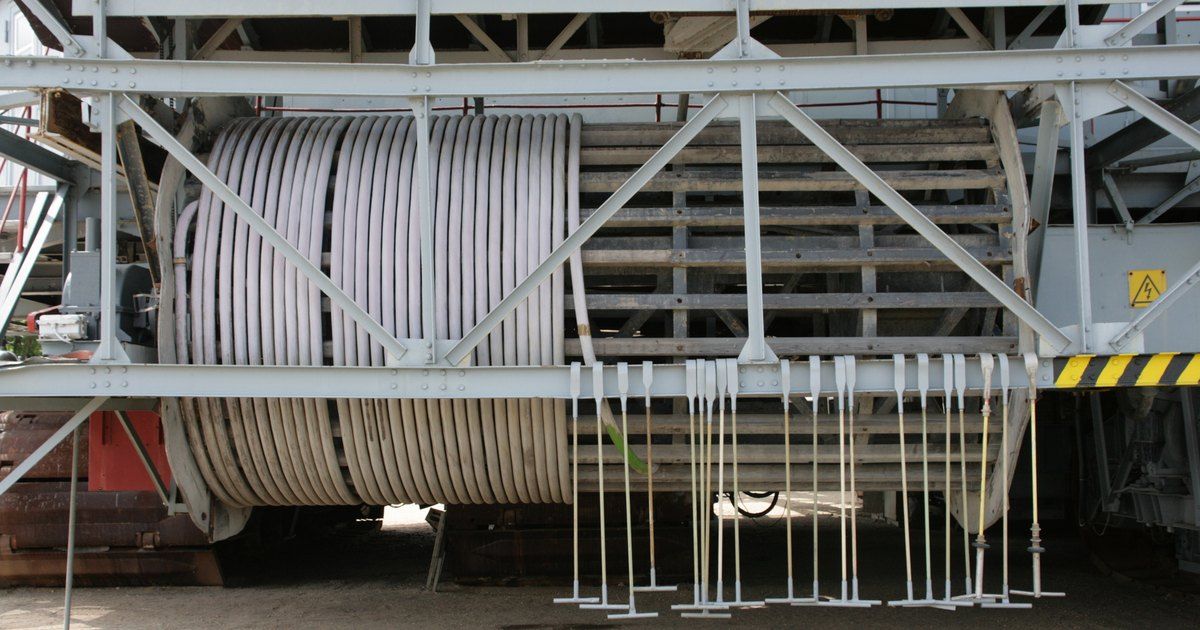
Maintenance crews often ask if stocked flat rubber cable can run outdoors on a motorized drum. Festoon loops hang gently between trolley wheels up to 180 m/min and bend in one plane. Reeling drums apply cyclic axial tension, multi-layer coil heat, and side pulley twist.
Reeling tensile reinforcement is an embedded textile, polyester, or aramid layer inside a crane cable jacket. It absorbs drum startup torque so soft copper strands do not stretch. Unreinforced flat festoon cables stop at 15 N/mm² and fail early on motorized crane reels.
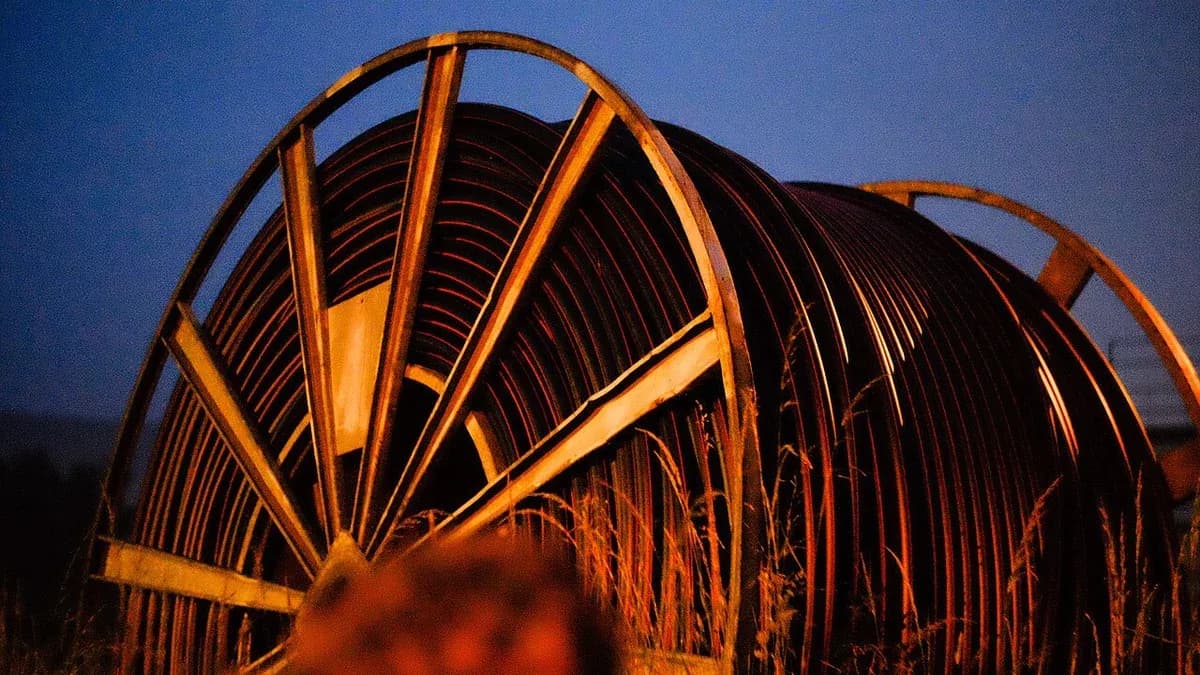
Three verified build paths upgrade an outdoor crane circuit onto powered reeling gear safely:
- Dimension-matched custom reinforcement. Fixed gland holes and pulley grooves often lock outer cable size (OD). TEBAOFLEX can add an internal tensile layer inside the nominal profile to carry reel pull cleanly.
- Double-sheath rubber reeling (NSHTÖU or dedicated 3PNCT-T / 3PNCT-B). Port cranes running up to 120 m/min horizontally use NSHTÖU reeling cables. Its polyester anti-torsion braid sits between inner rubber and outer 5GM3 sheaths, handling ±50 °/m twist (-25 °C to +80 °C flexing). Where JIS equipment geometry is mandatory, specify dedicated reeling derivatives (3PNCT-T or 3PNCT-B) instead of assigning ordinary portable 2PNCT or 3PNCT directly to continuous powered drums.
- Slim halogen-free polyurethane (PUR-HF or TRA PUR). Narrow reel flanges reject bulky 49 mm double rubber. PUR-HF festoon and moderate reel cables cut 4G50 OD down to 31.0 to 33.0 mm (2,400 kg/km) with a central textile carrier, 8 x D mobile bend radius, 200 m/min festoon and 60 m/min horizontal reel speed, and hydrolysis- and oil-resistant PUR HFFR jacketing. For 200 m/min horizontal or vertical crane reels up to 25 mm², TRA signal-green PUR reeling cables offer 25 N/mm² nominal tensile capacity (3,750 N catalog rating on 5G25) with an embedded textile anti-twisting braid inside a double PUR sheath.
Compare full winding families across our industrial reeling cables and festoon catalogs. Every outdoor crane series passes IEC 60332-1-2 vertical flame tests before shipment.
What to Measure and Verify Before Ordering a Crane Cable Replacement
Accurate field forensics prevent costly emergency re-orders. Do not trust swelled rubber diameters or combined crane kW sums. Check six measurable engineering points before ordering replacement reels.
- Conductor cross-section — Wrong Metric Often Sent: External worn jacket OD (+5 to +6 mm error); Exact Engineering Value Needed: Bare strand count (N) and single wire diameter (d); Verification Standard / Tolerance Check: Recover N * pi * (d/2)^2 per IEC 60228 conductor classes
- Motor circuit load — Wrong Metric Often Sent: Combined crane nameplate power (> 400 kW); Exact Engineering Value Needed: Individual motor kW, line voltage (V), and ED% duty; Verification Standard / Tolerance Check: Confirm ampacity and VDE reel layer derating factors
- Standard heritage ID — Wrong Metric Often Sent: Generic verbal name ("crane PNCT" by habit); Exact Engineering Value Needed: Crisp core-end photo showing colors, copper tinning, & shape; Verification Standard / Tolerance Check: Match DIN VDE standards vs JIS schedules cleanly
- Hardware envelope — Wrong Metric Often Sent: Approximate tape estimate across swelled flat; Exact Engineering Value Needed: Exact trolley saddle window (W x H) or drum flange width; Verification Standard / Tolerance Check: Hold factory die dimensions (65 to 66 mm class tolerance)
- Motion & tension mode — Wrong Metric Often Sent: Generic "outdoor crane" note; Exact Engineering Value Needed: Festoon (<= 180 m/min), drag chain, or motorized reel tension; Verification Standard / Tolerance Check: Verify whether axial support braid or cord layer is mandatory
- Factory Acceptance Test — Wrong Metric Often Sent: Unchecked commercial invoice description; Exact Engineering Value Needed: Routine AC dielectric test (2.5 or 3.5 kV), resistance, OD log; Verification Standard / Tolerance Check: Inspect per IEC 60502-1 dielectric methods & pre-dispatch video
Before dispatch, our quality lab logs three factory acceptance checks aligned with our factory quality certification records. Each reel receives digital micrometer scans, 20 °C conductor loop resistance verification (IEC 60228), and 2.5 to 3.5 kV AC withstand logs. Send your stripped core photo and single-motor parameters to the TEBAOFLEX engineering team for a fast profile verification.
Frequently Asked Questions
Why can an old rubber crane cable measure 5 to 6 mm thicker than a new replacement?
Heat aging, cyclic flattening, oil pickup, and internal delamination swell worn rubber over time. After 10 to 15 years outdoors, polychloroprene (5GM3 / CR) and EPDM covers flatten in festoon clips and soak up gearbox oil. Internal arc blisters add extra bulk before failure. Strip healthy core copper (IEC 60228 Class 5/6) and verify strand area rather than trusting swollen outer rubber.
Can I size a replacement crane cable directly from total crane connected power (kW)?
No, combined crane power adds motors that rarely peak at the same instant. Sizing one lead from a > 400 kW total pushes wire past 3x400+1x240 mm² and jams trolley saddles. Identify the specific motor circuit (hoist, luffing, trolley, or gantry travel) instead. Then apply its S3 duty cycle (ED%) and ambient derating under DIN VDE 0298-4.
How do I tell JIS PNCT from DIN VDE NGFLGOEU without legible jacket printing?
Inspect cross-section shape, core colors, and wire coating. German NGFLGOEU under DIN VDE 0250-809 uses parallel flat cores in HD 308 colors (green-yellow, brown, black, grey) over bare copper (1.5 to 120 mm² standard). Japanese 2PNCT / 3PNCT under JIS C 3312 / C 3327 uses round cabled cores with tinned copper, black/white/red/green insulation, and JIS steps (14, 22, 38, 60 mm²).
Can a flat NGFLGOEU festoon cable be used directly on an outdoor motorized crane reel?
No, standard flat festoon cables bend strictly in one vertical loop plane. Plain NGFLGOEU stops at 15 N/mm² conductor pull with zero twist allowance. Motorized drum startup tension stretches cores and cracks rubber jackets. Specify a custom reinforced flat build holding nominal OD, or switch to anti-torsion NSHTÖU, dedicated reeling 3PNCT-T / 3PNCT-B derivatives, PUR-HF, or double-PUR braided TRA.
What happens if you substitute a DIN metric cable into a JIS crane gland?
Conductor area steps and jacket diameters differ between metric IEC and JIS tables. Metric feeds (25, 35, 50, 70 mm²) do not match Japanese 22, 38, or 60 mm² steps. Forcing the wrong size damages crimp lugs or breaks IP66 / IP68 gland seals. Check lug bore diameter (Cond. OD) and gland grip range first.
Image credits: Port container cranes hero photograph by H. Zell (CC BY-SA 3.0, Wikimedia Commons, commercial crane signage removed); stainless digital caliper photograph by Jacek Halicki (CC BY-SA 4.0, Wikimedia Commons); steel cable drum photograph by Olaf (CC BY 3.0, Wikimedia Commons). Cable cross-section cutaways are TEBAOFLEX product imagery.