

Bucket-wheel excavators (BWEs), spreaders and stacker-reclaimers take medium-voltage (MV) power through a reeling or trailing cable as they move. A reeling cable winds on and off a drum as the machine travels. Our crane reeling cable guide covers reel basics for cranes. At mines, rules on earth continuity, isolation and tension also shape any choice from our reeling cable range.
In Western Australia (WA), WorkSafe WA guidance describes trailing and reeling cables as power cables for mobile apparatus "such as large excavators, draglines, stackers and reclaimers". Its reeling cable example is an iron ore rail-mounted reclaimer. The New South Wales (NSW) code of practice for electrical engineering control plans says such cables work in arduous conditions and "are regularly damaged". They currently supply equipment at voltages up to 22 kV, the code adds.
Key Takeaways
- WA regulation 641E requires reeling cables at mines other than underground coal mines to meet AS/NZS 2802:2000. Each needs a pilot core that cuts supply if the earthing circuit breaks.
- At Queensland mines other than coal mines, s 23 of the Mining and Quarrying Safety and Health Regulation 2017 (MQSHR) covers stackers and reclaimers. Their supply must be capable of interruption from an accessible position remote from the plant.
- Our (N)TSCGEWÖU-ATB datasheet, on the NTSCGEWÖU reeling cable page, rates a 95 mm² cable at 301 A on the ground at 30 °C. Three layers on the drum cut that to 147 A.
- Flat designs suit winding in one plane, since our flat MV reeling cable datasheet allows no torsion.
- DIN VDE 0168:2023-09, from the German DIN and VDE standards bodies, covers erecting electrical installations in open-cast mines, quarries and similar works.
How BWEs, Spreaders and Stacker-Reclaimers Take Power
BWEs, spreaders and stacker-reclaimers draw MV power through a flexible cable that either winds on a drum on board or trails behind the machine. A 1983 German trade-journal article, summarised in an abstract indexed by the US Department of Energy, describes a BWE with a total power of 12,700 kW. Its supply was designed for 30 kV, transformed to 6 kV, 500 V, 220 V and 110 V in transformer and switch panels. The conveyor belts had nine drives of up to 1,120 kW each at 6 kV.
An August 2018 notice from Poland's State Mining Authority (WUG) describes a lignite open-pit mine where a BWE worked with a crawler-mounted conveyor. That conveyor passed overburden onto a belt conveyor, and the notice refers to the excavator, belt conveyor and spreader as a single line. The photo below shows a spreader at another mine.
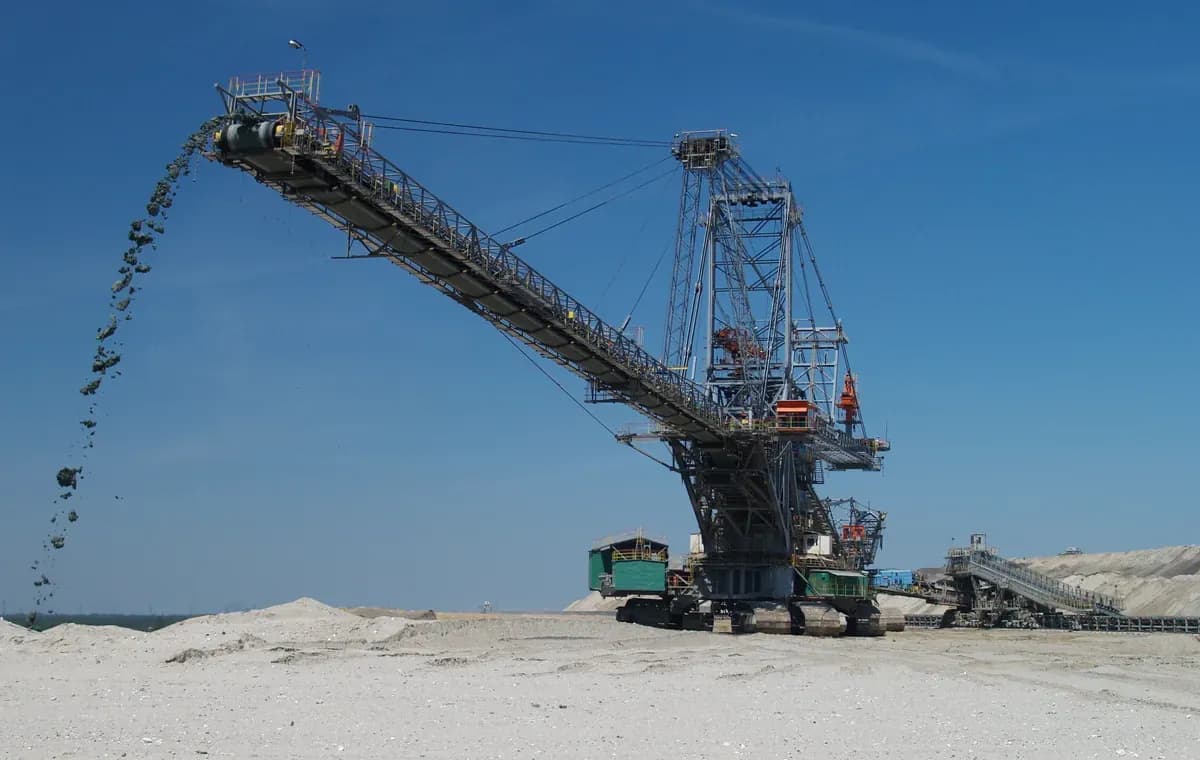
A spreader discharging overburden at a lignite mine in Poland, not the mine in the WUG notice. Photo: "Zwałowarka 15 400 - Chabielice" by Krzysztof Wiśniewski, CC BY-SA 4.0, via Wikimedia Commons, resized.

WorkSafe WA guidance contrasts the two cable types. A reeling cable is reeled on and off a drum frequently, as on that iron ore reclaimer. A trailing cable moves with the machine, as on a coal mine dragline or a mineral sands mobile processing plant.
Our stacker-reclaimer reeling cable video pairs a yellow low-voltage (LV) (N)SHTÖU-J sample with a schematic animation of a bucket-wheel stacker-reclaimer fed through its own reel. As the page points out, a reel circuit at MV needs an MV reeling cable instead.
Monospiral or Cylindrical Drum
The drum type decides how the cable bends and how its stored length is packed. On a monospiral drum, each turn lies on the one before in a single plane. The coil diameter therefore changes as the cable winds in or pays out.
A 2017 study of monospiral motorised reels on cranes finds variable parameters, "primarily a variable moment of inertia and a variable diameter of the coiled cable". To size the drive, the authors say, designers need the motor torques "as a function of the coiled cable".
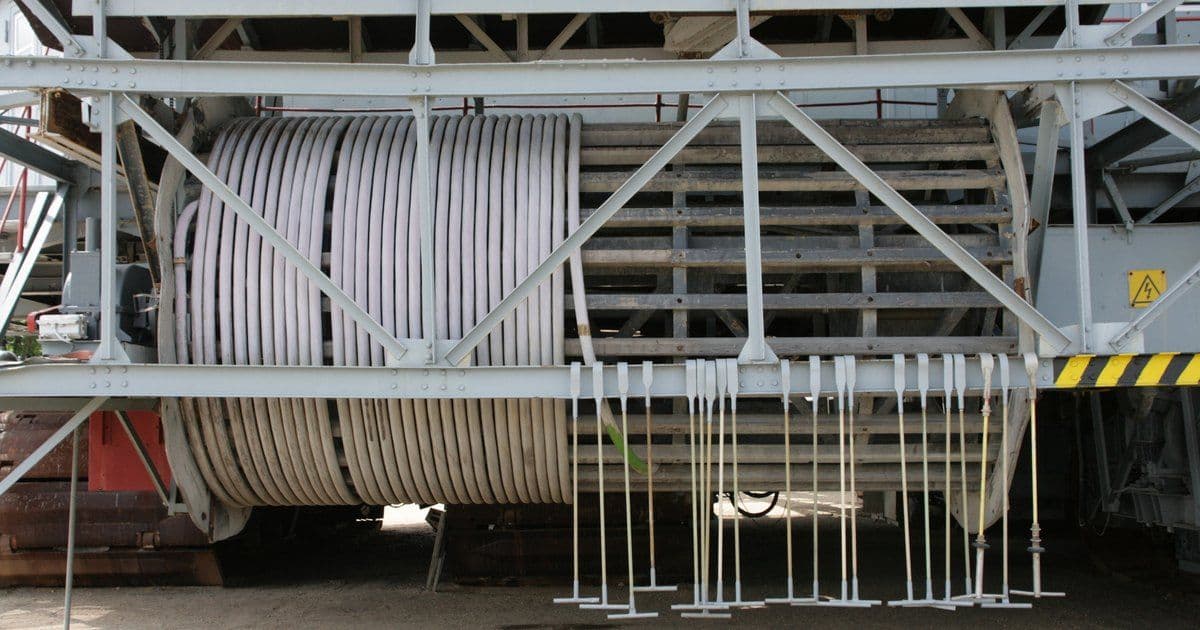
A cylindrical drum has a wide barrel instead. Its turns lie side by side across the width, as on the preserved BWE in the cover photo, and build up in layers as more cable is stored.
Our R-(N)TSCGEWÖU datasheet, written for large material handling machines such as open-cast mine excavators, covers both monospiral and cylindrical reels in heavy-duty reeling. Our flat cable is narrower in scope: its page limits it to bending in one plane, and its datasheet does not allow torsion.
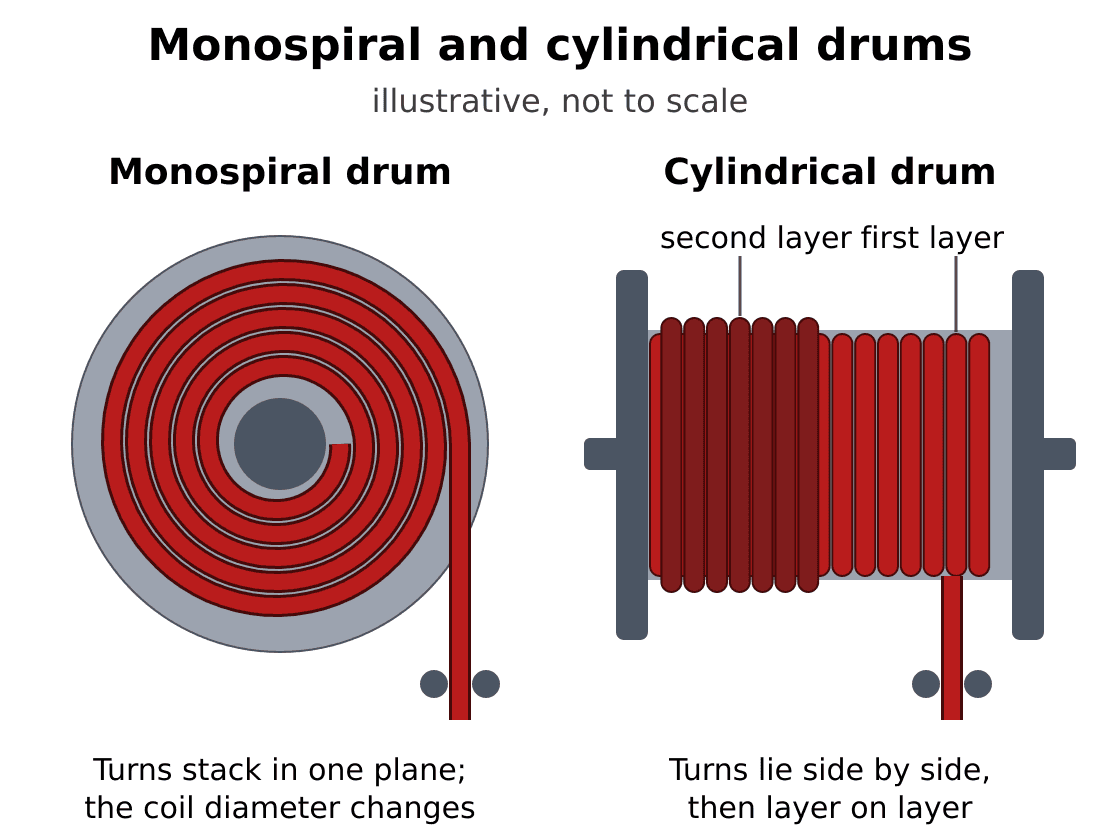
Illustrative comparison of the two drum types on reeling machines. On a monospiral drum each turn lies on the one before in a single plane, so the coil diameter changes as cable winds on and off. On a cylindrical drum the turns lie side by side across a wide barrel and build up in layers. Not to scale.
Drum comparison (readable on mobile):
- Monospiral drum: turns stack in a single plane; the coil diameter changes as cable winds on and off.
- Cylindrical drum: turns lie side by side across the barrel and build up in layers.
Round and Flat Medium-Voltage Reeling Cables
Round MV reeling cables handle S-shaped routes, two-plane bending and torsion, while flat ones suit winding in a single plane, as our flat cable page describes. Both designs in our MV range use ethylene propylene rubber (EPR) insulation with semi-conductive field control.
The table sets out values from our datasheets and product pages, including the Type 450 cable on our AS/NZS 2802 page. "Not stated" means the source gives no figure.
- Feature: Voltage range in our datasheet — Round NTSCGEWÖU: 1.8/3 kV to 18/30 kV — Flat (N)TSFLCGEWÖU: 3.6/6 kV; tables also cover 6/10 kV — AS/NZS 2802 Type 450: 3.3/3.3 kV to 33/33 kV
- Feature: Earth and pilot arrangement — Round NTSCGEWÖU: Earth split into three parts; pilot not stated — Flat (N)TSFLCGEWÖU: Split earth around each core; pilot not stated — AS/NZS 2802 Type 450: Two earth cores and one pilot core
- Feature: Tensile load — Round NTSCGEWÖU: Up to 20 N/mm² permanent, 30 N/mm² accelerating — Flat (N)TSFLCGEWÖU: 15 N/mm² maximum on the conductor — AS/NZS 2802 Type 450: Not stated
- Feature: Torsion — Round NTSCGEWÖU: ±25°/m — Flat (N)TSFLCGEWÖU: Not allowed — AS/NZS 2802 Type 450: Not stated
- Feature: Speed — Round NTSCGEWÖU: No limit in gantry reeling; consult us above 240 m/min — Flat (N)TSFLCGEWÖU: Up to 120 m/min in gantry reeling — AS/NZS 2802 Type 450: Not stated; slow reeling and trailing
- Feature: Duty named — Round NTSCGEWÖU: Excavators, draglines, stacker-reclaimers, conveyors — Flat (N)TSFLCGEWÖU: Cranes, large mobile equipment, excavators — AS/NZS 2802 Type 450: Draglines, shovels, excavators, wharf cranes, materials handling
For data links to the machine, our HVR-D adds 12 or 24 optical fibres to a round MV cable. The R-(N)TSCGEWÖU fibre-optic version offers 6, 12, 18 or 24 fibres.
Our pages are design references, not approval or conformity certificates. The approval each jurisdiction requires is confirmed per order.
Mining Cable Standards by Country
National standards and mining rules decide, because the International Electrotechnical Commission (IEC) standard for extruded MV power cables leaves mining cables out. IEC 60502-2, edition 3.1 of May 2024, excludes cables for special installation and service conditions, such as cables for "the mining industry".
- Germany: Our NTSCGEWÖU datasheets reference DIN VDE 0250 Part 813, which DIN Media's catalogue lists as a current standard for "trailing cable" (German "Leitungstrosse"). DIN VDE 0168:2023-09 names mining machines and belt conveyor systems among the installations it covers, where harsh operating conditions can occur. Our datasheet names DIN VDE 0298-3, a guide to non-harmonised cables, as its installation guide. DIN VDE 0298-4 gives recommended current-carrying capacities, including for flexible cables and cords.
- Australia: AS/NZS 2802:2000 specifies two classes of multicore elastomer insulated and sheathed flexible reeling and trailing cables. They serve surface mining, underground mining other than coal mining, and general use, at system voltages from 1.1/1.1 kV up to 33/33 kV. It remains current and appeared in a Standards New Zealand review consultation of joint standards over five years old that Standards Australia proposed for review. The consultation ran from 8 July to 12 August 2026.
- South Africa: SANS 1520-2:2020 covers high-voltage (HV) flexible trailing cables for mines, from 3.8/6.6 kV to 19/33 kV. It was approved on 16 September 2020 and reaffirmed on 23 July 2026.
- Canada: CSA C22.2 No. 96:23, from CSA Group, the Canadian standards body, covers portable power cables subject to frequent flexing. Its Clause 5 covers multiconductor round cables for mining and general use from 5 kV to 35 kV, including Types SHD, SHD-GC and SHD-BGC (balanced ground check).
Current on the Drum: Rating by Layer
Every layer left on the drum lowers the current the cable can carry. At 30 °C, our (N)TSCGEWÖU-ATB datasheet rates the 95 mm² size at 316 A in free air and 301 A on the ground.
One layer on the drum cuts that to 241 A, and two to five layers leave 184 A, 147 A, 126 A and 114 A. The chart below plots that 95 mm² row.
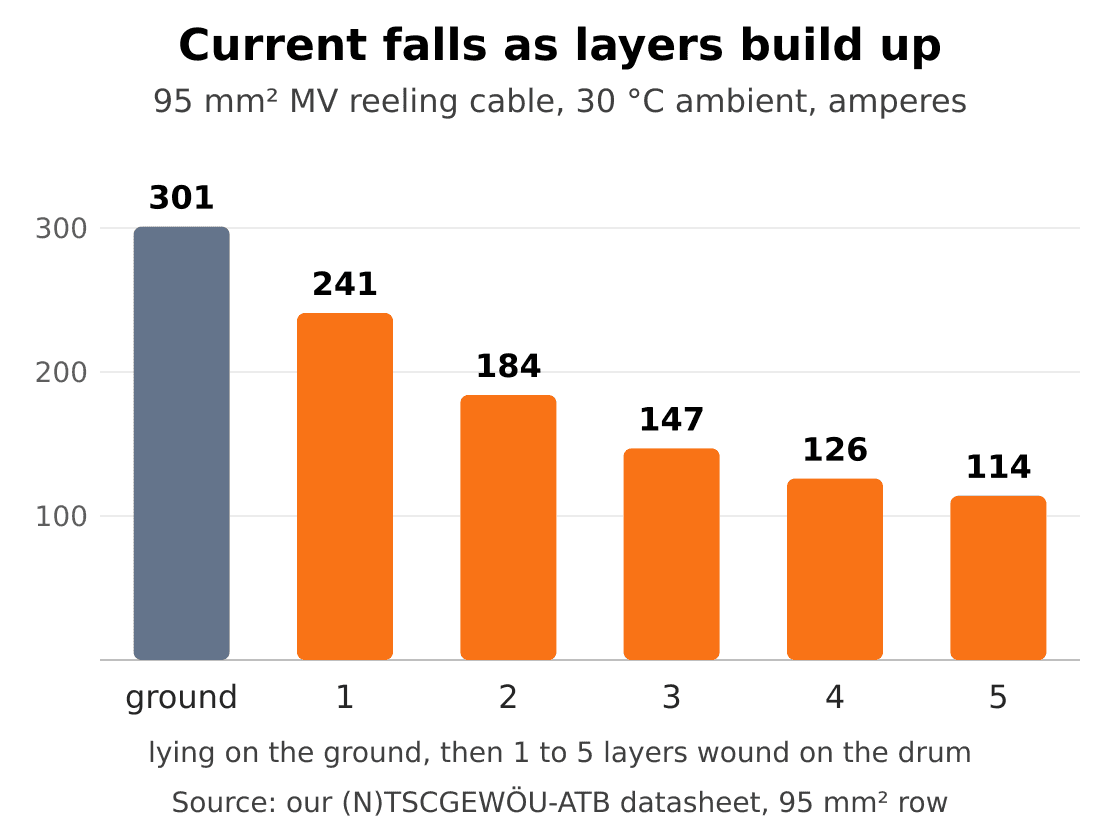
Current-carrying capacity of a 95 mm² (N)TSCGEWÖU-ATB medium-voltage reeling cable at 30 °C ambient, as listed in our ATB datasheet: 301 A lying on the ground, falling to 241, 184, 147, 126 and 114 A with one to five layers wound on the drum. Values differ for other sizes, ambient temperatures and duties; confirm the rating for the ordered cable.
Chart data (readable on mobile):
- Lying on the ground: 301 A.
- 1 layer on the drum: 241 A.
- 2 layers on the drum: 184 A.
- 3 layers on the drum: 147 A.
- 4 layers on the drum: 126 A.
- 5 layers on the drum: 114 A.
The same datasheet lists ambient de-rating factors of 0.91 at 40 °C, 0.87 at 45 °C and 0.82 at 50 °C. Our calculation from its two tables gives about 128 A for three layers at 45 °C (147 A × 0.87). Chile's mining safety regulation, DS 132, Art 400, bars using electrical equipment at higher voltages, or permanently at higher currents, than the manufacturer indicates.
The US Mine Safety and Health Administration (MSHA) described reel heating in Program Information Bulletin P10-20. The bulletin is addressed to "operators of underground coal or gassy metal and nonmetal mines, manufacturers of mining machinery" and others, not to surface mines. Heating "is most noticeable when three to four layers of cable are left on the cable reel for extended periods". Its remedies include a larger cable, a higher operating voltage, or leaving only the last layer on the reel and tying the cable off near its anchor point.
A 1989 US Bureau of Mines (USBM) study oven-aged insulation from six LV unshielded coal mine trailing cables for up to 10 months. Its findings support a "tentative contention" that, in service underground, cables fail mechanically long before they deteriorate thermally. Our load-haul-dump (LHD) and jumbo cable guide covers a 1994 USBM model of heating on coal shuttle car reels.
Tension, Torsion and Cable Anchoring
Tension and torsion limits come from the cable datasheet, and mining rules add duties where the cable meets the machine. Our NTSCGEWÖU datasheet allows 20 N/mm² permanently and 30 N/mm² during acceleration, against the 15 N/mm² it attributes to DIN VDE 0298-3.
Torsion limits vary widely: ±25°/m for NTSCGEWÖU and ±100°/m for R-(N)TSCGEWÖU, while the flat cable allows none. The NTSCGEWÖU and flat cable datasheets both set a 20 × D minimum distance for S-type direction changes. For the round cable, D is the overall cable diameter. The flat-cable datasheet gives a recommended equivalent diameter D = 1.5 × cable height for applying its bending rules; confirm the S-type guide spacing for the actual flat-cable size and layout with the manufacturer. This guide spacing is not the minimum bending radius.
Under the US Code of Federal Regulations (CFR), 30 CFR 77.603 requires trailing cables at surface coal mines to be clamped to machines. The clamping must protect the cables from damage and the electrical connections from strain. Peru's DS 024-2016-EM, Art 363 f), also has trailing cables at open pits secured to the machines against damage and strain on the connections, entering enclosures only through suitable fittings.
Chile's DS 132, Art 419, requires flexible cables to be kept clear of cutting edges and moving parts and protected from excessive traction. In WA, the monitoring duty in regulation 641F also covers plant whose supply cable may be exposed to damage from tension.
South Africa's regulation 3.26 says the employer must take reasonably practicable measures to ensure a cable reel used with a self-propelled mobile machine has a cut-off device. It must cut power before the cable fully unreels, leaving at least one complete turn on the reel. This does not apply if other limits keep the machine's travel shorter than the reeled cable allows.
Earth Continuity and Isolation Rules
Australian rules and US surface coal mine rules make reeling cable supplies trip when the earth path breaks, with stated exceptions.
Western Australia
Under regulation 641E, WA mine operators must ensure each trailing and reeling cable meets AS/NZS 1802:2018 at underground coal mines or AS/NZS 2802:2000 elsewhere. It also needs a pilot core that trips supply on an earthing break, and installation and use that minimise the risk of damage. Repair and testing follow AS/NZS 1747:2003.
Regulation 641F adds earth continuity monitoring that disconnects supply automatically if the earth conductor breaks. WorkSafe WA guidance says a pilot open circuit, short circuit or loop resistance above its pre-tested value must trip the supply. The trip should latch until manually reset. Routine testing "should be done every three months" at surface operations; quarries, underground mines and dredges other than floating treatment plants must test monthly.
Queensland, New South Wales and the US
Section 23 of Queensland's MQSHR, made under the Mining and Quarrying Safety and Health Act 1999, which applies to mines other than coal mines, sets the stacker and reclaimer remote interruption duty. It also covers other plant that a risk assessment identifies as needing remote interruption.
Under section 28, mobile equipment on a trailing or reeling cable above extra-low voltage needs earth continuity protection. It must isolate supply immediately if the earthing circuit breaks or the cable is disconnected, and prevent inadvertent contact with live parts. LV cables are exempt if they have no joining plugs or sockets, earth leakage protection of 30 mA or less and individually screened power conductors.
Queensland's Coal Mining Safety and Health Regulation 2017 (CMSHR) has its own rule for surface coal mines. Its section 114 requires earth continuity monitoring that cuts supply immediately where equipment lacks a local earthing system. Subsection (3) has a matching LV exception, and subsection (4) requires an earth fault current limitation device at the supply that keeps prospective touch voltage within acceptable limits. Subsection (5) waives (4) for LV equipment where people are otherwise adequately protected against indirect contact.
The NSW code quotes the Work Health and Safety (Mines and Petroleum Sites) Regulation at 34(2)(g). Mobile plant on a reeling or trailing cable must not be powered with an earth fault in the cable, and its power must cut automatically if earth continuity is lost. The code calls the cable's earth conductors "often the only return path" for fault currents, and says earth fault lockout and continuity devices "should be compliant with AS/NZS 2081".
At US surface coal mines, 30 CFR 77.803 requires a fail-safe ground-check circuit, or an approved device no less effective, on HV resistance-grounded systems. Section 77.804 sets the shield, grounding and ground-check conductors of HV trailing cables on those systems. Our shovel and dragline cable guide covers both.
What Goes Wrong in the Field
Field records show harm from moving power cables and from live repairs. A 2003 National Institute for Occupational Safety and Health (NIOSH) review covers electrical accidents at US mines of all types from 1990 to 1999. Its category "Move power cable (includes reeling)" counts 82 injuries, 3 of them fatal.
A WUG notice describes an August 2018 accident at a Polish lignite open-pit mine. As the BWE moved about 20 m beside a stopped conveyor, a control cable for the conveyor interlock, not a power reeling cable, was damaged. The crew's designated leader had the line started in emergency mode without the interlock and began repairing the cable himself.
He received an electric shock and survived after colleagues resuscitated him. The regulator's preliminary finding gave the cause as repairing a broken electrical cable under voltage on his own.
The NSW code warns that energising a damaged cable may cause arcing, burns, ignition of gas or dust, or electric shock. Chile's DS 132, Art 263, has staff check cables, connections and switches at the start of each shift.
How to Specify a Bucket-Wheel Excavator or Stacker-Reclaimer Reeling Cable
Start from the supply and the rules, then match the cable to the drum, its layers and the mechanical loads. See our mining and tunnelling range for other mine machines.
- System voltage and earthing: rated voltage, earthing system and earth fault current limitation.
- Jurisdiction and standard: the mining rules and the cable standard they call up.
- Drum type and winding plane: monospiral or cylindrical; flat cable only for one-plane winding.
- Stored length and layers: cable left on the drum, layers and maximum ambient temperature.
- Travel speed, acceleration and tension: checked against the datasheet's speed and tensile limits.
- Torsion, bending and S-type changes: torsion limit, minimum bending radius and S-type distance.
- Pilot, earth continuity and signals: pilot core, monitoring and any fibre or control elements.
- Retrofit dimensions and test documents: the outside-diameter window and the test documents required. In our coal plant reeling cable case, a replacement tender set windows of 56 to 59 mm and 62 to 65 mm for two 8.7/15 kV designs.
Frequently Asked Questions
What cable powers a bucket-wheel excavator?
A bucket-wheel excavator takes medium-voltage power through a flexible reeling or trailing cable. A 1983 abstract describes a 30 kV supply transformed to 6 kV and lower voltages. Drum type, stored layers, tension and local rules shape the cable choice.
What is the difference between a reeling cable and a trailing cable?
A reeling cable is built to wind on and off a drum frequently, while a trailing cable moves with the machine. WorkSafe WA guidance gives an iron ore rail-mounted reclaimer as a reeling example and a coal mine dragline as a trailing one.
Why does a reeling cable carry less current on the drum?
Cable wound in layers on a drum sheds heat poorly, so its current rating falls. Our (N)TSCGEWÖU-ATB datasheet rates a 95 mm² cable at 301 A on the ground but 147 A with three layers, at 30 °C. For underground machine reels, MSHA notes heating is most noticeable when three to four layers stay on the reel for extended periods.
When should a flat reeling cable be used?
A flat reeling cable suits a drum that winds it in a single plane, such as a monospiral reel, without torsion. Where the route bends in two planes, runs in S-shapes or twists, our flat cable page points to a round cable.
Do stacker-reclaimers need remote supply interruption?
At Queensland mines other than coal mines, yes: MQSHR section 23 requires stacker and reclaimer supply that can be interrupted from an accessible position remote from the plant. Other jurisdictions, such as Western Australia, set their own earth continuity duties.
How often is earth continuity protection tested?
WorkSafe WA guidance says surface operations should test earth continuity protection every three months. Quarries, underground mines and dredges other than floating treatment plants must test it every month. Ideally, it adds, a machine should not start without a healthy pilot.
Enquire About Mining Reeling Cable
Our engineering team needs the machine type, system voltage and earthing, drum type and dimensions, and stored length and layers. Please add travel speed and acceleration, ambient temperature, pilot and fibre needs, and your jurisdiction's standard. Send them through our contact page.
About the Author
Jyen is a technical and operations engineer at TEBAOFLEX, responsible for the company's online platforms. This guide draws on mining regulations and regulator guidance from Australia, the US, Chile, Peru and South Africa, accident records from Poland and the US, US government research, standards catalogue records and TEBAOFLEX product datasheets. The product pages cited are TEBAOFLEX's own; requirements quoted from regulators and standards bodies describe their scope, not certification or approval of our products.
Cover photo: "Görlitz - Bagger 1452 - Schaufelradbagger 22 ies" by Frank Vincentz, CC BY-SA 3.0, via Wikimedia Commons, cropped.
