


Festoons, cable reels and conductor bars all carry power, and often data, from a fixed feed to a moving crane. A festoon hangs flexible cables in loops from trolleys running along a track. A cable reel on the crane winds its cable on and off a spring- or motor-driven drum. A conductor bar feeds the crane through collectors sliding along rigid conductors fixed to the runway.
The choice turns on travel length, speed, voltage, data, space and the number of cranes. Many cranes use more than one system. MHI, the US material handling industry association, published an article on crane electrification options by members of the Electrification and Controls Manufacturers Association (ECMA). They note that "In many instances, a combination of two or more options is the optimal solution."
Key Takeaways
- For long travel on one cable, consider a motor-driven reel: VAHLE rates its motor-powered reels for travel paths up to 1,000 m.
- For heavy ship-to-shore (STS) trolley cable packages, consider a heavy-duty festoon; Conductix-Wampfler rates its I-Beam XL-Line 0375 trolleys at 800 kg each.
- For several cranes on one runway, low headroom or very high speed, consider a conductor bar, such as VAHLE's U30 at 720 m/min.
- Match the cable to the hardware: PUR-HF is rated up to 200 m/min in festoons but only up to 60 m/min for horizontal reeling.

How each system bridges the gap between a fixed power feed and a moving crane. Schematic drawn for this article.
Crane Power Supply Systems Compared
Festoons and reels move a cable with the crane. With a conductor bar, only the collector moves.
- Feature: How power reaches the machine — Festoon: Cable loops on moving trolleys — Cable reel: One cable winds onto a reel — Conductor bar: Collectors slide along fixed conductors
- Feature: Stated speed examples — Festoon: 100 m/min (C-Rail 0240) to 300 m/min (XL-Line 0375) — Cable reel: 200 m/min (VAHLE motor reels) — Conductor bar: 200 m/min (Demag DCL-Pro) to 720 m/min (VAHLE U30)
- Feature: Stated length figures — Festoon: 120 m maximum system length (C-Rail 0240) — Cable reel: 112 m total travel (SR spring reels, central feed); 1,000 m travel path (VAHLE) — Conductor bar: Runs over 250 m need an expansion section (VAHLE KBH)
- Feature: Stated voltage examples — Festoon: Set by the cable — Cable reel: Up to 24 kV (Conductix-Wampfler) — Conductor bar: 24 to 690 V AC (DCL-Pro); up to 1,000 V AC (U20/U30)
- Feature: Data path — Festoon: Fibre in the cable; powerline — Cable reel: Fibre in the cable; Ethernet via slip rings up to 50 m; powerline — Conductor bar: Powerline or slotted waveguide
- Feature: Main upkeep — Festoon: Cable wear from constant extension and retraction (ECMA) — Cable reel: Routine maintenance and inspection; the cable can tangle if the system is poorly designed or managed (ECMA) — Conductor bar: Collector cleaning and inspection (ECMA)
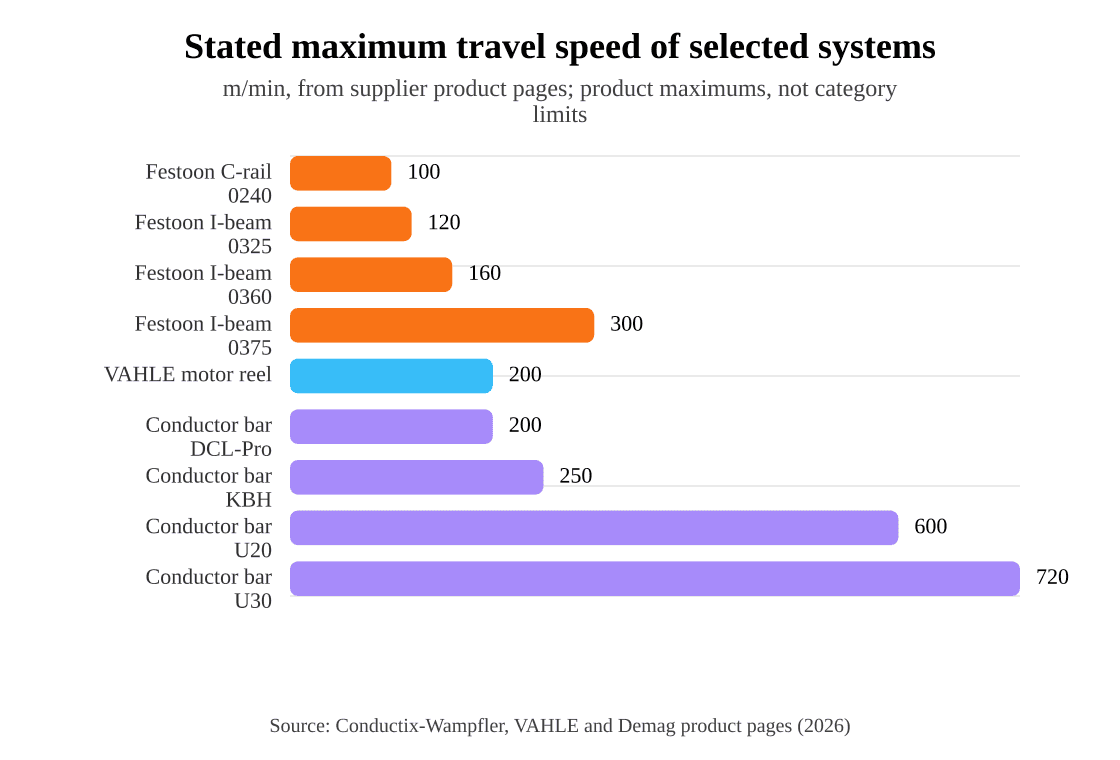
Sources: Conductix-Wampfler trolley series 0240, 0325, 0360 and 0375; VAHLE motor-powered cable reels; Demag DCL-Pro; VAHLE KBH and U20/U30. Retrieved September 2026. Product maximums, not limits for each system type.
m/min, from supplier product pages; product maximums, not category limits
- Festoon C-rail 0240 — 100 m/min
- Festoon I-beam 0325 — 120 m/min
- Festoon I-beam 0360 — 160 m/min
- Festoon I-beam 0375 — 300 m/min
- VAHLE motor reel — 200 m/min
- Conductor bar DCL-Pro — 200 m/min
- Conductor bar KBH — 250 m/min
- Conductor bar U20 — 600 m/min
- Conductor bar U30 — 720 m/min
Festoon Systems: Cable Loops on Trolleys
Festoon trolleys carry the cable loops along a rail or beam, bunching together or spreading out as the crane moves. According to ECMA members, longer travel means a longer cable stack and more storage space. In low headroom, loops hanging into a work area, such as under a jib crane, can be a problem.
Conductix-Wampfler rates its C-Rail cable trolley series 0240 at 100 m/min, with a maximum system length of 120 m. At the heavy end, the I-Beam XL-Line 0375 trolleys used on STS cranes are rated at 300 m/min and 800 kg per trolley. Conductix-Wampfler's square-rail systems are mainly used on curved tracks or at very dusty sites such as silo works.
In a heavy-duty retrofit on two STS cranes at Dunkirk, Conductix-Wampfler reports cable packages of about 50 kg per metre (35 power and control cables). Crane downtime was not to exceed four days, and both retrofits were completed within four weeks.
Whatever the trolley, the festoon cable must be rated for at least the travel speed. NGFLGÖU flat festoon cable is rated up to 180 m/min in one-plane bending and PUR-HF up to 200 m/min. The fibre-optic FESTOON PUR FO 2x12 is rated for motor-driven crane trolleys up to 240 m/min.
Cable Reels: Long Travel on One Cable
A cable reel pays out its cable as the crane moves away and winds it back on the return. Conductix-Wampfler's SR spring reels, announced in 2018, wind horizontal lengths up to 56 m, or 112 m of total travel with a central feed.
VAHLE motor-powered cable reels are rated at 200 m/min over travel paths up to 1,000 m, with optional integrated fibre optics. For MV (medium voltage), Conductix-Wampfler cites up to 24 kV on container-handling cranes and bulk and mining machines using its motor-driven reels.
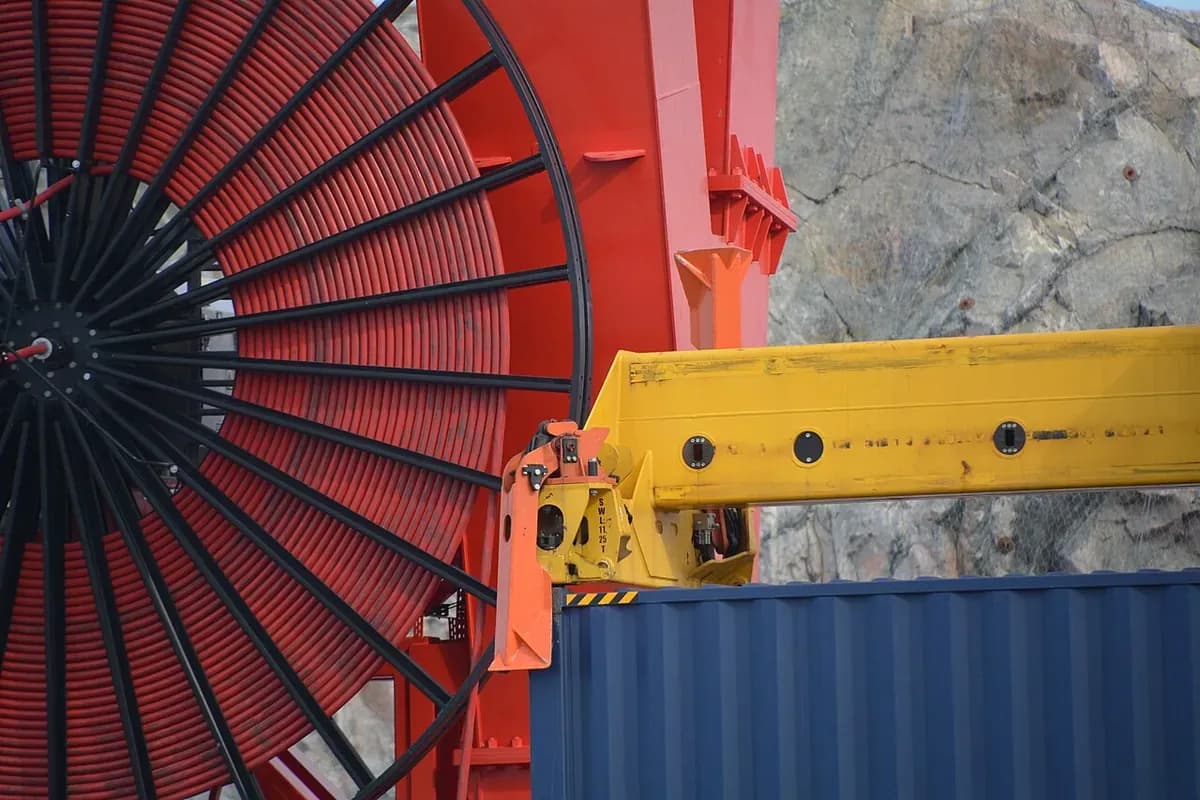
A cable reel on a container-handling crane, with the yellow spreader in front. Photo: "Container grip" by Bengt Oberger, CC BY-SA 4.0, via Wikimedia Commons, resized.

The main limit is cable count. ECMA members say a reel typically manages only one cable, and exceptionally long travel needs an exceptionally large reel.
A composite cable eases the one-cable limit. For a port crane in Vladivostok, the specified 6/10 kV reeling cable combines power cores, 16 control cores and 24 fibres. The 300 m length is split across two reels of 125 m and 175 m.
The same cable can have a much lower reeling rating: PUR-HF is rated up to 200 m/min in festoons but up to 60 m/min for horizontal reeling. Rubber Crane FO 2x12, an optical reeling cable, is rated up to 120 m/min on spring- and motor-driven crane reels. For MV feeds, the NTSCGEWÖU reeling cable covers 1.8/3 kV to 12/20 kV. Match these ratings to the reel when choosing reeling cables.
Conductor Bars: Rigid Rails and Sliding Collectors
A conductor bar system fixes rigid conductors along the runway, and collectors on the crane slide along them. ECMA members describe a typical system as four bars (three live, one ground) that generally take less space than festoons and cable reels. The trade-off is contact wear: collectors can wear down or get dirty, so regular cleaning and inspection are necessary.
Supplier ratings vary widely:
- Demag DCL-Pro: 24 to 690 V AC, 65 to 200 A at 100% CDF (cyclic duration factor), 200 m/min with a bronze sliding contact, curves down to 800 mm radius.
- VAHLE KBH: enclosed, 63 to 200 A, 250 m/min, 250 m without an expansion section.
- VAHLE U20 and U30: insulated, up to 1,000 V AC, 600 and 720 m/min.
- VAHLE open conductor system: up to 2,360 A and 250 m/min.
- Conductix-Wampfler Safe-Lec 2: finger-safe, up to 400 A and 600 V, IP20 (ingress protection), curved tracks possible.
Getting Data onto a Moving Crane
The sources cited offer four routes: fibre in the cable, reel slip rings, powerline and slotted waveguides. FESTOON PUR FO 2x12 and the Vladivostok composite cable each carry 24 fibres. For travel up to 50 m, Conductix-Wampfler's reel slip rings carry one or two CAT5 or CAT6 (Category 5 or 6 Ethernet cable) links at up to 1 Gbit/s. Beyond 50 m, the supplier offers fibre optics.
Without a data cable, Conductix-Wampfler's powerline communication is rated up to 350 Mbit/s with MIMO (multiple-input multiple-output), at an average latency of 3 to 5 ms. It works over conductor bars, cable reels and festoons.
ProfiDAT, a Conductix-Wampfler slotted waveguide, delivers up to 240 Mbit/s per mobile unit over 400 m per access point. VAHLE's slotted microwave guides handle 100 Mbit/s: SMGM at 180 m/min indoors and SMGX at 300 m/min outdoors over up to 500 m.
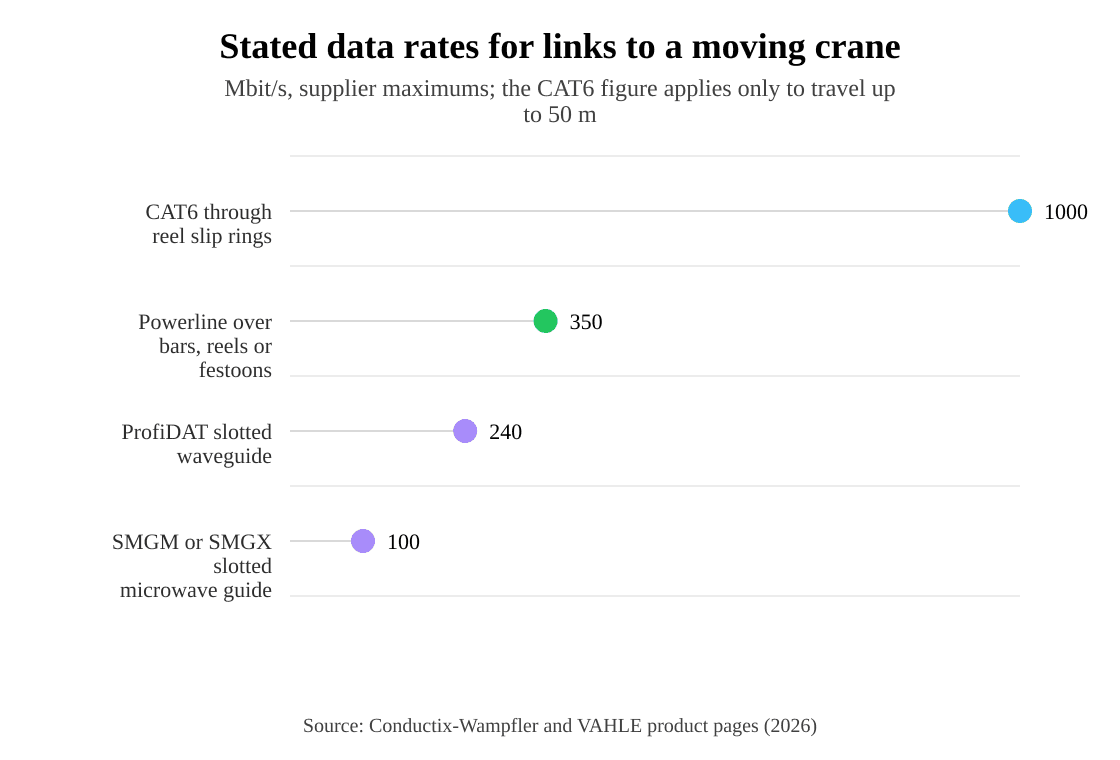
Sources: Conductix-Wampfler CAT6 motor-driven reels, powerline communication and ProfiDAT; VAHLE SMGM and SMGX. Retrieved September 2026. Fibre links are not shown because the suppliers state no data rate for them.
Mbit/s, supplier maximums; the CAT6 figure applies only to travel up to 50 m
- CAT6 through reel slip rings — 1000 Mbit/s
- Powerline over bars, reels or festoons — 350 Mbit/s
- ProfiDAT slotted waveguide — 240 Mbit/s
- SMGM or SMGX slotted microwave guide — 100 Mbit/s
Safety Rules and Standards to Check
Check guarding, disconnects, the electrical code and the equipment standards. In the US, the OSHA (Occupational Safety and Health Administration) rule for overhead and gantry cranes, 29 CFR 1910.179(g)(6), covers open runway conductors. They must be "so located or so guarded" that people entering or leaving the cab or footwalk cannot normally touch them. 29 CFR 1910.306(b)(1) requires a lockable disconnecting means between the runway contact conductors and the supply, operable from the ground or floor and within view of the conductors.
According to the trade magazine EC&M, Article 610 (cranes and hoists) of the 2014 NEC (National Electrical Code) requires bridge contact conductors located and guarded against accidental contact [610.21(A)]. It also requires insulating supports every 20 ft or less [610.21(C)] and collectors designed to minimise sparking [610.22]. For several cranes on a common conductor system, add the loads and apply the demand factor in Table 610.14(E). Check the NEC edition your jurisdiction enforces.
The International Electrotechnical Commission (IEC) standard IEC 60204-32:2023 covers hoisting-machine electrical equipment up to 1,000 V AC or 1,500 V DC, so medium-voltage reel feeds such as the 24 kV systems above fall outside it. Its scope includes feeders such as flexible cables and conductor bars. ANSI ACE 35-2026, an American National Standards Institute (ANSI) standard formerly called ECMA 35, refines voltage-drop and load calculations for conductor bars and festoons.
Which System Fits Your Crane?
The best fit depends on crane count, travel, speed, voltage, headroom, track shape and data needs.
- If several cranes share one runway, consider a conductor bar, since one conductor system can feed them all, sized with an NEC demand factor.
- If the crane runs faster than 300 m/min, look at conductor bars: among the products cited, only VAHLE's U20 and U30 (600 and 720 m/min) exceed the fastest festoon trolley (300 m/min) and reel (200 m/min).
- If the crane travels far outdoors at MV, consider a motor-driven reel. VAHLE states travel up to 1,000 m and Conductix-Wampfler up to 24 kV.
- If an STS trolley carries heavy cable packages, a heavy-duty festoon fits: trolleys such as the XL-Line 0375 are rated at 800 kg each.
- If headroom is low indoors, consider a conductor bar, which generally takes less space and has no loops hanging into the work area.
- If the track curves or the site is very dusty, consider a square-rail festoon, or a curve-rated conductor bar such as the DCL-Pro (800 mm radius) or Safe-Lec 2.
- If the crane already has a festoon or reel, use a fibre-optic festoon cable or a composite reeling cable; with a conductor bar, compare powerline (up to 350 Mbit/s) and slotted-waveguide (up to 240 Mbit/s per mobile unit) links.
The systems can also be combined, so each crane motion can use the system that suits it.
Frequently Asked Questions
What is the difference between a festoon and a conductor bar?
A festoon moves flexible cables with the crane; a conductor bar stays fixed and only its collector moves. Festoon cables wear from constant extension and retraction. Conductor bars generally take less space, according to ECMA members, but collectors wear or get dirty and need regular cleaning.
Which is better for a long runway, a cable reel or a conductor bar?
A cable reel suits one long feed, especially at MV; a conductor bar suits several cranes sharing a runway. VAHLE states reel travel paths up to 1,000 m, and Conductix-Wampfler cites up to 24 kV on container-handling cranes. ECMA members add that a reel typically manages only one cable.
How fast can a festoon system travel?
Conductix-Wampfler rates its festoon trolleys from 100 m/min (C-Rail 0240) to 300 m/min (I-Beam XL-Line 0375), and the cable must match. FESTOON PUR FO 2x12, for example, is rated for motor-driven crane trolleys up to 240 m/min. These are product ratings, not limits for every festoon.
Can several cranes share one conductor bar runway?
Yes. Under NEC Article 610, as summarised by EC&M, the loads of cranes on a common conductor system are added and a demand factor applied. Under 29 CFR 1910.306(b)(2), cranes and monorail hoists also need a lockable disconnecting means in the leads from the runway contact conductors, with a narrow exception in (b)(2)(iv).
How do you get Ethernet or video onto a moving crane?
Use fibre inside the festoon or reeling cable, Ethernet through reel slip rings for short travel, or a powerline or slotted-waveguide link. Conductix-Wampfler's CAT6 slip rings serve travel up to 50 m, with fibre beyond. Its powerline system is rated up to 350 Mbit/s and ProfiDAT up to 240 Mbit/s per mobile unit.
Match the Cable to the System
The cable must carry the same speed, bending and tensile duty as the festoon or reel hardware. Send the system type, travel length, speed and trolley spacing or reel type to our engineering team through the contact page. For crane applications, see port and material-handling cranes; for other cable types, see special cables and their standards.
About the Author
Jyen is a technical and operations engineer at TEBAOFLEX, responsible for the company's online platforms. This comparison draws on the regulations, standards and supplier product pages cited above and on project records published in the TEBAOFLEX case library. The NGFLGÖU, PUR-HF, FESTOON PUR FO 2x12, Rubber Crane FO 2x12 and NTSCGEWÖU datasheets cited are TEBAOFLEX's own product pages; the festoon, reel and conductor bar hardware data come from the suppliers named.
Cover photo: "Container crane at Antwerp harbour pic2" by Alf van Beem, CC0, via Wikimedia Commons, cropped.
