

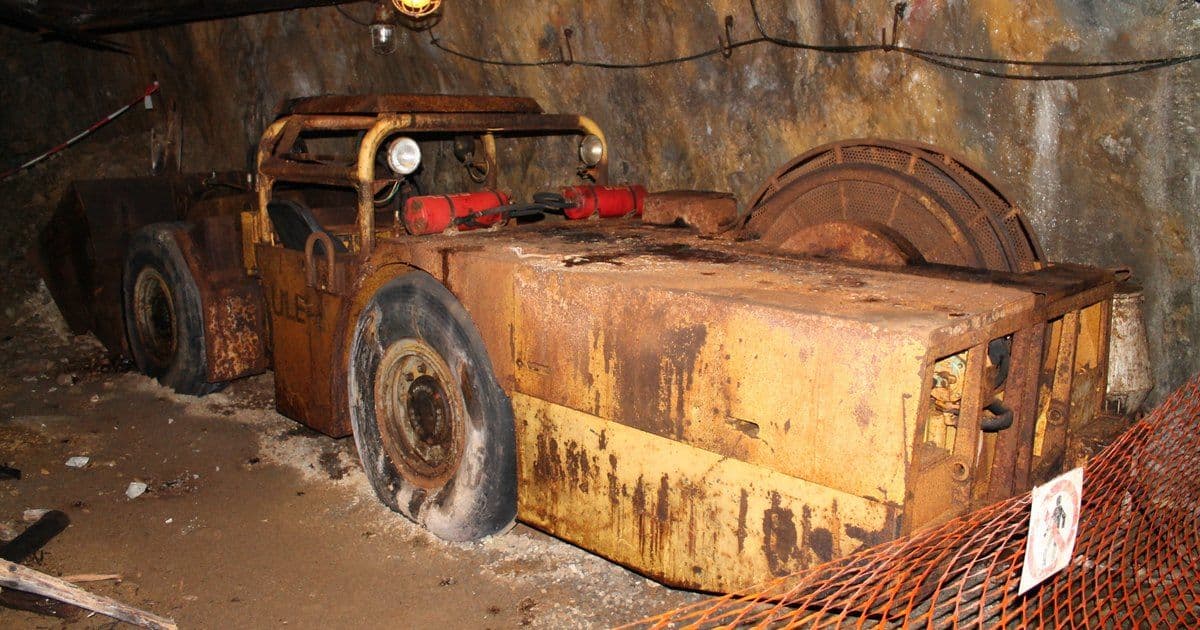
Tethered electric load-haul-dump loaders (LHDs) take power through a reeling cable wound on an on-board reel. Drill jumbos and bolters draw theirs through a trailing cable from a power point. These cables are reeled, dragged, run over and spliced, so their design and handling decide how long they last.
A 2003 review by the National Institute for Occupational Safety and Health (NIOSH) covered 1,926 US mine electrical accidents from 1990 to 1999. Its table of machine types links 28 injuries, fatalities included, to LHDs, scoop trams and similar machines. Rock or roof bolters account for 34, and electric or hydraulic drills for 18.
US underground metal and nonmetal mines follow Part 57 of Title 30 of the Code of Federal Regulations (CFR). Chile, Peru, Australia, Canada and South Africa set their own rules.
Key Takeaways
- Within 25 feet (about 7.6 m) of the machine, US rule 57.12088 allows only vulcanized or equivalent splices, unless the machine has a cable reel or other payout-retrieval system. A temporary splice may be made to move it for repair.
- US Part 57 requires grounding continuity and resistance tests after installation, repair and modification, and yearly (57.12028), but no ground-check monitor.
- Chile's mining safety regulation bars voltages above 600 V on portable machines used at or next to working faces (Art 221), but does not define a portable machine.
- South Africa's regulation 3.26 makes employers take reasonably practicable measures so reels on self-propelled machines cut supply while at least one complete turn of cable remains, unless travel is otherwise limited.
- A 1994 US Bureau of Mines (USBM) model of coal shuttle car reels put the one-layer derating factor at 0.34 for static conditions, against 0.85 in the published tables.
How Electric LHDs and Jumbos Take Their Power
Both machines are tethered: an LHD reels its cable on board, while a jumbo drags or reels a trailing cable from a power point. Our LHD video page shows the reel paying cable out as the loader leaves its supply point and winding it back on return. Each trip bends the cable on and off the drum under combined tensile and torsional stress.
In our Venezuela jumbo case, a drill jumbo's hydraulic booms articulate as the rig repositions. Every move drags and bends the trailing cable and winds it on or off a reel. The cable must also cope with rock dust, moisture and rough floors.
In US metal and nonmetal mines, 57.12006 requires a disconnecting device for each branch circuit in a distribution box. Each device must be visibly open when off, and the box labelled with the circuit each controls. Trailing cable connections to junction boxes must not be made or broken under load (57.12007).
A New South Wales safety alert of 30 April 2013 describes a development jumbo tramming into a cuddy at an underground metalliferous mine. As it turned, the acute angle between its reel and the cable lying in the access drive apparently stopped the cable reeling out. The cable pulled tight between its anchor point and the jumbo, deformed a quad hook hanger, slipped off and whipped across the drive. It struck a miner's leg, seriously injuring his knee.
The alert recommends:
- Keep people out of no-standing zones around mobile equipment and trailing cables while cable runs in or out.
- Pay out enough cable before tramming into places where reeling out may stop.
- Consider a cab warning for when the reel is stationary and the cable stops running.
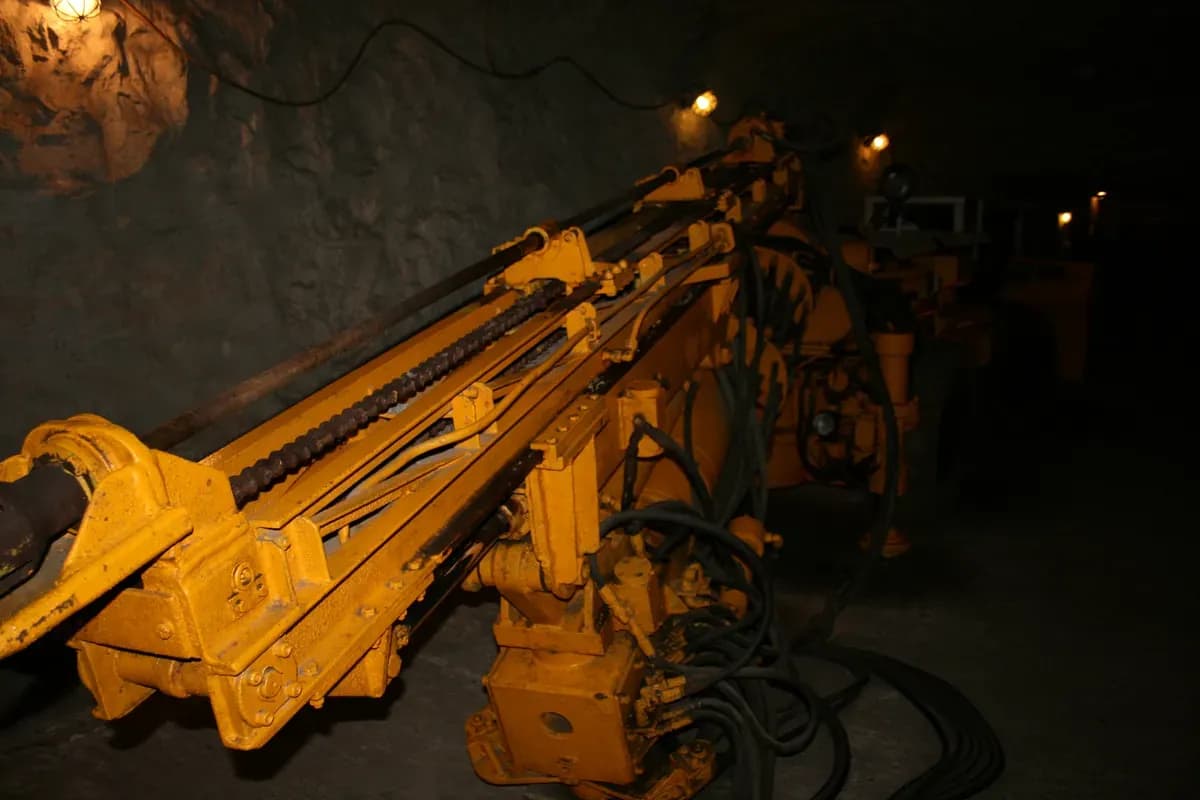
An electro-hydraulic drill jumbo underground, its drill feeds and hoses lit by mine lamps. Photo: "Bohrwagen Bülten 001" by Matthias Becker, CC BY-SA 3.0, via Wikimedia Commons, resized.

What Wears Out an LHD or Jumbo Cable
Heat on the reel, tension spikes, run-overs, weak splices and handling wear these cables out.
Heat on the Reel
In 1994, the usual rating method multiplied a single cable's free-air ampacity by layer derating factors. These came from the Insulated Cable Engineers Association and National Electrical Manufacturers Association (ICEA/NEMA) and covered only one to four layers. A 1994 USBM model of coal shuttle car reels found that these values "can lead to serious overheating" on reeled cables. The model's factors were 0.34, 0.30, 0.27 and 0.24 for one to four layers, against ICEA/NEMA values of 0.85, 0.65, 0.45 and 0.35.
The paper flagged overheating risk "particularly for those reels that have less than three layers of cables". Its factors were calculated for static conditions only. The study modelled coal shuttle car reels, so it informs reeled cables generally rather than LHDs specifically. The chart compares both sets of factors.
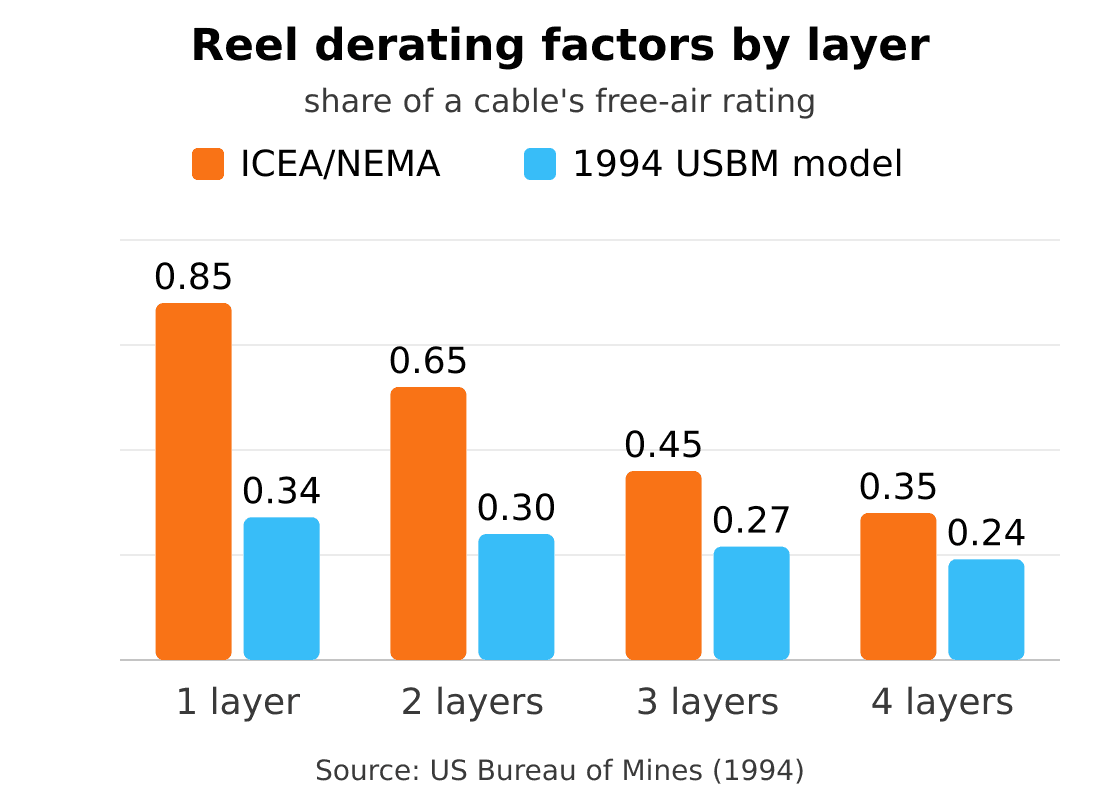
Derating factors for one to four layers of cable on a reel, as a share of a single cable's free-air rating: the ICEA/NEMA factors (0.85, 0.65, 0.45 and 0.35) against those calculated in a 1994 US Bureau of Mines model of shuttle car reels (0.34, 0.30, 0.27 and 0.24), for static conditions. Source: Thermal characteristics of shuttle car cable reels, 1994. Retrieved October 2026.
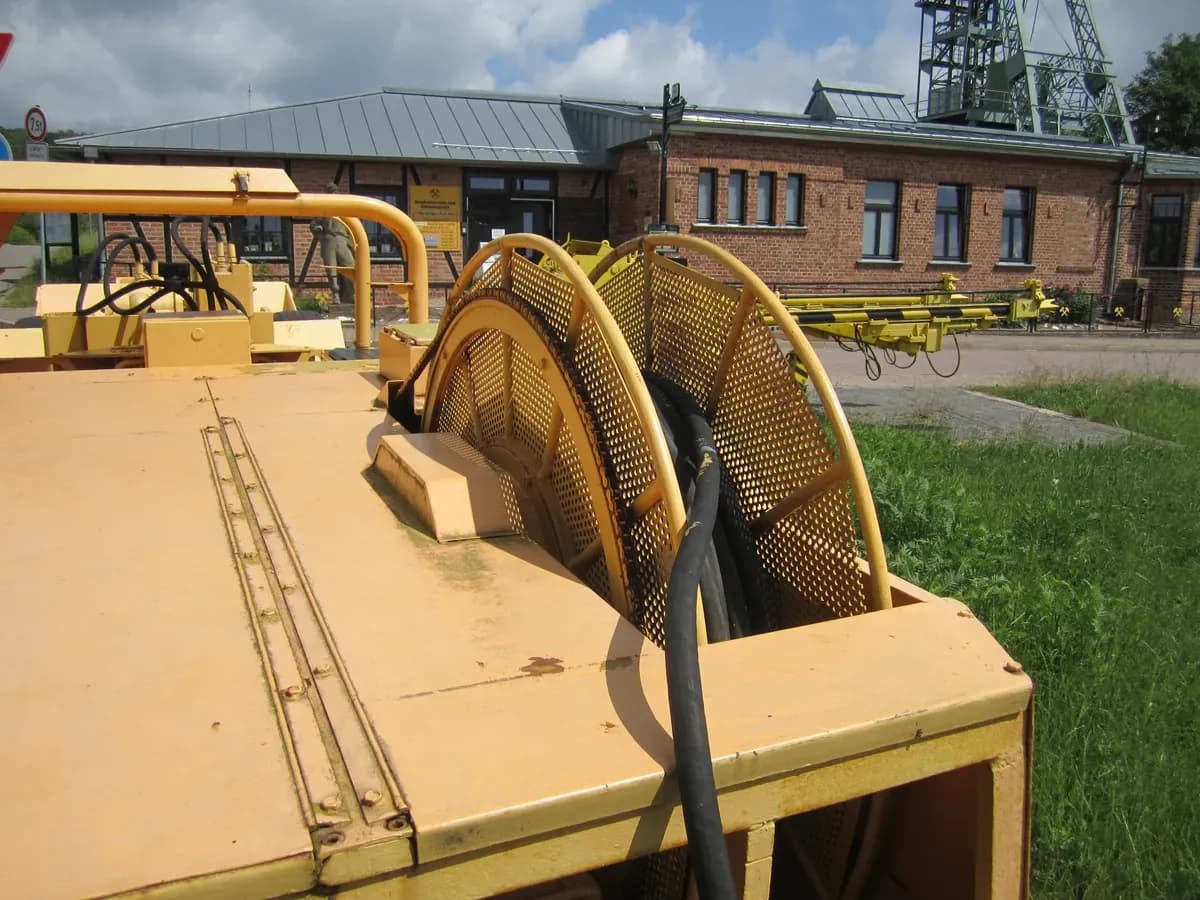
The cable reel at the rear of a historic electric loader on outdoor display, with its trailing cable wound on the drum. Photo: "Universallader ULE2 1" by Markscheider, CC BY-SA 4.0, via Wikimedia Commons, resized.

Tension, Splices and Handling
A 1983 report for the USBM on coal shuttle car reels, not LHDs, set the practical tension limit for a No. 4 three-conductor cable at 390 pounds (about 177 kgf). That figure came from splice strength, yet spikes of 1,000 to 1,500 pounds (about 450 to 680 kgf) appeared "not uncommon". Sharp spikes came as the car passed the tie point and the reel switched from pay-in to pay-out.
In laboratory tests for USBM Report of Investigations 9540 (1995), spliced joints ran 5 to 20 °C hotter than intact cable at rated current. Spliced samples averaged "only 30% of the original cable tensile strength", which the report said would critically affect spliced cable life, "especially for reeled applications".
In the 2003 NIOSH review, 86 accidents involved workers handling cables with unnoticed cuts and abrasions that apparently exposed live conductors. Only 12 mentioned a worker contacting a bad cable splice.
A 1998 fatality report from the Mine Safety and Health Administration (MSHA) covers an underground trona mine in Wyoming. Some 240 feet (about 73 m) of the mine's 480 V shuttle car cable, from a circuit centre to the car's reel, "contained 15 splices and repairs". It had been run over, and a puncture through the outer jacket reached a power conductor. MSHA gave the direct cause as "the poor condition of the trailing cable and failure to repair the damaged part before it was energized".
US Rules: 30 CFR Part 57 Subpart K
Part 57, Subpart K sets the electrical rules for US underground metal and nonmetal mines. Underground coal falls under Part 75, whose different rules our shearer and continuous miner guide covers. Under 57.2, "high potential means more than 650 volts", so a 1,000 V machine counts as high potential.
Mobile equipment trailing cables need individual overload or short circuit protection (57.12003). Conductors must be sized so normal heating spares the insulation (57.12004). Machines must not run over power conductors unless the conductors are properly bridged or protected (57.12005).
Trailing cables must be attached to machines so the cable is protected and its connections are not strained (57.12038). Surplus trailing cable on shovels, cranes and similar equipment must be kept in cable boats, on reels mounted on the equipment, or otherwise protected from damage (57.12039).
Above 150 V phase to ground, 57.12014 requires insulated sleds or slings to move energised cables with equipment. Hand moving needs insulated hooks, tongs, ropes or slings unless people are otherwise protected. The rule exempts a machine pulling or dragging its own cable when that cable is mechanically attached to and insulated from it.
Splices, Grounding and Flame Resistance
Under 57.12013, every permanent splice and repair in a power cable, ground conductor included, must be mechanically strong with near-original conductivity. It must be insulated at least to the original, sealed against moisture and protected about as well, with good bonding to the outer jacket.
A separate underground rule, 57.12088, allows only a vulcanized splice or equivalent in a trailing cable within 25 feet of the machine. That limit does not apply if the machine has a cable reel or other payout-retrieval system, and a temporary splice may be made to move equipment for repair.
Mobile equipment fed by trailing cables needs frame grounding or equivalent protection (57.12027). Grounding systems need continuity and resistance tests immediately after installation, repair and modification, and annually, with the latest reading available to MSHA (57.12028). MSHA's policy manual applies them to trailing cable grounding conductors, with results in ohms.
No Part 57 section requires a ground-check monitor. A May 1981 MSHA paper said "ground wire monitors are not required by the metal/nonmetal regulations" but can be used to meet the 57.12028 tests.
MSHA flame-resistance acceptance of cables appears in Part 57 only for some Subpart T gassy-mine categories. In Subcategory II-A domal salt mines with a reportable outburst, 57.22311 requires such jacketed cables for face and bench areas. For Subcategory I-C, 57.22310 requires the same acceptance for submersible sump pump cables unless they run in continuous metal conduit or pipe.
Chile and Peru
Chile caps portable machines near working faces at 600 V and requires approved equipment, while Peru sets coupler rules above 300 V. Under Art 216 of Decreto Supremo (DS) 132, Chile applies its general electrical chapter underground. Article 217 requires approval from the Superintendencia de Electricidad y Combustibles (SEC) for all electrical equipment taken into the mine.
Voltages above 600 V are barred on portable machines used at or next to working faces, or in galleries people travel through (Art 221). Higher voltages are reserved for transmission into the mine, transformers, stationary motors and apparatus with fixed windings. DS 132 does not define "máquina portátil", so buyers should confirm with the SEC or Chile's national geology and mining service (Sernageomin) how an LHD or jumbo is classed.
Feeders above 600 V need earthed armour, or for flexible feeders an earthed concentric metallic screen on each phase (Art 222). Unarmoured cables with fire-safe specifications need Sernageomin's authorisation. Any work on portable cables, such as those on drills, shovels and lifting equipment, needs the power off and locked out (Art 448). Repairs must restore conductivity, insulation and protective covers (Art 423), and joints must at least match the conductor's conductivity and tensile strength (Art 466).
In Peru, Art 362 of DS 024-2016-EM covers electrical installations in underground workings. Under 362 c), couplers on portable power cables above 300 V need a mechanical clamp stronger in tension than the cable, strain relief and a moisture seal. The earth pin must close first and open last, and the earth-monitoring pin must close after and open before the phase pins. Article 362 b), which applies open-pit rules, names only raise borers, shaft sinking equipment and submersible pumps.
Australia, Canada and South Africa
Western Australia and Queensland require earth continuity protection, Ontario requires a fail-safe ground circuit above 300 V to ground, and South Africa makes employers limit joints and reel payout.
Australia
AS/NZS 2802:2000 covers two classes of elastomer reeling and trailing cables for surface mining, non-coal underground mining and general use, from 1.1/1.1 kV to 33/33 kV. Our AS/NZS 2802 page lists Class 1 and Class 2 designs for surface and metalliferous mines.
In Western Australia, r 641E requires trailing and reeling cables at mines other than underground coal to conform to AS/NZS 2802:2000. They also need a pilot core that cuts supply if the earthing circuit breaks, and repair and testing to AS/NZS 1747:2003, now in its 2022 edition. Regulation 641F adds earth continuity monitoring that cuts supply to mobile plant automatically if the earth conductor breaks.
WorkSafe WA guidance, updated 6 May 2025, wants a competent person's risk assessment before an AS/NZS 1802 Type 241.1 trailing cable enters a metalliferous underground mine. The guidance says earth continuity protection must be tested monthly at underground mines.
Queensland's Mining and Quarrying Safety and Health Regulation 2017 requires earth leakage protection on circuits above extra low voltage that supply trailing cables (s 26). Section 28 adds earth continuity protection for equipment on trailing or reeling cables. Low voltage cables are exempt if they have no joining plugs or sockets, individually screened power conductors and earth leakage protection tripping at 30 mA or less.
Canada and South Africa
Ontario Regulation 854 (Mines and Mining Plants), s 164, covers electrical mobile equipment above 300 V to ground, a term that "includes drills which connect to an electrical power supply". Its supply needs a neutral grounded through a current-limiting device that limits ground fault potential to 100 V to ground, plus ground fault protection. A fail-safe circuit must also stop supply when the ground return circuit is not continuous.
CSA M421:23 sets minimum requirements for electrical work and equipment at mines. This edition adds clauses on protecting cables and conductors (4.3.1.5) and on cable restraint (4.3.1.6).
South Africa's 2015 electricity regulations make employers take reasonably practicable measures on trailing cables. Such cables may serve only self-propelled mobile machines and movable or portable electric apparatus (3.23). They must be screened individually or collectively with earthed screens, and individually in hazardous areas (3.24).
Those measures must also ensure no cable has more than fifteen joint repairs, sheath patches included, over 200 metres (3.25). Repairs must be at least 5 metres apart and 3 metres from the plug or machine terminal. Under 3.26, the measures must give a self-propelled machine's reel a supply cut-off that leaves at least one complete turn on the drum, unless travel is otherwise limited.
SANS 1520-1:2022 covers the construction, materials, dimensions and electrical properties of low-voltage flexible trailing cables for mines. Our SANS 1520 guide explains its cable types.
Our LHD and Jumbo Cable Designs
Our related designs cover LHDs, e-loaders and jumbos at 0.6/1 kV, 640/1100 V and 2 kV. Their pages are design references, not approval certificates, and the approval each jurisdiction requires is confirmed for each order.
- NSHTÖU LHD reeling cable: a 0.6/1 kV rubber reeling cable, unshielded in standard form. Its LHD datasheet lists mono-spiral and cylindrical reels, a central aramid support, a bonded polyester torsion braid and yellow or orange 5GM5 sheaths.
- NTSWÖU e-loader cable: its e-loader datasheet describes a 0.6/1 kV cable for heavily loaded underground machines, including reeling. It lists a tensile-resistant braided copper and steel concentric earth, optional pilot cores and a yellow 5GM5 sheath.
- Type G-GC: a round three-conductor 2 kV portable mining cable with ethylene propylene rubber (EPR) insulation, two grounding conductors and an insulated ground-check conductor. Our jumbo case describes a 3 × 2 American Wire Gauge (AWG) version with an orange chlorinated polyethylene (CPE) jacket and aramid braid, built in 15 days instead of the usual 20.
- SANS Type 41: a 640/1100 V trailing cable for reeling and non-reeling service, with individually screened power cores, one pilot core and a reinforced polychloroprene sheath. Its page lists loaders, LHDs and drilling rigs among its uses; its datasheet cites SANS 1520-1.
How to Specify an LHD or Jumbo Cable
Specify the machine and local thresholds first, then the reel, duty, current, earthing, splices, sheath and documents. Related designs sit in our mining and tunnelling range.
- Machine and voltage. Name the machine and supply voltage, and check local thresholds such as Chile's 600 V cap, Ontario's 300 V to ground and Part 57's 650 V high-potential line.
- Reel geometry. State the reel type, mono-spiral or cylindrical (both named in our LHD datasheet), plus barrel, flange, guide roller and lead-in details.
- Travel and tension. Give travel distance, cable left on the drum, speed and reversals, and allow for tension spikes like those found in 1983.
- Current at real layers. Rate current for the actual number of layers on the drum, not a free-air figure, as the 1994 model showed.
- Earthing and monitoring. Define grounding conductors, any pilot or ground-check core, and the local continuity or monitoring rule.
- Splices and repairs. Plan lengths and repairs within 57.12013, 57.12088, Chile's Art 466 or South Africa's regulation 3.25.
- Sheath and colour. Choose the sheath compound and a visible colour such as yellow or orange.
- Documents and approvals. Ask for test reports and documents, plus any local approval such as SEC approval under Chile's Art 217.
Frequently Asked Questions
What cable does an electric LHD use?
A tethered electric LHD takes power through a flexible reeling cable that an on-board reel pays out and winds back as the machine travels. Local rules shape the design: Western Australia's r 641E requires AS/NZS 2802:2000 cables at mines other than underground coal.
Can a trailing cable be spliced near an LHD?
In US underground metal and nonmetal mines, 57.12088 allows only vulcanized or equivalent splices within 25 feet of an LHD, unless it has a cable reel or payout-retrieval system. A temporary splice may be made to move it for repair. Every permanent splice must still meet 57.12013.
Do metal mines need ground-check monitors?
US Part 57 has no ground-check monitor rule, but Ontario, Western Australia and Queensland require earth continuity protection or monitoring. A May 1981 MSHA paper said such monitors are "not required by the metal/nonmetal regulations" but can help meet the 57.12028 grounding tests.
Why do reeled cables overheat?
Reeled cables can overheat because wound turns shed heat less easily than a single cable in free air. A 1994 USBM model of coal shuttle car reels found most heat leaves through the outer surface of the wound cable. Its static one-layer factor was 0.34, against ICEA/NEMA's 0.85.
Does a jumbo cable need MSHA flame-resistance acceptance?
A jumbo cable in a US underground metal or nonmetal mine needs MSHA flame-resistance acceptance only in certain gassy mines. Part 57 asks for it in some Subpart T categories, such as Subcategory II-A face and bench areas under 57.22311. Elsewhere, Part 57 sets grounding, protection and splice rules instead.
What voltage can a portable mining machine use in Chile?
Portable machines in Chile may not exceed 600 V at or next to working faces, or in galleries people travel through, under Art 221 of DS 132. The decree does not define a portable machine, so buyers should confirm an LHD's or jumbo's status with Sernageomin or the SEC.
Enquire About LHD and Jumbo Cable
Through the contact page, send our engineering team the machine type and supply voltage, plus a reel drawing showing drum, flanges, rollers and lead-in. Include the travel distance and speed, the earthing and monitoring arrangement, conductor size and length, and your jurisdiction's requirements.
About the Author
Jyen is a technical and operations engineer at TEBAOFLEX, responsible for the company's online platforms. This guide draws on US federal mine safety regulations, MSHA policy, technical papers and accident reports, NIOSH and US Bureau of Mines research, mining regulations from Chile, Peru, Australia, Canada and South Africa, standards catalogue records, and TEBAOFLEX product datasheets and project records. The product pages cited are TEBAOFLEX's own; requirements quoted from regulators and standards bodies describe their scope, not certification or approval of our products.
Cover photo: "Schwefelkiesgrube Einheit21 ULE" by Markscheider, CC BY 3.0, via Wikimedia Commons, cropped.
