

There is no single LSZH (low smoke zero halogen) cable standard. A low-smoke, halogen-free claim rests on separate test methods from the International Electrotechnical Commission (IEC). The main LSZH cable standards are IEC 60754 for halogen acid gas and corrosivity, IEC 61034 for smoke density and IEC 60332 for flame spread. LSZH itself is a market term, and IEC 62821-1 instead describes halogen-free cables "having low emission of smoke and corrosive gases".
These methods set out how to test, but the pass limits usually come from a cable product standard or a regulation. Under the EU Construction Products Regulation (CPR), for example, acidity class a1 requires a conductivity below 2.5 µS/mm and a pH above 4.3 in the European Standard (EN) 60754-2 test. Fire resistance, meaning circuit integrity under IEC 60331, is a separate property again.
Key Takeaways
- Each property behind a low-smoke, halogen-free claim has its own IEC method, such as IEC 61034-2 for smoke density.
- CPR class a1 means conductivity below 2.5 µS/mm and pH above 4.3, and s1a adds light transmittance of at least 80 % to s1.
- Hydrofluoric acid is outside IEC 60754-1, whose 2011 text says the method "is not able to determine" it and points to IEC 60684-2 instead.
- Since 10 June 2025, IEC 60332-1-2 has been in edition 2.0, whose NOTE 2 says a single-cable test does not cover cables installed as a group.
- From 8 January 2026 the main part of CPR-2024 applies, but cables under EN 50575 in principle stay under the 2011 provisions until a new standard is cited.
LSZH Cable Standards at a Glance
Each LSZH property has its own test method, and the pass limit usually sits in a separate document. Entries come from the publisher records and regulations linked in this guide, checked on 5 October 2026.
- Property: Halogen acid gas — Test method: IEC 60754-1 — What it measures: Halogen acid gas, other than hydrofluoric acid, from burning cable materials — Where pass limits come from: Cable standard or specification
- Property: Low-level halogens — Test method: IEC 60754-3 — What it measures: Chlorine, bromine, fluorine and iodine, by ion chromatography — Where pass limits come from: Cable standard or specification
- Property: Corrosivity — Test method: IEC 60754-2 — What it measures: pH and conductivity of the combustion gases in water — Where pass limits come from: Cable standard, specification, informative Annex A or CPR classes a1 to a3
- Property: Smoke density — Test method: IEC 61034-1 and -2 — What it measures: Light transmittance through smoke from burning cables — Where pass limits come from: Cable standard, specification, informative Annex B or CPR classes s1a and s1b
- Property: Single-cable flame spread — Test method: IEC 60332-1-2 — What it measures: Vertical flame propagation on one cable, using a 1 kW pre-mixed flame — Where pass limits come from: Annex A (new in 2025), cable standard or CPR class
- Property: Bunched-cable flame spread — Test method: IEC 60332-3 series — What it measures: Whether cables tested together on a ladder limit flame spread — Where pass limits come from: Annex B (recommended) or cable standard
- Property: Circuit integrity — Test method: IEC 60331-1 and related parts — What it measures: Whether a cable keeps its circuit working in a fire — Where pass limits come from: Not part of an LSZH claim
A datasheet word such as "halogen-free" or "low smoke" says little until it names the test method and the limit. The same word can rest on a material test, a cable test or a regulatory class.
Halogen Acid Gas and Corrosivity: IEC 60754
IEC 60754 measures the halogen acid gas and the corrosivity of gases released when cable materials burn. Part 1, edition 3.1 of November 2019, covers halogen acid gas "other than hydrofluoric acid" from halogenated polymers and halogenated additives. Its 2011 text says the method "is not able to determine hydrofluoric acid" and points to IEC 60684-2.
The same text says the method is "not recommended for reporting values of halogen acid evolved less than 5 mg/g", for reasons of precision. It is a reporting level, not a definition of halogen-free. NOTE 2 also allows the method for materials used in cable manufacture, but warns against declaring cable performance from such a test.
IEC 60754-3, published in March 2018, measures chlorine, bromine, fluorine and iodine by ion chromatography. It is intended for materials with "an individual halogen content not exceeding 10 mg/g" and is not recommended below 0.1 mg/g. That low range suits checks on materials sold as halogen-free.
IEC 60754-2 assesses potential corrosivity from the pH and conductivity of an aqueous solution of the combustion gases. It also gives formulae for a weighted value across the materials in a specified cable. Its 2011 contents list an informative Annex A of "Recommended performance requirements". The CPR sets its own numbers: a1 needs conductivity below 2.5 µS/mm and pH above 4.3, and a2 relaxes conductivity to below 10 µS/mm.
Smoke residue can also harm equipment that survives a fire. A 1992 Swedish report indexed by the National Institute of Standards and Technology (NIST) says hydrogen chloride forms where polyvinyl chloride (PVC) is present. It warns that electronic equipment is "especially sensitive" to the resulting ionic contamination. NIST Technical Note 1769 (2012) names circuit bridging via "current leakage through deposited smoke" as an important failure mechanism in nuclear power plant fires.
Smoke Density: IEC 61034
IEC 61034 measures smoke density as the light transmittance through smoke from cables burnt under defined conditions. Part 1 covers the apparatus, and its 2005 text specifies "a cubic enclosure with inside dimensions of 3 000 mm ± 30 mm". Transmittance under flaming and smouldering conditions can be used to compare cables or to meet specific requirements.
Part 2 gives the procedure for preparing, assembling and burning the cables, plus recommended requirements for evaluating results. Its 2005 text expresses smoke density "in terms of minimum levels of light transmittance". Its informative Annex B recommends a requirement for use "where no specified requirement is given in the particular cable standard or specification".
In the CPR, smoke classes s1a and s1b build on s1 from the EN 50399 test. Class s1a adds a transmittance of at least 80 % in EN 61034-2, and s1b requires at least 60 % but less than 80 %.
Product standards apply the method directly. BS EN 50525-3-21 checks low smoke with EN 61034-2, and low corrosive-gas emission within the absence-of-halogens check in Annex B of EN 50525-1.
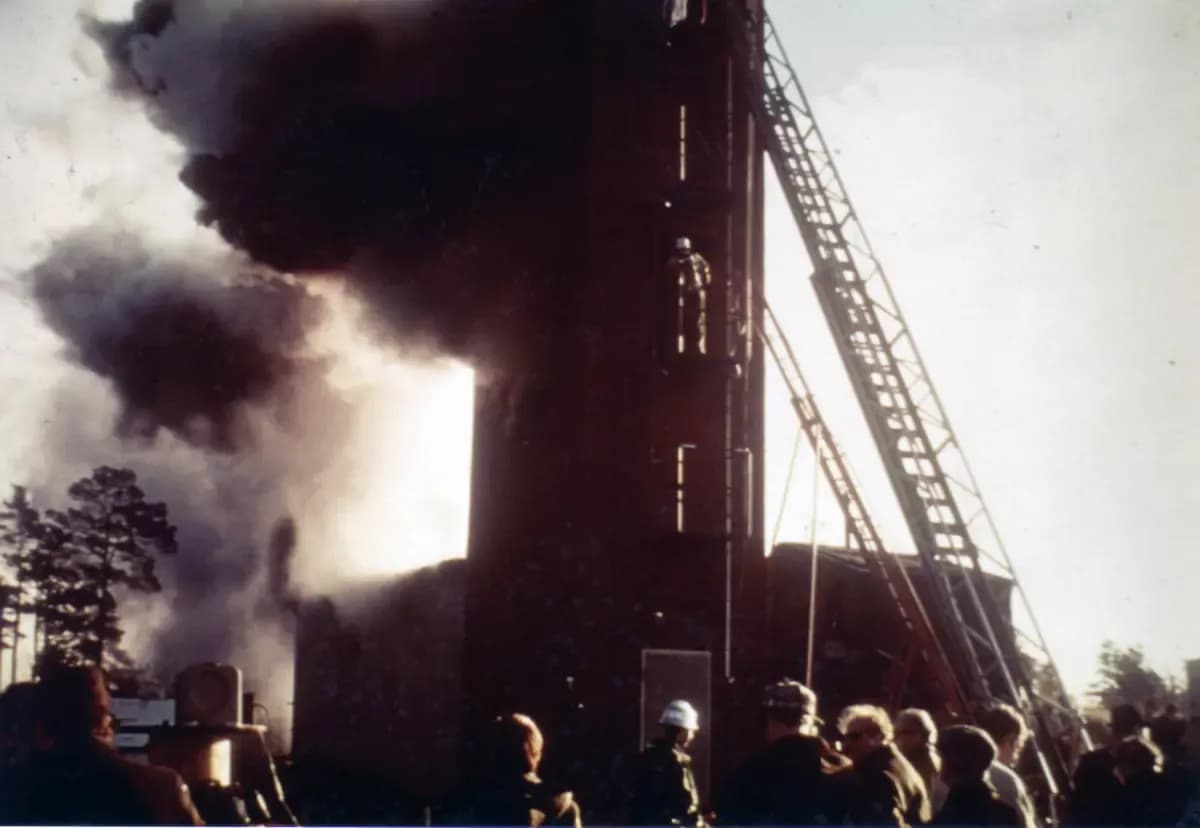
Smoke pours from a small test building during a Swedish government fire test of cable trays and fire-stopped cable penetrations. Photo: "Swedish gov test 2" by Achim Hering, CC BY 3.0, via Wikimedia Commons, resized.

Flame Spread: IEC 60332 Single and Bunched Tests
IEC 60332 tests flame spread, with a single-cable test in Part 1 and group tests in the Part 3 series. IEC 60332-1-2:2025, edition 2.0, was published on 10 June 2025 and applies a 1 kW pre-mixed flame to a single vertical cable. Its NOTE 2 says a single-cable test "does not provide compliance with fire propagation requirements" for cables installed as a group.
The 2025 preview lists two significant changes: changed positioning of test pieces, "which move out of the flame", and new performance requirements in Annex A. IEC 60332-2-2 gives a "Procedure for diffusion flame" for "a single small insulated wire or cable".
The IEC 60332-3 parts, all edition 2.0 of July 2018, can be used to "demonstrate the cable's ability to limit flame spread". Each gives a recommended performance requirement in Annex B. Categories A F/R and A both use 7 l/m of non-metallic material and a 40 min flame time. A F/R covers only power cables with conductors over 35 mm², spaced on the front and rear of the ladder, and "is not intended for general use".
Category B uses 3.5 l/m for 40 min, and C uses 1.5 l/m for 20 min. Category D uses 0.5 l/m for 20 min and is meant for small cables, mounted "in touching formation only" on the front of the ladder. The chart compares the non-metallic volume for each category.
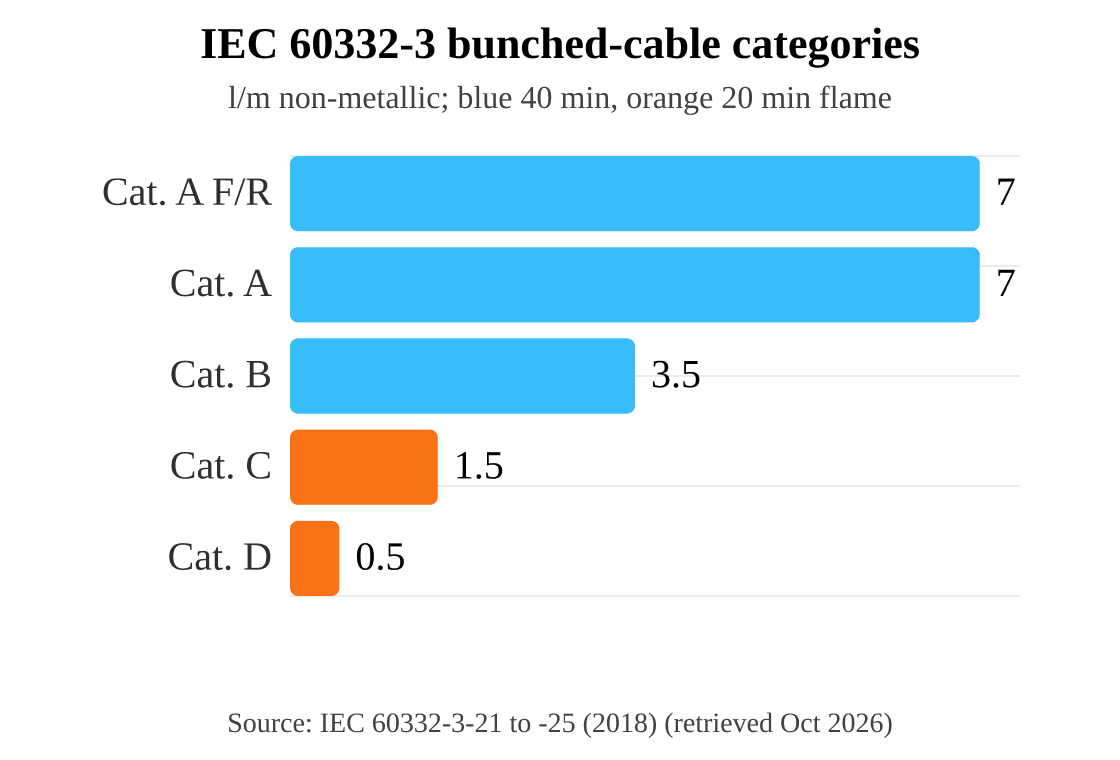
Nominal non-metallic volume per metre of test sample in each IEC 60332-3 category: A F/R and A 7 l/m, B 3.5 l/m, C 1.5 l/m and D 0.5 l/m. The flame is applied for 40 min in A F/R, A and B, and for 20 min in C and D. Category A F/R covers power cables above 35 mm² and "is not intended for general use". Sources: IEC 60332-3-21 to IEC 60332-3-25, Edition 2.0 (2018). Retrieved October 2026.
Chart data (readable on mobile):
- Category A F/R: 7 l/m non-metallic material; 40 min flame application.
- Category A: 7 l/m non-metallic material; 40 min flame application.
- Category B: 3.5 l/m non-metallic material; 40 min flame application.
- Category C: 1.5 l/m non-metallic material; 20 min flame application.
- Category D: 0.5 l/m non-metallic material; 20 min flame application.
These values describe the test samples and flame application, not interchangeable cable performance grades. Category A F/R has specific mounting and conductor-size conditions and is not intended for general use.
Flame Retardant Is Not Fire Resistant
Flame retardance limits flame spread along a cable, while fire resistance keeps a circuit working during a fire. IEC 60331-1, edition 2.0 of March 2018, tests cables "required to maintain circuit integrity when subject to fire and mechanical shock". Its title, quoted in the NEK TS 606:2025 preview, specifies at least 830 °C for cables up to 0.6/1.0 kV and over 20 mm in diameter. The same preview lists IEC 60331-2 for diameters up to 20 mm.
Our NEK 606 offshore cable page shows the split in practice. RFOU is flame-retardant without a fire barrier, while a mica-based fire barrier in BFOU serves emergency or critical circuits that must keep working. The page also lists IEC 60754-1 and -2 for halogen-free performance and IEC 61034-1 and -2 for low smoke. These are design references, not test certificates.
EU CPR Classes and the 2024 Regulation
The CPR classes cables Aca to Fca for reaction to fire, plus additional classes for smoke, flaming droplets and acidity. CPR Annex I requires that "the generation and spread of fire and smoke" be limited and that "occupants can leave the construction works or be rescued by other means". EN 50575 is the product standard, cited under the 2011 regulation, as the Commission's summary list shows. EN 13501-6 is the classification procedure and EN 50399 the test.
Delegated Regulation (EU) 2016/364 assesses Aca with EN ISO 1716: gross calorific potential (PCS) ≤ 2.0 MJ/kg. B1ca to Dca use EN 50399 (30 kW for B1ca, 20.5 kW otherwise), with limits that include total heat release (THR1200) of 10, 15, 30 and 70 MJ. All four need an EN 60332-1-2 result (H) of at most 425 mm. Eca needs only that, and Fca means H > 425 mm.
Table 4 sets additional classes only for B1ca to Dca. Smoke classes use total smoke production (TSP) and smoke production rate (SPR).
- Class: s1 — Criterion: TSP1200 ≤ 50 m² and peak SPR ≤ 0.25 m²/s
- Class: s1a — Criterion: s1 and EN 61034-2 transmittance ≥ 80 %
- Class: s1b — Criterion: s1 and EN 61034-2 transmittance ≥ 60 % and < 80 %
- Class: s2 — Criterion: TSP1200 ≤ 400 m² and peak SPR ≤ 1.5 m²/s
- Class: s3 — Criterion: Not s1 or s2
- Class: d0 — Criterion: No flaming droplets or particles within 1,200 s
- Class: d1 — Criterion: None persisting longer than 10 s within 1,200 s
- Class: d2 — Criterion: Not d0 or d1
- Class: a1 — Criterion: EN 60754-2 conductivity < 2.5 µS/mm and pH > 4.3
- Class: a2 — Criterion: EN 60754-2 conductivity < 10 µS/mm and pH > 4.3
- Class: a3 — Criterion: Not a1 or a2
CPR-2024, Regulation (EU) 2024/3110, entered into force on 7 January 2025; its main part has applied since 8 January 2026. Products whose standards are cited under CPR-2011 in principle follow that regulation until a new harmonised standard is cited. The old citation is then withdrawn after "at least one year", and CPR-2011 "will be officially repealed in 2039".
Where Halogen-Free, Low-Smoke Cable Is Specified
Halogen-free, low-smoke requirements sit in cable product standards, ship and offshore specifications, and tray tests. In the UK, BS 7211 covers thermosetting-insulated cables up to 450/750 V, including the single-core 6181B. They emit limited smoke and corrosive gases "compared with corresponding PVC cables conforming to BS 6004". BS 6724 covers armoured cables of 600/1,000 V and 1,900/3,300 V with "low emission of smoke and corrosive gases".
BS EN 50525-3-21 covers flexible 450/750 V cables for connecting equipment and machinery to the fixed supply, and IEC 62821-1 covers thermoplastic types up to 450/750 V. For rail vehicles, BS EN 45545-2 gives "Requirements for fire behaviour of materials and components". For ships and offshore units, the IEC 60092-360 preview lists SHF 1 among thermoplastic and SHF 2 among cross-linked sheathing compounds. It also cites IEC 60754-1 and -2 as normative references.
NEK TS 606:2025 is titled "Cables for offshore installations Halogen-free low smoke flame-retardant / fire-resistant (HFFR-LS)". Its contents include clauses on "Content of Halogen" and "Smoke Emission", and our NEK 606 vs IEEE 1580 guide compares it with the IEEE marine practice.
In tunnels and mines, our flexible (N)3GHSSHCH cable, rated 3.6/6 kV to 18/30 kV, pairs ethylene propylene rubber (EPR) insulation with halogen-free flame-retardant (HFFR) inner and outer sheaths. It lists IEC 60332-1, DIN EN 60332-1-2 and VDE 0482-332-1-2 as flame-retardant references.
In North America, the UL flame exposure in UL 1685 is a vertical-tray fire test of cable damage height and smoke release. Its limited-smoke criteria are a char height under 244 cm, total smoke of 95 m² or less and a peak smoke release rate of 0.25 m²/s or less. The standard notes that the test "does not investigate the toxicity" of combustion products.
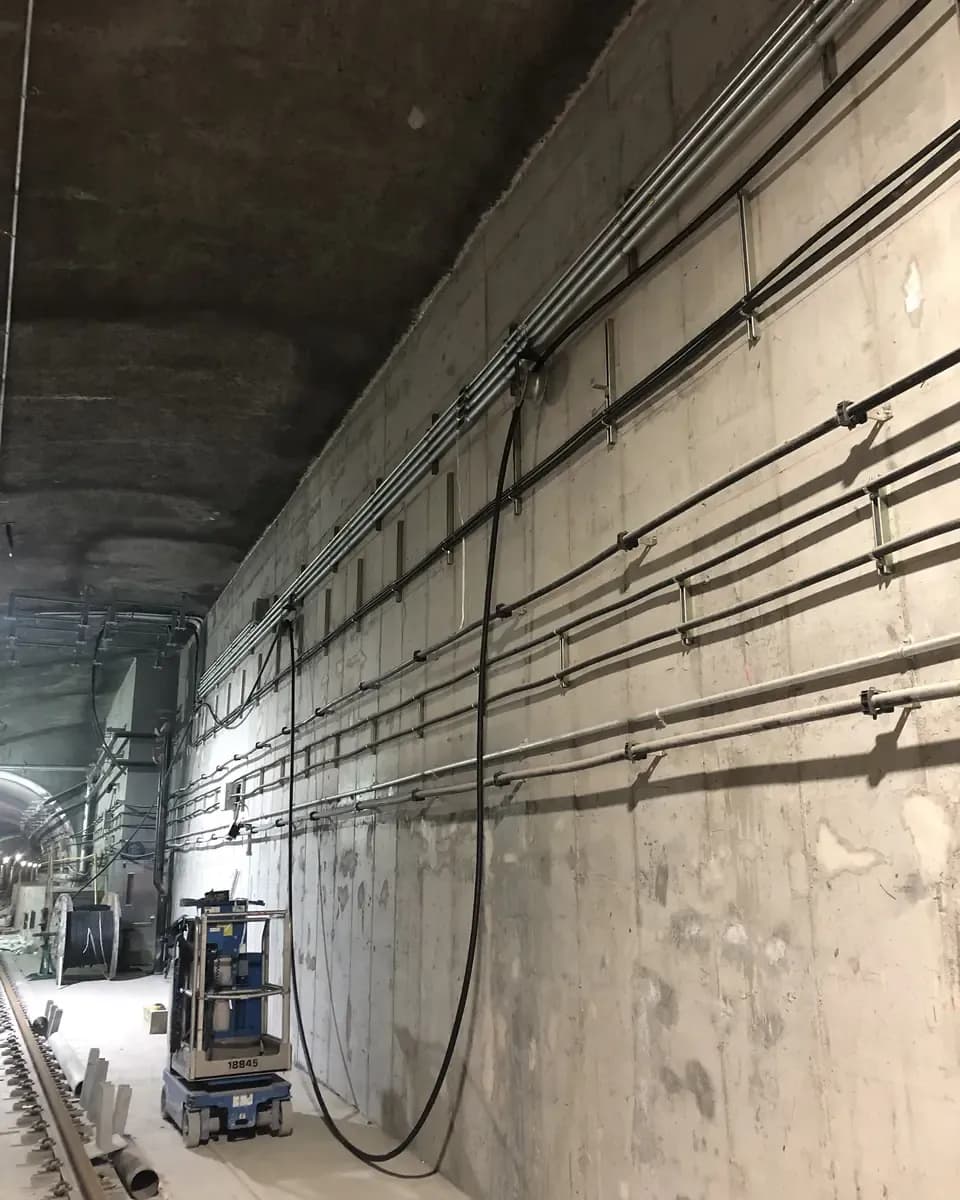
Cables being installed along a tunnel wall in Queens, New York, with a cable drum and pulley wheels in use. Photo: "Installing cables along the tunnels in Queens. 08-27-2019" by MTA Capital Construction Mega Projects, CC BY 2.0, via Wikimedia Commons, cropped.

Halogen-Free Flexible Cables: Check the Sheath
Heavy-duty flexible cables often use halogenated rubber sheaths, so check the sheath before calling a flexible cable halogen-free. As our H07RN-F guide explains, the "N" in that name stands for a polychloroprene outer sheath. Our NSGAFÖU family, with DIN VDE 0250 Part 602 as its reference, is sheathed in 5GM3 chlorinated rubber.
Its halogen-free counterpart, NSHXAFÖ, uses the HM3 compound instead, referenced to DIN VDE 0250 Part 606; the "H" in its name marks the change. Our page lists rail vehicles, buses, switchgear and control cabinets as uses for this 1.8/3 kV single-core cable. It also stresses that a cable's halogen content is a different property from its smoke density or flame propagation.
Federal Aviation Administration (FAA) report DOT/FAA/AR-05/14 (2005) describes the limiting oxygen index (LOI) test as finding the minimum oxygen concentration that sustains burning. Its LOI polymer values, in % oxygen, are 45 for rigid PVC, 40 for polychloroprene (CR) and 17 for polyethylene (PE). The FAA warns that the test "does not correlate well with other fire and flammability tests" and is no reliable guide to real fires.
For smoke, Table A-7 gives smoke extinction area (SEA) polymer values of 325 m²/kg for PE and 455 m²/kg for polypropylene (PP), against 770 to 1,078 m²/kg for three PVC grades. The FAA links the highest SEAs to halogen-containing polymers, "apparently because of combustion inhibition by chlorine".
Our polyurethane (PUR) festoon cables, PUR-HF and the screened PUR-C-HF, state halogen-free materials and an IEC 60332-1 single-cable flame reference only. PUR-HF lists polyester-based halogen-free insulation under an HFFR polyurethane sheath, while PUR-C-HF has halogen-free flame-retardant PUR sheaths.
Our screened (N)GRDGCGÖU energy-chain cable, described as halogen-free, pairs EPR insulation with an ethylene vinyl acetate (EVA) outer sheath. For all three cables, a smoke-density or halogen test has to be specified separately. The chart compares the FAA smoke extinction area polymer values.
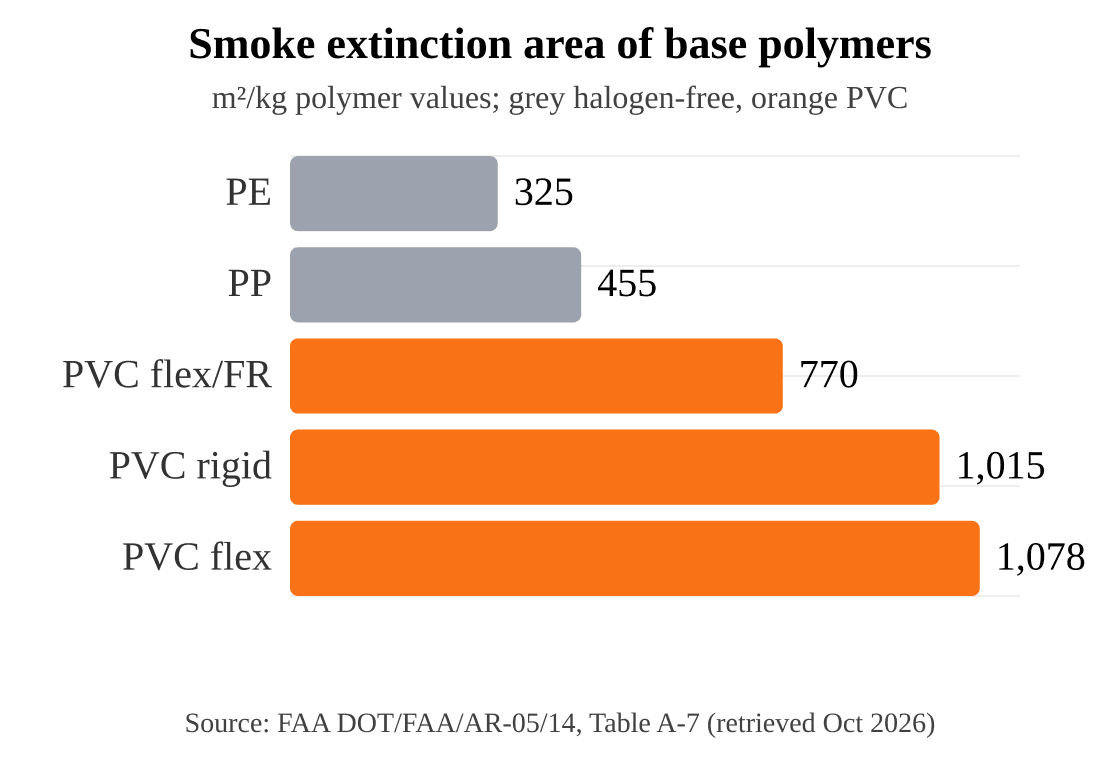
Polymer values, not cable test results. Smoke extinction area in FAA report DOT/FAA/AR-05/14, Table A-7: PE 325, PP 455, PVC flex/FR 770, PVC rigid 1,015 and PVC flex 1,078 m²/kg. The report links the highest values to halogen-containing polymers "apparently because of combustion inhibition by chlorine". Retrieved October 2026.
Chart data (readable on mobile):
- PE: smoke extinction area 325 m²/kg.
- PP: smoke extinction area 455 m²/kg.
- PVC flex/FR: smoke extinction area 770 m²/kg.
- PVC rigid: smoke extinction area 1,015 m²/kg.
- PVC flex: smoke extinction area 1,078 m²/kg.
These are polymer data from FAA Table A-7, not supplied-cable test results. They do not establish compliance with IEC 61034 or a CPR smoke class.
How to Specify LSZH Cable
Specify each property as a named test method with a stated limit, then add the CPR classes and evidence the project needs. A bare "LSZH" on an order specifies none of them.
- Halogen content. Name IEC 60754-1 with a limit, or IEC 60754-3 where low levels must be measured.
- Corrosivity. Name IEC 60754-2 and a limit, such as CPR class a1.
- Smoke. Name IEC 61034-2 and a minimum light transmittance. For CPR s1a or s1b, first satisfy the s1 requirements from EN 50399, then the additional EN 61034-2 transmittance threshold; transmittance alone does not establish either subclass.
- Flame spread. Ask for IEC 60332-1-2 on single cables, and name an IEC 60332-3 category for bunched runs.
- CPR class. For cables within the applicable EU construction-products scope, state the required reaction-to-fire class. Add the s, d and a classifications for B1ca, B2ca, Cca and Dca; these suffixes do not apply to every main class.
- Circuit integrity. Where circuits must keep working in a fire, specify an IEC 60331 test separately.
- Evidence. Ask for test evidence on the supplied construction. Our TRA 0.6/1 kV and heavy-duty RXP reeling cable datasheets, for example, list halogen-free PUR and an IEC 60332-1 flame reference. Any smoke or acid-gas requirement must therefore be added to the order.
Frequently Asked Questions
Is there a single LSZH cable standard?
No. A low-smoke, halogen-free claim combines separate test methods: IEC 60754 for halogen acid gas and corrosivity, IEC 61034 for smoke density and IEC 60332 for flame spread. Product standards such as BS 6724 cover cables with "low emission of smoke and corrosive gases when affected by fire".
What pH and conductivity limits apply to halogen-free cable?
That depends on the cable standard, specification or regulation, because IEC 60754-2 is a test method whose informative Annex A only recommends requirements. Under the EU CPR, class a1 requires conductivity below 2.5 µS/mm and pH above 4.3. Class a2 allows conductivity below 10 µS/mm, again with pH above 4.3.
What light transmittance does IEC 61034 require?
No fixed value: Part 2 only recommends one, in an informative annex for use "where no specified requirement is given" in the cable standard or specification. Results are expressed as minimum light transmittance. Under the CPR, both s1a and s1b first require s1 performance in EN 50399. In addition, EN 61034-2 transmittance must be at least 80 % for s1a, or at least 60 % but below 80 % for s1b. A transmittance result alone does not establish the CPR subclass.
Is LSZH cable fire resistant?
Not necessarily. Low smoke and halogen-free properties do not show that a circuit keeps working in a fire, which IEC 60331-1 tests for cables "required to maintain circuit integrity". On our NEK 606 page, for example, flame-retardant RFOU lacks the fire barrier that BFOU adds.
What is the difference between IEC 60332-1 and IEC 60332-3?
IEC 60332-1 tests a single vertical cable, while IEC 60332-3 tests cables together on a ladder. IEC 60332-1-2 applies a 1 kW pre-mixed flame, and its NOTE 2 says a single-cable test does not show compliance for cables installed as a group. The IEC 60332-3 categories run from A F/R to D by non-metallic volume.
Does the new EU CPR change cable classes?
Not immediately. The European Commission says that where a product is covered by a standard cited under CPR-2011, "in principle the provisions of the CPR-2011 apply". That lasts until a new harmonised standard is cited under CPR-2024, and the old citation is withdrawn after a transition of at least one year.
Enquire About LSZH Cable
Through the contact page, send our engineering team the application, voltage and movement duty. Add the halogen, corrosivity, smoke and flame tests, each with its limit, plus any CPR class and any circuit-integrity need. Our LSZH cable range treats low smoke, halogen-free, flame retardance and fire resistance as separate selection terms.
About the Author
Jyen is a technical and operations engineer at TEBAOFLEX, responsible for the company's online platforms. This guide draws on IEC, BSI and UL Standards & Engagement publication records, EU and UK legislation texts, European Commission guidance, FAA and NIST reports and TEBAOFLEX product datasheets. The product pages cited are TEBAOFLEX's own; test methods, limits and classes quoted from standards bodies and regulations describe requirements, not certification of our products.
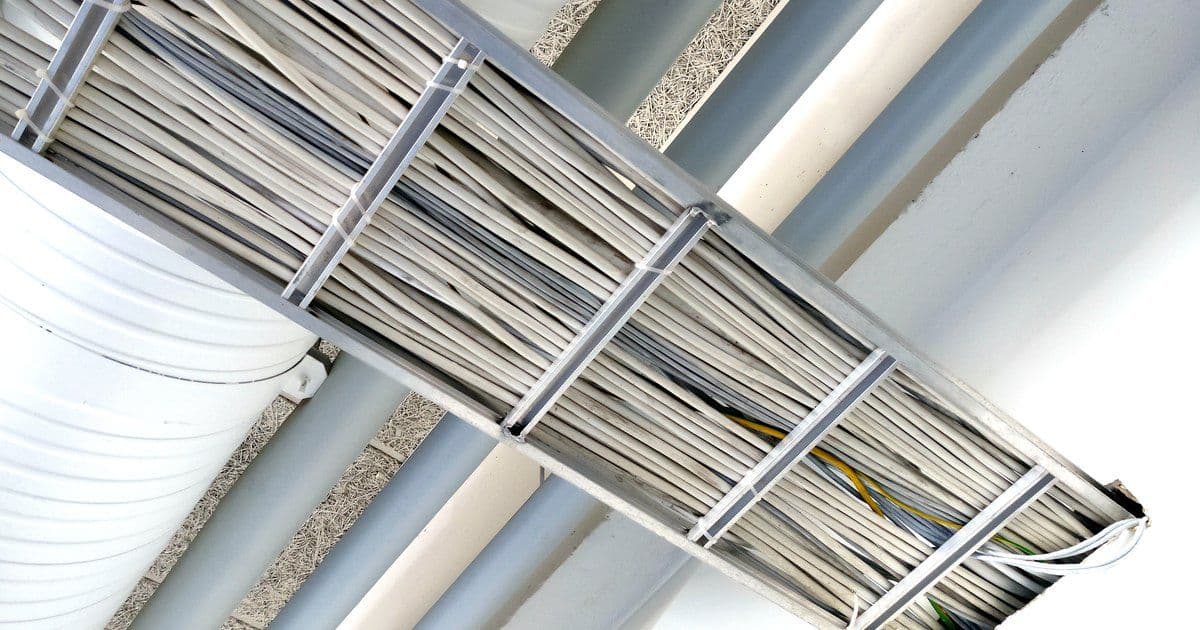
Cover photo: a cable tray loaded with cables, © Santeri Viinamäki, CC BY-SA 4.0, via Wikimedia Commons, cropped.
