


NEK TS 606 is the technical specification (TS) from NEK (Norsk Elektroteknisk Komite, the Norwegian Electrotechnical Committee) for halogen-free and/or mud-resistant offshore cables, such as RFOU and BFOU. Its current edition, NEK TS 606:2025, is the seventh.
IEEE 1580 is the Institute of Electrical and Electronics Engineers (IEEE) recommended practice for marine cable on ships and fixed or floating offshore facilities. Its current edition is IEEE 1580-2021, with the 1580a-2024 amendment. In the historical IEEE 1580-2001 source, Type P identifies crosslinked polyolefin (XLPO) insulation rated 0 to 2000 V, as IEEE's errata sheet for the 2001 edition shows.
Which document a project uses is set mainly by the jurisdiction and the purchase specification. US Coast Guard (USCG) rules in Title 46 of the Code of Federal Regulations (CFR) list IEEE 1580 and UL 1309 (published by UL Standards & Engagement) but no NEK document. In Norway, guidance from Havtil (Havindustritilsynet) says the 61892 series from the International Electrotechnical Commission (IEC) "should be used", with relevant IEC 60092 parts where that series does not apply.
Key Takeaways
- NEK TS 606:2025, the seventh edition, covers "halogen-free and drilling fluid-resistant cables" for maritime petroleum environments.
- Coast Guard rules in 46 CFR 110.10-1 list "IEEE Std. 1580-2010", approved on 30 September 2010, rather than the 2021 edition.
- Voltage scope differs widely: NEK TS 606:2025 reaches 76/132 (145) kV, against 35 kV ac for IEEE 1580-2021.
- Where 46 CFR Subchapter J applies, electric cables "must meet" one of the documents in 111.60-1(a), a list with IEEE 1580 but no NEK title.
- Havtil's guidance to section 47 of the Facilities Regulations says the IEC 61892 series "should be used" and does not name NEK TS 606.
NEK TS 606 and IEEE 1580 at a Glance
NEK TS 606 specifies several offshore cable types, while IEEE 1580 is a recommended practice for marine cable that US Coast Guard rules cite. Entries reflect the publisher records and rules linked below, checked on 3 October 2026.
- : Publisher — NEK TS 606: NEK (Norway) — IEEE 1580: IEEE
- : Document type — NEK TS 606: Technical specification — IEEE 1580: Recommended practice
- : Current edition — NEK TS 606: NEK TS 606:2025, seventh edition — IEEE 1580: IEEE 1580-2021, amended by 1580a-2024
- : Scope in brief — NEK TS 606: Halogen-free and/or mud-resistant power, control, lighting, instrumentation, telecommunication and optical fibre cables, plus hydrocarbon fire and jet fire resistant types — IEEE 1580: Single or multiconductor marine cable, with or without metal armour or jacket, for vessels and fixed or floating offshore facilities
- : Highest voltage in scope — NEK TS 606: Up to and including 76/132 (145) kV — IEEE 1580: 35 kV ac; up to 2000 V dc
- : Typical designations — NEK TS 606: RFOU, BFOU, RU, BU, TFOU — IEEE 1580: Type P (2001 errata): XLPO insulation, 0 to 2000 V
- : Halogen-free and mud — NEK TS 606: Both in its scope — IEEE 1580: Not in IEEE's scope summary; the 2001 errata lists a low-smoke, halogen-free jacket table
- : Main users — NEK TS 606: Offshore installations whose purchase specification names it — IEEE 1580: Vessels where 46 CFR Subchapter J applies; fixed and floating offshore facilities in its scope
- : Our typical construction — NEK TS 606: EPR insulation, tinned copper wire braid, SHF2 sheath — IEEE 1580: XLPO insulation, thermoset jacket, optional basket-weave armour
NEK's preview explains why the document is a TS rather than an international standard. Its foreword says NEK developed it because "the required support cannot be obtained for an International Standard, despite repeated efforts".
IEEE 1580 defers to other rules for installation. Its scope expects cables to be installed "in accordance with industry installation standards and the regulations of the authorities having jurisdiction (AHJ)".
What NEK TS 606 Covers
NEK TS 606 covers halogen-free and/or mud-resistant offshore cables, from instrumentation and lighting circuits to high-voltage power. The scope in NEK's 2025 preview lists "low and high voltage power, control, lighting, instrumentation, and telecommunication, optical fibre cables". It also takes in "Hydro-Carbon Fire resistant (HCF) cables and Jet Fire (JF) resistant cables".
NEK first issued the document in 1993 as the "Norwegian electrotechnical standard" NEK 606. The 2025 edition "cancels and replaces the 6th edition published in 2022". Its listed changes include "IEC 60331-4 is introduced in this document" and "Added high voltage cables up to and including 76/132 (145) kV". Direct current (DC) cable specifications and a new clause 10, "Cables for Battery circuits and primary DC distribution grids", were added too.
The introduction to the TS says its types are "generally based on IEC 60092-350, -360 and -370". Examples in the 2025 contents include "P101 RFOU/TFOU 0,6/1 kV (1,2)", "P105 BFOU 0,6/1 kV", "P110 BU 0,6/1 kV" and "P111 RU/TU 0,6/1 kV". A 250 V example with the (i) suffix is "S101 RFOU(i)/TFOU(i) 250 V".
On the datasheets behind our NEK 606 offshore cables, RFOU is the armoured type: halogen-free, low in smoke and flame-retardant. BFOU keeps those properties and adds fire resistance, while RU and BU are the same families without armour. The M suffix marks a version documented as resistant to mud and drilling fluid, (i) marks instrumentation elements screened individually, and (c) marks collective screening.
For the letter B, NEK's 2015 comment record on a draft fifth edition includes the reply "Reserve B for Mica tape." That is a comment on a draft, not text from the 2025 edition.

Ula field platforms in the Norwegian North Sea, with the vessel Edda Fjord nearby, 2007. Photo: "Ula Platform" by tom jervis, CC BY 2.0, via Wikimedia Commons, resized.

What IEEE 1580 Type P Means
The IEEE 1580-2001 errata identifies Type P as crosslinked polyolefin insulation rated 0 to 2000 V. IEEE's errata sheet for 1580-2001 names Table 14 for "crosslinked polyolefin insulation (type P)". The complete 2021 type tables have not been independently verified for this article; confirm the requirements in the edition specified for the project.
IEEE's record for 1580-2021 covers "single or multiconductor cables, with or without metal armor and/or jacket". Those cables are rated "300 V to 35 kV ac" or "up to 2000 V dc". The title begins "IEEE Recommended Practice for Marine Cable", while the status reads "Active Standard". Board approval came on 9 November 2021, and publication on 28 March 2022.
IEEE now lists the 2010 edition as an "Inactive-Reserved Standard", superseded by 1580-2021. The 1580a-2024 amendment adds offshore wind electrical substation cables, because "the industry needed a recommended practice" for them.
UL 1309, "Marine Shipboard Cable", is the companion product standard that US rules list beside IEEE 1580. UL's catalogue shows edition 3 as active, published on 21 April 2017 and last revised on 3 May 2022. Its scope covers cables rated 300 V to 35 kV for vessels, offshore petroleum facilities and mobile offshore drilling units (MODUs). UL adds that these cables are "not intended for use in accordance with the National Electrical Code (NEC)".
Our IEEE 1580 Type P marine and offshore cable family offers 600 V, 0.6/1 kV and 2 kV options, depending on construction. Flexible, high-strand-count tinned copper conductors carry flame-retardant XLPO insulation under a thermoset jacket, with basket-weave metallic armour as an option. Constructions cover power, control, instrumentation with screened pairs or triads, and variable frequency drive (VFD) circuits.
Which Rules Accept Which Cable
US Coast Guard rules accept cable meeting one of their listed documents, none from NEK, while Havtil's guidance points to IEC series. Subchapter J of 46 CFR applies to electrical installations contracted for after 17 April 2023 on vessels subject to the subchapters that 110.01-1 lists.
On those vessels, 46 CFR 111.60-1(a) says electric cables "must meet all the requirements of" one listed document. The list names seven IEC 60092 parts, IEEE 1580, UL 1072, UL 1309 and two MIL-DTL documents, but no NEK document.
For hazardous locations on offshore supply vessels, 46 CFR 111.106-5(a) says cable and wiring "must meet the cable construction and testing provisions of" a shorter list, including IEEE 1580 and UL 1309. It must also be "of a copper-stranded type".
46 CFR 110.10-1 lists "IEEE Std. 1580-2010", approved on 30 September 2010. In the final rule of 16 March 2023, the USCG said "the 2010 version is still sufficient and relevant for marine cables". It added that "the public can submit equivalency requests for the 2021 edition to the Marine Safety Center (MSC)" under 46 CFR 110.20-1.
Part 250 of 30 CFR sits in the chapter of the Bureau of Safety and Environmental Enforcement (BSEE). On platforms, artificial islands and fixed structures, 30 CFR 250.114(c) says "You must install all electrical systems according to" American Petroleum Institute (API) Recommended Practice (RP) 14F or RP 14FZ. Section 250.105 defines "you" to include a lessee, an operating-rights holder and a designated operator.
Havtil's guidance to section 47 says "the IEC 61892 series should be used" for the design of electrical installations. Where that series is not applicable, relevant IEC 60092 parts and the Regulations relating to electrical power installations "should be used". For ship-registered mobile facilities that are not production facilities, "the DNV OS-D201 standard may be used as an alternative". The page does not name NEK TS 606.
Edition gaps in 46 CFR go beyond IEEE 1580. The chart compares cited and current editions.
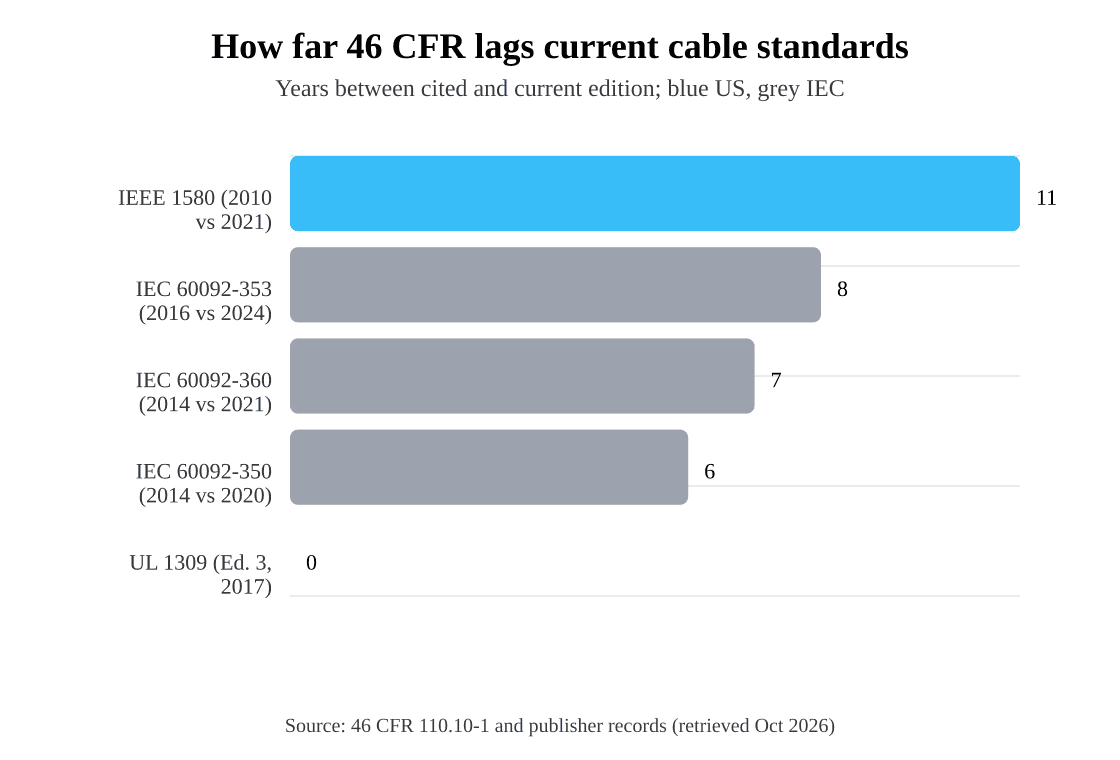
Editions cited in 46 CFR 110.10-1 against the current editions: IEEE 1580-2010 vs 2021; IEC 60092-353:2016 vs 2024; IEC 60092-360:2014 vs 2021; IEC 60092-350:2014 vs 2020; UL 1309 third edition (2017), still current. Current editions from the IEEE, IEC and UL records. Retrieved October 2026.
Chart data (readable on mobile):
- IEEE 1580: incorporated edition 2010; comparison edition 2021; difference 11 years.
- IEC 60092-353: incorporated edition 2016; comparison edition 2024; difference 8 years.
- IEC 60092-360: incorporated edition 2014; comparison edition 2021; difference 7 years.
- IEC 60092-350: incorporated edition 2014; comparison edition 2020; difference 6 years.
- UL 1309: incorporated and comparison third edition 2017; difference 0 years.
These are differences between edition years, not a measure of validity or safety. The legally incorporated edition remains applicable unless the relevant authority accepts an alternative.
Fire, Smoke and Mud Performance
Fire and smoke performance follow the tests each document names, while mud resistance has to be specified separately. Under 46 CFR 111.60-1(a), electric cables covered by Subchapter J must meet a listed document "including the respective flammability tests contained therein". Paragraph (b) adds that "IEC 60092 series cable must meet the Category A or A F/R flammability requirements of IEC 60332-3-22:2009 or 60332-3-21:2000".
NEK's full title adds "Halogen-free low smoke and flame-retardant / fire-resistant (HFFR-LS)" after "Cables for offshore installations". The launch page says the 2025 edition covers "halogen-free and drilling fluid-resistant cables". The 2025 contents also list RFOU-HCF and TFOU-HCF types (P114 to P117) and RFOU/TFOU-FIRE RESISTANT types from P120, so fire duty depends on the full type.
IEC treats mud resistance as a sheath material test. IEC 60092-360:2021 sets requirements for insulating and sheathing materials, and its preview lists Table 10, which sets test requirements for the mud resistance of sheathing compounds. A normative Annex D gives the procedure for a drilling fluid immersion test on sheaths. IEC 61892-4:2019 removed its own drilling fluid test requirements and refers instead to relevant standards from IEC subcommittee SC 18A.
Our RFOU and BFOU datasheet lists a single-cable flame test (IEC 60332-1-2), halogen tests (IEC 60754-1 and -2) and smoke tests (IEC 61034-1 and -2). For mud and drilling fluid, it offers the M variant. In our range, RFOU is the flame-retardant choice, while BFOU's mica barrier is for emergency and critical circuits that specify circuit integrity. IEC 60092-353:2024 also includes "Cables designed to maintain circuit integrity during a fire".
Sheath choice matters for Type P as well. Where a route meets oil or mud, our Type P page says to choose only a sheath qualified for that exposure. Our IEEE 1580 hub names flame spread, smoke, halogen and circuit-integrity tests as fire requirements a project may set.
Voltage and Installation Limits
NEK TS 606:2025 reaches furthest, up to and including 76/132 (145) kV, and the IEC base it builds on excludes cable intended for frequent flexing. Its contents also list a DC type, "D101 RU/TI 1500 V DC". IEEE 1580 covers 300 V to 35 kV ac or up to 2000 V dc, and UL 1309 covers 300 V to 35 kV. The IEC documents sit lower: IEC 60092-350:2020 runs "up to and including 18/30(36) kV", and IEC 61892-4:2019 "up to and including 18/30 kV AC".
IEEE 1580's scope speaks of cables "intended to be installed aboard marine vessels, fixed and floating offshore facilities". NEK TS 606 types are "generally based on IEC 60092-350". IEC 60092-350:2020 covers fixed systems subject to vibration or movement, "and not to those that are intended for frequent flexing".
IEC 61892-4 covers cables "intended for fixed electrical systems in mobile and fixed offshore units". Its preview adds: "This document does not cover flexible cables, for example, those used on drilling decks for top-drive, or cables for portable equipment."
Our NEK 606 hub places the RFOU and BFOU range in fixed installations on drilling rigs, production vessels, platforms and floating production, storage and offloading units (FPSOs). Reeling and trailing duty falls outside that range. Our Type P page likewise says a fixed-route design is not interchangeable with trailing, festoon or powered-reel cable. The chart compares the highest voltage in each document's scope.

Highest voltage in scope: NEK TS 606:2025 "up to and including 76/132 (145) kV" (U = 132 kV); IEEE 1580-2021 300 V to 35 kV ac; UL 1309 300 V to 35 kV; IEC 60092-350:2020 18/30(36) kV; IEC 61892-4:2019 18/30 kV AC. Sources: publisher records and preview PDFs cited in this section. Retrieved October 2026.
Chart data (readable on mobile):
- NEK TS 606:2025: maximum phase-to-phase voltage U of 132 kV.
- IEEE 1580-2021: maximum phase-to-phase AC voltage of 35 kV.
- UL 1309: maximum voltage of 35 kV.
- IEC 60092-350:2020: maximum phase-to-phase voltage U of 30 kV.
- IEC 61892-4:2019: maximum phase-to-phase voltage U of 30 kV.
Scope clarification: 35 kV is the scope of the whole IEEE 1580 document, not a Type P cable rating. Likewise, 132 kV is the NEK TS 606 document scope, not the rating of every RFOU/BFOU cable. Select the rated construction and required approvals for the individual circuit.

The drillship Deep Value Driller docked at Nedrevåge, Tysnes, Norway, 2023. Photo: "Deep Value Driller docked at Nedrevåge" by Christoffer Hjeltnes Støle, CC BY-SA 4.0, via Wikimedia Commons, resized.

Case: RFOU for an Offshore Platform in Guyana
RFOU cable in four three-core sizes served power and lighting distribution on an offshore platform in Guyana. The Guyana RFOU case, published on 8 September 2026, lists the sizes as 3 x 2.5, 3 x 4, 3 x 6 and 3 x 25 mm².
All four sizes share one construction. Tinned stranded copper conductors carry ethylene propylene rubber (EPR) insulation, followed by a halogen-free inner covering, a tinned copper wire braid screen and an SHF2 sheath. That layer sequence matches the RFOU construction on our datasheet.
In follow-up feedback, the customer reported that the cable's quality has been stable in service. The case page links the RFOU choice to lighting and general power, not emergency circuits. The project also shows the RFOU designation in use well outside the Norwegian sector.
A similar enquiry can start from the same record: designation, core count, sizes and layers. It still needs the voltage, fire requirement and any mud exposure stated.
NEK 606 vs IEEE 1580 Type P: How to Choose
Choose by jurisdiction first, then by the document and edition the purchase specification names, and only then by cable details. The seven checks below follow that order.
- Jurisdiction, flag and AHJ. Establish the flag and where the unit operates. Where 46 CFR Subchapter J applies, cable must meet a listed document such as IEEE 1580; elsewhere, confirm expectations with the project's authority having jurisdiction.
- Document and edition. Name NEK TS 606:2025, or IEEE 1580-2021 with its 1580a-2024 amendment. USCG rules list IEEE 1580-2010, and the public can submit equivalency requests for the 2021 edition to the MSC.
- Circuit function and voltage. Match each circuit to a rated type, such as the 250 V type S101 or the 0.6/1 kV type P101 in NEK TS 606. Our Type P options run from 600 V to 2 kV.
- Fire strategy. Choose flame-retardant RFOU, fire-resistant BFOU, or an HCF or JF resistant type where hydrocarbon or jet fire applies. Where circuits must keep working in a fire, name the circuit-integrity test in the specification.
- Mud and oil exposure. Where drilling mud can reach the cable, specify the M variant of RFOU or BFOU. For Type P, pick a sheath qualified for the oil or mud present.
- Installation. Confirm fixed installation rather than reeling, trailing or other flexing duty. State whether braid or armour is needed, and match glands to the finished cable.
- Class or type approval. Our NEK 606 and IEEE 1580 pages treat classification-society type approval as separate from conformity with either document. Request it explicitly where the project needs it.
These checks support, but do not replace, the project's engineering review. For other duties on vessels and offshore units, see our marine and offshore cables page.
Frequently Asked Questions
What is the difference between NEK 606 and IEEE 1580?
NEK TS 606 defines named offshore cable types, while IEEE 1580 is a recommended practice for marine cable. NEK's preview lists types such as RFOU and BFOU, up to 76/132 (145) kV. IEEE's record covers cable rated 300 V to 35 kV ac, or up to 2000 V dc, for vessels and offshore facilities.
Does the US Coast Guard accept NEK 606 cable?
Not by name. Where 46 CFR Subchapter J applies, 111.60-1(a) says electric cables "must meet" one listed document, and none is from NEK. In its passage on IEEE 1580, the USCG's 2023 final rule says the public can submit equivalency requests for the 2021 edition to the Marine Safety Center. Confirm any other route with the authority having jurisdiction.
What does Type P mean in IEEE 1580?
In the cited IEEE 1580-2001 errata, Type P identifies crosslinked polyolefin (XLPO) insulation with a voltage rating of 0 to 2000 V. IEEE's errata sheet for the 2001 edition names its Table 14 that way. Our Type P family pairs that insulation with tinned copper conductors and a thermoset jacket, in power, control, instrumentation and VFD constructions.
What is the difference between RFOU and BFOU cable?
BFOU adds fire resistance to what RFOU offers. Our pages describe RFOU as armoured, halogen-free, low in smoke and flame-retardant, and give BFOU a mica barrier for emergency and critical circuits that need circuit integrity. NEK's 2015 comment record on a draft fifth edition includes the reply "Reserve B for Mica tape."
What is the latest edition of NEK 606?
As of October 2026, the latest is NEK TS 606:2025, the seventh edition. NEK's preview says it "cancels and replaces the 6th edition published in 2022". Its changes include IEC 60331-4, cables up to and including 76/132 (145) kV, and DC cable specifications.
Is IEEE 1580 a standard or a recommended practice?
It is a recommended practice by title and an active standard by status. IEEE's record names it "IEEE Recommended Practice for Marine Cable for Use on Shipboard and Fixed or Floating Facilities" and lists it as an "Active Standard". Its scope leaves installation rules to industry standards and the AHJ.
Enquire About Offshore Cables
Through the contact page, send our engineering team the document and edition, designation (RFOU, BFOU or Type P model), voltage, and core, pair or triad count. Also state screening, fire requirement, mud or oil exposure, armour, length and any approvals needed. For the IEEE side, see our IEEE 1580 marine cable range and the Type P drilling cable video, which moves from a sample's cut end to drilling-rig footage.
About the Author
Jyen is a technical and operations engineer at TEBAOFLEX, responsible for the company's online platforms. This guide draws on the NEK, IEEE, UL and IEC publication records, US and Norwegian regulations cited above, and TEBAOFLEX product pages and case records. The product pages and case cited are TEBAOFLEX's own; standard titles, editions and scopes come from their publishers.
Cover photo: "Holstein at Dusk" by GuavaTrain, CC0 1.0, via Wikimedia Commons, cropped.
