

If you've sourced flexible power cable for outdoor, marine, or wet-location equipment, you've almost certainly come across the designation H07RN-F. It's one of the most widely specified rubber-sheathed flexible cables in industrial and outdoor applications — and for good reason. Here's what the code actually means, why the construction holds up where ordinary PVC cable fails, and what to check before you specify it.
Decoding the Name
H07RN-F is a designation from the CENELEC harmonized cable code (HD 361), and the cable itself is specified in EN 50525-2-21; its IEC counterpart is type 60245 IEC 66. Every letter tells you something about the cable:
- H — Harmonized type, meeting the CENELEC harmonization document for cable construction across Europe.
- 07 — Rated voltage of 450/750 V.
- R — Rubber insulation on each conductor.
- N — A polychloroprene (neoprene-type) outer sheath, chosen for its resistance to oil, abrasion, and weathering — a step up from the lighter-duty PVC used on general-purpose cords.
- F — Flexible construction, with fine-wire stranded copper conductors (flexibility class 5) rather than solid or coarse-stranded cores.
Put together: a flexible, rubber-insulated, neoprene-jacketed cable built to be bent, dragged, coiled, and left outdoors — not just wired once behind a wall. Sizes and technical data are on the H07RN-F product page.
Why the Construction Matters in Wet & Marine Environments
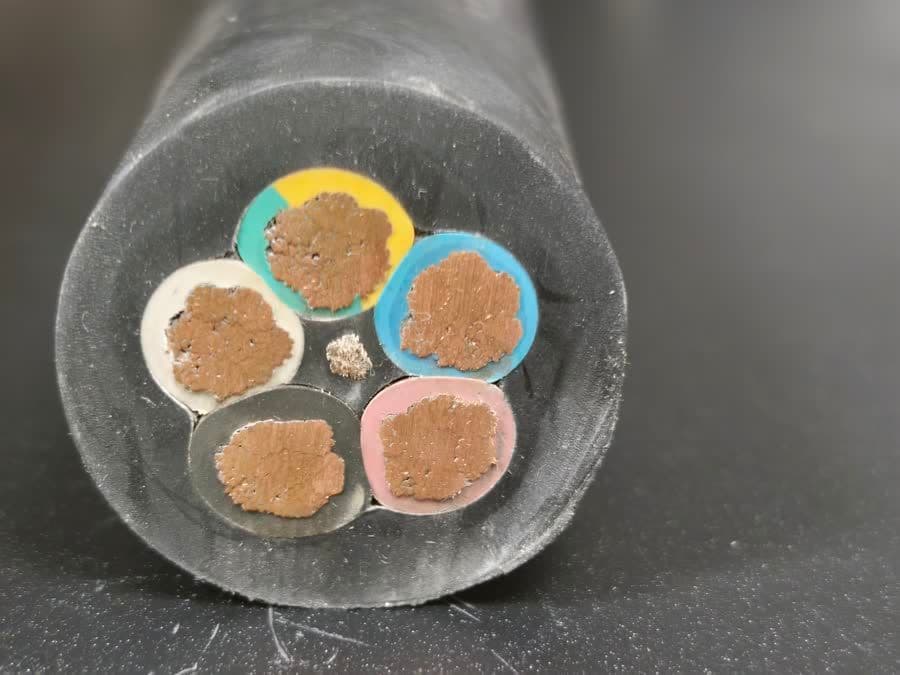
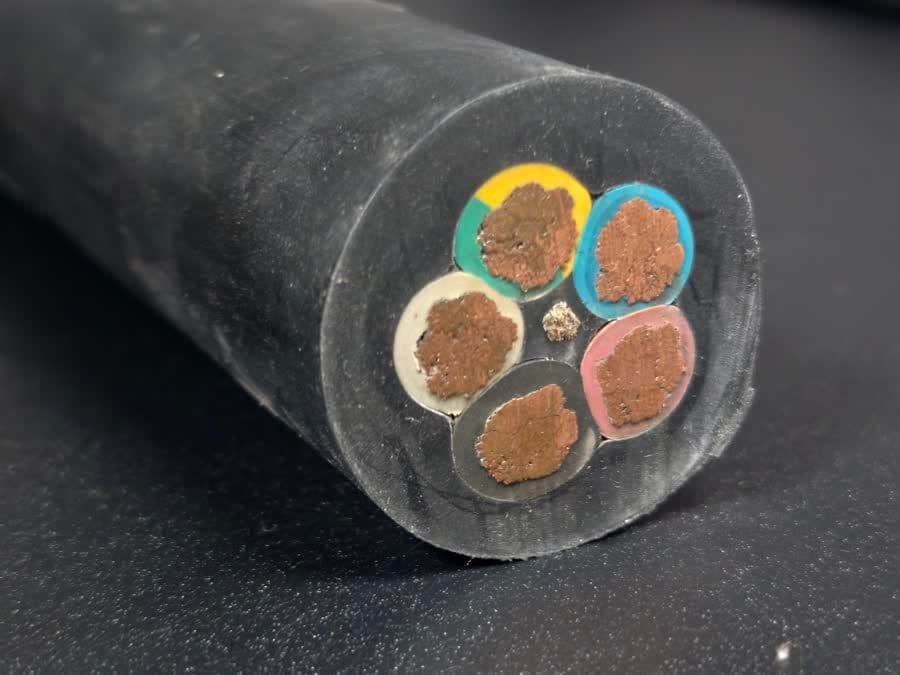
The cross-section above is from one of our own rubber cable production batches — five color-coded conductor cores, individually rubber-insulated, laid up around a central filler and wrapped in the outer neoprene sheath. A few things about that construction directly translate into field performance:
Water and moisture resistance. Rubber and neoprene don't wick moisture the way some lighter jacket compounds do, and the tight core lay-up limits paths for water ingress along the cable length — important for equipment exposed to rain, spray or temporary contact with water. H07RN-F is not intended for permanent immersion; for continuous use under water, choose its submersible counterpart, H07RN8-F.
Oil and abrasion resistance. The neoprene sheath offers good resistance to oils, greases and general abrasion from dragging across floors, gantries or rocky ground — common wear points for cable serving mobile or exposed equipment. Where oil resistance is a formal requirement, confirm the tested marking of the specific product.
Cold-flex performance. Rubber-based cable stays flexible at lower temperatures than standard PVC, which stiffens and becomes prone to cracking in cold conditions.
Constant flexing. The fine-stranded conductors are built to tolerate repeated bending in portable and mobile use — not a one-time installation, but ongoing movement over the cable's service life. Motorised cable reels and drag chains need a cable designed for that duty.
Where We've Seen It Used
We recently supplied H07RN-F cable for a floating-platform power application on an aquaculture site in Chile — an environment that combines constant wave motion, salt spray, and direct sun exposure, exactly the conditions the "R" and "N" in the designation are built for. You can watch this deployment in our Chile floating-platform case study.
What to Check Before You Specify It
H07RN-F is a strong default for wet and outdoor duty, but it isn't the answer to every marine or industrial application. Before specifying it, check:
- Voltage and current requirements — confirm the standard 450/750 V rating and available conductor cross-sections actually cover your load.
- Chemical exposure beyond standard resistance — sustained contact with hydraulic fluids, strong acids/alkalis, or specific solvents may call for a compound upgraded beyond standard neoprene.
- Extreme or sustained UV exposure — for permanent outdoor installations in high-UV regions, ask about additional UV-stabilized jacket options.
- Certification requirements for your target market — confirm which approvals (VDE, UL, CE, KTL, etc.) your project actually requires before ordering.
The Takeaway
H07RN-F earns its place as a go-to flexible cable for wet and outdoor power applications because every part of its construction — rubber insulation, neoprene sheath, fine-stranded conductors — is chosen for durability under conditions that would degrade a standard PVC cord. When your application pushes past what a standard H07RN-F spec covers, that's where custom cable engineering comes in: matching conductor size, sheath compound, and certification to the actual duty cycle rather than picking the nearest catalog part.
Have a wet or outdoor power application you're specifying cable for? Get in touch with your operating conditions and we'll help you match the right construction.