

BS 6708 is the British Standard for flexible cables for use at mines and quarries. The BSI (British Standards Institution) record for the standard lists types from 320/550 V to 6350/11000 V, armoured or non-armoured, with or without individually screened cores. Voltages follow the usual cable convention, Uo/U: Uo is the voltage to earth and U the voltage between phases.
That record lists BS 6708:1998 as withdrawn on 22 May 2026 and names no replacement. Yet the type numbers still appear in cable schedules, so buyers still need to read them. Each number points to a voltage, an armour and screening arrangement, and an intended use. Guidance from the HSE (Health and Safety Executive) then helps decide which of those a machine needs.
Key Takeaways
- BSI lists BS 6708:1998 as withdrawn on 22 May 2026 and names no replacement, so confirm which specification an order calls for.
- Every type in BSI's list has pliable wire armour, individually screened cores, or both.
- Under HSE guidance HSG278, Electrical safety in mines, the underground supply to motors or machines (excluding distribution transformers) designed to be moved while working and served by trailing cable should be restricted to 3300 V.
- HSG278 says unscreened flexible cables, including pliable wire armoured types, should have an earth conductor besides any armour.
- In the selected datasheet examples, armoured and higher-voltage designs have larger minimum bending radii: at 120 mm² phase size, the datasheet values compared below run from 580 mm to 1,185 mm.

Two common BS 6708 layouts: individually screened cores without armour, and pliable galvanised steel wire armour. Illustrative only and not to scale; core arrangements differ by type. Drawn for this article.
What BS 6708 Covers and Its Status
BS 6708 covers flexible cables for mines and quarries, and its latest edition, BS 6708:1998, is withdrawn (BSI record checked 30 September 2026). BSI's record titles it "Flexible cables for use at mines and quarries". Its scope reads: "BS 6708 specifies requirements and dimensions for flexible cables used in mining and quarrying."
BSI's records show these editions:
- BS 6708:1977, "Specification for trailing cables for mining purposes": published 29 July 1977, withdrawn 31 December 1991.
- BS 6708:1991, "Specification for flexible cables for use at mines and quarries": published 20 December 1991, withdrawn 15 April 1998.
- BS 6708:1998, "Flexible cables for use at mines and quarries": published 15 April 1998, withdrawn 22 May 2026.
The 1998 record also describes three annexes. Annex A gives information on approved codes of practice and conductivities, and annex B gives recommended current ratings. Annex C covers the short-circuit current carrying capability of flexible cable screens.
For buyers, the type numbers remain a common shorthand even after withdrawal. BSI names no replacement, so confirm with the purchaser or the mine electrical engineer which specification applies to an order. For other cable families and their standards, see our special cables and standards guide.
BS 6708 Types at a Glance
BSI's list groups BS 6708 cable types by voltage, armour, core screening and main use, without setting out differences within a group, such as between Types 11, 14 and 16. Rows follow BSI's record unless marked "datasheet", and the linked type numbers open our product datasheets.
- Types: 7, 7M, 7S, 11, 14, 16 — Uo/U: 640/1100 V — Armour: None — Cores and screens: Individually metallic screened — Main use (BSI wording): Coalface cutters and other similar machines
- Types: FS4 — Uo/U: 640/1100 V — Armour: None — Cores and screens: Individually metallic screened; flat form — Main use (BSI wording): Overhead catenary systems and similar applications
- Types: 20, 21 — Uo/U: 640/1100 V — Armour: Pliable wire — Cores and screens: Unscreened — Main use (BSI wording): Not stated in BSI's summary
- Types: 62, 63, 64, 70, 71 — Uo/U: 640/1100 V — Armour: Pliable wire — Cores and screens: Individually metallic screened or unscreened — Main use (BSI wording): Primarily remote control circuits and coalface lighting
- Types: 201, 211 — Uo/U: 640/1100 V — Armour: Pliable wire — Cores and screens: Individually metallic screened — Main use (BSI wording): Not stated in BSI's summary
- Types: 321, 331 — Uo/U: 1900/3300 V — Armour: Pliable wire — Cores and screens: Not stated (datasheet: 321 unscreened, 331 screened) — Main use (BSI wording): Trailing cables in quarries or mine roadway cable extension
- Types: 506, 512, 518, 524 — Uo/U: 320/550 V — Armour: Pliable wire — Cores and screens: Up to 24 individually metallic screened cores — Main use (BSI wording): Primarily large mining machines where interconnection is required
- Types: 621, 630, 631 — Uo/U: 3800/6600 V — Armour: Pliable wire — Cores and screens: Individually metallic screened or unscreened — Main use (BSI wording): Trailing cables in quarries and roadway extension
- Types: 44 — Uo/U: 600/1000 V — Armour: None — Cores and screens: Individually metallic screened — Main use (BSI wording): Primarily hand-held drilling machines in mines
- Types: 43 — Uo/U: 600/1000 V — Armour: None — Cores and screens: Individually non-metallic screened — Main use (BSI wording): Primarily hand-held drilling machines in mines
- Types: 730 — Uo/U: 3800/6600 V — Armour: None — Cores and screens: Individually metallic screened — Main use (BSI wording): Primarily trailing cables for large machines at quarries
- Types: 830 — Uo/U: 6350/11000 V — Armour: None — Cores and screens: Individually metallic screened — Main use (BSI wording): Primarily trailing cables for large machines at quarries
- Types: 307, 307M, 307S — Uo/U: 1900/3300 V — Armour: None — Cores and screens: Individually metallic screened — Main use (BSI wording): Coalface cutters and other similar machines
The chart below shows each group's U in kV (kilovolts): orange bars are non-armoured groups and blue bars armoured.
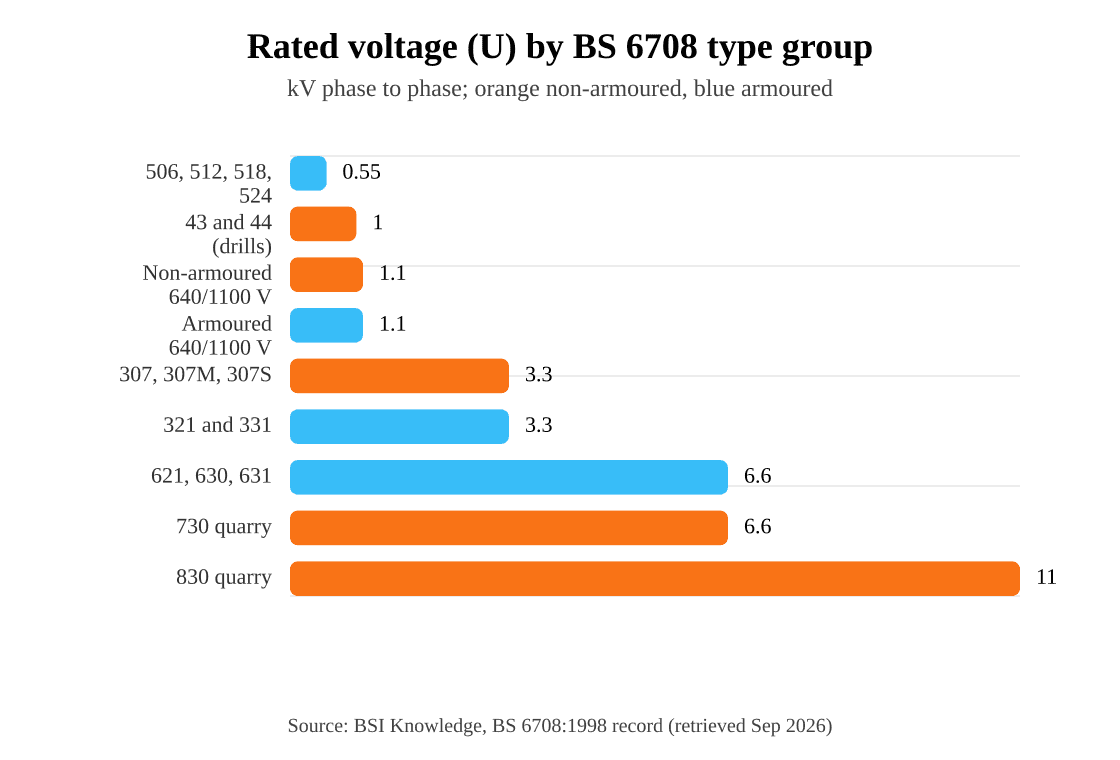
Source: BSI Knowledge record for BS 6708:1998 (standard withdrawn 22 May 2026). Retrieved September 2026.
kV phase to phase; orange non-armoured, blue armoured
- 506, 512, 518, 524 — 0.55 kV
- 43 and 44 (drills) — 1 kV
- Non-armoured 640/1100 V — 1.1 kV
- Armoured 640/1100 V — 1.1 kV
- 307, 307M, 307S — 3.3 kV
- 321 and 331 — 3.3 kV
- 621, 630, 631 — 6.6 kV
- 730 quarry — 6.6 kV
- 830 quarry — 11 kV
Non-Armoured Screened Types for Machines
BS 6708's non-armoured machine types have individually metallic screened cores. They serve coalface cutters and similar machines at 640/1100 V or 1900/3300 V, and large quarry machines at 3800/6600 V or 6350/11000 V.
At 640/1100 V, BSI lists Types 7, 7M, 7S, 11, 14 and 16 for coalface cutters and other similar machines. Our Type 7/7M/7S datasheet names coalcutters, shearers and roadheaders, while the Type 11/14/16 page adds excavating and crushing equipment.
The Type 7/7M/7S datasheet gives each of the three phase cores its own composite copper/nylon braid. Type 7 adds one unscreened pilot core, while Type 7M has one separately screened pilot core. A flexible bare tinned copper earth conductor sits in the centre, and both types run from 3 x 16 to 3 x 150 mm².

A bolter miner for underground coal mining at Delmas Colliery, South Africa. Photo: "Bolter Miner Delmas 06" by Na derdingseben, CC BY-SA 3.0, via Wikimedia Commons, resized.

The same coalface duty reaches 1900/3300 V with Types 307, 307M and 307S. BSI's wording is unchanged: coalface cutters and other similar machines, with individually metallic screened cores.
For large machines at quarries, BSI lists Type 730 at 3800/6600 V and Type 830 at 6350/11000 V, both primarily as trailing cables. On our Type 730 datasheet, the 3 x 120 + 16 and 3 x 150 + 16 sizes have three screened phase cores. Each also has a central bare copper 1 x 16 mm² earth core.
The selected higher-voltage examples have larger minimum bending radii. At a 120 mm² phase size, our datasheets give a minimum bending radius of 580 mm for Type 7, 615 mm for Type 307 and 809 mm for Type 730.
Pliable Wire Armoured Types
BS 6708's armoured types have galvanised steel pliable wire armour, and the quarry and roadway groups run at 1900/3300 V and 3800/6600 V. Three more armoured groups run at 640/1100 V.
Types 20 and 21 have unscreened cores. Mainly used for remote control circuits and coalface lighting, Types 62, 63, 64, 70 and 71 have individually metallic screened or unscreened cores.
Completing the 640/1100 V set, Types 201 and 211 have individually metallic screened cores. Type 201 has three screened power cores and no separate earth core, according to our datasheet. Type 211 adds one insulated, green/yellow, unscreened earth core, and power cores for both run from 3 x 10 to 3 x 120 mm².
At 1900/3300 V, Types 321 and 331 serve as trailing cables in quarries or for mine roadway cable extension. Our datasheet shows Type 321's three power cores unscreened, with an earth core, while each Type 331 power core is screened.
Types 621, 630 and 631 cover the same duties at 3800/6600 V, with screened or unscreened cores. On our datasheet, Type 630 has three individually screened phase cores and no separate earth core, while Type 631 adds one unscreened earth core.
The selected armoured examples also have larger minimum bending radii. At a 120 mm² phase size, our datasheets give 810 mm for Type 201, 940 mm for Type 321 and 960 mm for Type 331. Type 630 reaches 1,185 mm.
Special-Purpose Types
Three BS 6708 groups serve special duties: flat cable for overhead catenary systems, cables for hand-held drills, and screened auxiliary cables for large mining machines. For overhead catenary systems and similar applications, BSI lists Type FS4, a non-armoured flat form cable with individually metallic screened cores, at 640/1100 V. Our FS4 datasheet names overhead catenary and supported power-supply systems, with sizes 4 x 2.5 mm² and 4 x 4 mm².
Types 43 and 44 are non-armoured 600/1000 V cables, primarily for hand-held drilling machines in mines. In BSI's wording, the difference is the screen: Type 44 has individually metallic screened cores, and Type 43 individually non-metallic screened cores. Note the voltage too: 600/1000 V, not the 640/1100 V of Types 7, 11, 14 and 16.
Types 506, 512, 518 and 524 are auxiliary cables with galvanised steel pliable wire armour and up to 24 individually metallic screened cores at 320/550 V. BSI lists them primarily for large mining machines that need interconnection between machine sections, or between a section and auxiliary equipment. Our datasheet lists Type 518 as 18 x 1.34 mm², with core sizes from 0.93 to 1.34 mm².
How to Choose a BS 6708 Type: Five Checks
Choose a type through five checks against HSE guidance HSG278, Electrical safety in mines.
- Voltage (the Uo/U column). HSG278 para 29 says underground supply voltage "should not normally exceed 11 000 V". It gives a lower figure, 3300 V, for motors or machines (excluding distribution transformers) designed to be moved while working and served by trailing cable.
- Screening (the cores and screens column). HSG278 para 55 says conductors above 125 V should, where necessary, be further protected by a metallic screen, armour or conduit. Para 63 lists steel wire armour, individual conducting screens or a collective screen with an independent earth conductor. Para 65 describes individually screened conductors, with leakage protection, for mains-powered flexible cables vulnerable to damage.
- Earthing and pilot. Earthing conductors should have a combined conductivity not less than the largest conductor's (para 96), or half where earth fault current is restricted (para 97). Unscreened flexible cables, including pliable wire armoured, should have an earth conductor besides any armour (para 98). Types 211 and 631 add an earth core; 201 and 630 do not. Under US rule 30 CFR 75.902 of the Code of Federal Regulations (not UK law), a fail-safe ground check circuit opens the breaker if "the ground or pilot check wire is broken".
- Armour and flexibility (the armour column). Compare the selected designs' minimum bending radii in the chart below; the configurations differ as noted in its caption. Para 67 says trailing cables supplying 3300 V to mobile machinery should, where necessary, have a cable handling system.
- Protection and connections. Para 109 says power systems referenced to earth (excluding those using an earth return) should automatically cut off excess earth leakage above 125 V when supplying equipment intended to move while energised. With conducting elastomeric screens, the setting should be under 1 A (para 111). Para 112 recommends a 2 A earth fault current limit for systems up to 3300 V supplying equipment designed to move while working and served by flexible trailing cable. Para 103 calls for restrained or bolted and interlocked plugs and sockets below ground, and for bolted types on equipment supplied through flexible cable above 1100 V. Outer coverings should not readily propagate flame (para 57).
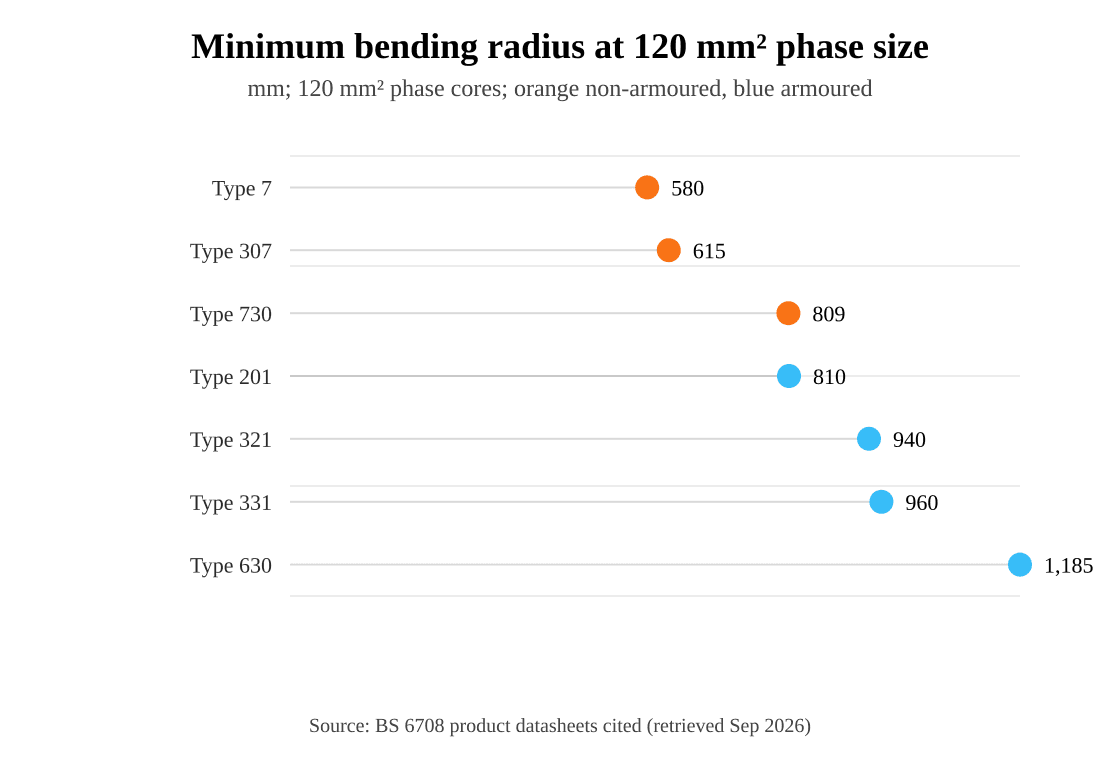
Source: minimum bending radius values from the Type 7, 307, 730, 201/211, 321/331 and 630/631 product datasheets linked in this article. Rows compared: Type 7, 201 and 630 at 3 x 120 mm²; 307 at 3 x 120 + 70 + 70; 321 at 3 x 120 + 1 x 120; 331 at 3 x 120 + 1 x 70; 730 at 3 x 120 + 16. An indicative comparison, retrieved September 2026.
mm; 120 mm² phase cores; orange non-armoured, blue armoured
- Type 7 — 580 mm
- Type 307 — 615 mm
- Type 730 — 809 mm
- Type 201 — 810 mm
- Type 321 — 940 mm
- Type 331 — 960 mm
- Type 630 — 1,185 mm
UK Rules Behind the Checks
Behind the checks sit the EAWR (Electricity at Work Regulations 1989) and the Mines Regulations 2014, which are law in England, Wales and Scotland, and HSG278, which is guidance. The regulations set the duties; HSG278 describes one way to meet them. HSG278 and the Mines Regulations 2014 are written for mines, so for quarry machines, confirm the applicable requirements with the purchaser or quarry electrical engineer.
EAWR regulation 6 covers equipment that may reasonably foreseeably be exposed to mechanical damage and other hazards. Such equipment "shall be of such construction or as necessary protected as to prevent, so far as is reasonably practicable, danger arising from such exposure."
Regulation 7 applies to all conductors in a system which may give rise to danger. Each shall either "be suitably covered with insulating material and as necessary protected so as to prevent, so far as is reasonably practicable, danger" or have other precautions taken.
The Mines Regulations 2014 state: "These Regulations come into force on 6th April 2015." On that date, they revoked EAWR regulations 17 to 28, the EAWR part headed "Regulations applying to mines only". HSE's guidance on the Mines Regulations is L149.
HSG278 replaces L128, the Approved Code of Practice on the use of electricity in mines. Its para 16 says: "Equipment constructed to appropriate British Standards or equivalent international specifications should be used". Which specification counts as appropriate after BS 6708's withdrawal is a question for the purchaser and the mine electrical engineer.
On its legal status, HSG278 says: "Following the guidance is not compulsory, unless specifically stated, and you are free to take other action." It adds: "But if you do follow the guidance you will normally be doing enough to comply with the law."
Frequently Asked Questions
What is BS 6708?
BS 6708 is the British Standard for flexible cables for use at mines and quarries. BSI's record says it "specifies requirements and dimensions for flexible cables used in mining and quarrying". Its types run from 320/550 V auxiliary cables to 6350/11000 V quarry trailing cables, armoured or non-armoured. BSI lists the 1998 edition as withdrawn.
Is BS 6708 still current?
No. BSI lists BS 6708:1998 as withdrawn on 22 May 2026, and its record names no replacement. The type numbers still appear in cable schedules, so buyers still meet them. Before ordering, confirm with the purchaser or mine electrical engineer which specification applies.
What is the difference between BS 6708 Type 201 and Type 211?
Type 211 adds a separate earth core; Type 201 has none. Both are 640/1100 V armoured types with individually metallic screened cores in BSI's list. Our datasheet shows three screened power cores in each, with Type 211's extra core insulated, green/yellow and unscreened. Power cores for both run from 3 x 10 to 3 x 120 mm².
What is the difference between BS 6708 Type 43 and Type 44?
The difference is the core screen. BSI lists both as non-armoured 600/1000 V cables, primarily for hand-held drilling machines in mines. Type 44 has individually metallic screened cores, while Type 43 has individually non-metallic screened cores. Neither shares the 640/1100 V rating of coalface Types 7, 11, 14 and 16.
What voltage can trailing cables use in UK mines?
Up to 3300 V underground for motors or machines (excluding distribution transformers) designed to be moved while working and served by trailing cable, under HSE guidance HSG278. Para 29 also says underground supply should not normally exceed 11 000 V, or 6600 V for normally stationary equipment moved at times with power applied. Following HSG278 is not compulsory, but normally enough to comply with the law.
Specify Your BS 6708 Cable
Specify a BS 6708 cable by type number, phase size, voltage, length and machine, plus any screening or pilot requirement. If the purchaser names a specification other than BS 6708, include it. Send those details to our engineering team through the contact page. For other designs, see our trailing cable and mining and tunnelling pages.
About the Author
Jyen is a technical and operations engineer at TEBAOFLEX, responsible for the company's online platforms. This guide draws on the BSI, HSE and legislation.gov.uk sources cited above and on TEBAOFLEX product datasheets. The BS 6708 product pages cited are TEBAOFLEX's own; the type definitions and voltages come from BSI's record of the standard.
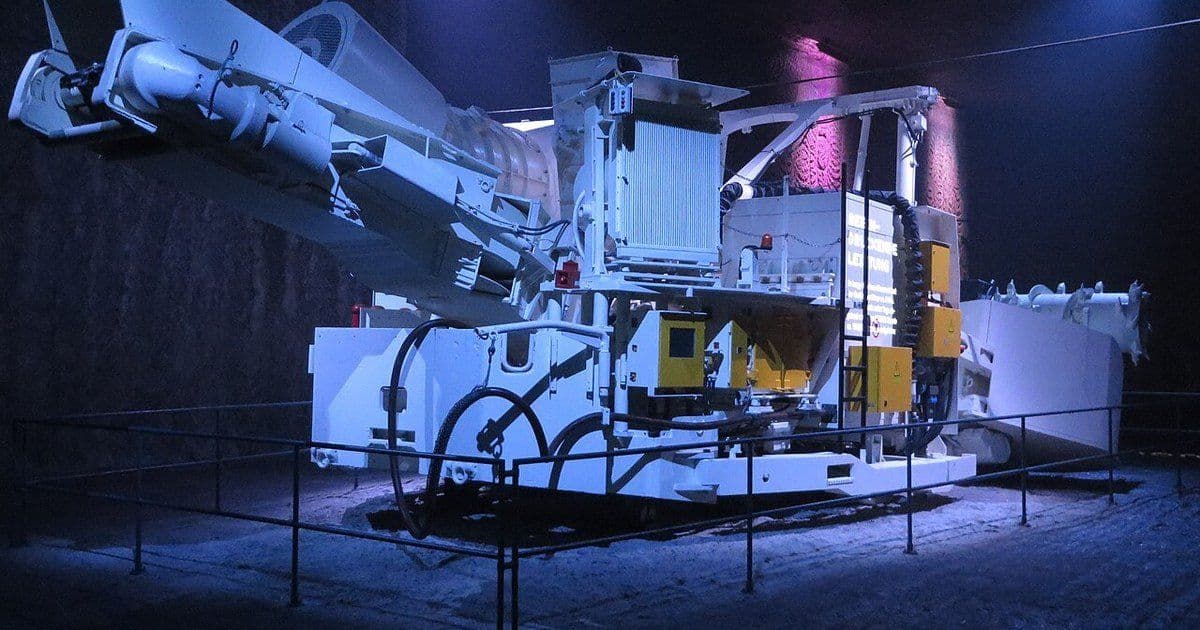
Cover photo: "Bad Friedrichshall Continuous Miner 20180923" by Rosenzweig, CC BY-SA 4.0, via Wikimedia Commons, cropped.
