

SANS 1520 is the South African National Standard (SANS) for flexible electric trailing cables for use in mines. The South African Bureau of Standards (SABS) sells it in three parts, split by voltage. Part 1 covers 640/1100 V and 1900/3300 V, Part 2 covers 3.8/6.6 kilovolts (kV) to 19/33 kV, and Part 3 covers 1 500 V direct current (d.c.).
Type numbers such as 41, 61A, 61B, 63, 66, 611, 622 and 633 sit in those bands. Chapter 3 of the Mine Health and Safety Regulations sets rules for how trailing cables are used, screened, repaired and reeled. Unlike BS 6708:1998, which the British Standards Institution lists as withdrawn on 22 May 2026, all three SANS 1520 parts are on sale from SABS as current editions.
Key Takeaways
- Voltage decides the part: Part 1 spans 640/1100 V and 1900/3300 V, Part 2 3.8/6.6 kV to 19/33 kV, and Part 3 1 500 V d.c.
- SABS reaffirmed SANS 1520-2 on 23 July 2026, and it sells all three parts as current editions.
- Under regulation 3.24, the employer must take reasonably practicable measures so that trailing cables are screened individually or collectively, with earthed screens, and individually in a hazardous area.
- No more than fifteen joint repairs, including sheath patches, are allowed over a length of 200 metres of trailing cable, an employer duty under regulation 3.25.
- Chapter 3's medium-voltage band, above 1 000 V to below 44 kV, spans Part 1's 1900/3300 V rating and all of Part 2's range.
SANS 1520: Three Parts and Their Status
SANS 1520 has three parts, divided by operating voltage, and SABS lists all three as current editions on sale. Each part shares the main title "Flexible electric trailing cables for use in mines" and adds its own part title.
- Part: SANS 1520-1:2022 — Part title (SABS, verbatim): Part 1: cables with operating voltages of 640/1100 V and 1900/3300 V — Edition: Ed. 2.01 — Approved: 1 Nov 2022 — Status note: Current edition; replaces ed. 2 of 2016; amendment 1A (national)
- Part: SANS 1520-2:2020 — Part title (SABS, verbatim): Part 2: Cables with operating voltages of 3,8/6,6 kV to 19/33 kV — Edition: Ed. 2.01 — Approved: 16 Sep 2020 — Status note: Current edition; replaces ed. 2 of 2017; reaffirmed 23 Jul 2026
- Part: SANS 1520-3:2022 — Part title (SABS, verbatim): Part 3: Cables with operating voltage of 1 500 V d.c. — Edition: Ed. 1.01 — Approved: 6 Dec 2022 — Status note: Current edition
The SABS abstracts summarise each part's scope. For Part 1, the abstract says it "covers the construction, materials, dimensions and electrical properties of low-voltage flexible electric trailing cables for use in mines". Part 2's abstract refers to "high-voltage flexible electric trailing cables for use in mines", while Part 3's covers trailing cables on supply systems of up to 1 500 V d.c.
SABS sells the standards, and their clauses are not reproduced here. Quote the part, year and edition on orders, for example SANS 1520-1:2022 (Ed. 2.01).
SANS 1520 Cable Types at a Glance
Our SANS cable range covers eight rubber mining cable types from 640/1100 V to 19/33 kV, four in Part 1's voltage band and four in Part 2's. The range page describes all eight as intended for "demanding trailing, reeling or feeder service". Sheaths, pilot cores and bending radii vary across the range.
Ratings are written Uo/U, the usual cable convention: Uo is the voltage to earth and U the voltage between phases. The part column follows the voltage bands in the SABS titles, and the uses come from our datasheets.
- Type: Type 41 — Uo/U: 640/1100 V — SANS 1520 part (by voltage band): Part 1 — Main uses named on our datasheet: Loaders, load-haul-dump (LHD) machines, drilling rigs, low-haulage dumpers, conveyors; submersible and dewatering pumps
- Type: Type 61A — Uo/U: 640/1100 V — SANS 1520 part (by voltage band): Part 1 — Main uses named on our datasheet: Shuttle cars and mobile haulage equipment
- Type: Type 61B — Uo/U: 640/1100 V — SANS 1520 part (by voltage band): Part 1 — Main uses named on our datasheet: Roadheaders, shearers, stackers and reclaimers
- Type: Type 63 — Uo/U: 1.9/3.3 kV — SANS 1520 part (by voltage band): Part 1 — Main uses named on our datasheet: Medium-sized draglines, shovels and drills; section-feeder and trailing supply circuits
- Type: Type 66 — Uo/U: 3.8/6.6 kV — SANS 1520 part (by voltage band): Part 2 — Main uses named on our datasheet: Draglines, shovels, drills and section feeders
- Type: Type 611 — Uo/U: 6.35/11 kV — SANS 1520 part (by voltage band): Part 2 — Main uses named on our datasheet: Open-cast mining applications
- Type: Type 622 — Uo/U: 12.7/22 kV — SANS 1520 part (by voltage band): Part 2 — Main uses named on our datasheet: Reeling and section-feeder duty on open-cast draglines, shovels and drills
- Type: Type 633 — Uo/U: 19/33 kV — SANS 1520 part (by voltage band): Part 2 — Main uses named on our datasheet: Reeling and section-feeder duty on open-cast machinery
The chart below plots each type's U in kV. Orange bars fall in Part 1's band and blue bars in Part 2's.

Sources: type voltages from the product datasheets linked in this article; part bands from the SABS records for SANS 1520-1 and SANS 1520-2. Retrieved September 2026.
Part 1 Types: 41, 61A, 61B and 63
Four types in our range sit in Part 1's band: Types 41, 61A and 61B at 640/1100 V, and Type 63 at 1.9/3.3 kV. On their datasheets, listed sizes run from 2.5 mm² on Type 41 to 240 mm² on Type 63.
Type 41 has ethylene propylene rubber (EPR) insulation and a nylon/tinned-copper-wire braid screen on each power core. One insulated pilot core sits in the lay-up, under a chloroprene rubber (CR) outer sheath. Conductor sizes run from 2.5 to 25 mm², and the minimum bending radius is 6 x the overall diameter (OD). Applications span underground and surface mining machinery.
Listed in a single size, 95 mm², Type 61A has an abrasion-resistant thermoplastic polyurethane (TPU) outer sheath. The datasheet lists it for reeling and non-reeling service on shuttle cars and mobile haulage equipment.
Intended for movable electrical apparatus in hazardous areas under severe mechanical duty, Type 61B is listed for non-reeling service. It has three triple-extruded EPR power cores, three pilot cores, twin polychloroprene (CR) sheaths and a nylon reinforcement braid. Sizes run from 35 to 150 mm².
Type 63's 1.9/3.3 kV rating falls in the voltage band of SANS 1520-1, whose title covers 640/1100 V and 1900/3300 V. Its datasheet lists sizes from 25 to 240 mm² for open-cast machinery such as medium-sized draglines, shovels and drills. Section-feeder and trailing supply circuits, and cable-reeling systems on mobile equipment, are also named.
Part 2 Types: 66, 611, 622 and 633
Types 66, 611, 622 and 633 fall in the voltage band of SANS 1520-2, which runs from 3.8/6.6 kV to 19/33 kV. The datasheets for Types 611, 622 and 633 show a shared construction family.
Rated 3.8/6.6 kV, Type 66 has three insulated pilot cores laid up with the individually screened power cores. Its datasheet names draglines, shovels, drills and section feeders, a list close to Type 63's at 1.9/3.3 kV. Like Type 41, it has a minimum bending radius of 6 x OD.
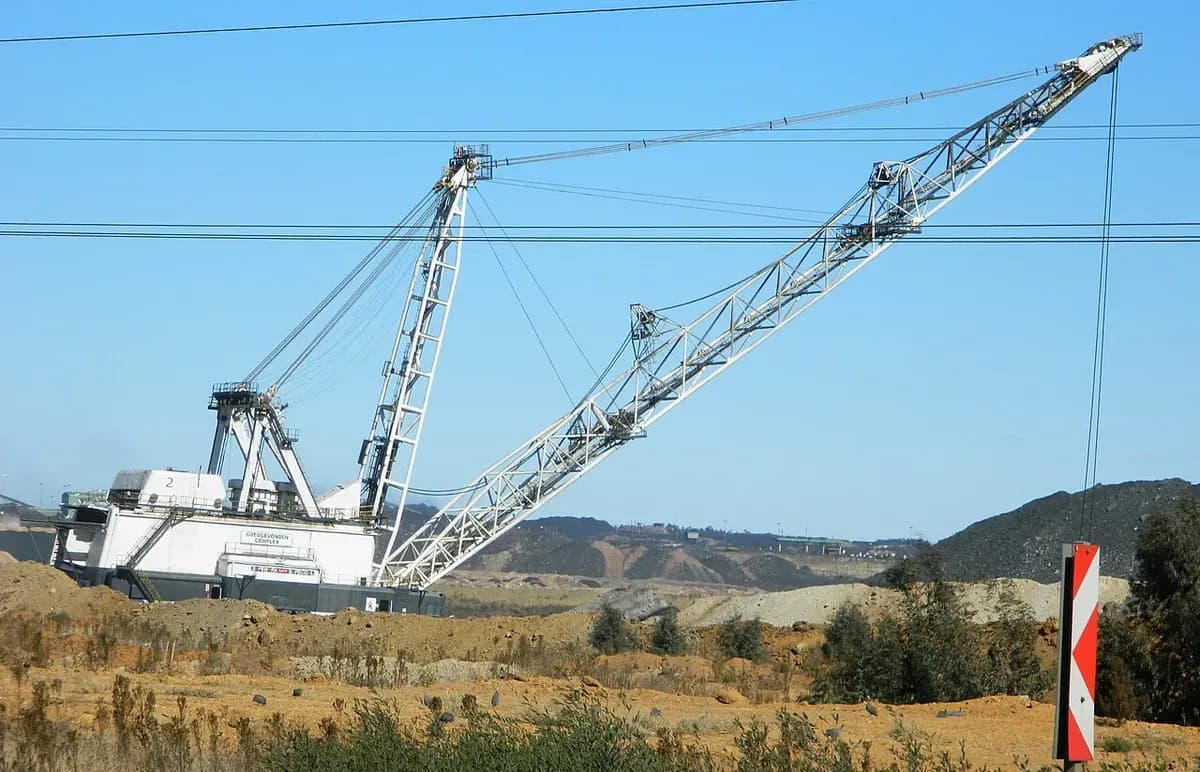
A walking dragline at the Goedgevonden open-cast coal mine near Ogies, South Africa. Photo: "Dragline at Goedgevonden Open Cast Mine Ogies." by Bob Adams (photo: D. Gallop), CC BY-SA 2.0, via Wikimedia Commons, resized.

For open-cast mining, Types 611, 622 and 633 are rated 6.35/11 kV, 12.7/22 kV and 19/33 kV. Each has EPR insulation triple-extruded with a strippable semi-conducting core screen, plus a CR inner sheath. The open nylon reinforcement braid has at least 16 strings in the listed construction. With the construction shared, the choice between them turns on system voltage and conductor size.
Type 622 is listed from 25 to 150 mm² and Type 633 from 25 to 120 mm², so the largest listed size is smaller at 19/33 kV. Types 611, 622 and 633 all need a minimum bending radius of 9 x OD, against 6 x OD for Types 41 and 66. Check any drums, sheaves or cable guides against the larger radius.
Part 3: 1 500 V d.c. Cables
SANS 1520-3 covers trailing cables for supply systems with operating voltages of up to 1 500 V d.c. Its SABS abstract also names "d.c. cable constructions for battery-operated equipment in hazardous locations". SABS approved the current edition, Ed. 1.01, on 6 December 2022.
That 1 500 V ceiling matches the d.c. upper limit for low voltage in the Chapter 3 definitions. None of the eight types in our range falls in Part 3. For battery-operated or other d.c. equipment, name Part 3 and its edition in any enquiry.
What Chapter 3 Requires of Trailing Cables
Chapter 3 restricts trailing cables to mobile, movable and portable equipment, and sets rules for screening, repairs, reeling and hazardous areas. The Chapter 3 definitions describe a trailing cable as a "cable used to supply power to any mobile machine and movable electrical apparatus which is designed to be dragged across the ground".
Those definitions also cover screening: individually screened means a conductive covering around each power conductor, and collectively screened means one around all power and control conductors. Each regulation below opens with the employer's duty: "The employer must take reasonably practicable measures to ensure that" the requirement is met.
- 3.23: cables "may only be used" with a self-propelled mobile machine or movable or portable electric apparatus.
- 3.24: cables "shall be screened either individually or collectively and such screens shall be earthed", and a cable in a hazardous area "shall be screened individually".
- 3.25: at most "fifteen joint repairs, including sheath patches over a length of 200 metres", at least 5 metres apart and 3 metres from the plug or terminal connection.
- 3.26: reels on self-propelled mobile machines need a device that interrupts power so "at least one complete turn of the cable" stays on the reel.
- 3.37: electric apparatus in a hazardous area "shall be explosion protected and certified as such by an inspection authority (Ia) certificate issued by an accredited test laboratory".
- 3.7(c): cables where a fire can occur "must be fire retardant cables or be coated with fire retardant material" near timber.
The regulator is the Department of Mineral and Petroleum Resources (DMPR); its 2026 budget vote lists a Mine Health and Safety Inspectorate among its programmes. Confirm how each rule applies with the mine's competent person or engineer.
Voltage Terms: SABS Titles vs Chapter 3
SABS and Chapter 3 draw their voltage lines in different places. Under the Chapter 3 definitions, low voltage (LV) tops out at 1 000 V alternating current (a.c.) or 1 500 V d.c. Medium voltage (MV) runs from above 1 000 V to below 44 kV.
SABS's abstracts label Part 1 "low-voltage", although its title includes 1900/3300 V, above the LV limit. Part 2 is "high-voltage" in SABS's wording, but its top rating of 19/33 kV stays below the 44 kV ceiling of MV. Type 63's 1.9/3.3 kV rating sits in the "low-voltage" part's band, while a 3.3 kV system is MV under Chapter 3.
The practical rule is to work from numbers, not labels. Match the cable's Uo/U to the system voltage, and use the nominal system voltage, not the cable's U, to decide which Chapter 3 class applies. Even a 640/1100 V cable has a U of 1 100 V, above the 1 000 V a.c. LV limit. The chart below compares the top ratings of Parts 1 and 2 with the Chapter 3 limits, in kV.
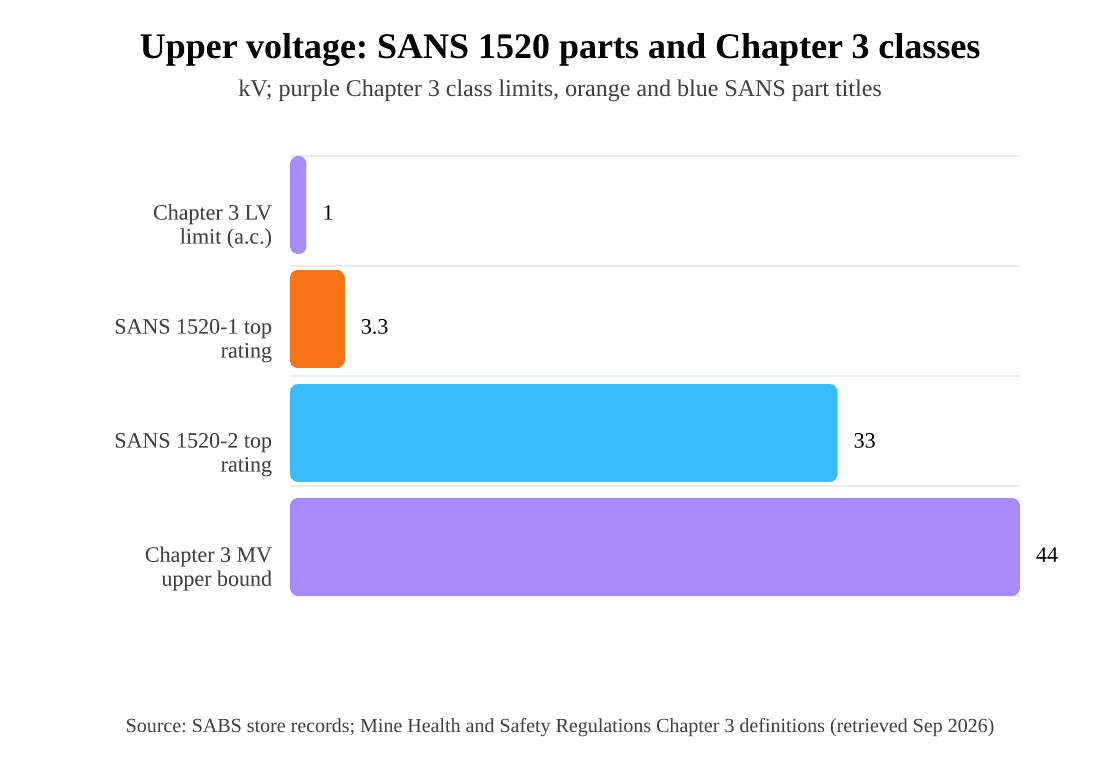
Sources: part titles from the SABS records for SANS 1520-1 and SANS 1520-2; LV and MV limits from the Chapter 3 definitions of the Mine Health and Safety Regulations. Retrieved September 2026.
How to Specify a SANS 1520 Trailing Cable
Specify a SANS 1520 trailing cable by type number, part and edition, then check it against the system voltage, the machine's protection and duty, and Chapter 3. The six checks below cover each of those points.
- Type, part and edition. Name the type number with the SANS 1520 part and edition, such as SANS 1520-1:2022 (Ed. 2.01).
- Voltage. Check the system voltage against the type's Uo/U in the table above, not against the part's label. For a dragline on a 6.6 kV system, Type 66 at 3.8/6.6 kV is the voltage match.
- Screening. Under regulation 3.24, screens must be individual or collective and earthed, and individual in a hazardous area. Confirm the screen arrangement on the type's datasheet.
- Pilot cores. Match pilot or monitoring cores to the machine's protection: Type 41 has one pilot core, and Types 61B and 66 have three each.
- Duty and bending. Type 61A covers reeling and non-reeling service, 61B is non-reeling, and 63's uses include cable-reeling systems. Minimum bending radius is 6 x OD for Types 41 and 66, and 9 x OD for 611, 622 and 633.
- Repairs and reels. Plan repairs and patches within the count and spacing limits of regulation 3.25. On self-propelled machines, regulation 3.26 calls for a reel device that cuts power while at least one complete turn remains on the reel.
Section 21 of the Mine Health and Safety Act 29 of 1996 (MHSA) places a duty on the supply side too. Designers, manufacturers, repairers, importers and suppliers must ensure, as far as reasonably practicable, that an article for use at a mine is "safe and without risk to health and safety when used properly". Such an article must also comply with all the requirements of the MHSA.

A rope shovel dipper at an open-pit mine north of Mokopane, South Africa. Photo: "VR RopeShovelDipper Cover 01" by Vrsteel webdev, CC BY-SA 4.0, via Wikimedia Commons, resized.

Frequently Asked Questions
What is SANS 1520?
SANS 1520 is the South African National Standard for flexible electric trailing cables for use in mines. SABS sells it in three parts: Part 1 for 640/1100 V and 1900/3300 V, Part 2 for 3.8/6.6 kV to 19/33 kV, and Part 3 for 1 500 V d.c.
Is SANS 1520 still current?
Yes. SABS lists all three parts as current editions on sale: SANS 1520-1:2022, SANS 1520-2:2020 and SANS 1520-3:2022. Part 2, the 3.8/6.6 kV to 19/33 kV part, was reaffirmed on 23 July 2026. Part 1's current edition replaced the 2016 edition.
What is the difference between SANS 1520-1 and SANS 1520-2?
The difference is voltage. SANS 1520-1 covers cables with operating voltages of 640/1100 V and 1900/3300 V, which its SABS abstract calls low-voltage. SANS 1520-2 covers 3.8/6.6 kV to 19/33 kV and is described as high-voltage. In Chapter 3 terms, Part 1's 1900/3300 V rating and all of Part 2 sit in the medium-voltage band.
Do trailing cables in South African mines have to be screened?
They do. Regulation 3.24 places a duty on the employer to take reasonably practicable measures so that any flexible or trailing cable is screened, individually or collectively, with the screens earthed. A cable used in a hazardous area must be screened individually. Confirm the arrangement with the mine's competent person or engineer.
How many joint repairs may a trailing cable have in a South African mine?
A trailing cable may have no more than fifteen joint repairs, including sheath patches, over a length of 200 metres, under regulation 3.25. Repairs and patches must be at least 5 metres apart and 3 metres from the plug or the terminal connection at the machine or apparatus. The duty to ensure this sits with the employer.
Enquire About SANS 1520 Cables
Send the type number, SANS 1520 part and edition, system voltage, conductor size, length, machine and duty to our engineering team through the contact page. For related designs and other standards, see the special cables guide.
About the Author
Jyen is a technical and operations engineer at TEBAOFLEX, responsible for the company's online platforms. This guide draws on the SABS records and South African legislation cited above and on TEBAOFLEX product datasheets. The SANS 1520 product pages cited are TEBAOFLEX's own; the part titles, editions and status come from SABS.
Cover photo: "ABM10 ANGLO 002" by Na derdingseben, CC BY-SA 3.0, via Wikimedia Commons, cropped.
