

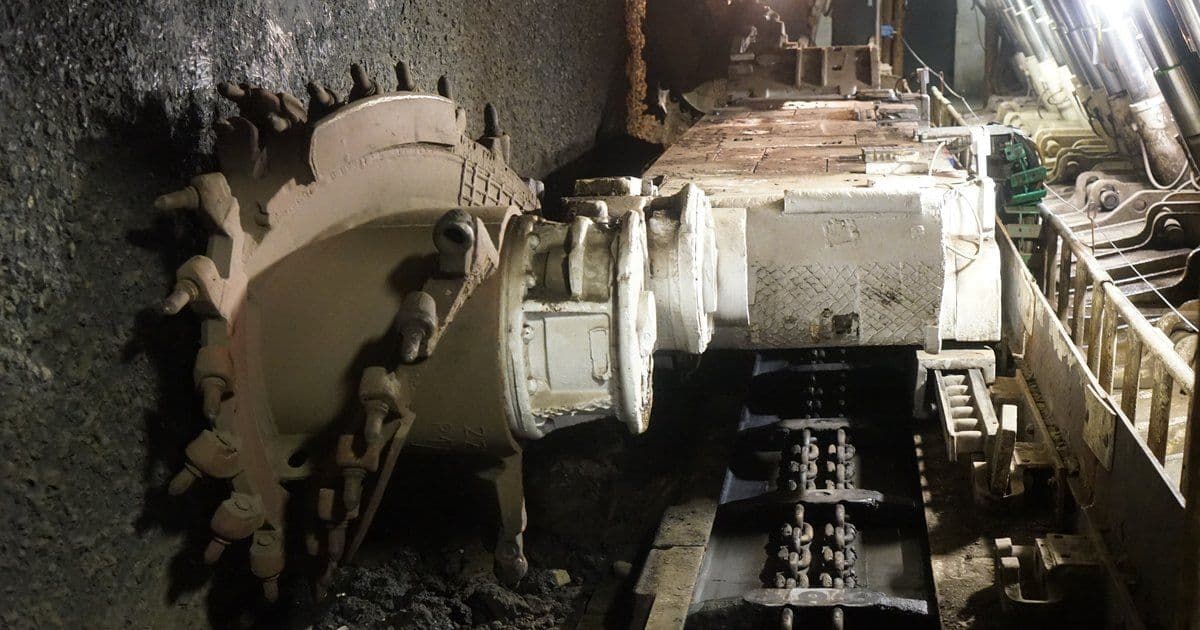
Longwall shearers, continuous miners, shuttle cars and roof bolters all run on flexible trailing cables that are dragged, reeled, run over and spliced. The cable design, the splices made in it and the way crews handle it decide how long it lasts underground.
Cable handling is a hazard in itself. A 2006 paper by the National Institute for Occupational Safety and Health (NIOSH), citing Mine Safety and Health Administration (MSHA) data, ranked moving cables third among tasks in continuous miner accidents. The data counted 847 such accidents from January 1983 to April 2004.
Rules differ by country. US underground coal mines must meet Part 75 of Title 30 of the Code of Federal Regulations (CFR). China applies its 2025 Coal Mine Safety Regulations, and Australian states apply their own rules.
Key Takeaways
- Trailing cables in US underground coal mines must be accepted or approved by MSHA as flame resistant, under 30 CFR 75.600-1.
- One temporary splice is allowed in a trailing cable under 75.603, for the next 24 hours only, but none in high-voltage trailing cables (75.810).
- On 2,400 V continuous miners, 75.830 bars splicing the high-voltage trailing cable within 35 feet (about 10.7 m) of the machine.
- Currents allowed under the federal rules as of 1994 may not keep reeled shuttle car cables below 90 °C, NIOSH researchers reported.
- In China, surface-repaired rubber cables must pass a water-immersion voltage withstand test before going underground, under the 2025 regulations.
Which Machine Takes Which Cable
Each machine needs a cable matched to its duty and voltage; US rules and China's MT 818 name the types. Our related designs are for reference only, not approved equivalents.
- Machine: Longwall shearer — Cable types named in rules or standards: US: type SHD with a centre ground-check conductor on high-voltage longwalls (75.822). China: MT 818 Parts 2 to 4, shearer cables rated 1.9/3.3 kV and below. — Our related design: AS/NZS 1802 Type 245, BS 6708 Type 7, SHD-CGC, NSSHKCGEÖU
- Machine: Continuous miner — Cable types named in rules or standards: US: Part 18 tables list G-GC (nonshielded) and SHC-GC (shielded overall) at 2,000 V and SHD-GC (individually shielded) from 2,001 to 5,000 V; 18.54(f) sets high-voltage cable construction. China: MT 818 mobile cable parts. — Our related design: SHD and SHD-CGC, Type G-GC, Type 245
- Machine: Shuttle car — Cable types named in rules or standards: US: unshielded medium-voltage cable on reel equipment if insulation is rated 2,000 V or more (75.907). China: MT 818 Part 5, mobile cables rated 0.66/1.14 kV and below. — Our related design: AS/NZS 1802 Type 275, Type G-GC
- Machine: Roof bolter or loader — Cable types named in rules or standards: US: ground and ground-check conductors in mobile equipment cables (75.906). China: MT 818 Part 5; Part 8 covers 0.3/0.5 kV drill cables. — Our related design: Type G-GC; NSSHKCGEÖU for drills
General power cable standards do not cover these cables. IEC 60502-1 from the International Electrotechnical Commission (IEC) excludes mining-industry cables, and IEC 60245-1 stops at 450/750 V.
US Rule 1: MSHA Flame-Resistance Acceptance
Every trailing cable in a US underground coal mine needs MSHA flame-resistance acceptance or approval, under 75.600 and 75.600-1. Approval follows Part 7, Subpart K, which covers electric cables, signalling cables and splice kit designs.
The 7.407 test uses three specimens, each 3 feet (about 0.9 m) long. Their power conductors carry five times their ampacity rating until they reach 400 °F (204.4 °C), then a flame is applied for 60 seconds. Burning must not last over 240 seconds, and the charred length must not exceed 6 inches (about 15 cm). Under 7.409, markings repeat at intervals of 3 feet or less and show the MSHA-assigned approval number, conductor number and size, cable type and voltage rating.
MSHA's list of flame-resistant cables accepted under Part 18, section 18.64, and Part 7, section 7.407, was last updated on 11 August 2026. Its note lets cables accepted under Part 18 still be made and sold if nothing departs from the approval documentation.
MSHA's Electrical Inspection Procedures Handbook PH26-V-1, dated August 2026, has inspectors confirm flame resistance from the embossed acceptance number. Buyers should ask for the approval number and cable type the cable will be marked with under 7.409, then confirm MSHA's list shows that number under the maker.
US Rule 2: Ground Check and Cable Construction
US rules require a fail-safe ground-check circuit, or an approved device no less effective, on resistance-grounded systems, capped at 40 V for low and medium voltage and 96 V for high voltage. At low and medium voltage, the 75.902 circuit must open the breaker if the ground or pilot check wire breaks; 75.902-1 sets the cap. Under 75.906, mobile equipment cables need ground conductors at least half the power conductor's cross-section, plus an insulated ground-check conductor or an approved equivalent device.
75.907 adds grounded metallic shields for medium-voltage trailing cables, around each power conductor or over the assembly. Reel equipment may use unshielded cable if the insulation is rated 2,000 volts or more. Our shielded cable article explains how shields and ground-check conductors work.
At high voltage, 75.803 and 75.803-1 apply. 75.804(a) adds a metallic shield around each power conductor and ground conductors totalling at least half its area. The insulated ground-check conductor must be at least No. 8 AWG (American Wire Gauge, about 8.4 mm²) if external, or No. 10 AWG (about 5.3 mm²) if internal. Medium- and high-voltage couplers under 75.805 must break the ground-check conductor first and the grounding conductors last when uncoupling.
High-Voltage Longwalls and 2,400 V Continuous Miners
Sections 75.813 to 75.822 cover high-voltage longwall circuits. Under 75.822, their cables may be type SHD with a stranded centre ground-check conductor of at least No. 16 AWG (about 1.3 mm²). The cables must be MSHA accepted or approved as flame resistant.
Sections 75.823 to 75.834 cover 2,400 volt continuous miners, whose cables meet the 75.804 ground-check rule or carry a stranded centre ground-check conductor of at least No. 16 AWG under 75.826. Machine approval under 18.54(f) adds 100 percent semiconductive tape and a grounded metallic braid over each insulated power conductor. Jackets must not be black, and a double jacket's layers must differ in colour.
MSHA's 2010 final rule, effective 7 June 2010, followed 52 petitions for modification granted since 1997. Part 18 allows approval up to 4,160 volts, but 4,160 V machines would still need a petition.
Splices: What US and Chinese Rules Allow
US rules limit temporary splices and require MSHA-accepted or approved kits for permanent ones; China sets the repair method and a water-immersion test. Under 75.603, one temporary splice may be made in any trailing cable, which may then be used only for the next 24 hours. No temporary splice may be made within 25 feet (about 7.6 m) of the machine, except on cable reel equipment.
Permanent splices under 75.604 must be mechanically strong, conductive, flexible, insulated and sealed against moisture. They must be vulcanised or otherwise treated for flame resistance and jacket bonding, and made with splice kits accepted or approved by MSHA as flame resistant.
75.810 bars temporary splices in high-voltage trailing cables. For 2,400 V continuous miners, 75.830 prohibits splicing within 35 feet of the machine and allows only four splices at a time in the 300 feet (about 91 m) outby it. Those splices must use only MSHA-approved high-voltage kits.
MSHA's 2010 final rule says the 35 feet nearest the machine take more strain, stress and handling than the rest of the cable. Granted petitions carried a four-splice limit.
In laboratory work reported in 1995, US Bureau of Mines researchers found spliced joints at rated current ran 5 to 20 °C hotter than intact cable. Accelerated life tests found the insulating tape's thermal rating deficient, and crimping tool choice affected splice strength under tension.
In China, Article 504 of the 2025 regulations requires rubber cable repairs to use flame-retardant materials, by hot vulcanising or an equally effective cold repair. Cables repaired on the surface must pass a water-immersion voltage withstand test before going underground. Article 516 bars any other use of a rubber cable's earth core, except as part of earth-circuit monitoring.
Shuttle Car Reels, Handling and Damage
Reel heat, run-overs and handling all damage shuttle car and continuous miner cables. NIOSH researchers reported that currents allowed under the federal rules as of 1994 may not keep reeled trailing cables below 90 °C. Earlier static tests by the former US Bureau of Mines found round cables could overheat at the accepted derating factors, which proved conservative for flat cables. NIOSH links shuttle car cable overheating to premature insulation failure, shock and electrocution.
MSHA's PH26-V-1 handbook has inspectors check that reels keep positive tension, just high enough to stop the machine running over its own cable. Under 75.606, trailing cables must be adequately protected against damage by mobile equipment.
On 2,400 V continuous miners, 75.827 requires guarding for 10 feet (about 3 m) from the power centre coupler and 10 feet outby the machine's last strain clamp. Guarding also applies wherever moving equipment could damage the cable, and crossovers must not be black. Under 75.833, miners may handle these energised cables only with insulated tools or high-voltage insulating gloves. The glove system must include rubber insulating gloves and leather outer protectors. Rubber gloves must be rated at least Class 1 (7,500 volts), tested every 30 days, and air-tested at the beginning of each shift; both layers must be visually inspected before each use. Alternatively, cable-handling tools must be purpose-built, rated and maintained to withstand at least 7,500 volts, and visually inspected before each use. Damaged or defective protective equipment must be removed from service as required by 75.833. These handling provisions do not authorize energized repair.
MSHA fatality reports show these hazards, with MSHA's stated causes:
- A West Virginia mine (2003): a shuttle car cable in mud and water had three undetected damaged areas, and MSHA cited poor precautions for wet electrical work and inadequate cable protection.
- A West Virginia mine (2022): a metal S-hook punctured a 480-volt roof bolter cable, and MSHA cited inadequate cable protection and cable-handling training.
Weight adds strain too: the 2006 NIOSH paper says the usual mine cable weighs 4 lb/ft (about 6 kg/m), which can cause back injuries. The chart shows the three tasks most often under way in continuous miner accidents.
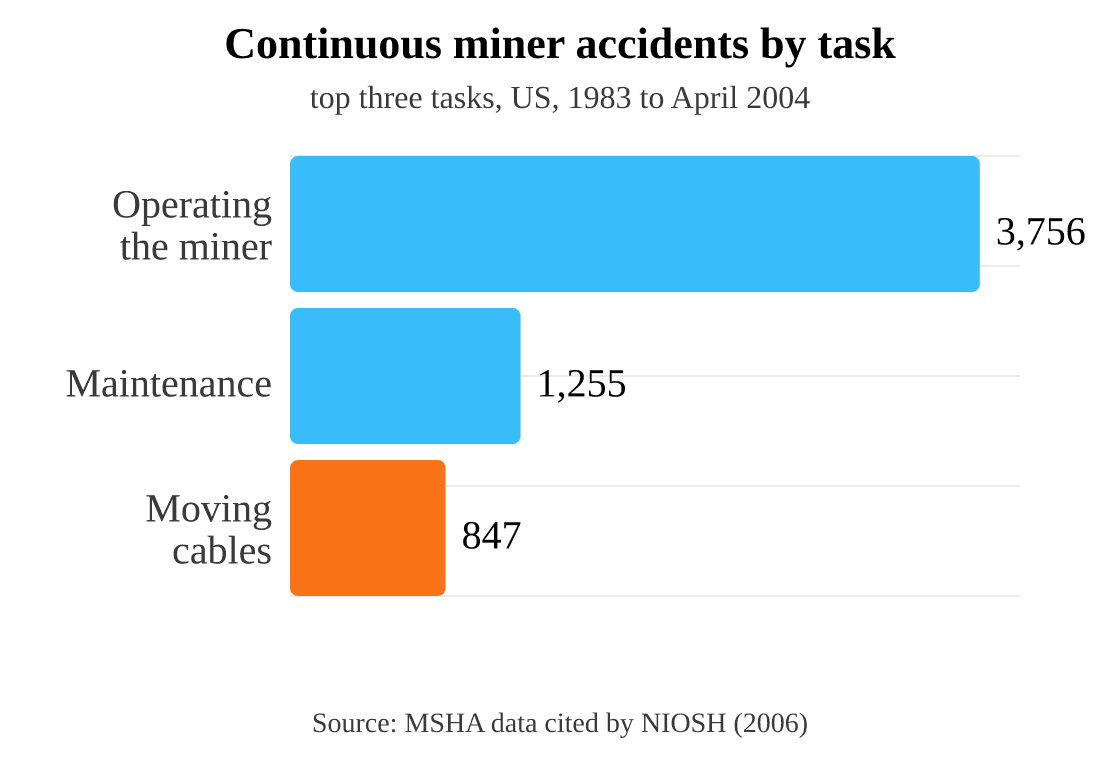
Accidents involving continuous mining machines reported in the US from January 1983 to April 2004, by the task under way: operating the machine (3,756), maintenance (1,255) and moving cables (847), out of 11,367 in total. Source: MSHA statistics cited in a 2006 NIOSH paper. Retrieved October 2026.
Chart data (readable on mobile):
- Operating the continuous miner: 3,756 accidents.
- Maintenance: 1,255 accidents.
- Moving cables: 847 accidents.
Historical US data from January 1983 to April 2004, cited by NIOSH in 2006. These are the three most frequent tasks among 11,367 reported accidents involving continuous mining machines, not current accident rates.
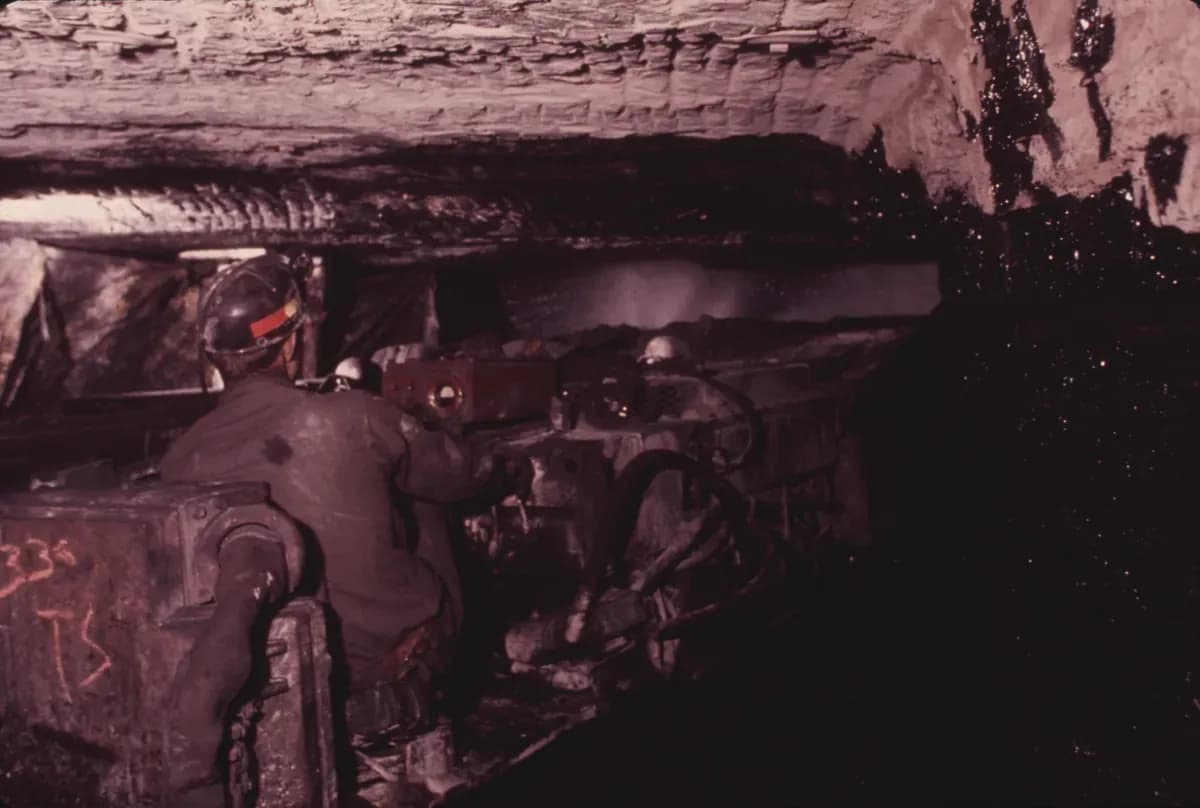
An operator at the controls of a continuous miner in a Virginia coal mine, with water sprays at the face, April 1974. Photo: Jack Corn for the US EPA DOCUMERICA project, US National Archives (NARA 556397), public domain, via Wikimedia Commons, cropped.

China: The MA Safety Mark and MT 818
Flame-retardant cables for China's coal mines must carry the coal mine product safety mark (煤矿矿用产品安全标志, often called the MA mark). Article 11 of the 2025 Coal Mine Safety Regulations, in force from 1 February 2026, requires products under safety-mark management to hold the mark. Flame-retardant cables (阻燃线缆) are item 62 in the National Mine Safety Administration's 2022 safety-mark catalogue.
Article 499 requires copper conductors, never aluminium, plus an earth conductor of sufficient section. Non-fixed high- and low-voltage cables must be coal mine rubber flexible cables, and mobile and hand-held equipment needs dedicated rubber cables.
MT 818 is China's coal mine cable series. The foreword of MT/T 818.13-2009 lists its parts:
- Part 1: general rules for mobile flexible cables.
- Parts 2 to 4: shearer flexible, screened monitored reinforced, and metal-screened cables, all rated 1.9/3.3 kV and below.
- Part 5: mobile flexible cables rated 0.66/1.14 kV and below.
- Parts 6 and 7: mobile screened cables to 8.7/10 kV and 6/10 kV.
- Parts 8 to 13: drill, light mobile, cap-lamp and fixed power cables.
China's national standards platform lists MT 818.1-2009 as mandatory and current, in force since 1 July 2010. The regulation articles cited here do not name MT 818 itself.
Australia: AS/NZS 1802 and Earth Continuity
AS/NZS 1802 is the reeling and trailing cable standard for underground coal mines, and state rules add earth-continuity protection. AS/NZS 1802:2018, listed as Pending Revision in October 2026, covers materials, construction, dimensions and tests for elastomer-insulated and sheathed cables.
In Western Australia, r 641E makes underground coal mine operators ensure trailing and reeling cables conform to AS/NZS 1802:2018. The cables need a pilot core that cuts supply if the earthing circuit breaks, and repair and testing to AS/NZS 1747:2003. Regulation 641F adds earth-continuity monitoring that disconnects supply automatically if the earth conductor breaks.
Queensland's Coal Mining Safety and Health Regulation 2017 names no cable standard, leaving selection to each mine's safety and health management system (s 188). Defective cables must be effectively repaired and tested before use (s 189(2)), unless only the outer sheath is damaged and is repaired first so a competent person judges the risk acceptable (s 189(3)). Circuits supplying these cables need earth continuity protection and a lockout earth fault current protection device (s 192(4)).
New South Wales guidance, the May 2025 electrical engineering control plan code, says cable-selection criteria should include factors such as reeling and trailing cables conforming to AS/NZS 1802 or AS/NZS 2802. Another is individual conductor screening, which the code notes has proven a reliable risk control at underground coal mines. In hazardous zones, cables other than intrinsically safe circuits must conform to AS/NZS 1802:2003 or AS/NZS 1972:2006.
Our AS/NZS 1802 page covers continuous miner, longwall and shuttle car cables. Its Type 245 datasheet describes a 1.1, 3.3 and 6.6 kV longwall shearer cable. Type 275 suits high-speed reeling on shuttle cars at 1.1 kV and is designed against corkscrewing.
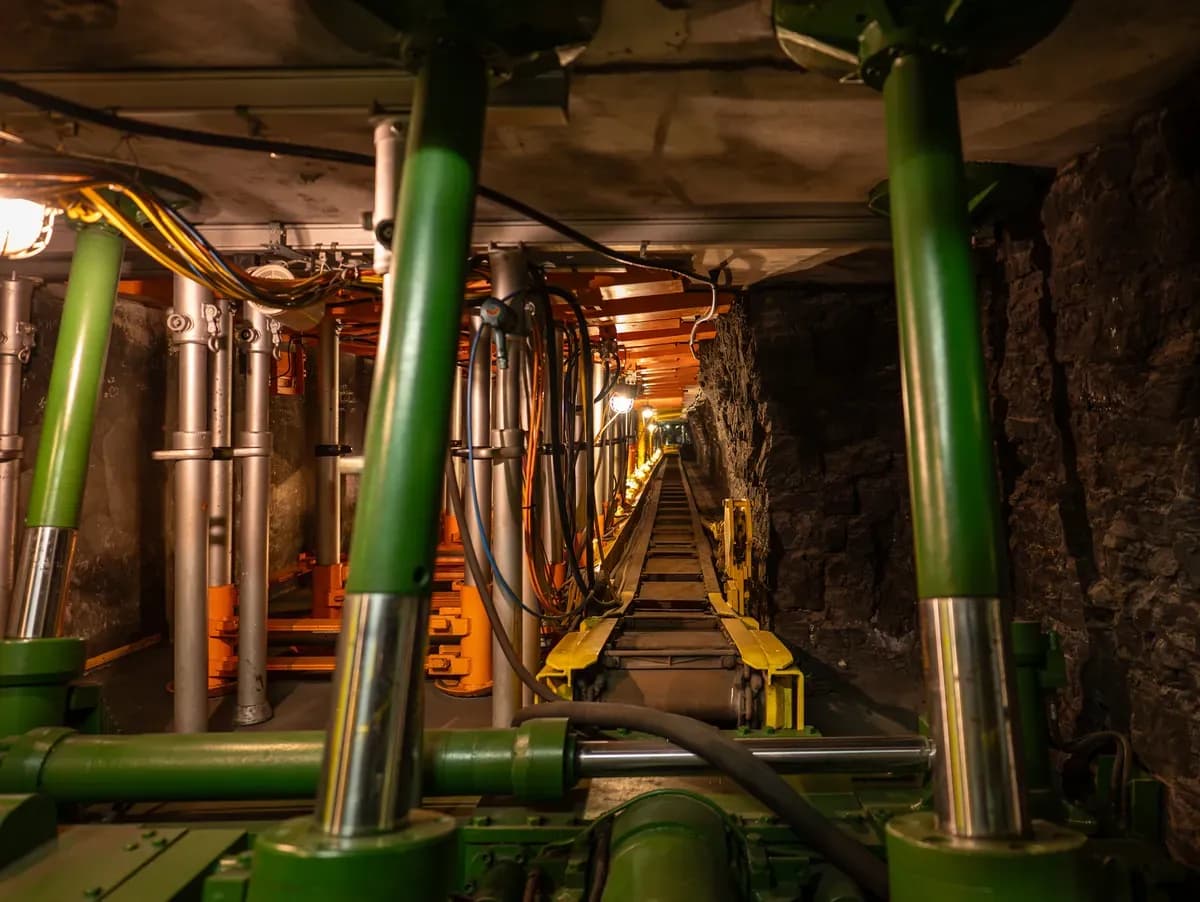
Cables and hoses slung from the roof-support canopies along a demonstration longwall face at the German Mining Museum in Bochum. Photo: "Mechanisierter-Schildausbau-Anschauungsbergwerk-Bergbaumuseum-Bochum-2025" by Tuxyso, CC BY-SA 4.0, via Wikimedia Commons, resized.

Our Underground Coal Cable Designs
Our underground coal designs cover cutters, shearers, continuous miners, shuttle cars and longwall controls, and their pages are design references, not approval certificates. Any approval a jurisdiction requires must be confirmed for the specific cable on each order.
- NSSHKCGEÖU coal cutter cable: a 0.6/1 kV cutter and drill cable with monitoring cores, steel and copper armour and a 5GM5 sheath.
- BS 6708 Type 7: screened 640/1100 V cables for coalcutters, shearers and roadheaders, with braided screens on ethylene propylene rubber (EPR) cores, an unscreened pilot and a central bare earth.
- SHD and SHD-CGC: 2 kV and 5 kV shielded cables with three power cores, flat or round. The SHD-CGC datasheets list a 16 AWG ground-check conductor with yellow polypropylene insulation and a black CPE jacket as standard.
- Type G-GC: a round three-conductor 2 kV portable cable with EPR insulation, two grounding conductors, a ground-check conductor and a reinforced chlorinated polyethylene (CPE) jacket.
- (N)3GHSSHCH: a 3.6/6 kV to 18/30 kV mining design with concentric protective conductors, monitoring and pilot cores, galvanised steel-wire braid armour between halogen-free flame-retardant (HFFR) inner and outer sheaths.
- Longwall signal cable: a 50 V control and monitoring cable with 2 to 9 conductors from AWG 18 to 10, rated +90 °C, in a black or orange thermoplastic polyurethane (TPU) sheath.
Our Type 241.1 video shows a flexible multi-core cable alongside mobile mining equipment. Its page notes that final voltage, construction and approvals need project review.
How to Specify a Shearer or Continuous Miner Cable
Specify the cable by fixing the machine, rules and construction first, then the duty, splices, handling and documents. Related designs sit in our mining and tunnelling range.
- Machine, duty and voltage class. Name the machine, its duty and its voltage class, using the 75.2 bands in US mines.
- Jurisdiction and approval mark. State the mark needed: MSHA acceptance in the US, the MA mark in China or AS/NZS 1802 conformity in Western Australia.
- Construction. Set shielding, grounding and ground-check conductors, with US check voltage within the 40 V or 96 V cap.
- Reel or trailing duty. Say whether the cable reels, because NIOSH reported that currents allowed as of 1994 may not keep reeled cables below 90 °C.
- Lengths and splice plan. Plan lengths so splices stay within 75.603, 75.810 or 75.830, whichever applies.
- Jacket and colour. Specify the jacket compound and colour; under 18.54(f), jackets on 2,400 V continuous miner cables must not be black. Our SHD-CGC and Type 245 datasheets list black jackets, so state a non-black colour for that duty.
- Handling and guarding. Plan reel tension and cable protection under 75.606; on 2,400 V continuous miners, add guarding and crossovers under 75.827 and Class 1 gloves under 75.833.
- Tests and documents. Ask for test reports and approval documents, and name the repair standard, such as AS/NZS 1747:2022. It covers repair and testing of reeling, trailing and feeder cables in underground coal, metalliferous and open cut mines, tunnelling, quarries and dredges. Western Australia's r 641E still cites the 2003 edition.
Frequently Asked Questions
What cable does a continuous miner use?
Continuous miner cables vary with voltage and jurisdiction. US Part 18 tables list G-GC (nonshielded) and SHC-GC (shielded overall) at 2,000 volts and SHD-GC (individually shielded) up to 5,000 volts, and 18.54(f) sets the cable construction for high-voltage continuous miners. China's MT 818 and Australia's AS/NZS 1802 define their own types.
Does a mining trailing cable need MSHA approval?
Yes, in US underground coal mines. 30 CFR 75.600-1 requires trailing cables to be accepted or approved by MSHA as flame resistant, and inspectors check the embossed acceptance number on the cable. Other countries use their own schemes, such as China's MA mark.
How many splices are allowed in a trailing cable?
Under 75.603, any trailing cable may have one temporary splice, then be used for the next 24 hours only. 75.810 bans temporary splices in high-voltage trailing cables. On 2,400 V continuous miners, 75.830 allows only four splices at a time in the 300 feet outby the machine, and none within 35 feet.
What voltage ratings do shearer cables have?
Shearer cable ratings vary by standard and design: China's MT 818 shearer parts cover cables rated 1.9/3.3 kV and below, while our AS/NZS 1802 Type 245 datasheet lists 1.1, 3.3 and 6.6 kV. US rules treat anything above 1,000 V as high voltage, with separate rules for high-voltage longwalls in 75.813 to 75.822.
Why do shuttle car cables overheat?
Reeled cables can overheat because tightly wound turns, all carrying current in an enclosed space, shed heat poorly. NIOSH researchers reported that currents allowed under the federal rules as of 1994 may not keep reeled cables below 90 °C. Overheating has long been known to cause premature insulation failure on shuttle cars.
What is the MA mark for coal mine cables?
The MA mark is China's coal mine product safety mark. Article 11 of the 2025 Coal Mine Safety Regulations requires products under safety-mark management to hold it. The 2022 catalogue lists flame-retardant cables as item 62.
Enquire About Underground Mining Cable
Send our engineering team the machine type, voltage, grounding and ground-check arrangement through the contact page. Include the conductor size, lengths and splice plan, reel or trailing duty, and the approval mark your jurisdiction requires.
About the Author
Jyen is a technical and operations engineer at TEBAOFLEX, responsible for the company's online platforms. This guide draws on US federal mine safety regulations, MSHA approval lists, handbooks and accident reports, NIOSH and US Bureau of Mines research, China's coal mine safety regulations and standards records, Australian regulations and guidance, standards catalogue records and TEBAOFLEX product datasheets. The product pages cited are TEBAOFLEX's own; requirements quoted from regulators and standards bodies describe their scope, not certification or approval of our products.
Cover photo: "2025-10-04 Walzenschrämlader, Bergwerk Guido, Zabrze" by Rudolf H. Boettcher, CC BY-SA 4.0, via Wikimedia Commons, cropped.
