

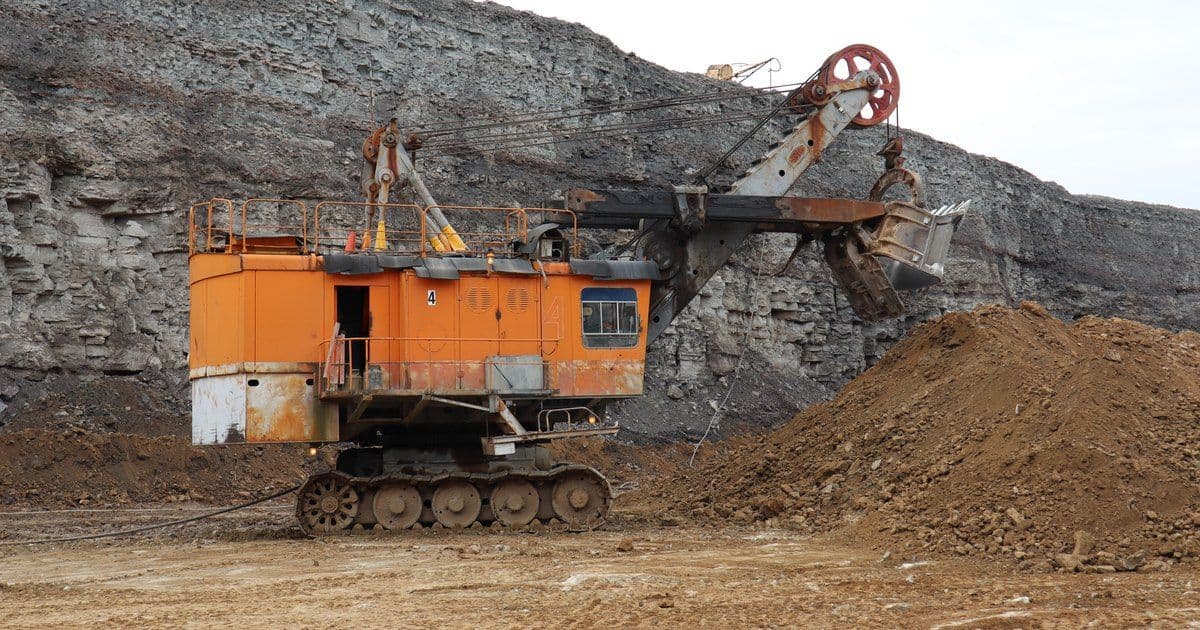
Electric shovels and draglines draw medium voltage (MV) power from a switch house through a trailing cable that moves with the machine. It carries shielded phase conductors, grounding conductors and usually a ground-check conductor, and must survive dragging, reeling and repeated splices.
A 2006 accident report from the Mine Safety and Health Administration (MSHA) describes such a system at a surface coal mine in Arizona. An electrician troubleshooting the dragline's locked-out trailing cable there was killed after on-board breakers were closed together, back-feeding about 23 kV through the dragline's transformers into the cable.
This guide compares two design families. Our Type SHD-GC datasheet references Insulated Cable Engineers Association (ICEA) standard S-75-381. Our (N)TSCGEWÖU-type datasheets reference DIN VDE 0250-813, a German standard that carries both Deutsches Institut für Normung (DIN) and Verband der Elektrotechnik Elektronik Informationstechnik (VDE) numbers.
Under Title 30 of the US Code of Federal Regulations (CFR), Part 77 covers surface coal mines plus surface work areas of underground coal mines; Part 56 covers surface metal and nonmetal mines.
Key Takeaways
- Most mine power cable bought by US surface mines in 1980 was Type SHD-GC, a contract study for the US Bureau of Mines (USBM) reported.
- Under 30 CFR 77.803, high-voltage resistance-grounded systems at US surface coal mines need a fail-safe ground-check circuit, or an approved device no less effective.
- Surplus shovel cable at US metal and nonmetal surface mines must be stored in cable boats or on machine reels, or otherwise protected, under 30 CFR 56.12039.
- Peru requires qualified staff to test permanent trailing cable splices for continuity and insulation before use, under Art 363 g).
- In Western Australia (WA), regulation 641E makes the mine operator ensure trailing and reeling cables include a pilot core that cuts supply if the earthing circuit breaks.
How Shovels and Draglines Get Their Power
In the system MSHA's 2006 report describes, power reached the dragline through a substation, a switch house, junction boxes and the trailing cable. A 69 kV supply fed a 10 MVA substation, which sent out a 23 kV resistance-grounded circuit.
In the same report, the switch house held two 25 kV vacuum circuit breakers and a pilot-wire ground-check monitor watching the grounding conductor to the dragline frame. Junction boxes stood about 1,500 feet (about 460 m) apart over roughly 7,500 feet (about 2.3 km), so cable could be added or removed as needed. On board, collector rings fed two 5,000 kVA transformers that stepped 23 kV down to 7,200 V for the 1,000 horsepower motors.
A 1980 field survey for the USBM covered 19 coal, 29 metal and nonmetal, and 2 sand and gravel mines. Voltages ran from 2,400 V to 22,900 V, most often 4,160 V or 7,200 V. Powered take-up reels were most common on large electric shovels, draglines and blasthole drills.
At US metal and nonmetal surface mines, 30 CFR 56.12039 covers surplus trailing cable to shovels, cranes and similar equipment. It must be stored in cable boats or on machine-mounted reels, or otherwise protected from mechanical damage. Peru's mine safety regulation, DS 024-2016-EM, sets the same options in Art 360 h).
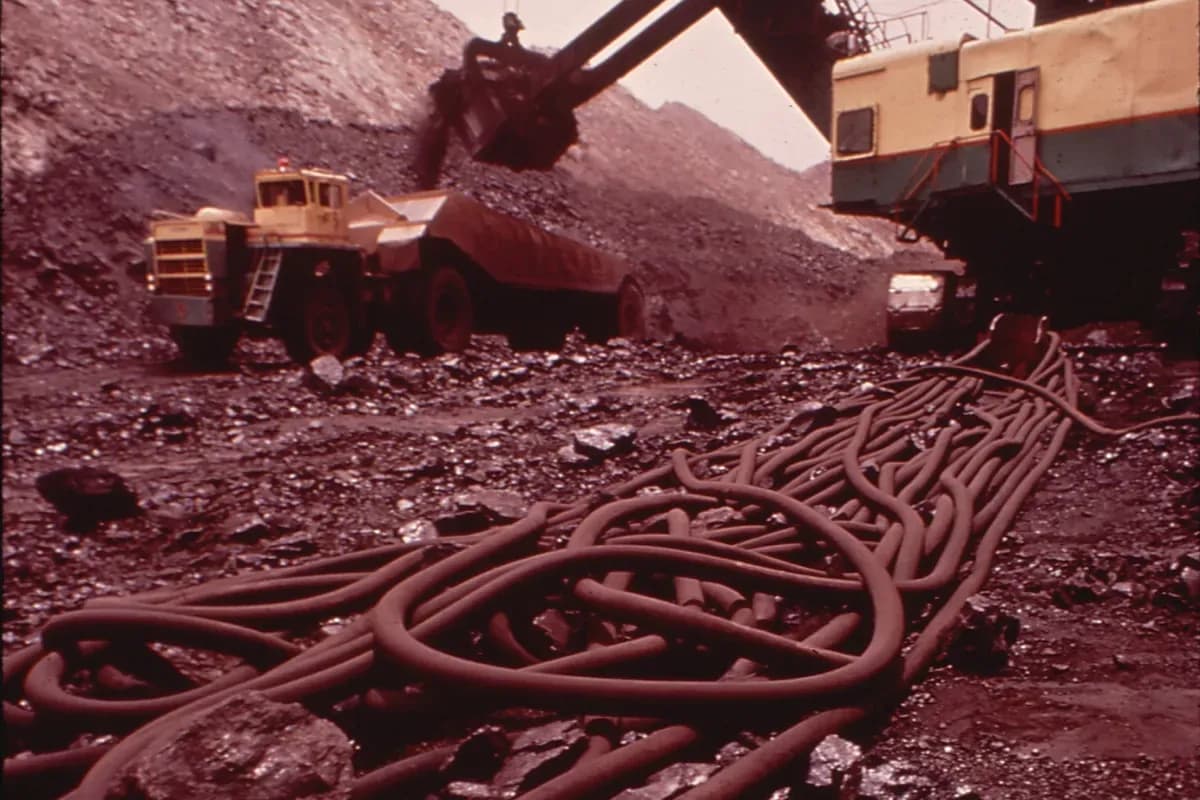
Coils of trailing cable on the pit floor as an electric shovel loads a haul truck at a US strip mine, May 1972; the archive record calls the machine a dragline. Photo: Lyntha Scott Eiler for the US EPA DOCUMERICA project, US National Archives (NARA 544165), public domain, via Wikimedia Commons, cropped.

SHD-GC: The ICEA Design
SHD-GC is a mine power cable with individually shielded phase conductors, ground conductors and a ground-check conductor, as a 1980 USBM study described it. The ICEA documents page lists S-75-381, the standard our datasheet references, jointly with WC 58 from the National Electrical Manufacturers Association (NEMA). Their shared title is "Portable and Power Feeder Cables for Use in Mines and Similar Applications".
Our SHD-GC cable datasheet lists 2, 5, 8, 15 and 25 kV classes for mobile mining machines, including shovels, draglines and dredges. Each phase conductor has flexible rope-lay stranding of tinned copper inside a helically applied semiconductive tape. Ethylene propylene rubber (EPR) insulation, resistant to heat, moisture and ozone, sits under a semiconductive tape and composite fibre/copper braid shield.
Alongside the phases run two grounding conductors and a ground-check conductor with yellow polypropylene insulation. The jacket is reinforced chlorinated polyethylene (CPE) in a heavy- or extra-heavy-duty grade, or an extra-heavy-duty thermoplastic polyurethane (TPU). Minimum bending radius is 6 x overall diameter (OD), and maximum conductor temperature is 90 °C. Listed references include ICEA S-75-381 / NEMA WC 58 and Canada's CAN/CSA-C22.2 No. 96.
(N)TSCGEWÖU: The DIN VDE 0250-813 Design
Our (N)TSCGEWÖU-type cables (also written NTSCGEWOEU), from (N)TSCGECEWÖU to (N)TSCGEH3S, reference VDE 0250 Part 813 on their datasheets. DIN Media lists DIN VDE 0250-813 as the 1985-05 edition, status Current, titled "Cables, wires and flexible cords for power installation; trailing cable" (German "Leitungstrosse").
Our (N)TSCGECEWÖU page describes an individually screened family for mine power, with a tinned copper braid on each phase core serving as screen and protective earth. The red base version, rated 3.6/6 kV to 12/20 kV, has no ground-check conductor and suits fixed or semi-flexible distribution in mines.
For draglines and shovels, the trailing and reeling cables are the yellow -ATB and -GCC versions, both with an anti-torsion braid. The -GCC versions add a pair of copper earth cores and a copper ground-check core for an earth-continuity monitor. Datasheet test voltages are 6, 11, 17, 24 and 29 kV for the 1.8/3, 3.6/6, 6/10, 8.7/15 and 12/20 kV ratings.
Our NTSCGEWÖU reeling cable, aimed at draglines, excavators and other big earth-moving machines, runs from 1.8/3 kV to 12/20 kV. Three field-controlled phase cores, a three-section protective earth and an anti-torsion braid sit inside its red rubber sheath.
Our (N)TSCGEH3S page describes an MV trailing cable with a polyurethane (PUR) sheath for shovels and draglines. Its self-luminous version adds a powered electroluminescent element under a transparent sheath and stays flexible down to -50 °C.
Our (N)TMCGETMPU page, which names no cable standard, describes a round three-conductor cable for continuous reeling on shovels, draglines, dredges and drills. Like SHD-GC, it carries two grounding conductors and an insulated ground-check conductor.
Comparing Our MV Trailing Cable Designs
SHD-GC, (N)TMCGETMPU and the -GCC versions carry a ground-check conductor, (N)TSCGEH3S carries a pilot conductor, and sheaths and bending radii vary. Table values come from our datasheets and product pages.
- Feature: Standard referenced — SHD-GC: ICEA S-75-381 / NEMA WC 58 — (N)TSCGECEWÖU-ATB / -GCC: VDE 0250 Part 813 — (N)TMCGETMPU: Not given on our page — (N)TSCGEH3S: Based on DIN VDE 0250-813
- Feature: Voltage classes — SHD-GC: 2, 5, 8, 15 and 25 kV — (N)TSCGECEWÖU-ATB / -GCC: -ATB: 3.6/6 to 12/20 kV; -GCC: 1.8/3 to 12/20 kV — (N)TMCGETMPU: 6/10, 8.7/15 and 14/25 kV — (N)TSCGEH3S: 3.6/6 and 6/10 kV (luminescent datasheet)
- Feature: Phase screen — SHD-GC: Semiconductive tape and composite fibre/copper braid — (N)TSCGECEWÖU-ATB / -GCC: Copper braid per core, also protective earth — (N)TMCGETMPU: Semiconductive conductor and insulation screens — (N)TSCGEH3S: Semiconductive layers
- Feature: Earth or grounding — SHD-GC: Two grounding conductors — (N)TSCGECEWÖU-ATB / -GCC: Core braids; -GCC adds two copper earth conductors — (N)TMCGETMPU: Two flexible grounding conductors — (N)TSCGEH3S: Split earth conductors, semiconductive rubber
- Feature: Ground check or pilot — SHD-GC: Yellow-insulated ground-check conductor — (N)TSCGECEWÖU-ATB / -GCC: Copper ground-check conductor (-GCC) — (N)TMCGETMPU: Insulated ground-check conductor — (N)TSCGEH3S: EPR-insulated pilot conductor
- Feature: Sheath — SHD-GC: CPE or TPU — (N)TSCGECEWÖU-ATB / -GCC: Yellow abrasion-resistant rubber; polyester anti-torsion braid on both — (N)TMCGETMPU: Extra-heavy-duty TPU — (N)TSCGEH3S: PUR; transparent orange on the luminescent version
- Feature: Minimum bending radius — SHD-GC: 6 x OD — (N)TSCGECEWÖU-ATB / -GCC: 6 x OD fixed, 10 x OD flexed (both) — (N)TMCGETMPU: 4 x OD fixed; 7.5 x OD on drum or free-bending — (N)TSCGEH3S: 6 x OD fixed; 10 x OD flexible
Plotted below for our SHD-GC 3 x 4/0 American Wire Gauge (AWG) cable, overall diameter rises from 58.7 mm at 2 kV to 88.9 mm at 25 kV. For the same size, higher classes need larger drums and sheaves at 6 x OD.
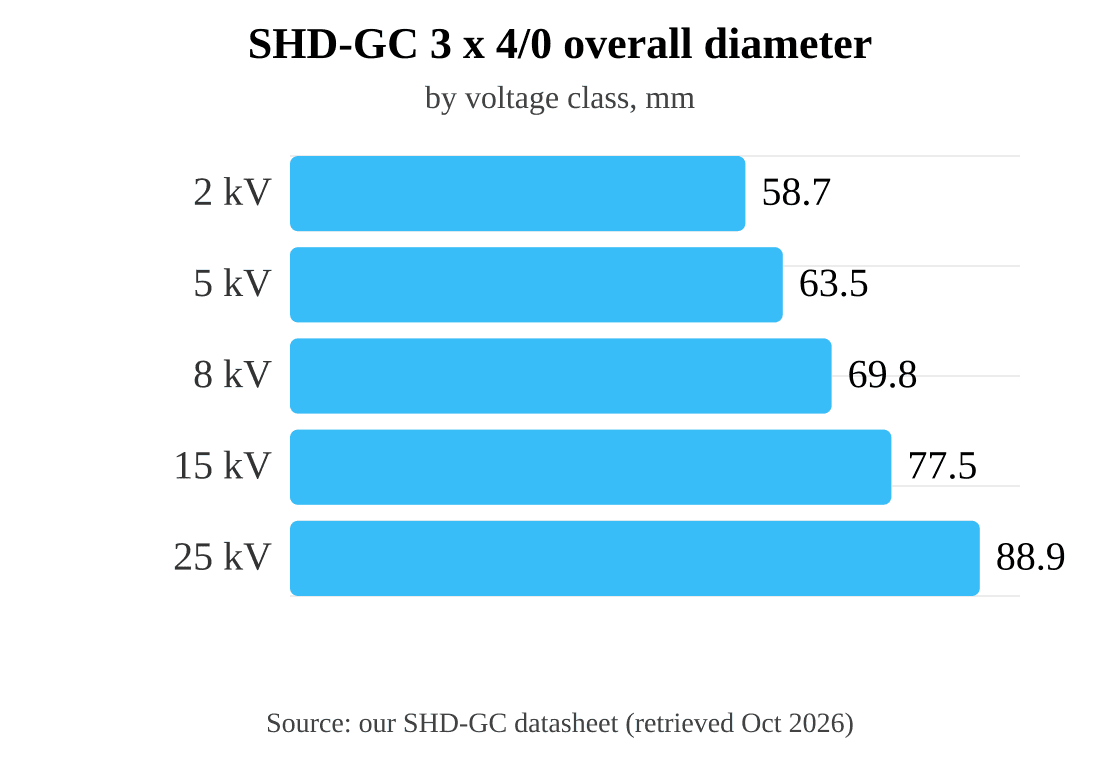
Overall diameter of the SHD-GC 3 x 4/0 AWG construction at each voltage class on our datasheet: 58.7 mm at 2 kV, 63.5 mm at 5 kV, 69.8 mm at 8 kV, 77.5 mm at 15 kV and 88.9 mm at 25 kV. At the datasheet minimum bending radius of 6 x overall diameter, that is about 352 mm, 381 mm, 419 mm, 465 mm and 533 mm. Source: our SHD-GC datasheet, retrieved October 2026.
Chart data (readable on mobile):
- 2 kV: overall diameter 58.7 mm; minimum bending radius approximately 352 mm.
- 5 kV: overall diameter 63.5 mm; minimum bending radius 381 mm.
- 8 kV: overall diameter 69.8 mm; minimum bending radius approximately 419 mm.
- 15 kV: overall diameter 77.5 mm; minimum bending radius 465 mm.
- 25 kV: overall diameter 88.9 mm; minimum bending radius approximately 533 mm.
Values are for the SHD-GC 3 x 4/0 AWG construction in our datasheet. Minimum bending radius is calculated as 6 x overall diameter; these are radius values, not drum diameters.
Ground Check: What the Rules Require
US surface coal and WA rules require ground-check or earth-continuity monitoring, Peru allows an alternative, and Part 56 has no ground-check monitor rule like 77.803.
Part 77: US Surface Coal Mines
- 77.803: high-voltage resistance-grounded systems need a fail-safe ground-check circuit, or an approved device no less effective, that opens the breaker if the ground or ground-check wire breaks.
- 77.803-1: the ground-check circuit voltage must not exceed 96 volts.
- 77.804(a): high-voltage trailing cables in resistance-grounded systems need a metallic shield around each power conductor, ground conductors totalling at least half the power conductor's area, and an insulated ground-check conductor.
- 77.805(a)(4): with pilot check circuits, couplers must break the ground-check conductor first and the ground conductor last.
- 77.800-1: breaker tests, at least monthly, must include breaking ground-check continuity where monitoring is used.
Our SHD-GC datasheet lists a metallic shield on each phase and an insulated ground-check conductor. The -GCC datasheets list a copper ground-check conductor without saying it is insulated, and the base (N)TSCGECEWÖU has none. Our (N)TMCGETMPU and (N)TSCGEH3S pages list semiconductive phase screens only. For any design, check all three 77.804(a) elements, including ground-conductor area, for the ordered size. An external ground-check conductor must be at least No. 8 AWG (about 8.4 mm²) with insulation rated at least 600 volts, under 77.804(a).
Part 56: US Metal and Nonmetal Mines
Part 56 instead requires frame grounding or equivalent protection for mobile equipment on trailing cables, under 56.12027. Grounding systems must be tested for continuity and resistance immediately after installation, repair and modification, then annually, under 56.12028.
Western Australia and Peru: Earth Continuity
In WA, r 641E(b) makes the mine operator ensure trailing and reeling cables have a pilot core, and r 641F requires earth-continuity monitoring that cuts supply automatically if the earth conductor breaks. WorkSafe WA guidance advises manual reset after a fault, plus tests every three months at surface operations and monthly at quarries, dredges and underground mines.
Under Peru's Art 363 a), open-pit drills, electric shovels and compressors above 40 horsepower need earth-fault protection with source-side earth-conductor monitoring. Alternatively, an external earth conductor of equivalent capacity can bond the machine to the earth grid. Where practicable, earth discharges must not exceed 100 volts.
Handling and Protecting Cable on the Bench
Protect cable on the bench from mobile equipment, and handle it with insulated gear when energised. At US surface coal mines, 77.604 requires trailing cables to be adequately protected from damage by mobile equipment. Under 77.606, only people wearing protective rubber gloves may handle energised trailing cables above 660 volts, which Part 77 calls medium and high voltage. For high-voltage cables, 77.606-1 requires lineman's gloves rated at least 20,000 volts.
At metal and nonmetal mines, 56.12005 bars running mobile equipment or dragging loads over power conductors unless they are properly bridged or protected. Above 150 volts phase-to-ground, energised cables may be moved with equipment only on insulated sleds or slings, under 56.12014. Manual moves need insulated hooks, tongs, ropes or slings unless other means give suitable protection. The rule still lets a machine drag its own cable when the cable is mechanically attached and insulated from it.
MSHA's dragline training module says to move cable with the bucket only on slings, and to take several loops rather than pull long lengths. Peru's Art 271 e) requires staff handling trailing cables to use dielectric rubber gloves or insulated hooks.
Dragging cable over rough ground wears the jacket and causes rock cuts and possible kinks, the 1980 USBM study warned. It blamed nylon rope and small-radius equipment for damage at most sites, and advised hoisting with a 'D' ring or cradle that keeps the minimum radius.
A 2020 MSHA report describes a fatal accident at a Georgia surface sand mine with a 4,160 V dredge supply. A bulldozer had damaged the surplus trailing cable to the dredge while miners relocated the sand line. MSHA cited 56.12039(c): that surplus cable lay openly on the pond shore, unprotected against mechanical damage.
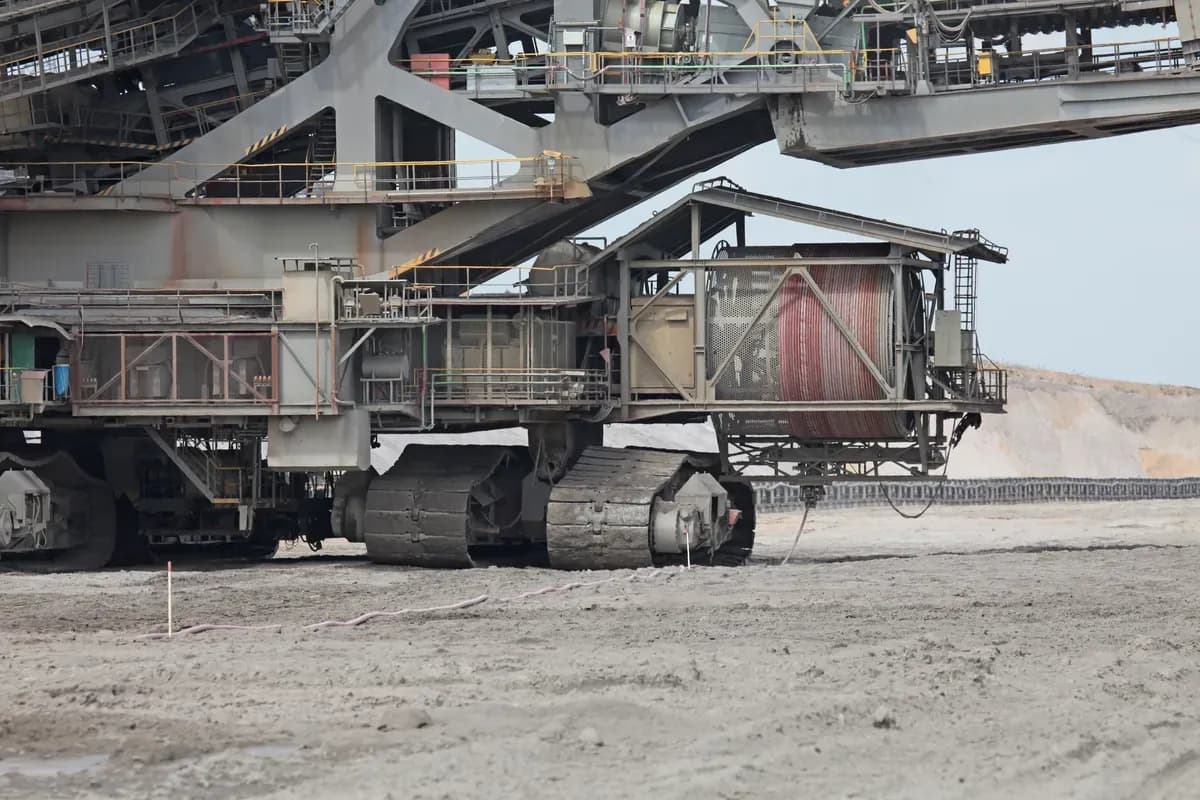
A machine-mounted cable drum on a crawler spreader, with the supply cable running along the ground. Photo: "Kabeltrommel für das Elektrokabel, über das der Absetzer 761 für den Betrieb mit Strom versorgt wird" by Smokeyharry, CC BY-SA 4.0, via Wikimedia Commons, resized.

Splices and Repairs
A damaged trailing cable can be spliced, provided the splice restores its strength, insulation, seal and continuity. At US surface coal mines, 77.602 requires permanent splices to be mechanically strong, conductive, insulated, sealed against moisture and vulcanised or otherwise bonded to the outer jacket. Splices in high-voltage cables must also keep all components continuous, under 77.804(b). Vulcanising was the most widely used repair method in the 1980 USBM study.
At metal and nonmetal mines, 56.12013 covers permanent splices and repairs, ground conductor included. They must be mechanically strong, with conductivity and damage protection near the original, insulation at least equal to it, a moisture seal and good bonding to the jacket.
Peru's Art 363 g) adds testing: qualified staff must test each permanent splice for continuity and insulation before it goes into service. Records of repairs and tests stay at the production unit.
Chile's mine safety regulation, DS 132, requires every cable repair to restore conductivity, insulation and protective covers faithfully (Art 423). Under Art 466, joints need welding or mechanical connectors no weaker or less conductive than the conductor, insulated like the better-insulated conductor.
In the 2020 MSHA case, none of the crew who spliced the damaged dredge cable were certified electricians, and their splice gave the wrong phase rotation. The mine superintendent died while correcting it inside the 4,160 V enclosure, whose incoming supply MSHA found had not been de-energised and locked out.
Trailing Cable Rules in Chile, Peru and Western Australia
Chile, Peru and WA add their own trailing cable rules on construction, inspection, handling and documents. Chile's DS 132, published in 2004, requires cables feeding shovels, cranes, drills and other major machines to have standard insulation and protection for that purpose (Art 262). They must not be left where vehicles can run over or damage them.
Art 265 bans moving, laying out or handling shovel and drill feed cables, or other high-voltage cables, with unsuitable equipment. Work on portable cables, such as those of drills, shovels and lifting equipment, needs the power off and lockout applied (Art 448). Art 30 requires technical and operating specifications in Spanish for all equipment and supplies.
Peru's DS 024-2016-EM defines medium voltage as 1 kV to 35 kV (Art 7). Under Art 271 d), an electric shovel needs its earth connection in optimum condition, inspected daily, and a trained, authorised electrician inspects its electrical parts and trailing cables. Art 363 a) 1 requires portable power cables suited to the equipment, its operating needs and the maker's recommendations.
In WA, r 641E requires the mine operator to ensure trailing and reeling cables conform to AS/NZS 2802:2000, or AS/NZS 1802:2018 at underground coal mines. Repairs and tests must follow AS/NZS 1747:2003. Our AS/NZS 2802 page lists reeling and trailing cables from 1.1/1.1 kV to 33/33 kV for draglines, shovels, excavators and drills.
How to Specify a Shovel or Dragline Trailing Cable
Specify a shovel or dragline trailing cable by working from system and jurisdiction to design, handling and documents.
- System voltage and grounding. State the nominal voltage and grounding method; on the feeder side, our Type MP-GC family covers stationary and semi-portable routes.
- Jurisdiction. Name the rule set: Part 77 or 56 in the US, WA r 641E, Chile's DS 132 or Peru's DS 024-2016-EM.
- Design family and standard. Name SHD-GC, a (N)TSCGEWÖU-type design or, for WA, an AS/NZS 2802:2000 type, with its standard; International Electrotechnical Commission (IEC) standard 60502-2, for fixed installations, excludes mining-industry cables.
- Ground check. Choose an internal or external ground-check conductor, confirm couplers break it first, and keep the circuit at 96 volts or less where 77.803-1 applies.
- Sheath and bending radius. Match sheath to duty and drums to radius: our 8 kV SHD-GC 3 x 4/0 is 69.8 mm OD, so 6 x OD gives a minimum bending radius of about 419 mm.
- Lengths and splice plan. Plan lengths and splices around junction box spacing, about 1,500 feet (about 460 m) in the 2006 MSHA case.
- Reel, boat or sled. Say whether the cable reels on the machine, lies in cable boats or moves on insulated sleds.
- Tests and documents. Ask for factory test reports against the ordered specification, like the 2,500 V insulation-resistance test in our insulation test video, plus Spanish specifications for Chile.
Frequently Asked Questions
What is SHD-GC cable?
SHD-GC is a mine power cable with individually shielded phase conductors, ground conductors and a ground-check conductor; our datasheet references ICEA S-75-381 / NEMA WC 58 for it. Most mine power cable bought by US surface mines in 1980 was SHD-GC, a USBM study of that year reported.
What voltage do electric shovels and draglines use?
The 50 US surface mines in a 1980 USBM survey ran at 2,400 V to 22,900 V, most often 4,160 V or 7,200 V. MSHA's 2006 report describes a 23 kV dragline circuit with 7,200 V motors. Part 77 treats anything above 1,000 volts as high voltage.
Is a ground-check conductor mandatory?
Yes for high-voltage trailing cables in resistance-grounded systems at US surface coal mines, where 30 CFR 77.804(a) requires an insulated ground-check conductor or an external one. Part 56 has no ground-check monitor rule like 77.803. WA operators must ensure a pilot core; Peru allows an external earth conductor instead.
Can a damaged shovel trailing cable be spliced?
Yes, if the splice restores strength, insulation, moisture seal and continuity. Under 77.602, US surface coal mines also require permanent splices to be vulcanised or otherwise bonded to the jacket. Peru requires qualified staff to test each permanent splice for continuity and insulation before service.
What is the difference between SHD-GC and (N)TSCGEWÖU?
Our SHD-GC datasheet references ICEA S-75-381 and lists separate grounding and ground-check conductors, while our (N)TSCGEWÖU-type datasheets reference DIN VDE 0250-813. On our (N)TSCGECEWÖU cables, a copper braid on each phase is screen and earth, and -GCC versions add a ground-check conductor. DIN Media lists the 1985-05 edition as current.
How should an energised trailing cable be moved?
Use insulated equipment. At metal and nonmetal mines, cables above 150 volts phase-to-ground need insulated sleds or slings when other equipment moves them, and insulated hooks, tongs, ropes or slings by hand, under 56.12014. US surface coal mines require rubber gloves above 660 volts under 77.606.
Enquire About Mining Trailing Cable
Send our engineering team the machine type, system voltage and grounding, ground-check arrangement, conductor size, lengths and junction box spacing through the contact page. Add reel or trailing duty, ambient temperature and the applicable rules, and browse our mining and tunnelling cable range.
About the Author
Jyen is a technical and operations engineer at TEBAOFLEX, responsible for the company's online platforms. This guide draws on US federal mine safety regulations, MSHA accident reports and training material, a US Bureau of Mines study, Chilean and Peruvian mine safety regulations, Western Australian regulations and guidance, standards catalogue records and TEBAOFLEX product datasheets. The product pages cited are TEBAOFLEX's own; requirements quoted from regulators and standards bodies describe their scope, not certification of our products.
Cover photo: "Narva mine rope shovel" by Siim Roov, CC BY-SA 4.0, via Wikimedia Commons, cropped.
