
Video
What the video shows
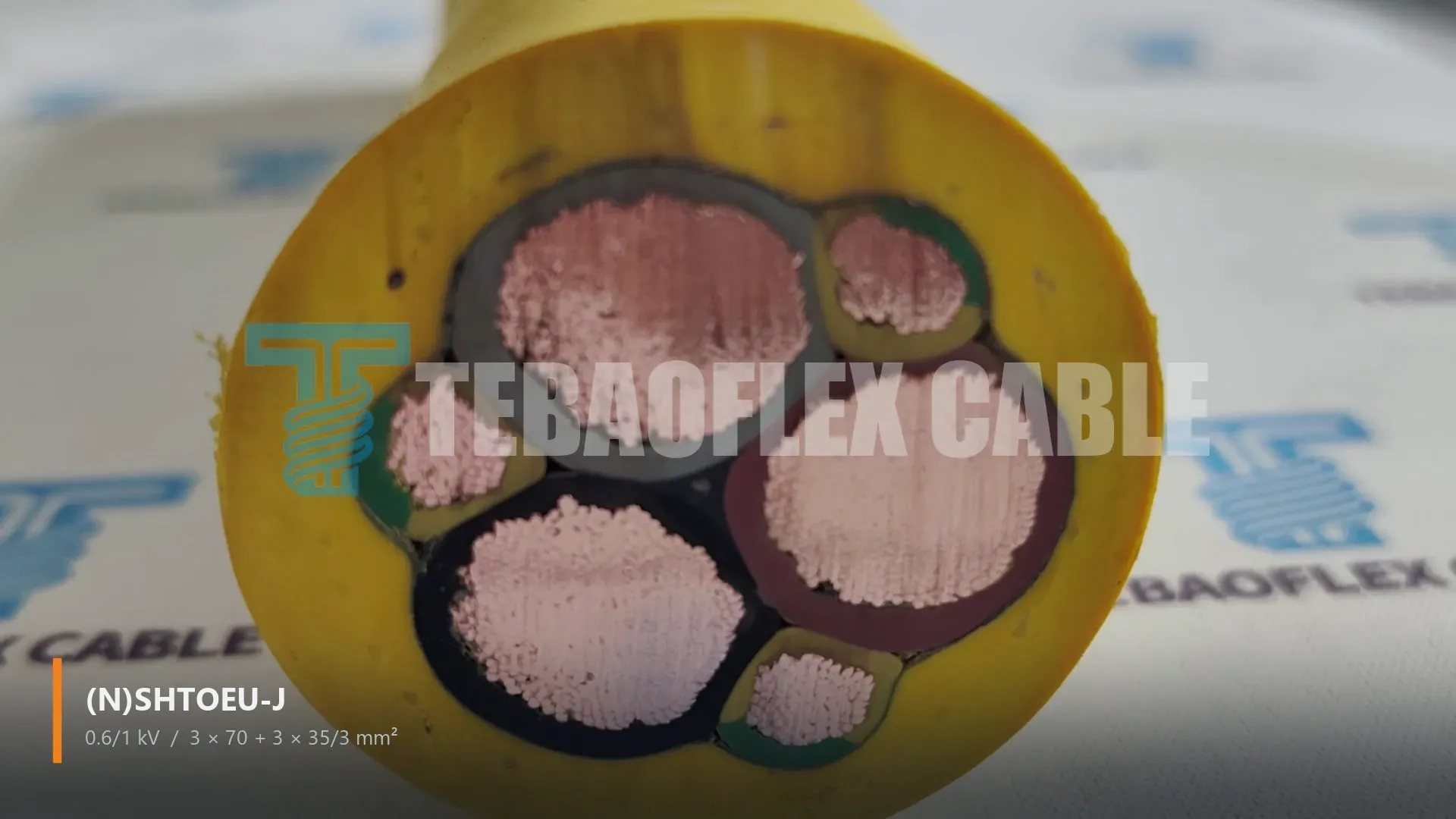
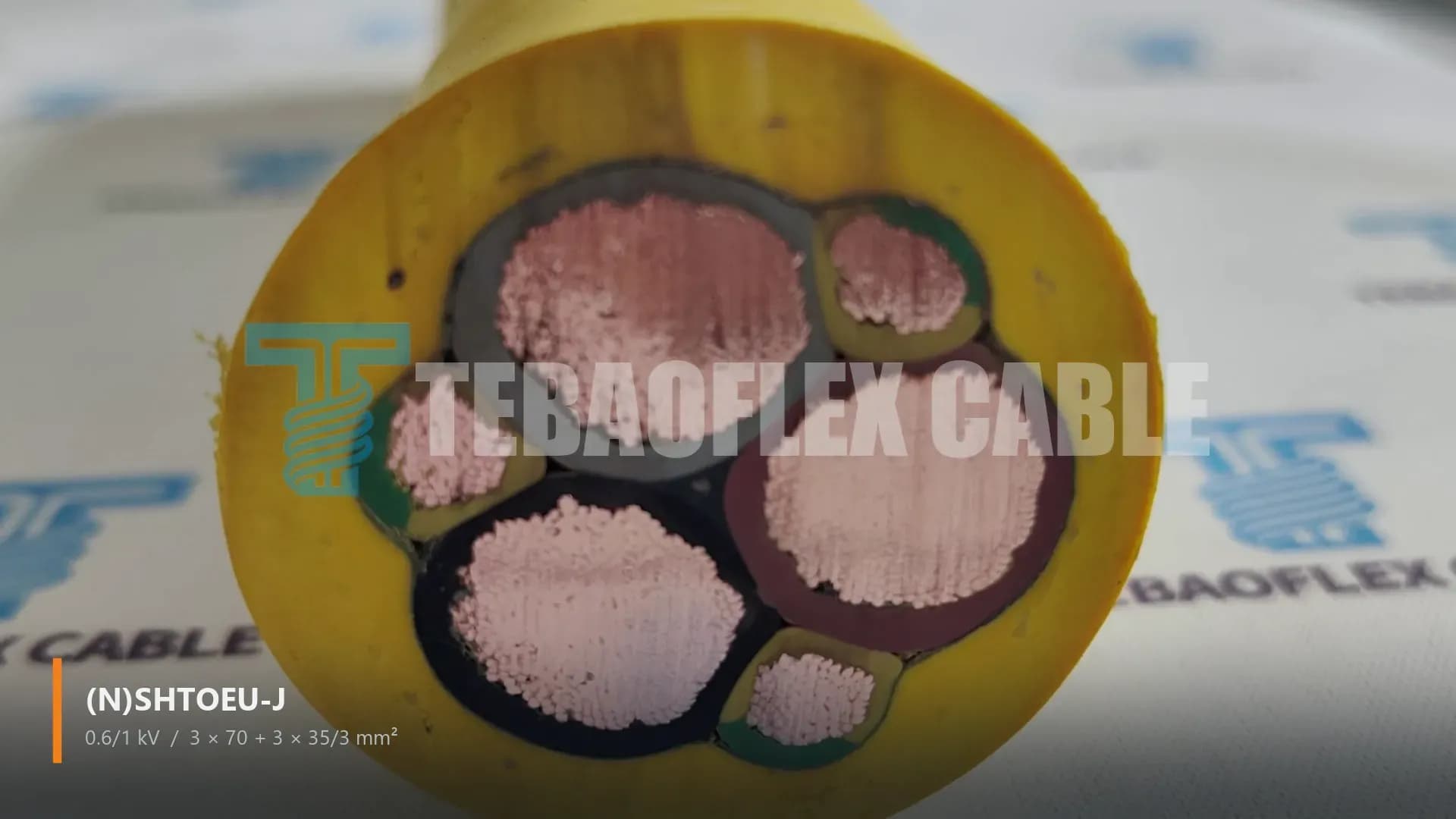
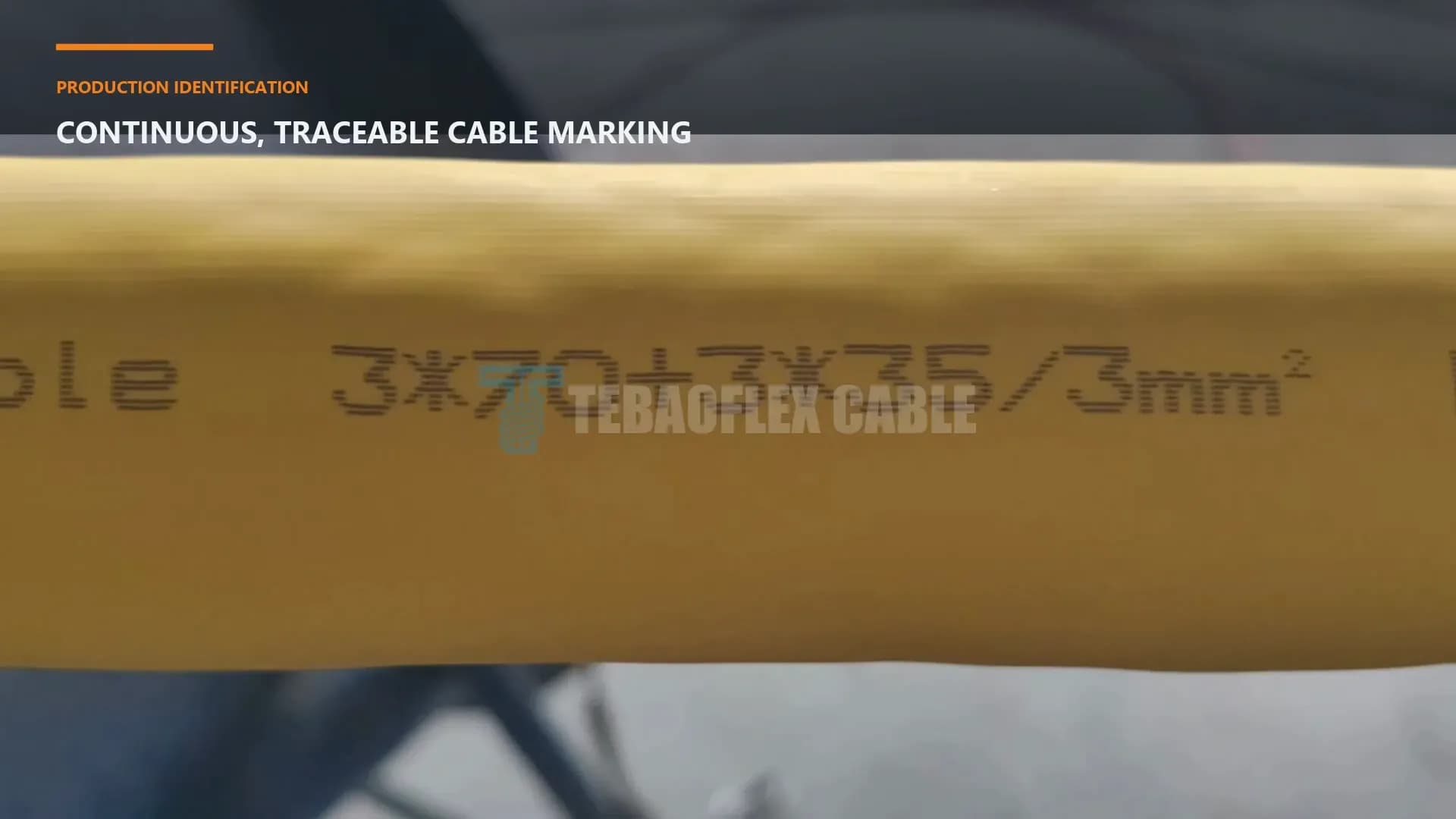
The video opens with TEBAOFLEX's own product footage: the cut end of a yellow 0.6/1 kV (N)SHTÖU-J 3 × 70 + 3 × 35/3 mm² sample, with three larger power cores in brown, black and grey insulation and three smaller green-yellow earth cores in the gaps between them, then a close pass along the continuous sheath print, which reads "0.6/1kV (N)SHTOEU-J Cable 3*70+3*35/3mm² DIN VDE Standard Sep 2026". Two production clips, captioned "Braiding and core protection" and "Controlled drum winding", show insulated cores passing through a lay-up and taping head and finished yellow cable wound on a drum.
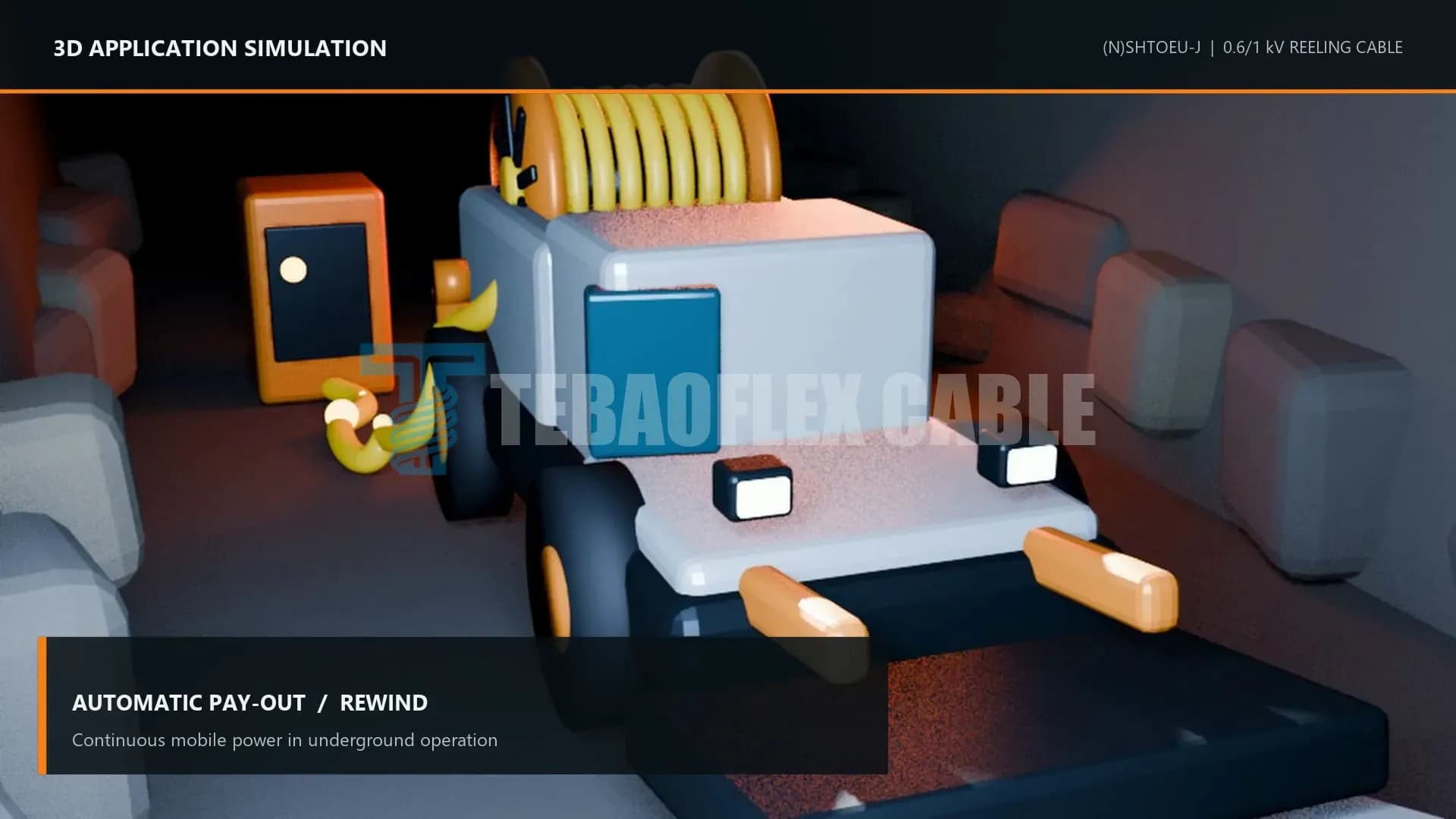
Underground footage supplied by a customer shows a loader working in a drift. A schematic 3D simulation, not to scale, then shows a loader whose on-board reel pays the cable out and rewinds it.
The video illustrates a sample, process, or operating context. Final product construction, suitability, standards, and test acceptance criteria are confirmed against the ordered specification.
NSHTÖU product specifications
Review construction, applications and enquiry requirements for the NSHTÖU 0.6/1 kV rubber reeling cable, including the downloadable datasheet for LHD scoop operations.
NSHTÖU product specificationsA Reeling Cable for Tethered Underground Loaders
(N)SHTÖU-J, also written (N)SHTOEU-J, is a 0.6/1 kV rubber reeling cable for machines that need continuous power while they move. A tethered loader takes its supply through a cable stored on an on-board reel: the reel pays the cable out as the machine travels away from its supply point and winds it back on the return. That is the "automatic pay-out / rewind" duty shown in the video's 3D simulation. TEBAOFLEX lists selected mobile mining and tunnelling equipment among the applications of the NSHTÖU family and publishes a separate NSHTÖU datasheet for LHD scoop operations.
Reading 3 × 70 + 3 × 35/3
The size code describes the cores. Three 70 mm² conductors carry the phases, and a 35 mm² protective earth is divided into three green-yellow cores of 35/3 mm² each, laid in the gaps between the phase cores, as the cut end in the video shows. The J in the type designation marks the version with a green-yellow protective conductor.
Across the family, TEBAOFLEX specifies IEC 60228 Class 5 fine-stranded copper, 3GI3 rubber insulation and a maximum conductor operating temperature of 90 °C. Common reinforced constructions add a rubber inner sheath, an anti-torsion textile or polyester braid between the sheath layers and a heavy-duty rubber outer sheath; the sample in the video has a yellow outer sheath. Confirm the complete construction of the ordered size against its datasheet.
Continuous Marking on the Sheath
The print pass in the video shows what the marking carries: rated voltage, type designation, conductor sizes, a DIN VDE reference and the production month, repeated along the sheath. The product data identifies DIN VDE 0250-814 as the construction standard for NSHTÖU. Marking, length, drum, termination and document requirements can be defined with the order, and the ordered construction, marking and test scope are confirmed during quotation.
Reel Duty Below Ground
Each trip winds and unwinds the cable while tensile and torsional stress act on it at the same time. The anti-torsion braid helps the assembly resist rotation, but it cannot correct an unstable winding pattern, a snagging cable or an unsuitable lead-in. Underground, the route adds dirt, moisture and mechanical contact, so check the drum, lead-in and guide rollers as one system and keep the cable away from recurring contact with abrasive surfaces.
Turns left on the drum release heat differently from cable paid out along the route, so current selection depends on the reel's operating state as well as on conductor size. The 0.6/1 kV rating suits low-voltage machine supplies; medium-voltage reel circuits call for a medium-voltage reeling cable such as NTSCGEWÖU.
What to Send Us for an LHD Cable
For a quick recommendation, send:
- the reel: drum barrel, flange and guide-roller dimensions and the lead-in direction;
- the travel distance and the cable length that stays on the drum;
- travel speed, acceleration, reversals and cable tension;
- the system voltage, load current and circuit schedule, including the J/G or O/X protective-conductor arrangement;
- the route conditions, such as water, abrasive contact and impact points, and any site or destination requirements for the cable.
We will analyze your application and recommend the right cable. See also our mining and tunnelling cables, the full reeling cable range and the companion video on (N)SHTÖU-J for gantry cranes and stacker-reclaimers.
Frequently Asked Questions
Is (N)SHTÖU-J a screened cable?
No. Standard NSHTÖU-J/O constructions are normally unshielded, and the anti-torsion braid is mechanical reinforcement, not an electrical screen. If the site specification or sensitive control circuits call for screening, state that requirement in the enquiry so it can be addressed in the cable and circuit design.
Does the type designation cover hazardous areas?
No. A cable type designation is not evidence of suitability for hazardous areas, fire-survival duty or electromagnetic compatibility. Where an underground site has explosive-atmosphere zones or other special requirements, define them separately in the enquiry.
Where should a reeling cable be inspected first?
At the points of highest mechanical concentration: the drum entry, guide rollers, end terminations and sections that repeatedly change direction. Look for sheath cuts, flattening, local swelling, persistent twist, uneven winding or exposed reinforcement, and correct the guide or drum condition behind the damage, not only the damaged section.