

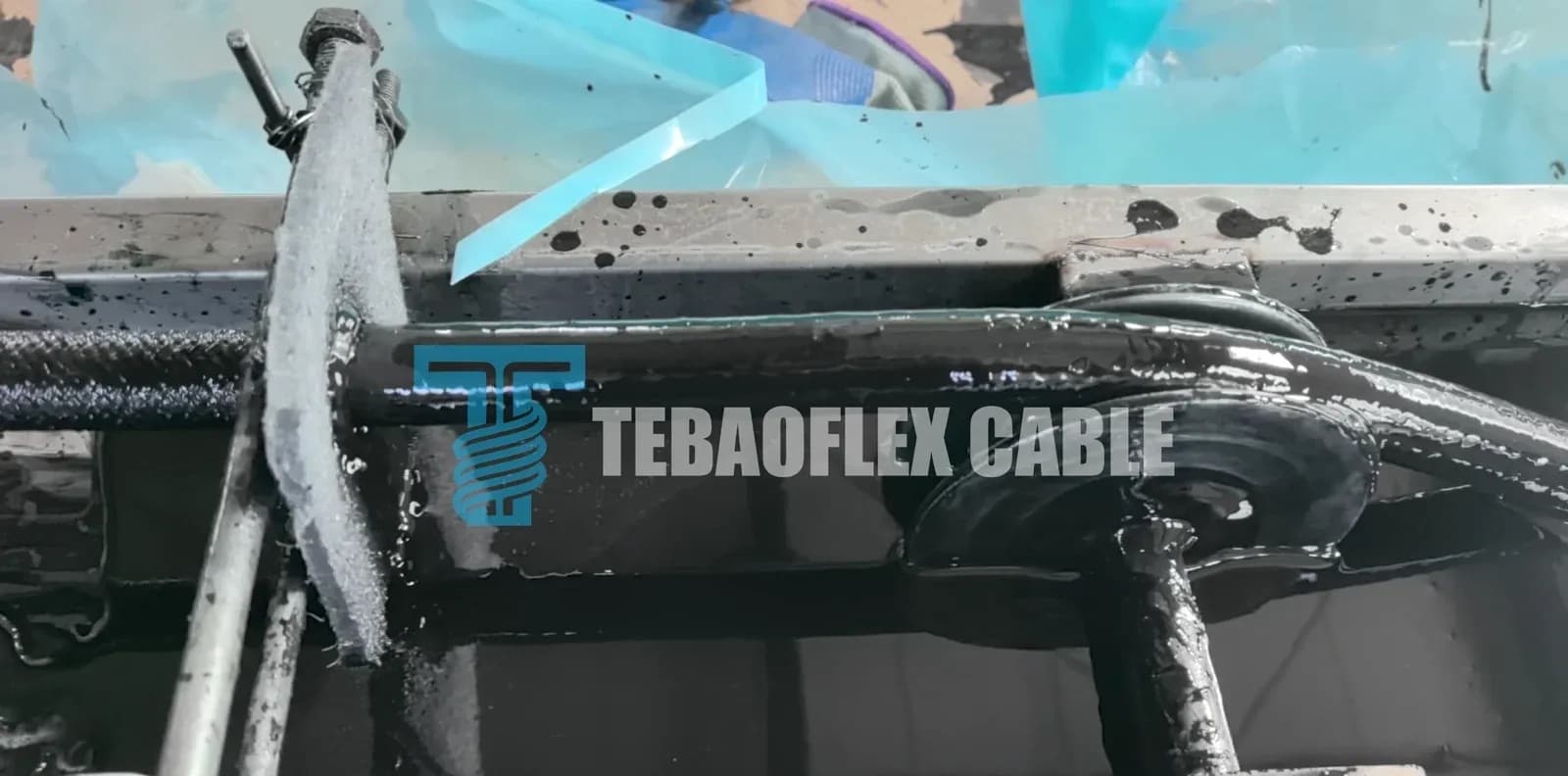
The impregnation stage on a running line: the cable passes through a trough of dark fluid and past a fibrous pad held against it by a threaded adjuster. On one side of the pad the surface is glossy and wet; on the other, the braid texture is visible and matte.
Almost every datasheet for a silicone single-core with a glass braid contains the same three words: impregnated glass fibre braid. Lapp uses it. FS Cables uses it. Caledonian uses it. It sits in the construction line between "silicone insulation" and the temperature rating, and it is almost never explained.
It is not a throwaway word. The impregnation is a separate manufacturing operation with its own bath, its own metering hardware and its own curing stage — and how well it is done is one of the things that separates two cables built to the same nominal specification.
The footage in this article shows that operation running. Below, the stills are kept clearly apart from the published engineering literature that explains what the step is for: indented, bolded "On the line" notes describe only what is visible in the frames. Everything else is sourced explanation, attributed where it matters.
In this article
- What "impregnated glass fibre braid" means on a datasheet
- What the braid does — and why bare glass braid would not be enough
- The impregnation step itself, on a running line
- Then it has to cure — and cure is a line-speed problem
- What to check when you are specifying one
- The takeaway
What "impregnated glass fibre braid" means on a datasheet
The designation is worth decoding first, because it tells you the construction order. In the German/VDE naming tradition, SiF is a silicone-insulated flexible single core, and the /GL suffix adds a glass-fibre braid over it. Published constructions from suppliers in this category are consistent: fine-stranded tinned copper to IEC 60228 / VDE 0295 class 5, silicone rubber insulation, and an impregnated glass-fibre braid over the top. Caledonian Cables cites DIN VDE 0250 parts 1 and 502 for it; Lapp's ÖLFLEX HEAT 180 SiF/GL describes the same three-layer build.
The braid is therefore not the insulation. It is a protective layer applied over an already-insulated core — and "impregnated" describes what is done to that layer after it is braided on.
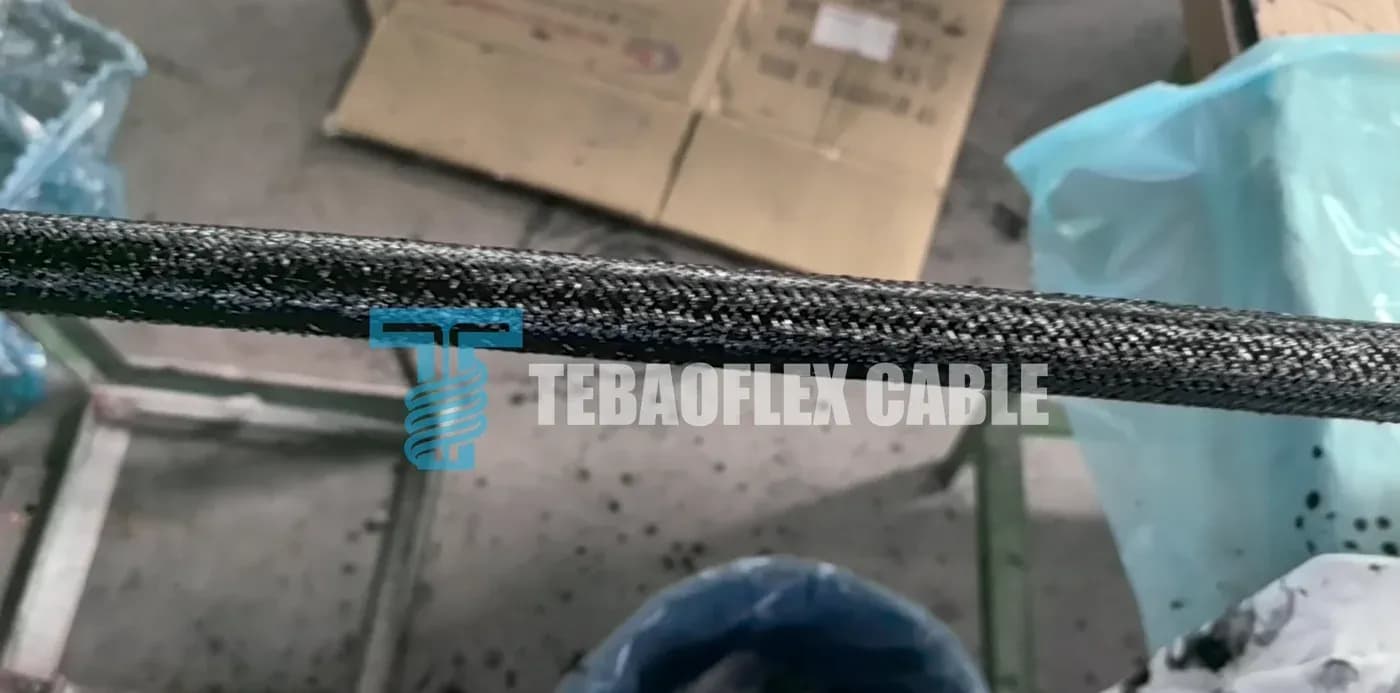
The finished surface: a dense textile braid with a regular lay, applied over a distinct inner layer. Fibre chemistry cannot be identified from footage — this is what the braid looks like, not what it is made of.
TEBAOFLEX's own catalogue describes the same treatment in different words. The silicone fiberglass fixture wire page gives the construction as "stranded copper conductor, silicone rubber insulation, and an overall fiberglass braid treated with a high-temperature finish." The silicone rubber insulated high-temperature wire page carries the glass-braided H05SJ-U and H05SJ-K variants of the harmonised range. "Treated with a high-temperature finish" and "impregnated" are describing the same operation.
What the braid does — and why bare glass braid would not be enough
Silicone's value is thermal and electrical. It stays flexible across a very wide temperature span, and it is specifically recommended over PVC where PVC would go brittle from sustained heat — that is the standard reasoning given for using it in power stations. Mechanical protection is not what it is there for, which is why the suppliers who publish a reason for the braid give the same one: it protects the silicone insulation from mechanical damage, and it is what allows the construction to be used under high mechanical stress at all.
That only works if the braid stays intact. This is the problem the impregnation solves, and the reason it exists is documented plainly in the patent literature on glass-fibre-covered conductors:
- The treatment achieves firm anchoring of the glass fibre to the wire and prevents the covering lifting away while conductors are being pulled into slots and while the cable is bent and twisted.
- The impregnant embeds the thin, fragile filaments so that they bake together into a solid mass, and gives the covered wire a smooth surface instead of an open, snagging weave.
- Dielectric properties improve because impregnation fills the interspaces in the weave rather than leaving them as air gaps.
An untreated glass braid would do its mechanical job only for as long as it stayed woven. The filaments are, in the patent literature's own words, thin and fragile — which is why an untreated covering is described as liable to lift away under exactly the handling a cable gets during installation. The impregnation converts a woven sleeve into a bonded skin that moves with the cable.
There is a second, quieter benefit. Silicone-based compositions are themselves used to impregnate woven glass fabrics and sleeving, and SAB markets silicone-impregnated fibre-glass braiding on its heat-resistant range — so on a silicone cable the treatment can be chemically compatible with the insulation underneath rather than a foreign material sitting on top of it.
The impregnation step itself, on a running line
This is where the footage earns its place. The stage is simple to watch and hard to find explained anywhere.
On the line — The cable is drawn through an open metal trough holding a dark fluid, guided by submerged pulleys. A pale fibrous pad is clamped against the cable by a threaded adjuster mounted on the trough frame. On one side of that pad the cable surface is glossy, black and visibly wet; on the other side the braid texture is distinct and matte. The trough rim and the surrounding floor carry heavy dark spatter.
The pad is the part worth noticing. It is not cleaning the cable; it is metering it. Published process descriptions for fibre impregnation are explicit that excess impregnant is removed as the material exits the wet-out tank, and that pickup control is part of the process rather than an afterthought.
That matters, and mostly in one direction. Too little pickup and the filaments are not fully embedded — and embedding them into a solid mass is, per the sourced explanation above, the whole point of the operation. Over-application is a cost and consistency question rather than a documented failure mode, but it is still compound paid for and not used. The adjuster on that pad is where pickup gets set.
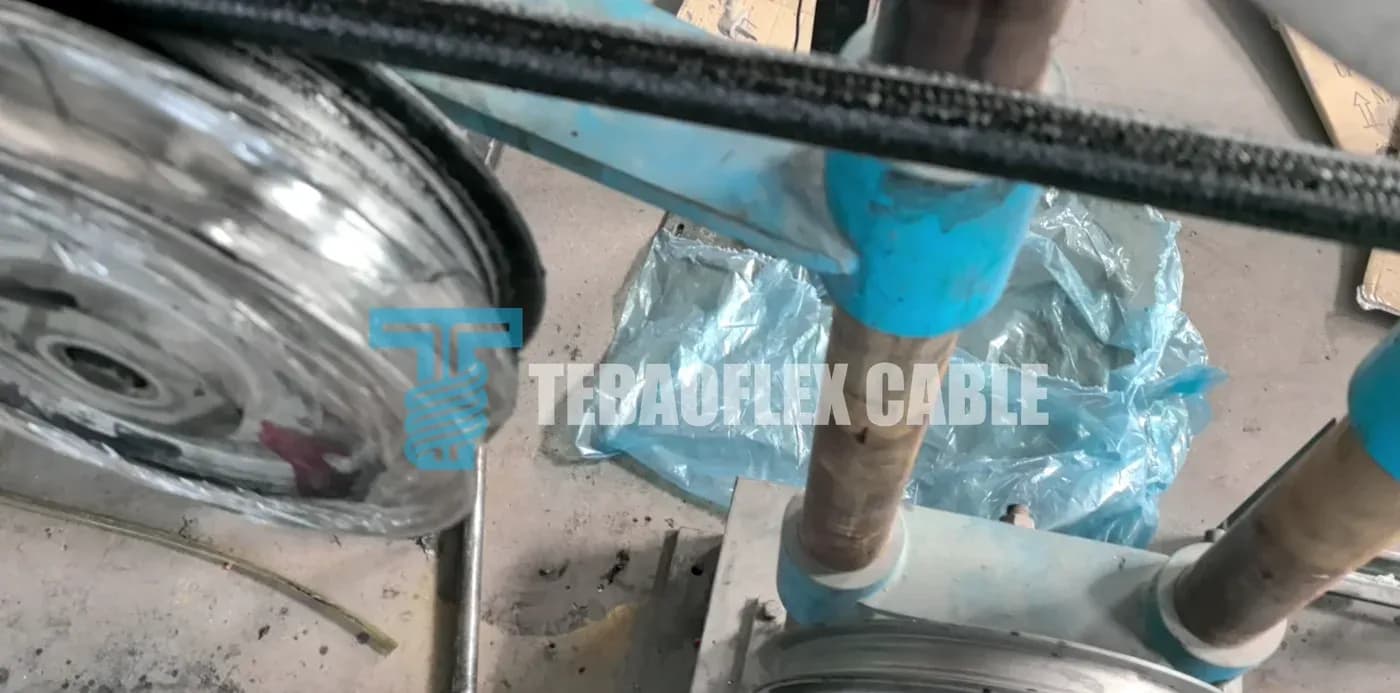
Upstream of the bath: a powered station with flanged bobbins and spindle rollers feeding the line. The braid has to exist before it can be treated.
Then it has to cure — and cure is a line-speed problem
A wet braid is not a finished braid. Immediately after the bath, the line runs the cable through a heated stage.
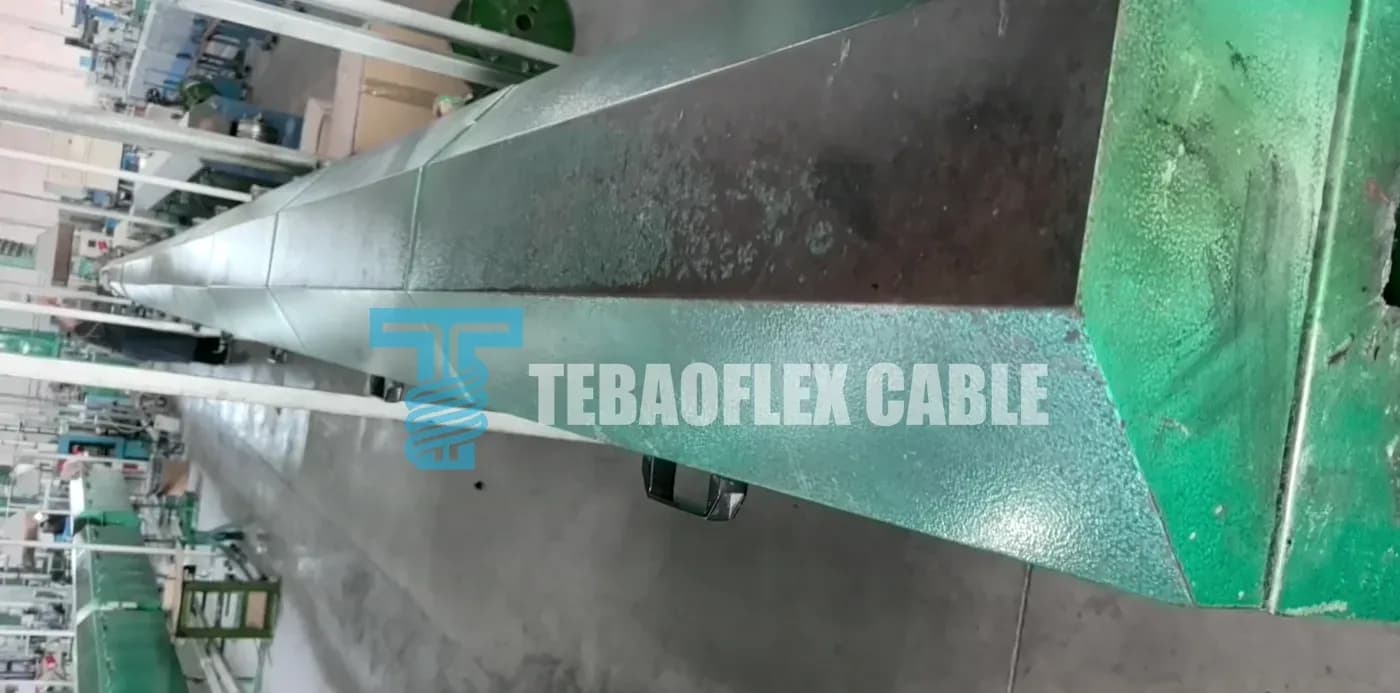
On the line — The cable passes through a rectangular aperture cut into a large enclosure. The surround of that aperture is lined with a tan, woven refractory / ceramic-fibre material, and a large galvanized extraction hood rises from the top of the enclosure toward the ceiling. No temperature display or gauge is legible anywhere in the footage. The cable runs in over bare metal sheaves, under tension, continuously.
Refractory lining plus an extraction hood is the signature of a heated chamber: the lining is there because the aperture edge gets hot, and the hood is there because curing drives off volatiles that have to leave the building rather than the shop floor.
The engineering point about this stage is the one most likely to be missed by anyone reading only a datasheet:
*The degree of cure depends on the oven temperature and the linear speed of the line. Under-cured material has inferior adhesion.*
That is a documented process-control relationship, not a manufacturer's opinion. It means the same oven, running the same compound, produces a different cable at a different line speed. Two suppliers can print an identical construction line on identical datasheets and ship braids that behave differently in the hand — one bonded and smooth, one that lifts at the first tight radius — because of what happened between the bath and the far side of that oven.
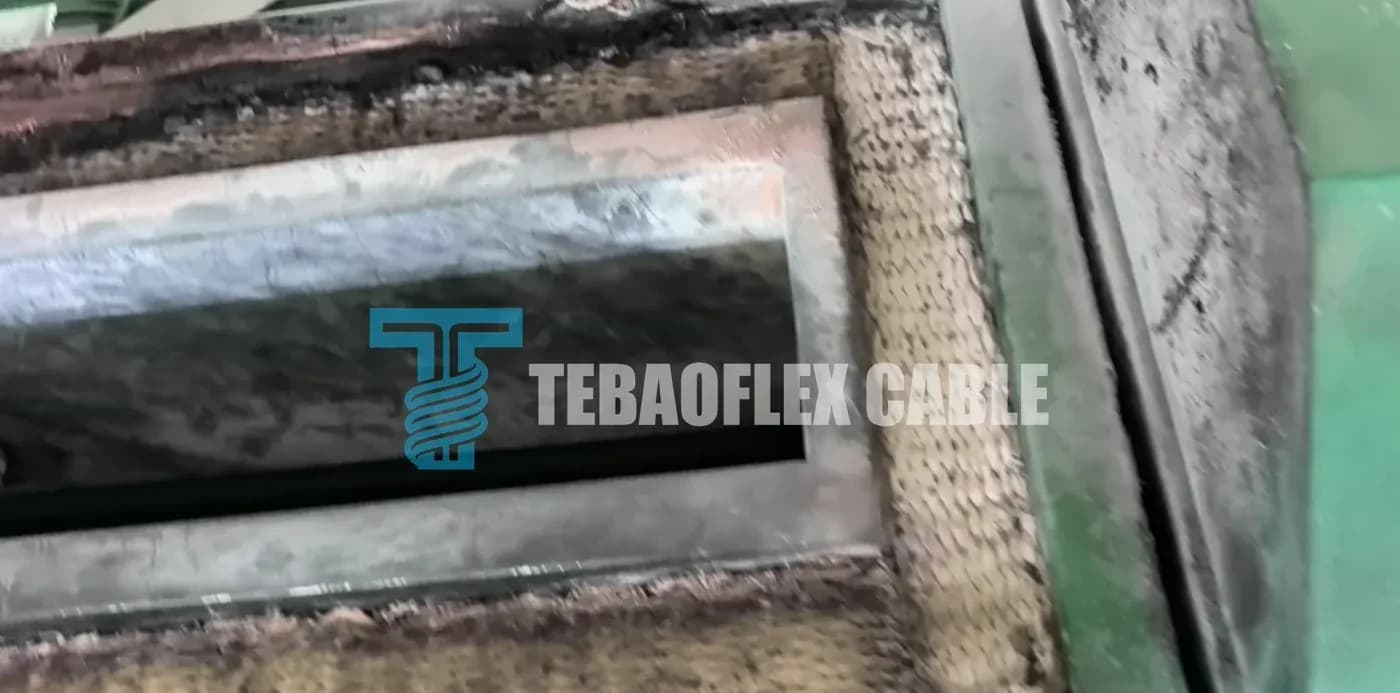
The aperture surround is lined with woven refractory material — the detail that identifies this as a heated stage rather than a guide.
The extraction hood above the same enclosure. Curing produces volatiles; they have to be taken out of the hall.
The full 64-second sequence: braiding, the impregnation bath and metering pad, and the run into the heated chamber.
What to check when you are specifying one
Six things worth confirming before you commit to a silicone/glass-braid single core, drawn from the published ranges rather than from generic advice.
1. The low-temperature end varies by supplier — check it. The upper figure is consistent across this category at +180 °C continuous. The lower one is not. Caledonian publishes −60 °C for SIF/GL; Lapp publishes −50 °C for ÖLFLEX HEAT 180 SiF/GL, with short-term capability to +200 °C. If your application genuinely goes below −50 °C, that is a real difference and not a rounding.
2. Know which number is the short-circuit number. +350 °C is widely cited as the maximum short-circuit conductor temperature for silicone cables under DIN VDE 0250. It is a fault-condition figure, not a continuous rating, and not a licence to run the cable hot. If it matters to your calculation, ask the supplier which duration it is quoted against.
3. Confirm the standard, not just the designation. "SiF/GL" is a trade designation, not a standard. Ask which document the cable is actually built to — DIN VDE 0250 parts 1 and 502 for the German route, EN 50525-2-41 for the harmonised H05SJ equivalents, UL 758 for AWM styles. The name on the drum tells you less than the standard behind it.
4. Check the size range, because it stops earlier than people expect. Published cross-section tables in this category top out lower than most buyers assume: Caledonian lists 0.25–50 mm², Lapp lists 0.5–50 mm², FS Cables goes to 95 mm². Above roughly 50–95 mm² you are no longer picking from a catalogue — you are having a made-to-order conversation. Worth asking, in that conversation, how the braid and impregnation stages behave at the diameter you need — those are the stages this article is about, and they are the ones whose settings a catalogue range has already been proven at and a special has not.
5. Ask about the braid treatment specifically. Given how much of the cable's handling life depends on it, "is the braid impregnated, and with what" is a fair question. So is asking to see the line.
6. Match approvals to the actual construction. Whichever supplier you use, ask for the approvals that cover the construction you are buying, not the company generally. TEBAOFLEX's published certification records are listed individually with certificate numbers and validity dates so they can be checked one by one.
TEBAOFLEX's high-temperature wire range covers eight constructions, including the two silicone-plus-glass-braid families linked above. On sizing and construction questions the company's stated approach is that "product selection starts from operating duty, not from a generic specification," and it lists cable design, development and custom supply, including OEM and ODM cooperation, among what it offers. More production and project footage sits in the video and project case archive.
The takeaway
"Impregnated glass fibre braid" is one line on a datasheet describing a bath, a metering pad and a curing oven — three operations whose settings decide whether the braid stays bonded to the cable for its service life or starts lifting the first time someone pulls it round a tight corner. It is not a material property. It is a process outcome, and process outcomes vary between suppliers even when the construction line on the datasheet does not.
If you are specifying a silicone single core for a hot environment, the temperature ratings are the easy part. The braid treatment is the part that decides how the cable behaves in someone's hands three years in.
Working out which construction fits your operating duty? Tell us the operating conditions — temperature range, movement, cross-section, and what the cable has to survive mechanically — and we will work back to the construction that suits them.
Sources for the technical explanation in this article
- Lapp, ÖLFLEX® HEAT 180 SiF/GL online catalogue entry — construction, ratings, size table.
- Caledonian Cables, SIF/GL product page — DIN VDE 0250 parts 1 and 502, −60 °C to +180 °C, size range.
- FS Cables, SiF-GL product page and datasheet — construction, size range to 95 mm².
- SAB, heat-resistant range — silicone-impregnated fibre-glass braiding.
- USPTO patent literature on glass-fibre impregnation and cure of fibre-covered conductors — purpose of impregnation, anchoring and anti-lift function, dielectric effect, and the oven-temperature/line-speed relationship governing degree of cure.
Images and video in this article are stills and a web derivative from a single continuous production recording. The facility is not identified on camera, and no claim is made here about where it is or who operates it.