- Location
- Saint Petersburg, Russia
- Application
- Airport apron PIT systems, mobile GPUs and boarding bridge reels
- Cable type
- 400 Hz aircraft ground power cable 4 × (1×70 mm² + 4×1.0 mm²) →
- Evidence
- 7 images
By TEBAOFLEX Jyen. Published on October 24, 2026.
TL;DR: A civil airport power builder in Saint Petersburg, Russia ordered450 mof 400 Hz Aircraft Ground Power Cable4 × (1×70 mm² + 4×1.0 mm²). Built to IEC 60228 and ISO 6858, the cable twists four yellow PUR sub-cables together. For example,15 mand28 mPIT whip assemblies flex cleanly down to-40°C.
Project Overview & Case at a Glance
In August 2026, TEBAOFLEX finished building, testing, and packing 450 m of aircraft ground power cable for an airport ground power integrator in Saint Petersburg, Russia. The customer needed bulk cable to cut into 15 m and 28 m lengths for plug assembly.
The client ordered 450 m of 4 × (1×70 mm² + 4×1.0 mm²) aircraft cable with signal wires. These cables link airport apron PIT boxes and mobile GPUs to parked planes. Our plant built the 450 m cable run in 20 days.
Project Parameter
Customer & Location
- Project Specification: the customer Aviation Ground Power Integrator, Saint Petersburg, Russia
Target Application
- Project Specification: Civil Airport Apron PIT Systems, Mobile GPUs, and Boarding Bridge Reels
Primary Cable Model
- Project Specification:
4 × (1×70 mm² + 4×1.0 mm²)400 Hz Ground Power Cable (EPR / FEP / Yellow PUR)
Companion Assembly
- Project Specification:
2 × (1×120 mm² + 4×1.0 mm²)28 V DC Ground Power Supply Cable (0095Mbatch)
Order Length & Cuts
- Project Specification:
450 mtotal length, designed for15 mand28 mlow-impedance assembly cuts
Temperature Rating
- Project Specification:
-40°C to +90°Cdynamic reeling;-50°C to +90°Cfixed;+110°Cshort-time (7,500 h)
Governing Standards
- Project Specification: IEC 60228, VDE 0295, ISO 6858, and FAA AC 150/5340-30
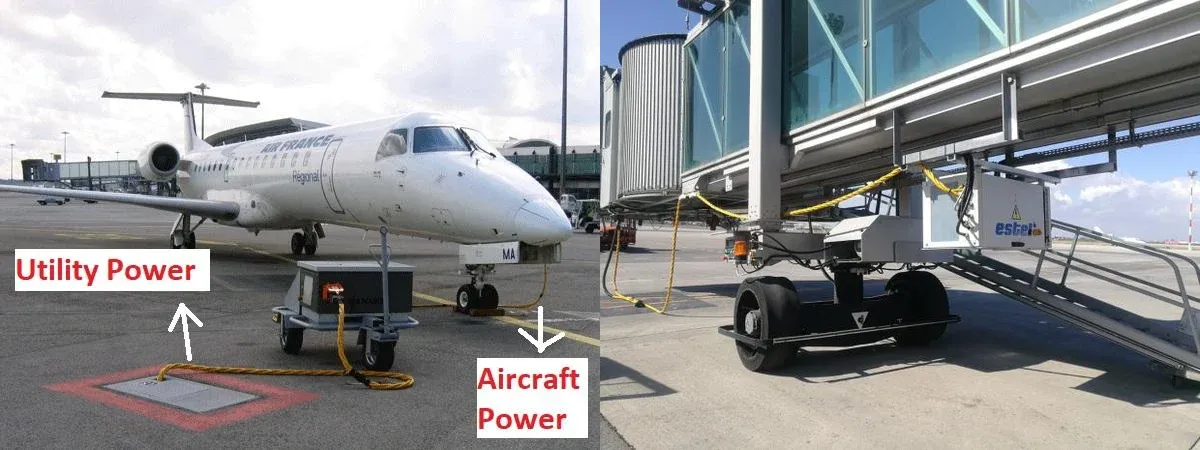
An Airport Apron PIT System is an underground power box set into the concrete parking stand that stores 400 Hz cables and air hoses. When a jet parks at the gate, ground crews open the lid. They pull out a 15 m or 28 m yellow cable and plug it into the plane's nose socket. When service ends, the cable coils back into the pit so fuel trucks and tugs can drive safely over the stand.
Civil Apron Duty Cycle: PIT Hatches, Mobile GPUs & Boarding Bridges
Feeding 115/200 V AC at 400 Hz from an apron PIT box or a diesel GPU cart to a parked jet puts heavy stress on the feeder cable.
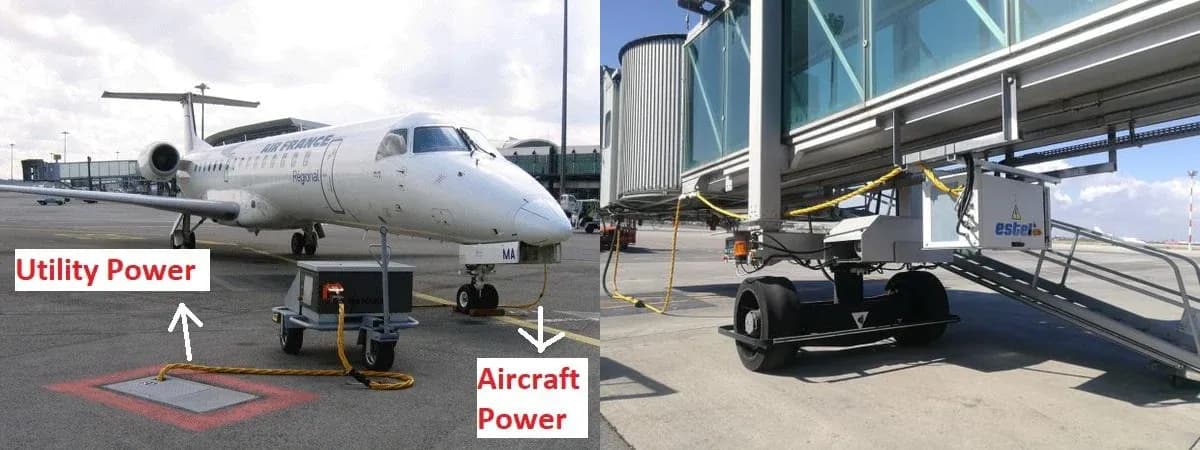
In our experience supplying cold-weather airport projects, 400 Hz ground power cables must survive four daily hazards.
- High-Frequency 400 Hz Reactance. Running at
400 Hzmakes inductive reactance 8 times higher than on a50 Hzgrid. This causes severe voltage drop if phase cores sit too far apart. - Russian Winter Cold-Flex (
-40°C). Cables pulled out of icy apron pits at-40°Cwill crack if made with standard PVC or basic rubber. - Concrete Apron Abrasion & De-Icing Fluids. Ground crews drag the cable over rough concrete wet with fluids such as glycol de-icer, Jet A-1 fuel, and oil.
- Tight Reeling & Plug Strain. Daily coiling into small PIT baskets or bridge reels needs fine copper strands that will not twist or kink.
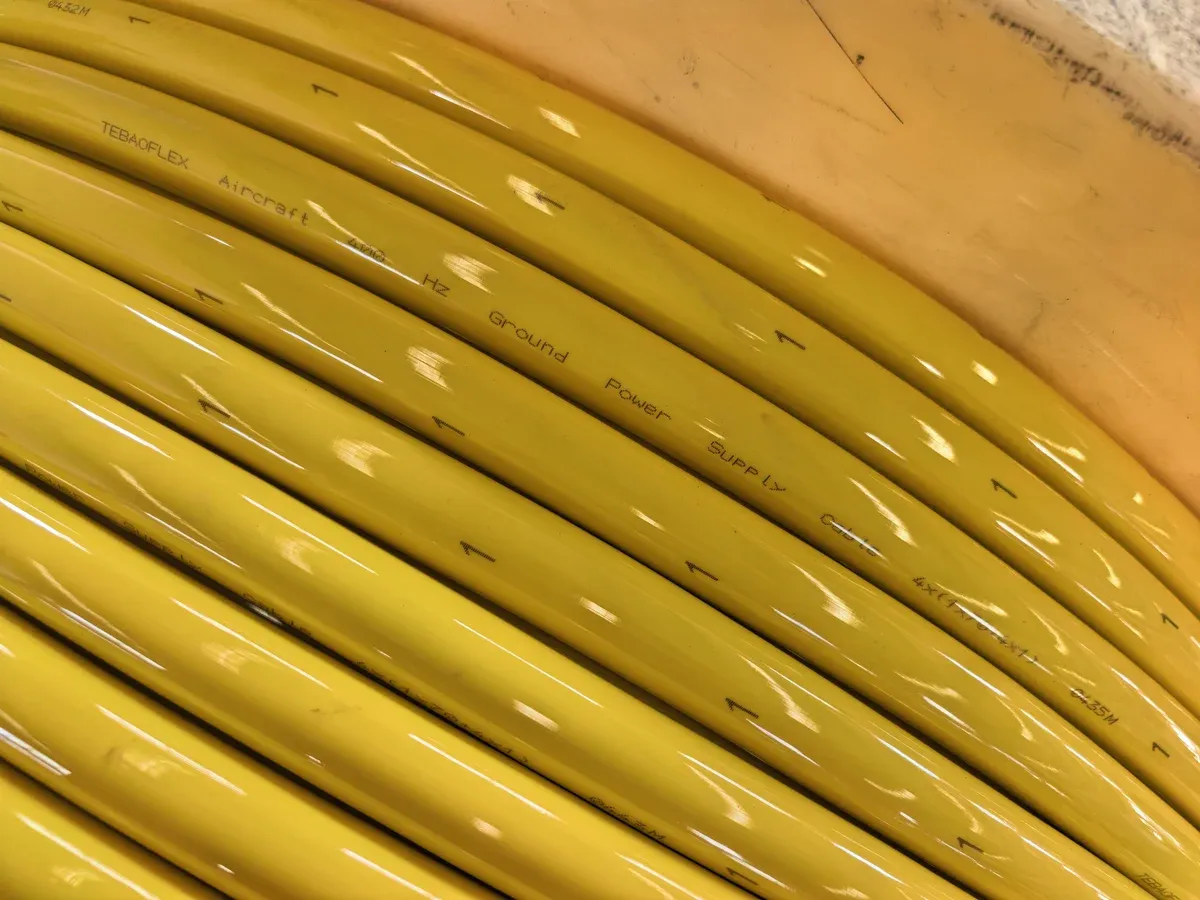
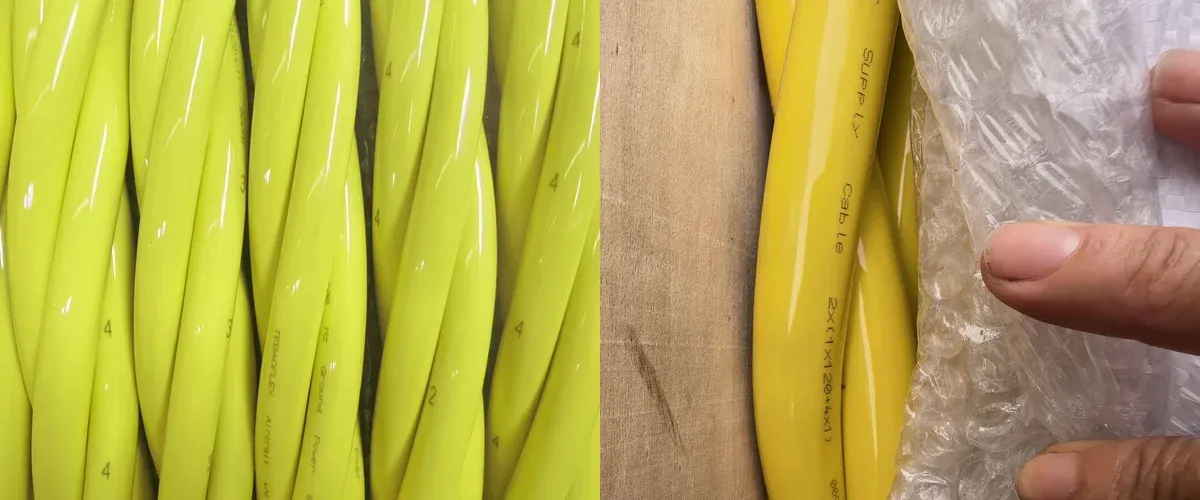
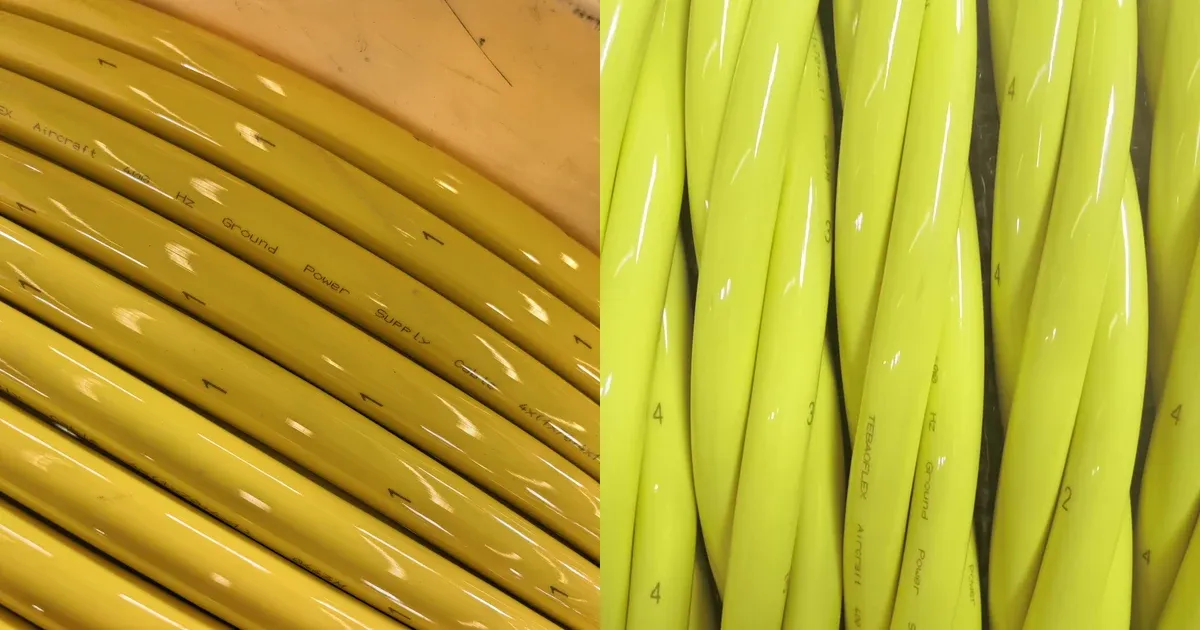
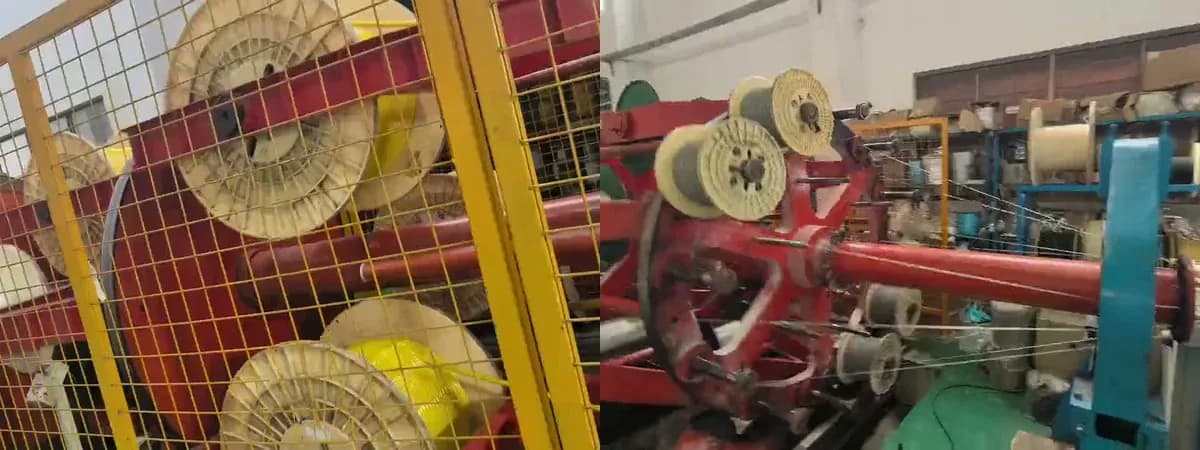
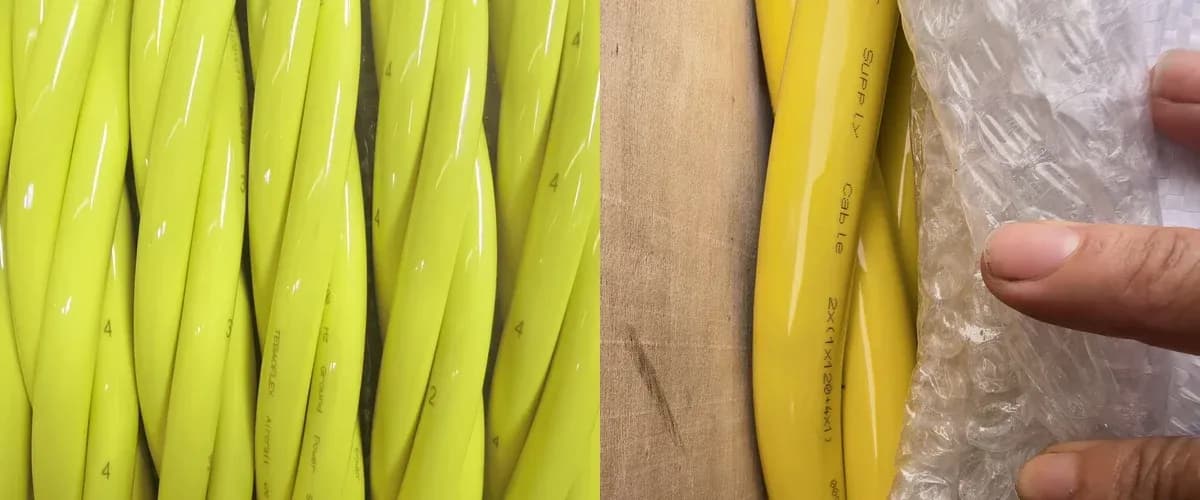
Project Photo Note: Cable photos, jacket print markings (4x(1x70+4x1) 0435M), and stranding frames illustrate this project. Airport engineers should check 400 Hz line-drop settings on their GPU before use.
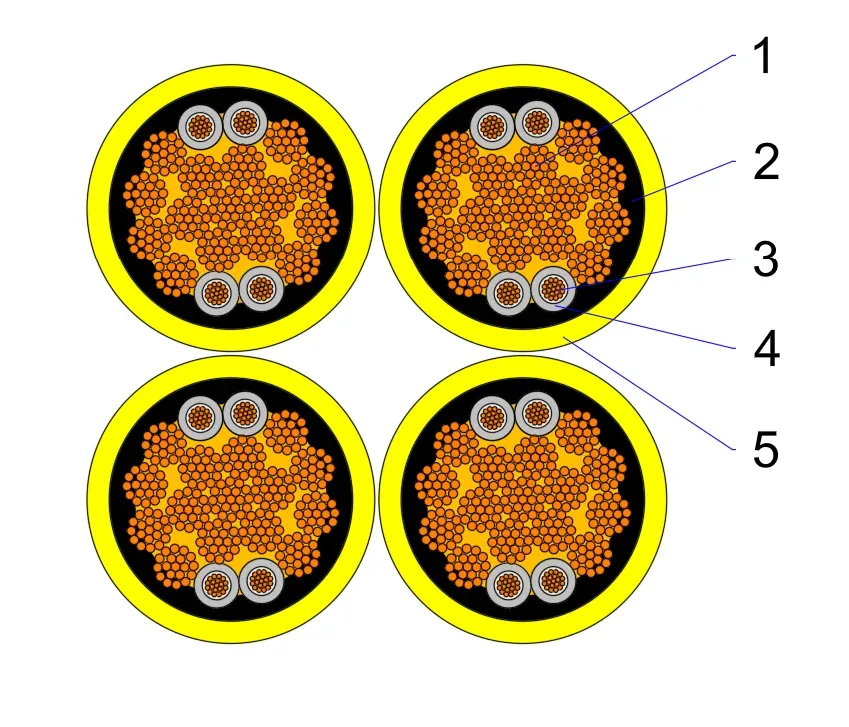
5-Layer Sub-Cable Architecture of 4×(1×70+4×1 mm²) Aviation Cable
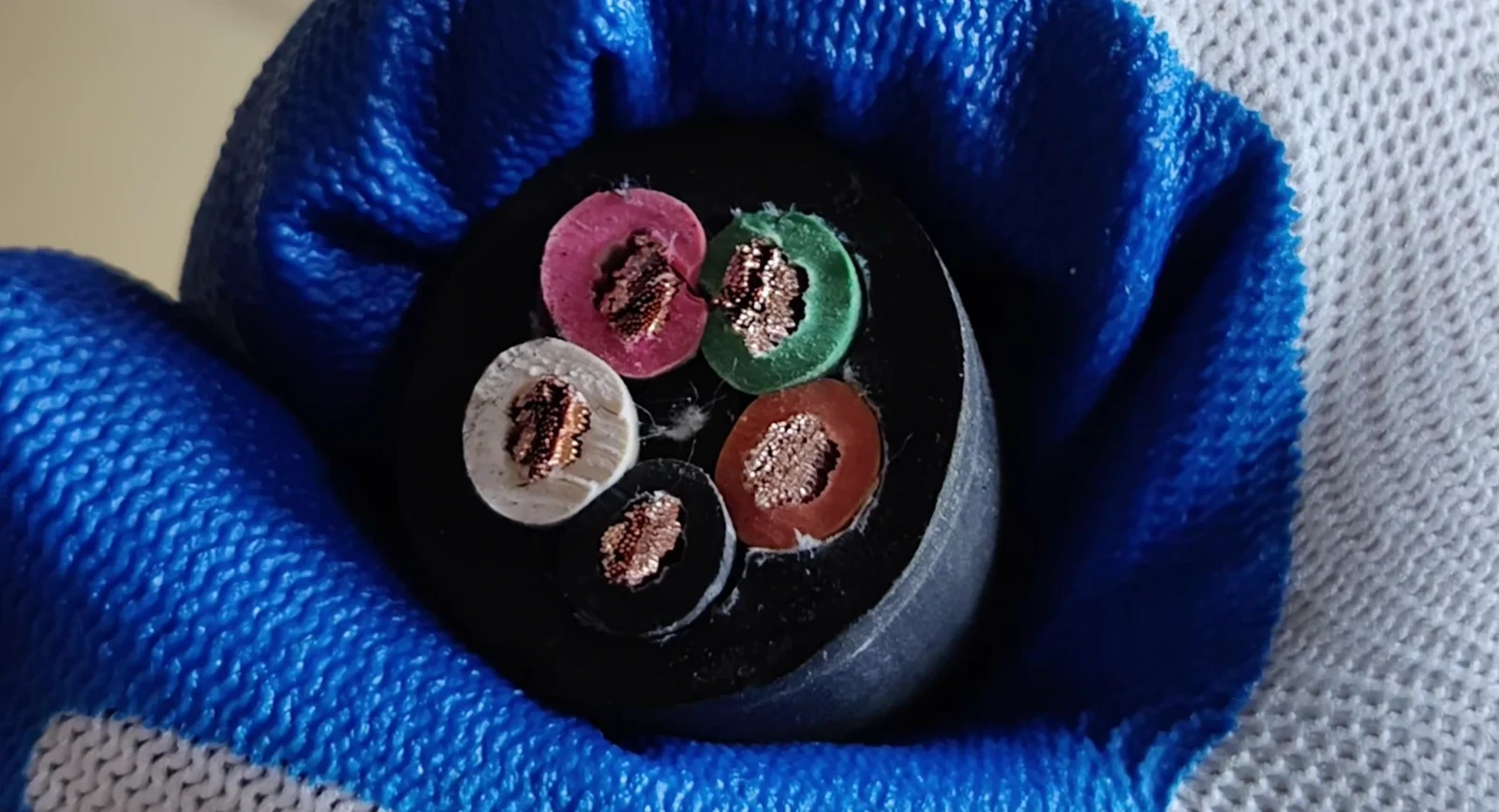
Instead of putting four stiff 70 mm² cores inside one thick outer jacket, TEBAOFLEX built this cable by twisting four Yellow PUR sub-cables (Core 1, Core 2, Core 3, and Core 4) together on a planetary strander. Each sub-cable holds five layers.
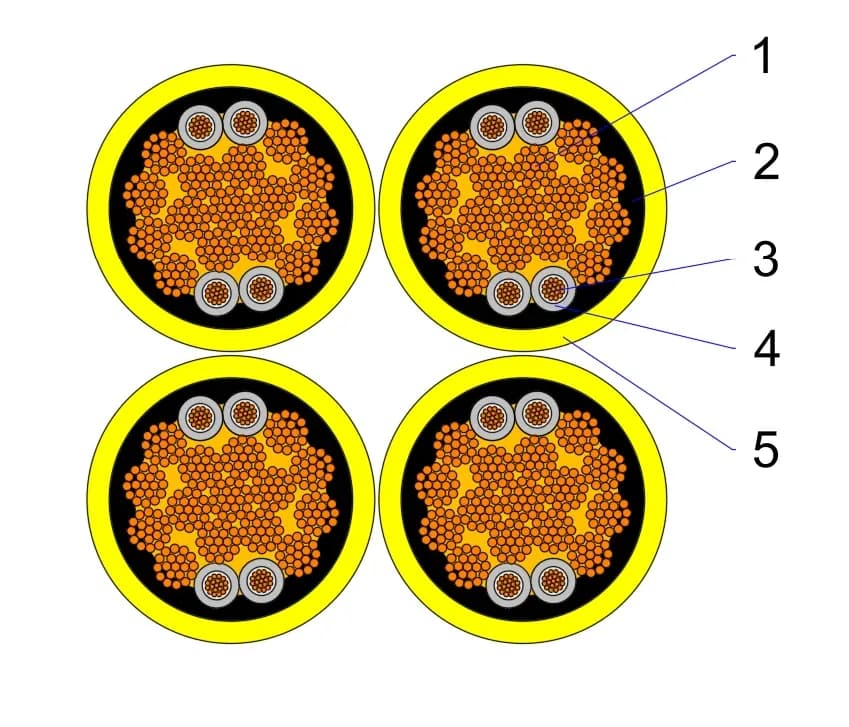
Layer
Layer 1
- Component Name: Power Conductor (
4 × 70 mm²) - Material & Standard Specification: Tinned copper fine wires per IEC 60228 Class 5 (
1 × 70 mm²inside each of the 4 sub-cables) - Aviation Ground Power Function: Carries 400 Hz phase and neutral current with high flexibility and corrosion resistance
Layer 2
- Component Name: Power Insulation
- Material & Standard Specification: Cross-linked Ethylene-Propylene Rubber (EPR, Black) over each
70 mm²conductor - Aviation Ground Power Function: Rated for
+90°Ccontinuous service and+110°Cshort-time overload (7,500 hours)
Layer 3
- Component Name: Control Cores (
4 × 4 × 1.0 mm²) - Material & Standard Specification:
4 × 1.0 mm²extra-fine tinned copper strands per VDE 0295 / IEC 60228 Class 6 in each sub-cable - Aviation Ground Power Function: Carries 28 V DC plug-interlock (
E/Fpins) and voltage-sensing signals back to the GPU
Layer 4
- Component Name: Control Core Insulation
- Material & Standard Specification: FEP (F-46) fluoropolymer insulation in Grey with white number markings
- Aviation Ground Power Function: Ultra-thin, heat-resistant insulation lets control cores slip smoothly during tight bending
Layer 5
- Component Name: Sub-Cable Outer Sheath
- Material & Standard Specification: Cold-flex, abrasion-resistant Polyurethane (PUR) in high-visibility Aviation Yellow
- Aviation Ground Power Function: Resists
-40°Cdynamic reeling, concrete dragging, de-icing fluids, and jet fuel spills
1. Why Each 70 mm² Sub-Cable Integrates Four 1.0 mm² Class 6 FEP Control Wires
A 400 Hz Ground Power Unit (GPU) Cable is a flexible power and signal assembly that feeds 115/200 V AC 400 Hz power plus 28 V DC safety interlock signals to a parked plane. Under ISO 6858, a 400 Hz plug cannot turn on until pins E and F confirm a 90% plug seating depth (ISO 6858, 2026).
FEP (Fluorinated Ethylene Propylene) Control Insulation is a high-heat fluoropolymer (F-46) placed over the 4 × 1.0 mm² Class 6 tinned copper control wires inside each sub-cable. FEP has very low friction and takes +200°C extrusion heat without melting. As a result, the grey white-numbered 1.0 mm² control wires slide freely when crews bend the cable around nose-gear doors.
2. Why Arctic-Grade Yellow PUR Survives -40°C Russian Apron Reeling
During design reviews, the customer's engineers asked a key question for Russian airports. Will the yellow PUR jacket crack during daily reeling and dragging at -40°C?
Arctic-Grade Polyether Polyurethane (PUR) Jacketing is a cold-weather outer sheath made with a glass-transition point below -50°C so it stays flexible during winter reeling. As we shared with the client, PUR comes in many grades. We drew on our compound testing across subsea umbilical cables and offshore fish-farm cables. From that data, we chose an aviation polyether-PUR grade rated for -40°C to +90°C dynamic flexing and -50°C to +90°C fixed use (plus +110°C short-time heat for 7,500 hours).
400 Hz Impedance & Cut-Length Engineering (15 m vs. 28 m)
When the customer ordered 450 m of 4 × (1×70 mm² + 4×1.0 mm²) cable, our team asked what cut lengths they planned to build. the customer confirmed two field cut lengths: 15 m for apron PIT pop-up units and 28 m for mobile GPU carts and boarding bridges. They also ordered 2 × (1×120 mm² + 4×1.0 mm²) 28 V DC cables.
Assembly Type
Apron PIT Whip
- Cable Construction & Marking:
4 × (1×70 + 4×1.0 mm²)Yellow PUR - Typical Cut Length: 15 m
- Operating Voltage & Frequency:
115/200 V AC,400 Hz - Continuous Current Rating: 200 A to 260 A
- Target Connector / Plug System:
CD-400HTG-M1/TOC6-pole 400 Hz plug
GPU / Bridge Feeder
- Cable Construction & Marking:
4 × (1×70 + 4×1.0 mm²)Yellow PUR - Typical Cut Length: 28 m
- Operating Voltage & Frequency:
115/200 V AC,400 Hz - Continuous Current Rating: 200 A to 250 A
- Target Connector / Plug System:
CD-400HTG-M1/TOC6-pole 400 Hz plug
28 V DC Starter Unit
- Cable Construction & Marking:
2 × (1×120 + 4×1.0 mm²)Yellow PUR - Typical Cut Length: 15 m to 20 m
- Operating Voltage & Frequency:
28 V DCAircraft Start - Continuous Current Rating: 600 A / 1,500 A peak
- Target Connector / Plug System: 3-pin 28 V DC Nato / civil aviation plug
Evaluating 400 Hz Voltage Drop Across 15 m and 28 m Assemblies
At 400 Hz, skin effect and reactance drive cable impedance (Z_400Hz is about 0.42 mΩ/m per phase on a twisted 4 × 70 mm² bundle). Under ISO 6858, the 115 V phase voltage at the plane's pins must stay within tight limits (±3.0 V passive window before line-drop boost).
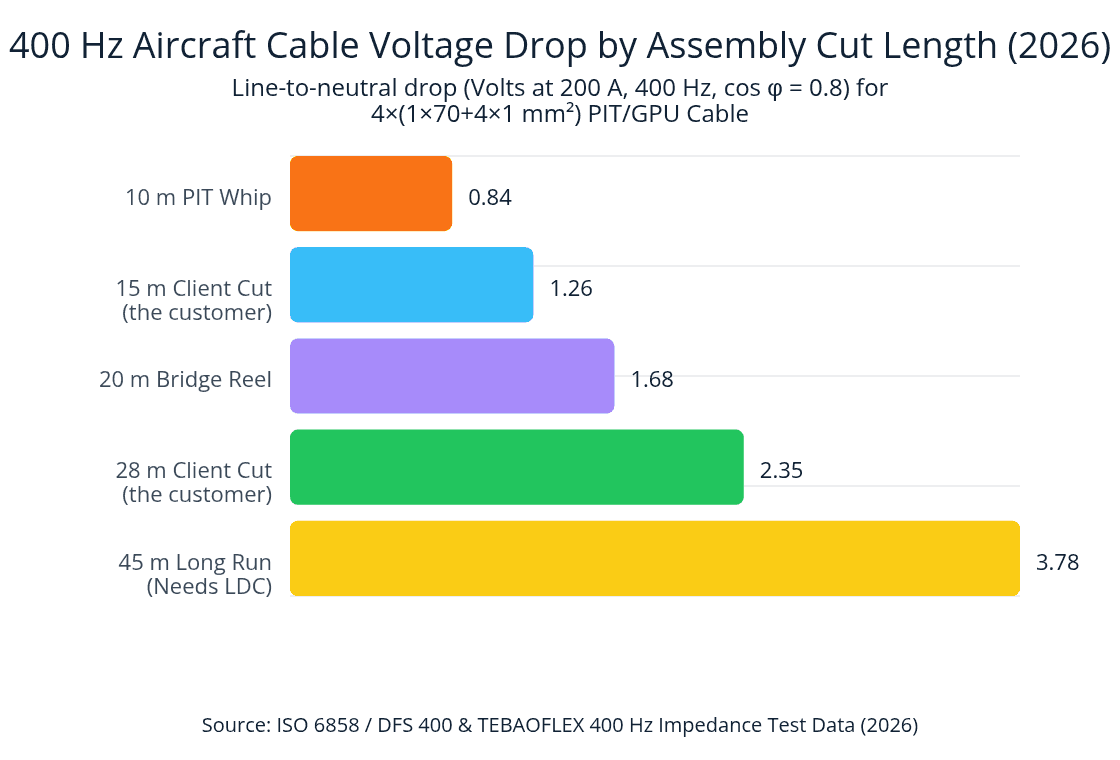
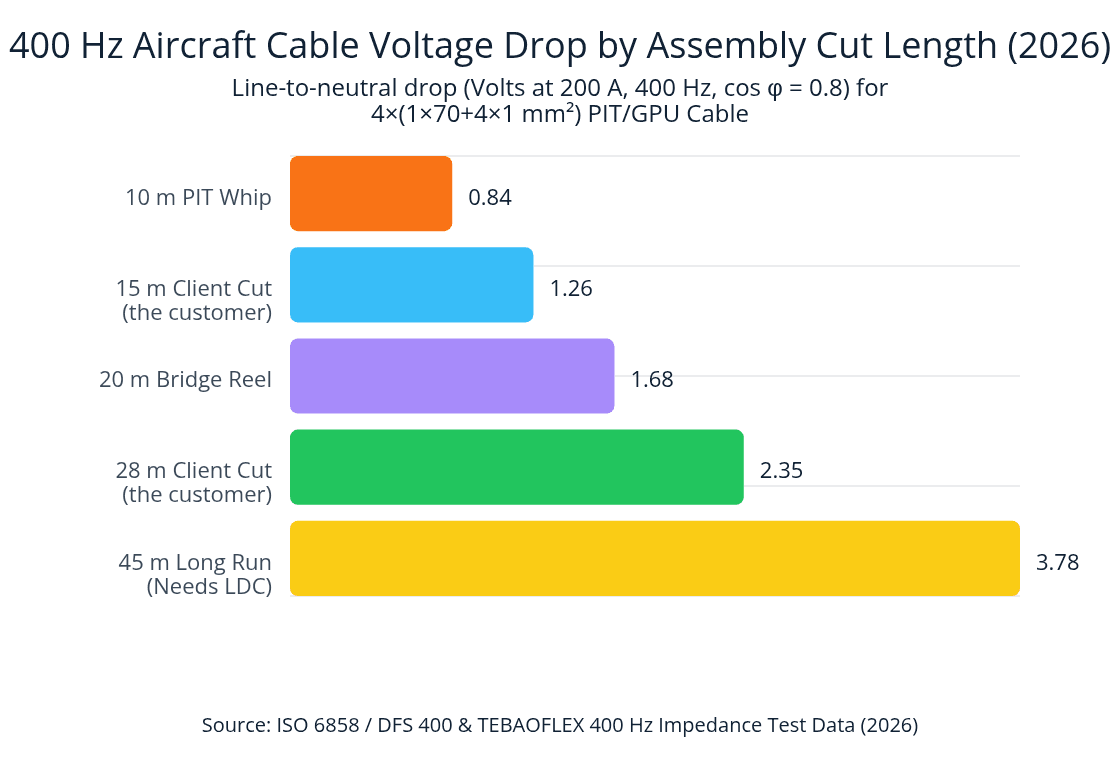
400 Hz Aircraft Cable Voltage Drop by Assembly Cut Length (2026). horizontal bar data: 10 m PIT Whip 0.84; 15 m Client Cut (the customer) 1.26; 20 m Bridge Reel 1.68; 28 m Client Cut (the customer) 2.35; 45 m Long Run (Needs LDC) 3.78. Source: ISO 6858 / DFS 400 & TEBAOFLEX 400 Hz Impedance Test Data (2026).
Source: ISO 6858 / DFS 400 & TEBAOFLEX 400 Hz Impedance Test Data (2026).
At a 200 A load, the customer's 15 m cut causes only a 1.26 V drop, and the 28 m cut stays at 2.35 V. Both lengths stay safely below 3.0 V. Meanwhile, the 16 × 1.0 mm² FEP control wires give the GPU dedicated sensing lines to boost voltage during peak loads.
Factory Acceptance Testing (FAT), Jacket Markings & Plug Selection
Before spooling order, our test lab ran a full test methodology on both the single sub-cables and the finished 4-core bundle.
1. Sub-Cable Print Legend, Phase Numbering & Helical Lay Inspection
In our testing, we checked the inkjet print along each yellow PUR sub-cable per IEC 60228. Each sub-cable carries the clear mark: TEBAOFLEX Aircraft 400 Hz Ground Power Supply Cable 4x(1x70+4x1) 0435M 1 (with phase numbers 1, 2, 3, and 4 printed on the four sub-cables).
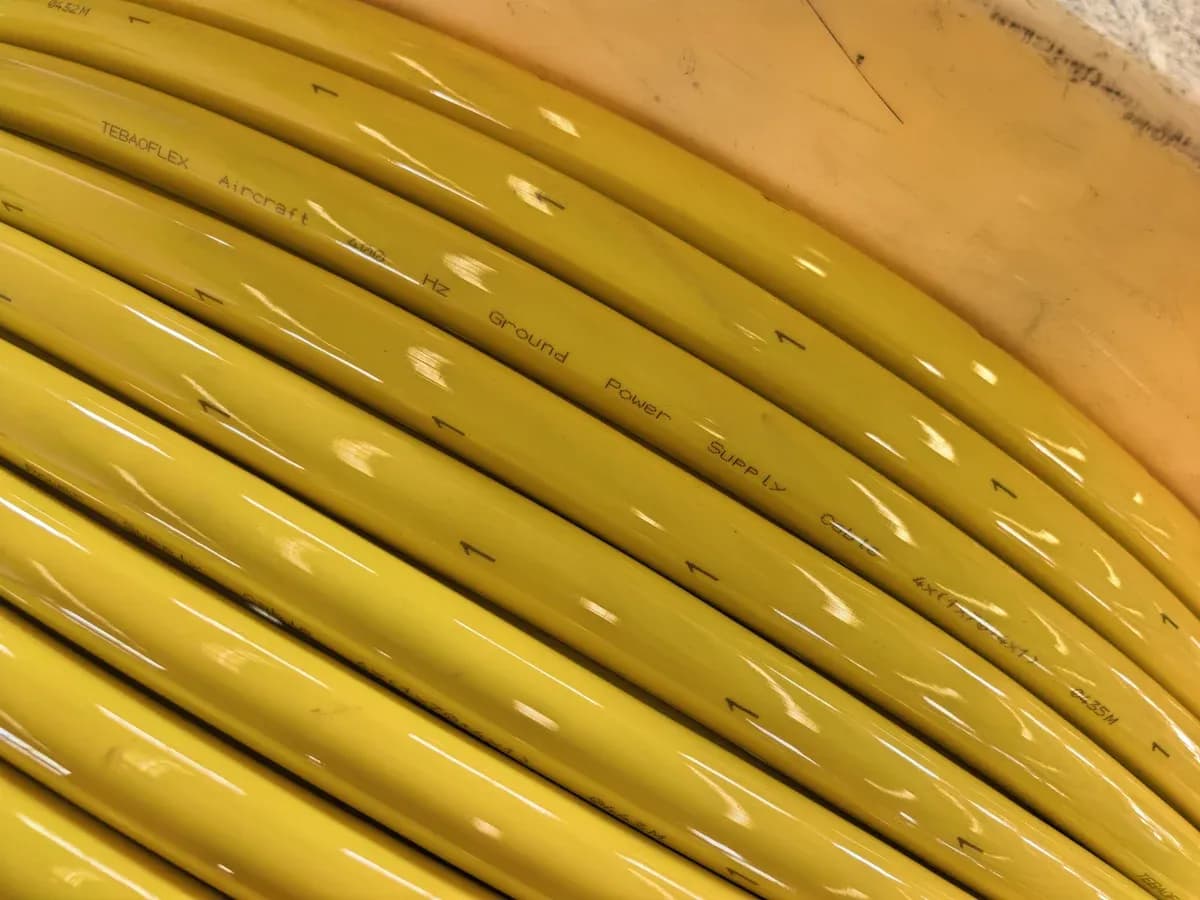
We also checked the lay pitch on the finished 4 × (1×70+4×1) bundle next to the 2 × (1×120+4×1) (0095M) cable. This confirmed that all sub-cables stayed tightly wound without gaps on the drum.
TEBAOFLEX PRE-SHIPMENT FACTORY ACCEPTANCE TEST (FAT) LOG
---------------------------------------------------------------------------
1. Power & Control Conductor Stranding (IEC 60228 Class 5 & Class 6):
   - 4 x 70 mm² tinned copper Class 5; 16 x 1.0 mm² tinned copper Class 6 -> PASS.
2. Insulation & Sheath Material Check:
   - Black EPR power insulation, Grey white-numbered FEP control cores, Yellow PUR -> PASS.
3. Cold-Bend & Low-Temperature Reeling Verification (-40°C Dynamic / -50°C Fixed):
   - Polyether PUR outer sheath showed zero cracking after -40°C flex check -> PASS.
4. Surface Print Legend, Phase Numbering & Meter Marks:
   - "TEBAOFLEX Aircraft 400 Hz Ground Power Supply Cable 4x(1x70+4x1)" + Cores 1-4 -> PASS.
5. 20°C DC Conductor Resistance & Dielectric Voltage Withstand Test:
   - 70 mm² and 1.0 mm² resistance within IEC 60228 limits; HV test passed -> PASS.
2. Aviation Plug Options: Customer Self-Installation vs. Factory Termination
During order planning, we offered two plug options for the CD-400HTG-M1 civil aviation power plug. Our European-trained techs could mount the plugs at our plant, or we could ship loose TOC plugs. TOC is an American-tech plug brand made in China that holds a 65% domestic airport market share (TEBAOFLEX Market Survey, 2026). Because the customer runs its own assembly shop in Saint Petersburg, the client bought loose plugs for self-mounting and shipped the cable and plugs together.
Wooden Drum Lagging & Production Lead Time
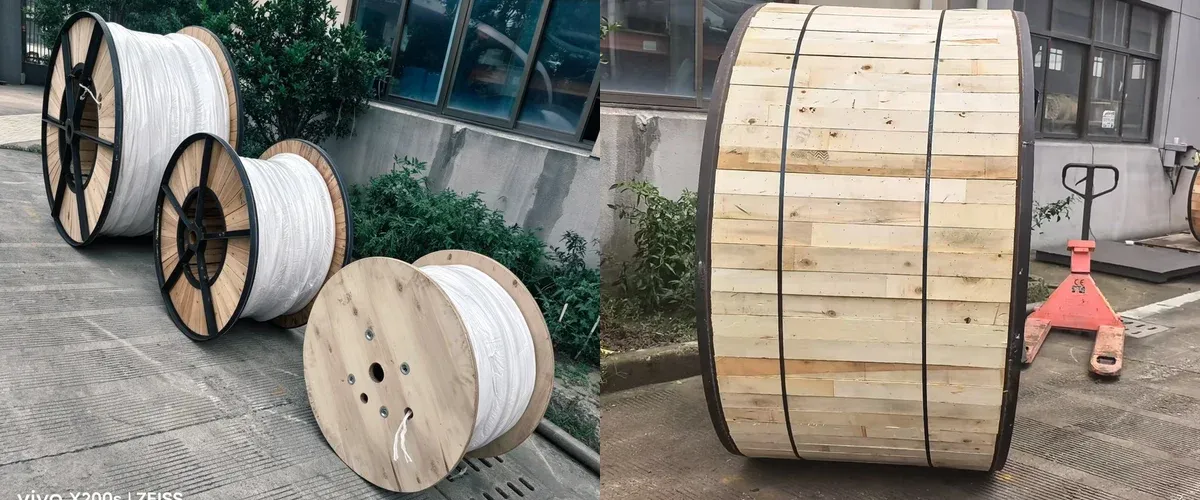
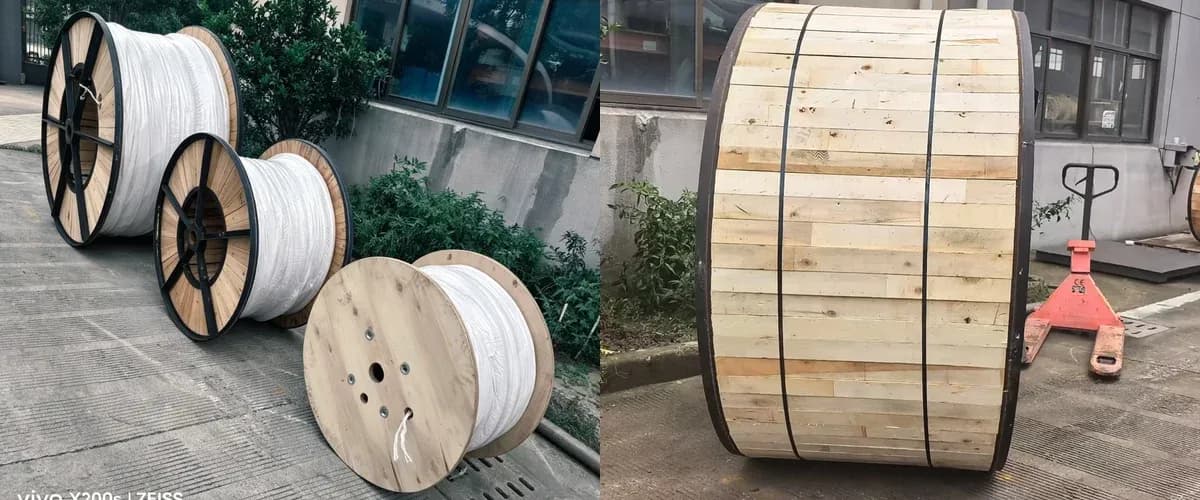
After passing all factory tests, the 450 m order and companion reels were wound onto heavy wooden export drums. Each drum was wrapped in film and bubble wrap, then sealed with full wooden battens for transit to Russia.
- Fast Production Schedule. TEBAOFLEX finished the
450 m4 × (1×70+4×1)cable run in 20 days. We also matched the35 to 40 dayCD-400HTG-M1/TOCplug schedule so both items shipped in one lot.
Frequently Asked Questions (FAQ)
Below are answers to the 4 key questions from our Russian civil aviation cable project under IEC 60228 and ISO 6858.
Will the yellow PUR jacket crack during repeated reeling at -40°C in Russian winters?
No. TEBAOFLEX uses a cold-flex polyether PUR jacket rated for -40°C to +90°C in mobile reeling and -50°C to +90°C in fixed use. It also handles +110°C short-time heat for 7,500 hours and will not crack on icy aprons.
Why are four 1.0 mm² FEP control wires built inside each 70 mm² sub-cable?
Each 70 mm² power core holds four 1.0 mm² Class 6 tinned copper wires with grey white-numbered FEP (F-46) insulation. These 16 control wires carry the 28 V DC plug interlock loop (E/F pins) and voltage feedback without needing an extra cable.
Can TEBAOFLEX supply 400 Hz aircraft plugs or pre-terminated cable assemblies?
Yes. We supply loose CD-400HTG-M1 or TOC 400 Hz plugs for buyers with their own assembly shops. Or our European-trained techs can deliver pre-mounted, tested 15 m and 28 m cable assemblies.
What is the production lead time for 4×(1×70+4×1) 400 Hz aviation cable?
For a 450 m order of 4 × (1×70 mm² + 4×1.0 mm²) 400 Hz aircraft cable, production takes 20 days. If you order CD-400HTG-M1 plugs to ship with the cable, total lead time is 35 to 40 days.
Next Steps & Technical Inquiries
Need 400 Hz 4 × (1×70+4×1 mm²) or 28 V DC 2 × (1×120+4×1 mm²) aircraft ground power cables built to IEC 60228 and ISO 6858 for airport PIT boxes, mobile GPUs, or boarding bridges?
- Explore our Trailing & Reeling Cable Catalog for high-flex airport and industrial cables.
- Review our Airport and Airfield Cable Applications and cold-weather compounds.
- Check our International Cable Standards & Approvals.
- To request a 400 Hz datasheet or TOC plug quote, visit our Contact Us page. You can also email
info@tebaoflex.comor message us on WhatsApp at +86 185 9591 3361.
Contact TEBAOFLEX on WhatsApp: +86 185 9591 3361