Case study
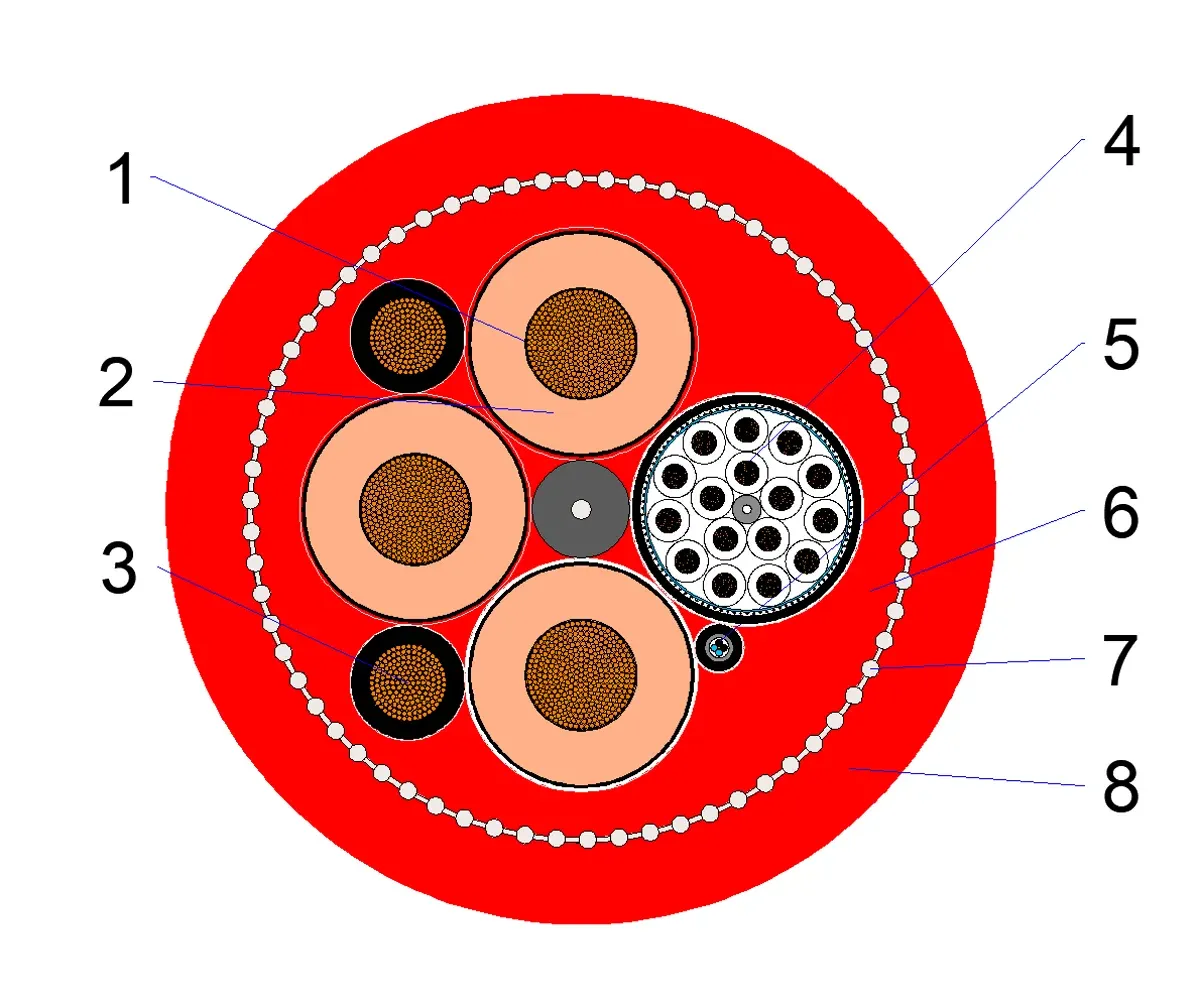
A cross-section from TEBAOFLEX's own reeling-cable production, close in construction to the cable built for this project.
A maintenance and installation company responsible for reel-fed equipment at a port in Vladivostok, in Russia's Far East, needed to replace the cable running to its cable-drum equipment. Sourcing from Europe had meant long lead times. An earlier search among Chinese suppliers hadn't turned up one the company was ready to commit to. That's the position the customer was in when they reached TEBAOFLEX.
As part of that first conversation, TEBAOFLEX shared photos and short video from previously completed orders — finished cable, on the reel, ready to ship — the same kind of in-process documentation the company routinely sends customers as an order moves through production. What followed was a detailed, technical back-and-forth that settled a full custom specification, a Russian standards question, and how a Chinese manufacturer and a Russian buyer would actually handle payment and delivery. This case study walks through how that order came together.
The request: power, control, and fiber optic in one reeling cable
The customer needed a cable built specifically for winding and unwinding on a cable reel — not a fixed installation cable — rated for medium voltage and carrying data alongside power. The agreed specification was:
(6/10 kV) 3×35 + 2×25/2 + (16×2.5)C + 24FO (62.5/125)
That notation describes a single cable combining four different jobs in one jacket:
- 3×35 mm² power conductors — electrolytic, stranded, tinned copper, built to DIN VDE 0295 Class 5 and DIN EN 60228 Type 6 (the fine, multi-strand, highly flexible conductor construction reeling applications need), wrapped in a semi-conductive conductor shield.
- Main insulation — an EPR rubber compound, selected for high mechanical strength and pressure resistance, with its own semi-conductive insulation shield.
- 2×25 mm² ground conductor, same tinned-copper construction, independently insulated.
- 16×2.5 mm² control cores, same conductor construction, for the equipment's control and signal circuits.
- A 24-core, 62.5/125 µm fiber-optic element, integrated into the same cable for data transmission alongside the power and control circuits.
Combining power, control, and fiber optic in one reeling cable is a recognized configuration in this segment of the cable industry — multiple manufacturers offer medium-voltage reeling cables with an integrated fiber-optic element for exactly this reason: reel-fed equipment with cameras, sensors, or control systems needs a data path that survives the same repeated winding as the power circuit. This order applied that configuration to the customer's own equipment and duty requirements.
Built to survive the drum, not just carry current
A cable that spends its working life winding and unwinding under tension needs a different construction than one that's installed once and left alone. Two layers in this design do that job specifically:
- An extruded rubber inner sheath, formulated for cable-reel duty.
- A Kevlar aramid-fiber braided layer, wrapped around the core assembly specifically for anti-tensile and anti-twisting strength, ahead of a weather- and cold-resistant rubber outer sheath rated for abrasion, waterproofing, repeated winding, corrosion, and UV exposure.
The agreed mechanical and electrical parameters give a sense of what that construction has to hold up under:
- Parameter: Rated voltage — Specification: 6/10 kV (isolated-neutral network, 50 Hz), max. AC at least 12 kV
- Parameter: Flexibility class — Specification: ≥ 5 cl (TPZ wire ≤ 0.26 mm)
- Parameter: Max. theoretical weight — Specification: 4.35 kg/m
- Parameter: Max. DC resistance at 20°C — Specification: Phase conductor 0.565 Ω/km; ground conductor 0.795 Ω/km
- Parameter: Dynamic tensile load (during acceleration) — Specification: ≥ 3,150 N
- Parameter: Cable outer diameter — Specification: 48–53 mm
- Parameter: Max. reeling speed — Specification: 200 m/min
- Parameter: Operating temperature — Specification: −30°C to +80°C
- Parameter: Design life — Specification: ≥ 10 years
Both ends of the finished cable ship with terminal connectors already installed — power, control, and fiber cores each with a minimum 2,000 mm stub length, and the fiber core independently terminated as well. The order itself was split across two reels, 125 m and 175 m, for 300 m of cable in total — matching how the customer needed to receive and install it, rather than one continuous, harder-to-handle length.
Meeting a Russian marking standard with a VDE-built cable
The customer's own requirement was specific: cable marking has to comply with GOST 18690-2012 and GOST R 55025-2012 — the Russian/interstate standards governing marking, packaging, transportation, and storage of cables and cable fittings. Given a Chinese manufacturer building to VDE/DIN practice, the customer pushed for a direct answer: which standard would actually govern, and did it match TEBAOFLEX's own certification?
TEBAOFLEX's answer was that the two weren't in conflict for this order: the finished cable would carry the brand marking, spacing, and contrast the GOST clauses call for, printed on a cable built and constructed to VDE/DIN practice. TEBAOFLEX's product range separately carries VDE, KTL Safety, and ISO 9001/14001/45001 marks, along with a UL/cUL certificate (file E553318) and a CE-related compliance record — company- and range-level credentials, alongside the marking commitment made specifically for this order.
Getting a 300-meter cable from Jiangsu to the Russian Far East
TEBAOFLEX's factory sits in Taicang, Jiangsu — about 68 km, roughly an hour's drive, from Shanghai port. For this order, that meant two realistic shipping routes: direct to Shanghai port, or on to Qingdao, reachable in about two days by standard groupage freight or one day by dedicated truck from the factory.
The other practical question a Russian buyer has to solve is payment. TEBAOFLEX holds a VTB Bank account able to receive both RUB and RMB directly from Russian customers — a channel that's become one of the more common ways Chinese suppliers accept direct payment from Russian buyers since Western banking restrictions complicated other routes, letting a customer pay without routing through an intermediary bank.
Keeping a custom order on schedule
Against the customer's 300-meter, two-reel order, TEBAOFLEX quoted roughly 20 days of production time, depending on exactly when the order was placed. That estimate sits alongside a broader practice: TEBAOFLEX tracks every order internally and shares dated photo and video updates as production moves through its stages — stranding and cabling, braiding, and the finished coiled cable — so a customer isn't waiting on a single delivery-day status update.
Termination options
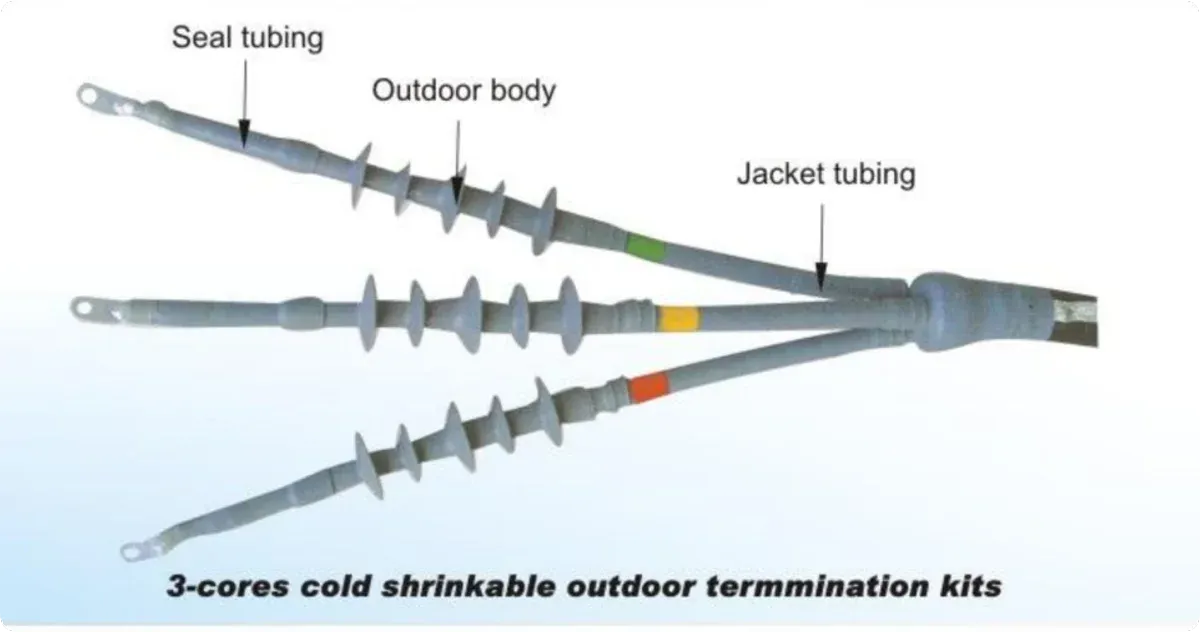
Terminal connectors for the finished cable weren't included as a default in this quote. TEBAOFLEX flagged the extra cost up front and left the customer two paths: source a connector locally in Russia based on the cable's finished outer diameter, or have TEBAOFLEX supply one. Where TEBAOFLEX supplies the termination, its recommendation for this cable was an outdoor cold-shrink kit rated 8.7/15 kV, 3×25 mm² — a three-core kit built around seal tubing, an outdoor body, and jacket tubing on each phase lead.
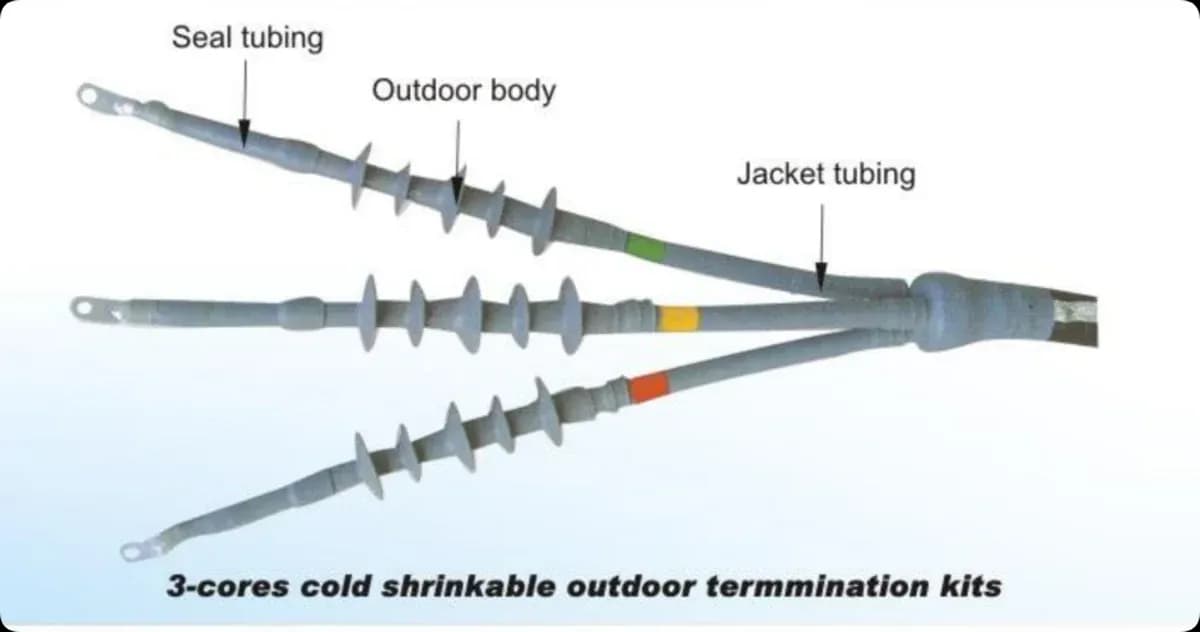
A 3-core cold-shrink outdoor termination kit of the type recommended for this cable.
Inside the cable
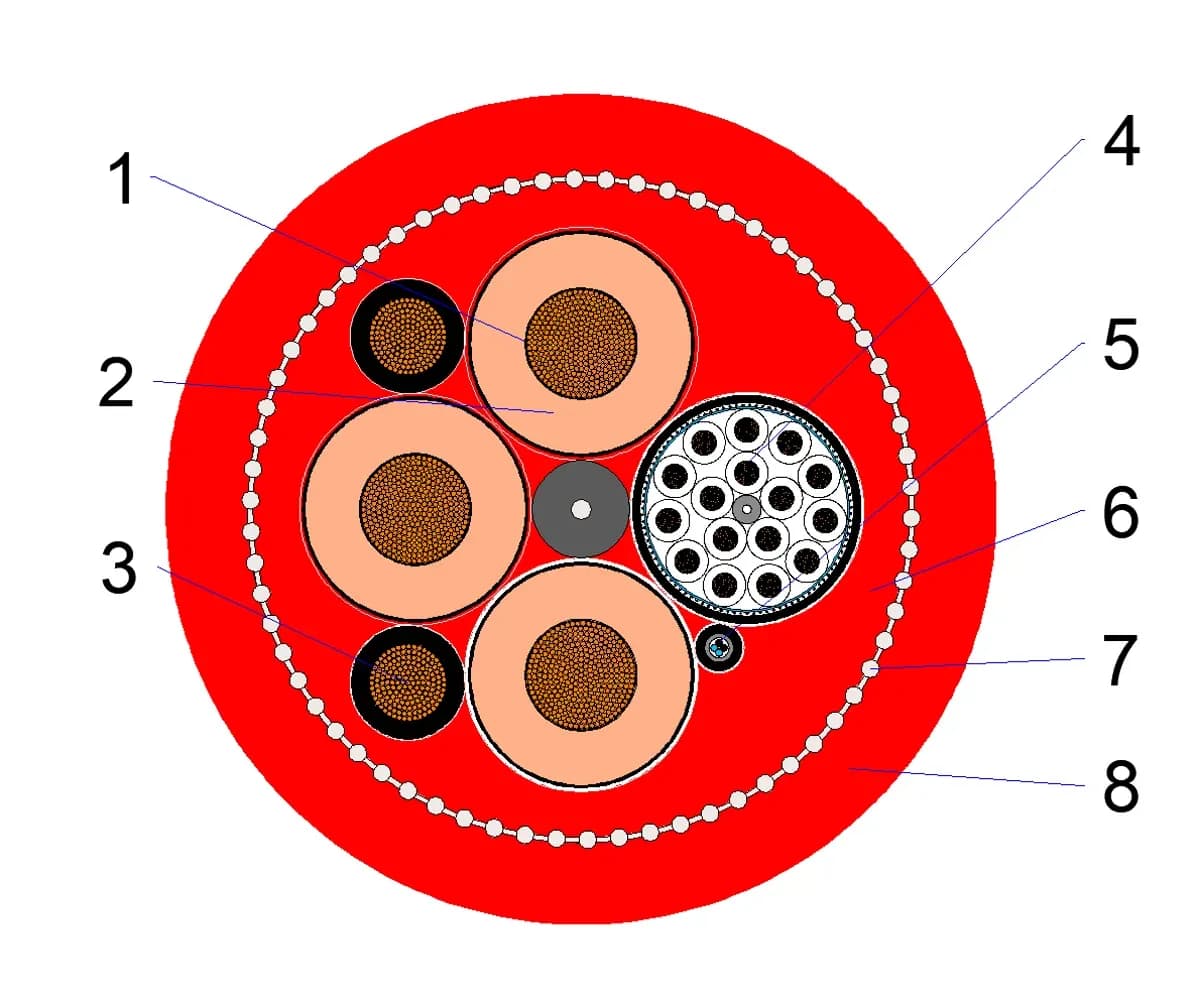
The cable's construction, layer by layer, as specified for this order.
Frequently asked questions
Does a VDE/DIN-standard cable satisfy Russian GOST cable-marking requirements?
It can, on the specific marking clauses those standards govern. GOST 18690-2012 and GOST R 55025-2012 set requirements for how a cable is marked, packaged, transported, and stored — brand name printed on the jacket, spacing between marks, contrasting print color, durability — rather than redefining the cable's own electrical or mechanical design. A cable built to VDE/DIN practice can still be manufactured and marked to meet those specific GOST clauses, which is the approach TEBAOFLEX took for this order.
Can one reeling cable combine medium-voltage power cores, control cores, and fiber optic together?
Yes — it's a recognized configuration for reel-fed equipment that needs both power and a data path on the same drum. This order's cable combined 3×35 mm² power conductors, a 2×25 mm² ground conductor, 16×2.5 mm² control cores, and a 24-core 62.5/125 µm fiber-optic element in one jacket, engineered for one-directional winding under the tensile and anti-torsion loads that puts on the cable.
Are cable terminations/connectors included with a custom reeling cable order, or supplied separately?
Not by default. TEBAOFLEX quotes terminations as an added cost on top of the cable itself, and a customer can choose to source a connector locally instead, matched to the cable's finished outer diameter. Where TEBAOFLEX does supply the termination, it recommends a kit sized and rated to the specific cable — an outdoor cold-shrink, 3-core, 8.7/15 kV kit for this order.
How can a Russian buyer pay a Chinese cable manufacturer directly?
TEBAOFLEX holds a VTB Bank account that accepts both RUB and RMB directly from Russian customers. Routing payment through VTB's China-side banking has become one of the more common channels Russian buyers use to pay Chinese suppliers directly since other cross-border banking routes became more difficult.
How long does custom production take, and can the cable be supplied in specific reel lengths?
For this 300-meter order, TEBAOFLEX quoted about 20 days of production, split across two reels — 125 m and 175 m — matched to how the customer needed to receive the cable, rather than as one continuous length. Exact lead time depends on factory scheduling at the time an order is actually placed.
Ready to specify a custom reeling cable?
TEBAOFLEX builds cable-reel and drum cable to a project's own electrical, mechanical, and standards requirements — including combined power, control, and fiber-optic constructions like this one. Contact TEBAOFLEX directly to work through a specification.