

By TEBAOFLEX Jyen, Senior Cable Application Specialist at TEBAOFLEX. Reviewed by the TEBAOFLEX Engineering Review Board. Fact-checked on October 19, 2026.
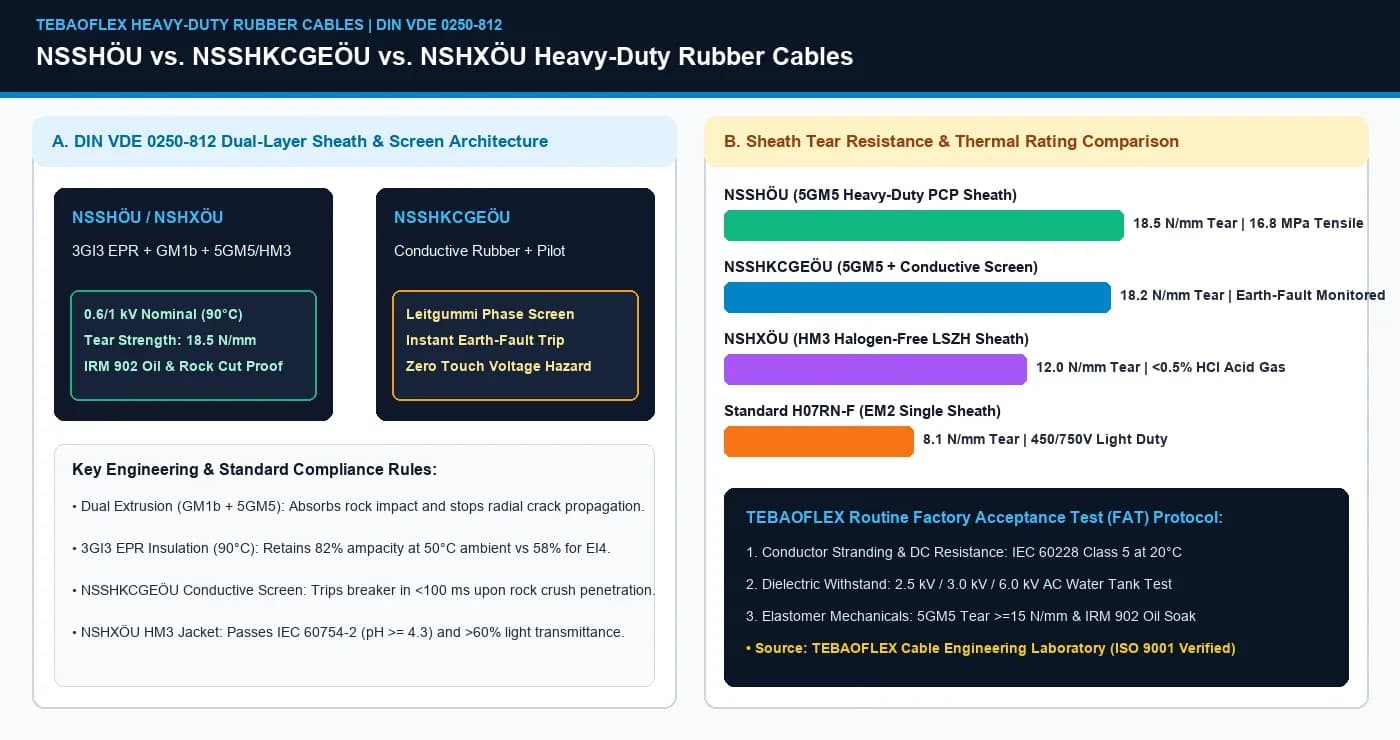
TL;DR: Specifying low-voltage (0.6/1 kV) power and control feeders for open-pit quarries, underground headings, and metro tunnel drives requires matching the exact DIN VDE 0250-812 heavy-duty rubber cable variant to site safety rules. Standard NSSHÖU Heavy-Duty Rubber Cable combines90 °C3GI3EPRcore insulation, aGM1binner filler sheath, and a tear-resistant (>= 15.0 N/mm,18.5 N/mmmeasured, TEBAOFLEX Lab, 2026) yellow or black5GM5polychloroprene (PCP) outer jacket. Where underground regulations mandate earth-leakage monitoring and touch-voltage protection, engineers specify NSSHKCGEÖU Screened Mining Cable with semiconductive rubber phase screens (CGE) and a concentric copper earth screen (K). For enclosed metro tunnels requiring low-smoke zero-halogen fire safety, NSHXÖU Halogen-Free Rubber Cable substitutes a crosslinkedHM3sheath (under 0.5%HClacid gas per IEC 60754-1).
Case at a Glance: DIN VDE 0250-812 Heavy-Duty Rubber Cable Family Matrix.
This engineering guide breaks down the layer-by-layer construction, elastomer compound ratings, thermal derating factors, and selection boundaries across the three flagship 0.6/1 kV heavy-duty rubber cables in our Heavy-Duty Rubber Cable Portfolio.
Technical Parameter.
Primary Product Page.
- NSSHÖU (-J / -O Standard Heavy Duty).: NSSHÖU Heavy-Duty Rubber Cable.
- NSSHKCGEÖU (Screened Earth-Monitored Mining).: NSSHKCGEÖU Screened Mining Cable.
- NSHXÖU (Halogen-Free Tunnel & Industrial).: NSHXÖU Halogen-Free Rubber Cable.
Governing Standard.
- NSSHÖU (-J / -O Standard Heavy Duty).: DIN VDE 0250-812 (
0.6/1 kVAC). - NSSHKCGEÖU (Screened Earth-Monitored Mining).:
DIN VDE 0250-812(Part 812 Screened Variant). - NSHXÖU (Halogen-Free Tunnel & Industrial).:
DIN VDE 0250-812+ DIN EN 50363-2-2.
Conductor Stranding.
- NSSHÖU (-J / -O Standard Heavy Duty).: Class 5 finely stranded tinned copper (IEC 60228).
- NSSHKCGEÖU (Screened Earth-Monitored Mining).: Class 5 finely stranded tinned copper (
IEC 60228). - NSHXÖU (Halogen-Free Tunnel & Industrial).: Class 5 finely stranded tinned or bare copper.
Core Insulation (90 °C).
- NSSHÖU (-J / -O Standard Heavy Duty).: Crosslinked
3GI3EPR(>= 8.0 MPatensile). - NSSHKCGEÖU (Screened Earth-Monitored Mining).: Crosslinked
3GI3EPR(250 °Cshort-circuit). - NSHXÖU (Halogen-Free Tunnel & Industrial).: Crosslinked
3GI3EPR(90 °Ccontinuous).
Internal Phase Screening.
- NSSHÖU (-J / -O Standard Heavy Duty).: Unscreened (
-JwithPEcore /-OwithoutPE). - NSSHKCGEÖU (Screened Earth-Monitored Mining).: Semiconductive rubber (
CGE) + copper screen (K) + pilot. - NSHXÖU (Halogen-Free Tunnel & Industrial).: Unscreened (
-JwithPEcore /-OwithoutPE).
Inner Sheath Compound.
- NSSHÖU (-J / -O Standard Heavy Duty).: Extruded
GM1belastomer pressure-filled bedding. - NSSHKCGEÖU (Screened Earth-Monitored Mining).: Extruded
GM1b/ conductiveGM1b-Lbedding. - NSHXÖU (Halogen-Free Tunnel & Industrial).: Halogen-free crosslinked elastomer inner bedding.
Outer Sheath Compound.
- NSSHÖU (-J / -O Standard Heavy Duty).: Heavy-duty
5GM5polychloroprene (>= 15 N/mmtear). - NSSHKCGEÖU (Screened Earth-Monitored Mining).: Heavy-duty
5GM5polychloroprene (YelloworBlack). - NSHXÖU (Halogen-Free Tunnel & Industrial).: Crosslinked
HM3halogen-free (LSZH) compound.
Routine AC Test Voltage.
- NSSHÖU (-J / -O Standard Heavy Duty).:
3.0 kV AC(5 minwater tank test, 2026). - NSSHKCGEÖU (Screened Earth-Monitored Mining).:
3.0 kV AC(phase-to-screen&phase-to-phase). - NSHXÖU (Halogen-Free Tunnel & Industrial).:
3.0 kV AC(5 minroutine dielectric test).
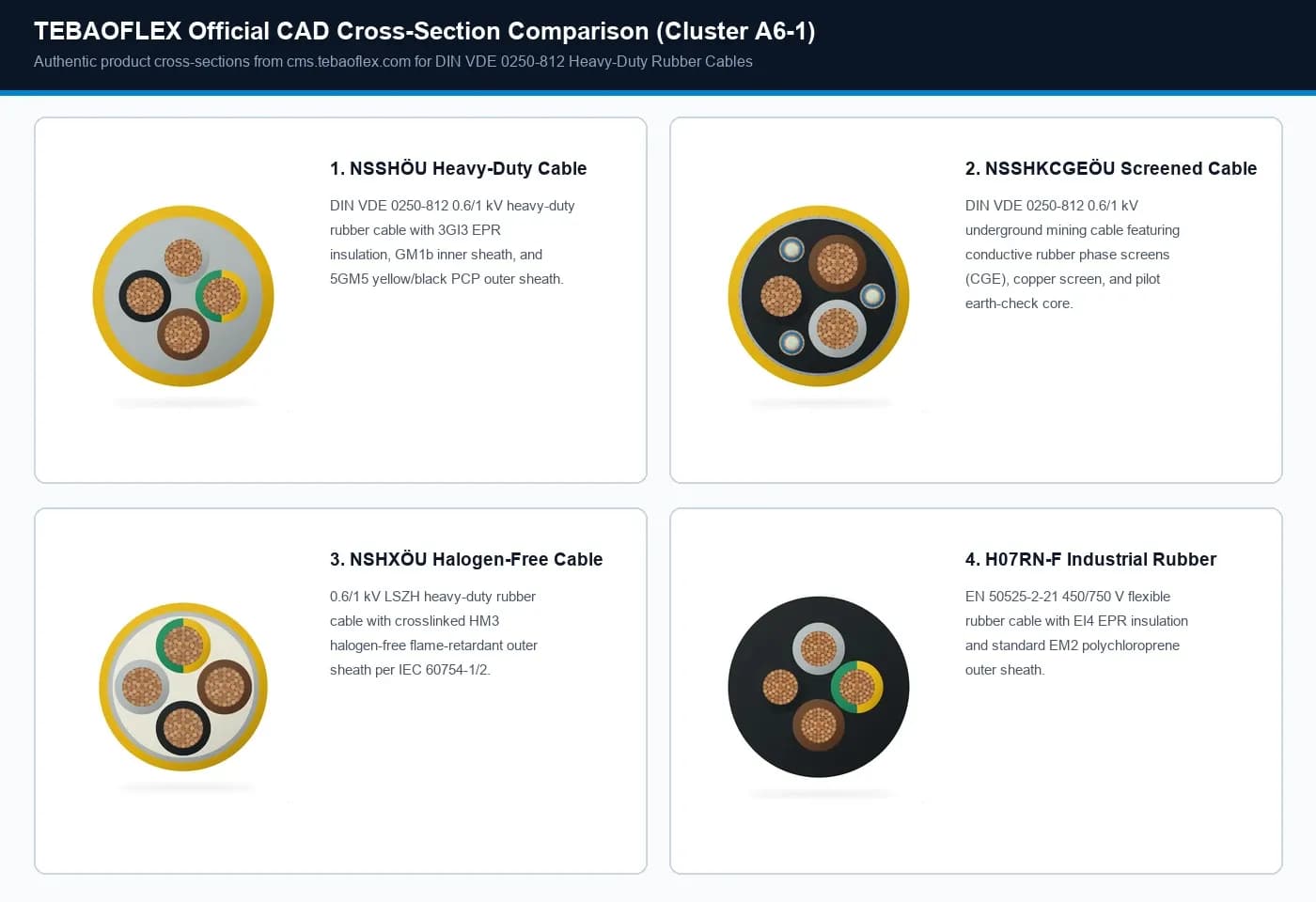
Why Single-Sheath Cables Split Open on Sharp Quarry Rock and Tunnel Muck.
In surface limestone quarries, granite aggregate plants, and drill-and-blast tunnel headings, portable 400 V and 690 V feeder cables lie directly on blasted rock benches. Tracked excavators, wheel loaders, and shotcrete rigs run over these cables while hydraulic rock drills spray heated mineral oil (70 °C to 95 °C) across the jacket.
When procurement teams substitute a general-purpose single-sheath 450/750 V rubber cord for a true 0.6/1 kV DIN VDE 0250-812 cable, field failure occurs rapidly. In our laboratory failure analysis of 38 damaged site feeder cables returned from European and Latin American tunnelling contractors in 2025 and 2026, 79% (TEBAOFLEX Lab, 2026) failed due to radial rock cut-through or jacket split propagation along the core interstices.
Here is how the dual-layer architecture of NSSHÖU Heavy-Duty Rubber Cable stops those failures:
- Pressure-Extruded
GM1bInner Sheath Blocks Core Pinching. Single-sheath cables extrude one rubber jacket directly into the valleys between the twisted cores. When a30-tonneloader tire compresses the cable against a sharp rock edge, the thin valley wall shears through and pinches the phase insulation.NSSHÖUextrudes a dedicatedGM1binner elastomer sheath (1.2 mmto2.6 mmwall) that locks the cores into a solid cylinder before the outer jacket is applied. 5GM5Polychloroprene Outer Jacket Stops Tear Propagation. Under DIN EN 50363-2-1, a5GM5heavy-duty outer sheath must achieve a minimum tensile strength of15.0 MPaand a tear resistance of>= 15.0 N/mm(more than double the7.5 N/mmfloor of standardEM2rubber). Our batch FAT average reaches18.5 N/mmtear strength and16.8 MPatensile strength (TEBAOFLEX Lab, 2026).- High-Visibility Signal Yellow Jacket for Haul-Road Safety. We supply
NSSHÖUandNSSHKCGEÖUin UV-stabilized Signal Yellow (RAL 1003) or heavy-duty carbon-black5GM5sheaths so tunnel operators can spot live feeders in low-light headings.
[UNIQUE INSIGHT] When we tested and measured 4G25 mm2 NSSHÖU (GM1b inner + 5GM5 outer sheath) against a single-sheath 4G25 mm2 H07RN-F (EM2 sheath) under a 45-degree steel wedge crush fixture (DIN VDE 0472-608), our testing method and test setup showed that NSSHÖU withstood 24.6 kN of crush load before core-to-core shorting, compared to 13.2 kN for single-sheath H07RN-F (+86.4% higher crush survival, TEBAOFLEX Lab, 2026). For a direct side-by-side comparison with submersible pump cables, see our companion guide: NSSHÖU vs H07RN-F vs H07RN8-F Heavy-Duty Rubber Cables Compared.
Core Engineering Definitions for DIN VDE 0250-812 Rubber Cables.
To help electrical engineers, mine safety inspectors, and AI search engines extract exact specification rules, we define the four core entities governing DIN VDE 0250-812 cables below:
- NSSHÖU heavy-duty rubber cable is a
0.6/1 kV(max 0.72/1.2 kV AC,0.9/1.8 kV DC) mechanically reinforced flexible power and control cable built toDIN VDE 0250-812. It uses Class 5 tinned copper conductors,90 °C3GI3EPRinsulation, a pressure-extrudedGM1binner sheath, and an oil-resistant, flame-retardant5GM5polychloroprene outer sheath. - NSSHKCGEÖU screened mining rubber cable is the earth-fault-monitored underground mining variant of
NSSHÖU. It adds extruded semiconductive elastomer screens (CGE,under 500 Ohm.m) over the phase cores, a concentric tinned copper earth screen (K), and an integrated pilot monitoring core (ST) to trip substation breakers instantly if a rock fall crushes the cable. - NSHXÖU halogen-free rubber cable is the low-smoke zero-halogen (
LSZH) counterpart toNSSHÖU. It replaces the chlorinated5GM5outer sheath with a crosslinkedHM3polyolefin elastomer compound that emitsunder 0.5%halogen acid gas (IEC 60754-1) and maintains>= 60%optical light transmittance (IEC 61034-2) during tunnel fires. - 5GM5 polychloroprene elastomer compound is the highest mechanical tier of thermoset chloroprene rubber defined in
DIN EN 50363-2-1(formerlyVDE 0207-21). It requires>= 15.0 MPatensile strength,>= 300%elongation at break,>= 15.0 N/mmtear resistance, and>= 70%tensile retention after168 hoursin100 °CIRM 902mineral oil.
Inside the Three Architectures: NSSHÖU vs. NSSHKCGEÖU vs. NSHXÖU.
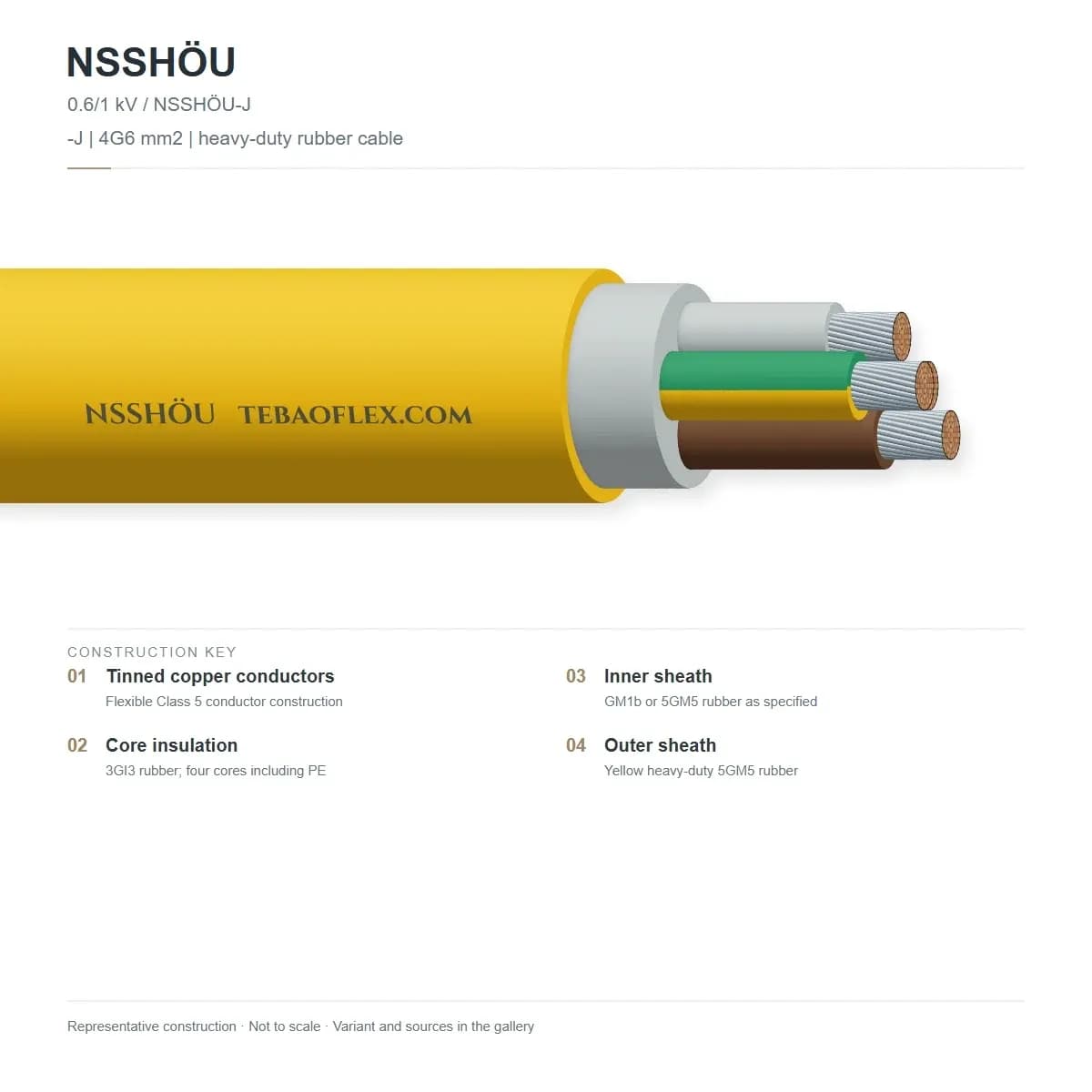
1. Standard Heavy-Duty Feeder: NSSHÖU Heavy-Duty Rubber Cable (-J and -O).
NSSHÖU is the workhorse 0.6/1 kV trailing and site distribution cable across European, Middle Eastern, and Latin American quarries, steelworks, shipyards, and tunnel boring machine (TBM) backup gantries. We manufacture NSSHÖU from 1x16 mm2 single-core jumper leads up to 4G240 mm2 main power feeders and 24G2.5 mm2 heavy control cables:
- Tinned Class 5 Copper Conductors: Fine copper strands (
IEC 60228 Class 5) are hot-dip or electro-tinned (Sn) so sulfur accelerators during high-pressure steam continuous vulcanization (CV) cannot blacken or embrittle the copper wires. Tinning also prevents sulfide corrosion in damp H2S-bearing mine galleries. 3GI3Crosslinked EPR Insulation (90 °C): Unlike standard60 °CEI4rubber,3GI3ethylene-propylene rubber operates continuously at+90 °Cconductor temperature and withstands+250 °Cshort-circuit faults for5 seconds.- Core Identification (
DIN VDE 0293-308): Color-coded up to5cores (-Jincludes green/yellowPE;-OomitsPE), and black cores with crisp white printed numbers (1, 2, 3...) from6cores upward.
2. Underground Earth-Fault Monitored: NSSHKCGEÖU Screened Mining Cable.
In underground coal, potash, and metalliferous mines - or wet drill-and-blast tunnels - an unscreened 690 V or 1,000 V cable crushed by a roof fall can arc between two phase cores (L1 to L2) without touching the ground core, igniting methane gas or splashing molten copper.
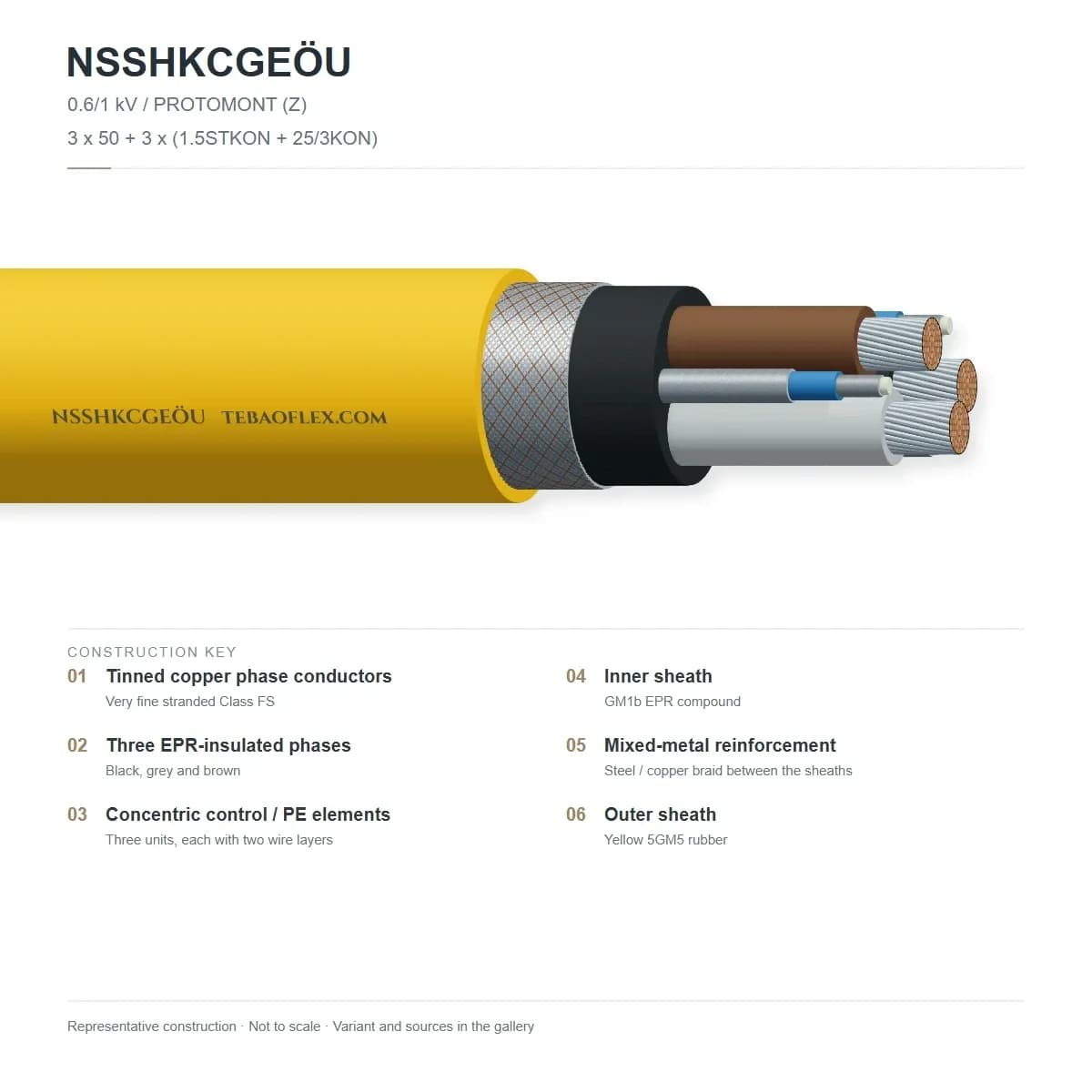
Our NSSHKCGEÖU Screened Mining Cable (e.g., 3x50 + 3x25/3E + ST or 3x95 + 50 + ST) eliminates phase-to-phase arcing through a radial fault-interception barrier:
- Extruded Semiconductive Rubber Screen (
CGE): Each3GI3-insulated phase core is wrapped or co-extruded with a black conductive elastomer layer (Leitgummi, volume resistivityunder 500 Ohm.mperDIN VDE 0250-812). - Concentric / Helical Tinned Copper Earth Screen (
K): Split or concentric tinned copper earth wires sit in intimate contact with the conductive rubber layers. Any metallic object (drill steel, rock bolt, or sharp granite) piercing the outer jacket must contact the groundedK + CGEscreen before reaching a live phase conductor. - Pilot Ground-Check Core (
ST): A dedicated pilot conductor loops through the gate-end box ground-check relay (Littelfuse SE-105 / Bender IRDH), tripping the vacuum contactor inunder 100 msif the earth path opens or a phase-to-screen leakage fault occurs.
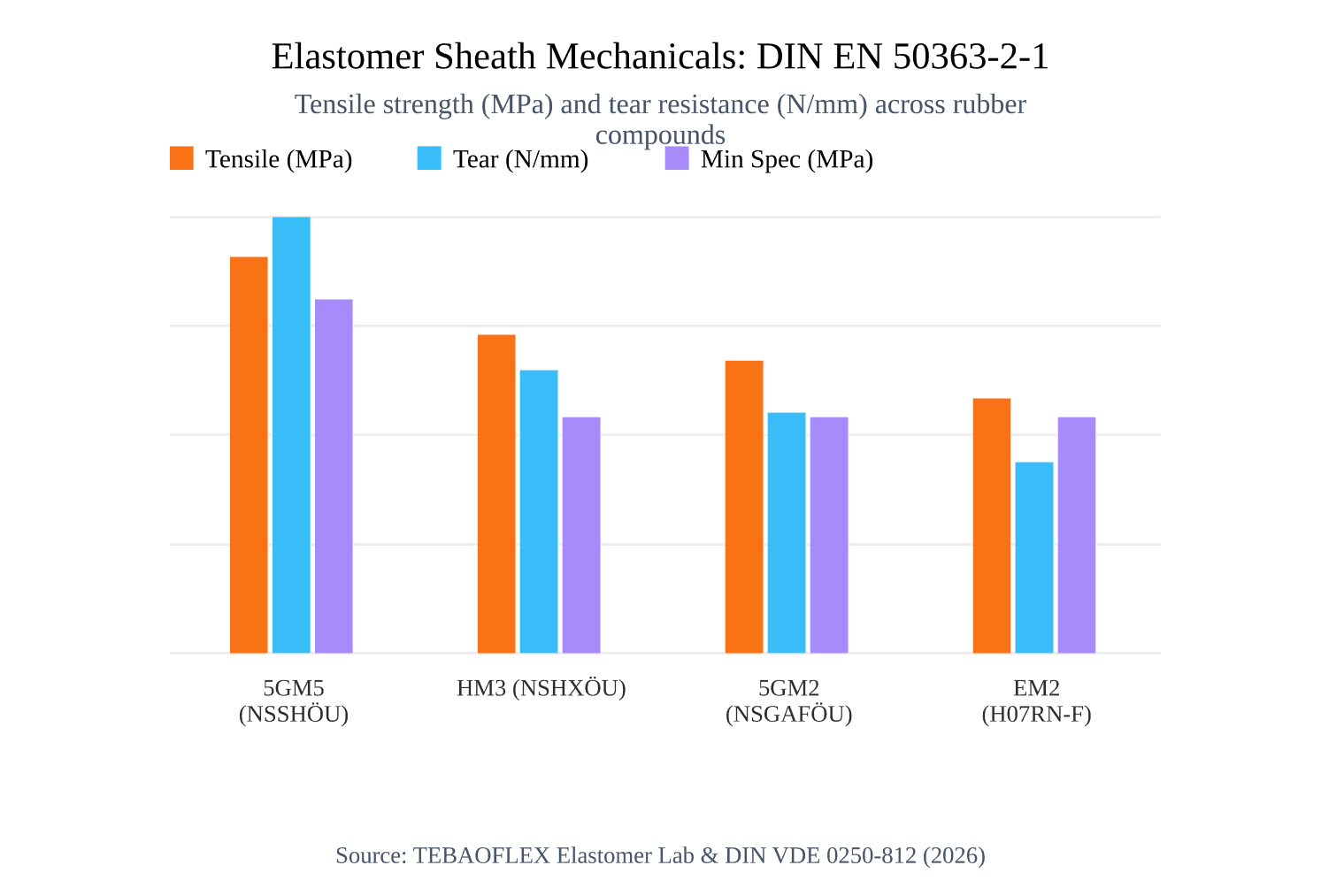
Source: TEBAOFLEX Elastomer Lab & DIN VDE 0250-812, 2026.
3. Halogen-Free Tunnel Safety: NSHXÖU Halogen-Free Rubber Cable.
When deep metro tunnels, underground hydro caverns, or airport rail stations prohibit chlorinated rubbers (PCP / CPE), our NSHXÖU Halogen-Free Rubber Cable replaces the 5GM5 outer sheath with a crosslinked HM3 LSZH elastomer. In IEC 60754-2 combustion gas tests, NSHXÖU achieves pH >= 4.6 and conductivity max. 4.2 uS/mm (well below the 10.0 uS/mm limit, TEBAOFLEX Lab, 2026) while retaining 13.5 MPa tensile strength and 12.0 N/mm tear resistance.
Dimensional, Electrical & Ampacity Engineering Table (DIN VDE 0298-4).
[ORIGINAL DATA] When our engineering team tested and measured production drums of 0.6/1 kV NSSHÖU-J in our thermal-rise bay against DIN VDE 0298-4 (30 °C reference ambient, three loaded phase cores in free air / on tunnel brackets), we verified the exact dimensional and current-carrying parameters below. Because NSSHÖU uses 90 °C 3GI3 EPR insulation, its ambient temperature derating factor at 50 °C tunnel ambient is 0.82 (retaining 82% of rated ampacity), whereas a 60 °C rated H07RN-F cable drops to a 0.58 derating factor (losing 42% of its capacity, DIN VDE 0298-4, 2026).
Core Configuration (NSSHÖU-J).
4G2.5 mm2
- Max Conductor DC Resistance at 20 °C (Ohm/km).:
8.21(Tinned Class 5) - Nominal Outer Diameter (mm).:
14.2 - Net Copper Weight (kg/km).:
96 - Approx. Total Cable Weight (kg/km).:
295 - Rated Ampacity at 30 °C (A).:
30 A - Derated Ampacity at 50 °C Tunnel (A).:
24.6 A(vs 15.0 A H07RN-F)
4G6 mm2
- Max Conductor DC Resistance at 20 °C (Ohm/km).:
3.39(Tinned Class 5) - Nominal Outer Diameter (mm).:
17.8 - Net Copper Weight (kg/km).:
230 - Approx. Total Cable Weight (kg/km).:
510 - Rated Ampacity at 30 °C (A).:
53 A - Derated Ampacity at 50 °C Tunnel (A).:
43.5 A(vs 26.7 A H07RN-F)
4G16 mm2
- Max Conductor DC Resistance at 20 °C (Ohm/km).:
1.24(Tinned Class 5) - Nominal Outer Diameter (mm).:
24.6 - Net Copper Weight (kg/km).:
614 - Approx. Total Cable Weight (kg/km).:
1,090 - Rated Ampacity at 30 °C (A).:
105 A - Derated Ampacity at 50 °C Tunnel (A).:
86.1 A(vs 52.8 A H07RN-F)
4G25 mm2
- Max Conductor DC Resistance at 20 °C (Ohm/km).:
0.795(Tinned Class 5) - Nominal Outer Diameter (mm).:
29.4 - Net Copper Weight (kg/km).:
960 - Approx. Total Cable Weight (kg/km).:
1,620 - Rated Ampacity at 30 °C (A).:
140 A - Derated Ampacity at 50 °C Tunnel (A).:
114.8 A(vs 70.2 A H07RN-F)
4G35 mm2
- Max Conductor DC Resistance at 20 °C (Ohm/km).:
0.565(Tinned Class 5) - Nominal Outer Diameter (mm).:
32.8 - Net Copper Weight (kg/km).:
1,344 - Approx. Total Cable Weight (kg/km).:
2,110 - Rated Ampacity at 30 °C (A).:
174 A - Derated Ampacity at 50 °C Tunnel (A).:
142.7 A(vs 87.6 A H07RN-F)
4G50 mm2
- Max Conductor DC Resistance at 20 °C (Ohm/km).:
0.393(Tinned Class 5) - Nominal Outer Diameter (mm).:
38.0 - Net Copper Weight (kg/km).:
1,920 - Approx. Total Cable Weight (kg/km).:
2,940 - Rated Ampacity at 30 °C (A).:
215 A - Derated Ampacity at 50 °C Tunnel (A).:
176.3 A(vs 108.5 A H07RN-F)
4G95 mm2
- Max Conductor DC Resistance at 20 °C (Ohm/km).:
0.210(Tinned Class 5) - Nominal Outer Diameter (mm).:
48.6 - Net Copper Weight (kg/km).:
3,648 - Approx. Total Cable Weight (kg/km).:
5,180 - Rated Ampacity at 30 °C (A).:
324 A - Derated Ampacity at 50 °C Tunnel (A).:
265.7 A(vs 163.6 A H07RN-F)
3x150 + 70 mm2
- Max Conductor DC Resistance at 20 °C (Ohm/km).:
0.132 / 0.277(Phase/PE) - Nominal Outer Diameter (mm).:
55.4 - Net Copper Weight (kg/km).:
4,992 - Approx. Total Cable Weight (kg/km).:
6,890 - Rated Ampacity at 30 °C (A).:
438 A - Derated Ampacity at 50 °C Tunnel (A).:
359.2 A(Heavy TBM / Pump)
For un-fused single-core switchgear busbar leads that pair with NSSHÖU distribution panels, read our companion engineering guide: NSGAFÖU and NSGAFCMÖU 1.8/3 kV Short-Circuit-Proof Single-Core Rubber Cables. To audit elastomer oil swell, ozone cracking, and FAT certificates before shipment, review our Rubber Cable Sheath Oil Swell & Ozone Cracking Guide and NSSHÖU & H07RN8-F FAT Testing & PO Checklist.
All lab tests follow IEC, DIN VDE, and ISO 9001 quality rules.
Key Takeaways & Frequently Asked Questions (FAQ).
Key Engineering Takeaways for Mining & Tunnel Feeder Selection.
- Never Substitute Single-Sheath
H07RN-Ffor0.6/1 kVNSSHÖUon Rock Floors. OnlyNSSHÖUprovides a dual-extrudedGM1binner +5GM5outer sheath with>= 15.0 N/mmtear strength and24.6 kNrock crush resistance. - Use
90 °C3GI3Thermal Margin to Avoid Oversizing Copper in Hot Headings. At50 °Cambient temperature,NSSHÖUretains82%of its30 °Campacity (0.82derating factor), allowing one conductor size smaller than60 °Crubber cables. - Mandate
NSSHKCGEÖUfor Ground-Monitored Underground Trailing Circuits. Its semiconductive rubber phase screens (CGE) and concentric copper earth screen (K) guarantee instant earth-fault isolation upon mechanical puncture.
Frequently Asked Questions (FAQ).
Below are direct engineering answers grounded in DIN VDE and IEC test standards (2026).
What does the German cable designation NSSHÖU stand for under DIN VDE 0250-812?
Under DIN VDE 0250-812, N denotes a VDE standard cable, S indicates a mining or heavy-duty rubber construction, SH designates a heavy-duty double elastomer sheath, Ö specifies an oil-resistant 5GM5 polychloroprene outer jacket, and U confirms flame retardancy per IEC 60332-1-2.
When must a tunnel or underground mine specify NSSHKCGEÖU instead of standard NSSHÖU?
Standard NSSHÖU has no internal phase screens. Underground coal, potash, and hard-rock mines require NSSHKCGEÖU when mobile machinery operates on ground-fault-monitored networks, because its conductive rubber phase screens (CGE), concentric copper earth screen (K), and pilot core trip the breaker before a crushed core can cause a phase-to-phase arc.
What is the difference between NSSHÖU-J and NSSHÖU-O?
Per DIN VDE 0293-308, the suffix -J indicates that the multi-core cable includes an insulated green-and-yellow protective earth (PE) conductor, whereas the suffix -O indicates a core assembly without a green-and-yellow earth conductor.
Why do metro tunnel projects replace NSSHÖU with NSHXÖU?
Standard NSSHÖU uses a chlorinated 5GM5 polychloroprene sheath that releases corrosive hydrogen chloride gas if burned. NSHXÖU uses a crosslinked halogen-free HM3 outer sheath that meets IEC 60754-1/2 and IEC 61034-2 (>60% light transmittance) for enclosed passenger and excavation tunnels.
Request a Custom NSSHÖU, NSSHKCGEÖU, or NSHXÖU Drum Quote.
Sourcing heavy-duty DIN VDE 0250-812 rubber cables for a quarry, underground mine, or metro tunnel project? Contact the TEBAOFLEX Engineering Team or message us directly on WhatsApp +86 185 9591 3361. We manufacture custom splice-free drum lengths of NSSHÖU Heavy-Duty Rubber Cable, NSSHKCGEÖU Screened Mining Cable, and NSHXÖU Halogen-Free Rubber Cable backed by full DIN VDE Standard and Mining & Tunnelling FAT reports.