
Video
What the video shows
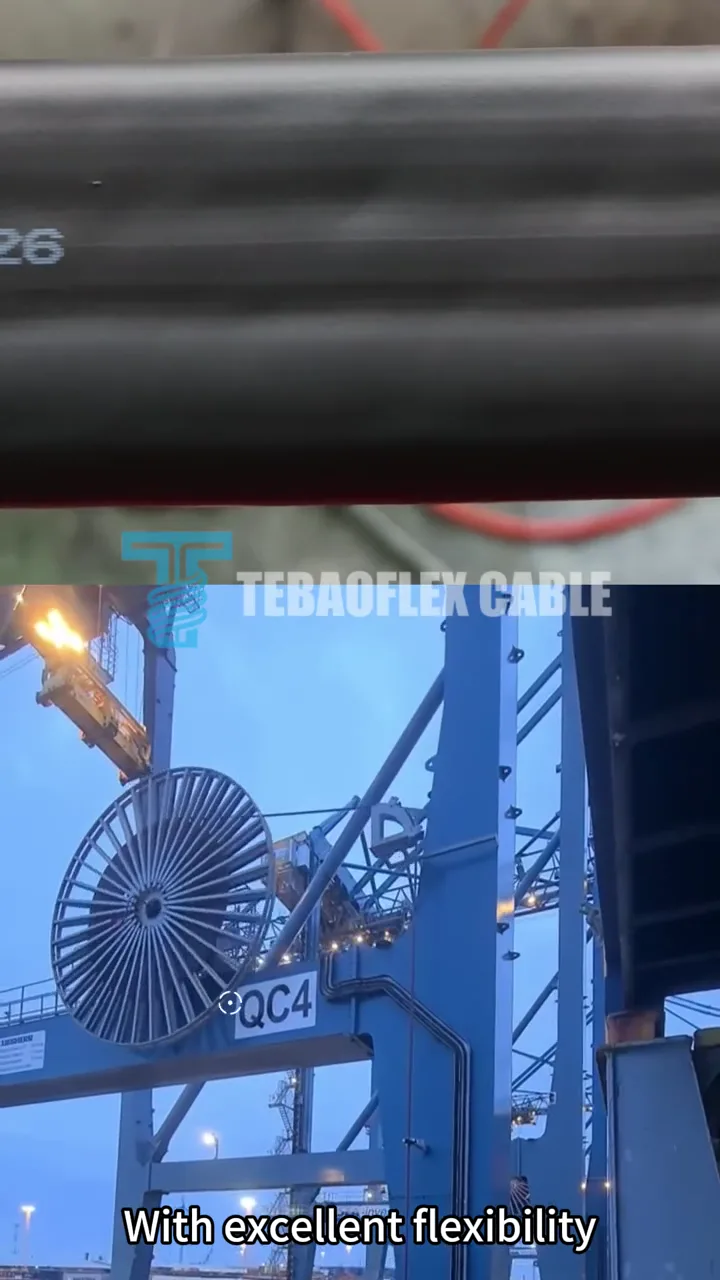
Close views show the PNCT cable sheath, printed marking, and multi-core conductor arrangement at the cable end.
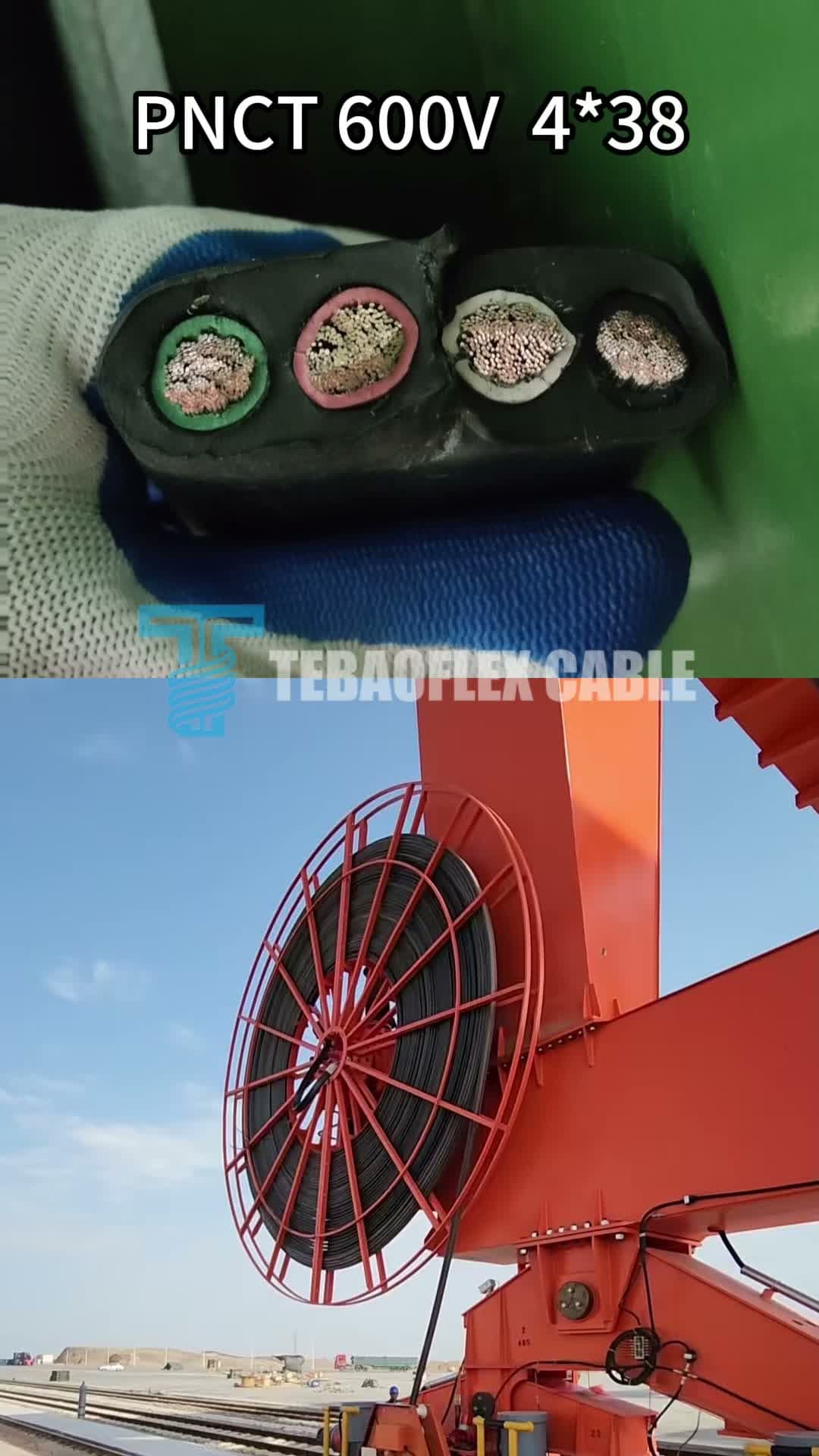
The application sequence shows port cranes, cable reels, bending paths, and repeated reeling or dragging duty. Final bending radius, movement frequency, reel design, and installation conditions require project review.
The video illustrates a sample, process, or operating context. Final product construction, suitability, standards, and test acceptance criteria are confirmed against the ordered specification.
PNCT cable product
Review the PNCT family and confirm movement-duty requirements.
PNCT cable productPNCT Cable: JIS C 3327 Specifications, Construction, and Port Crane Applications
A ship-to-shore or rubber-tyred gantry crane does not sit still, and neither does its power cable. Every hoist cycle, every trolley pass, every reel-in and reel-out winds and unwinds the same conductor against a drum or through a festoon trolley, thousands of times a year, often in salt air and direct sun. PNCT cable is the flexible power cable family built specifically for that duty — and it is what shows up, sheath cut open and reel spinning, in TEBAOFLEX's own PNCT application video.
What PNCT cable actually is
PNCT is a cable type designation defined under JIS C 3327, a Japanese Industrial Standard issued under Japan's Electrical Appliance and Material Safety Act for portable, cabtyre-type rubber cable. It is not a brand name or a single product — it is a construction family: flexible stranded copper conductors, an elastomeric (EPR-type) insulation on each core, and a chloroprene or similar rubber outer sheath, sized and stranded for repeated bending and reeling rather than fixed installation.
That base JIS specification centers on a 600 V class rated for continuous conductor operation up to roughly 80°C, across a -40°C to +80°C service range, with a factory test voltage of 3,000 V for one minute. Manufacturers building to the PNCT family — TEBAOFLEX included — commonly extend the same construction principle across a wider voltage range and offer several insulation and sheath rubber compounds (EPR, EPDM, CPE, nitrile, or silicone; CR, PCP, or CSP sheaths) to match different chemical, temperature, or flexing requirements, while keeping the same core idea: a cabtyre-type cable meant to survive constant movement.
Why port and container cranes specifically need it
A crane's cable duty is not like a building's. A cable wound onto a motorized reel drum experiences bending, tension, and torsion on every cycle; a cable carried through a festoon trolley system experiences a different, flatter bending pattern; a cable dragged in a trailing route takes abrasion and pulling load instead. Port and container-crane equipment — ship-to-shore cranes, rubber-tyred and rail-mounted gantry cranes, stackers and reclaimers — combines this constant mechanical cycling with an outdoor, often coastal environment: salt air, UV exposure, temperature swings, and dust or grit at ground level.
Ordinary fixed-installation cable is not built to survive that combination indefinitely. A PNCT-family cable's rubber insulation and sheath stay flexible through repeated winding rather than cracking, and the stranding is chosen specifically for continuous flex duty rather than a cable that is installed once and left in place.
Reading the designation: what "600V 4×38" means
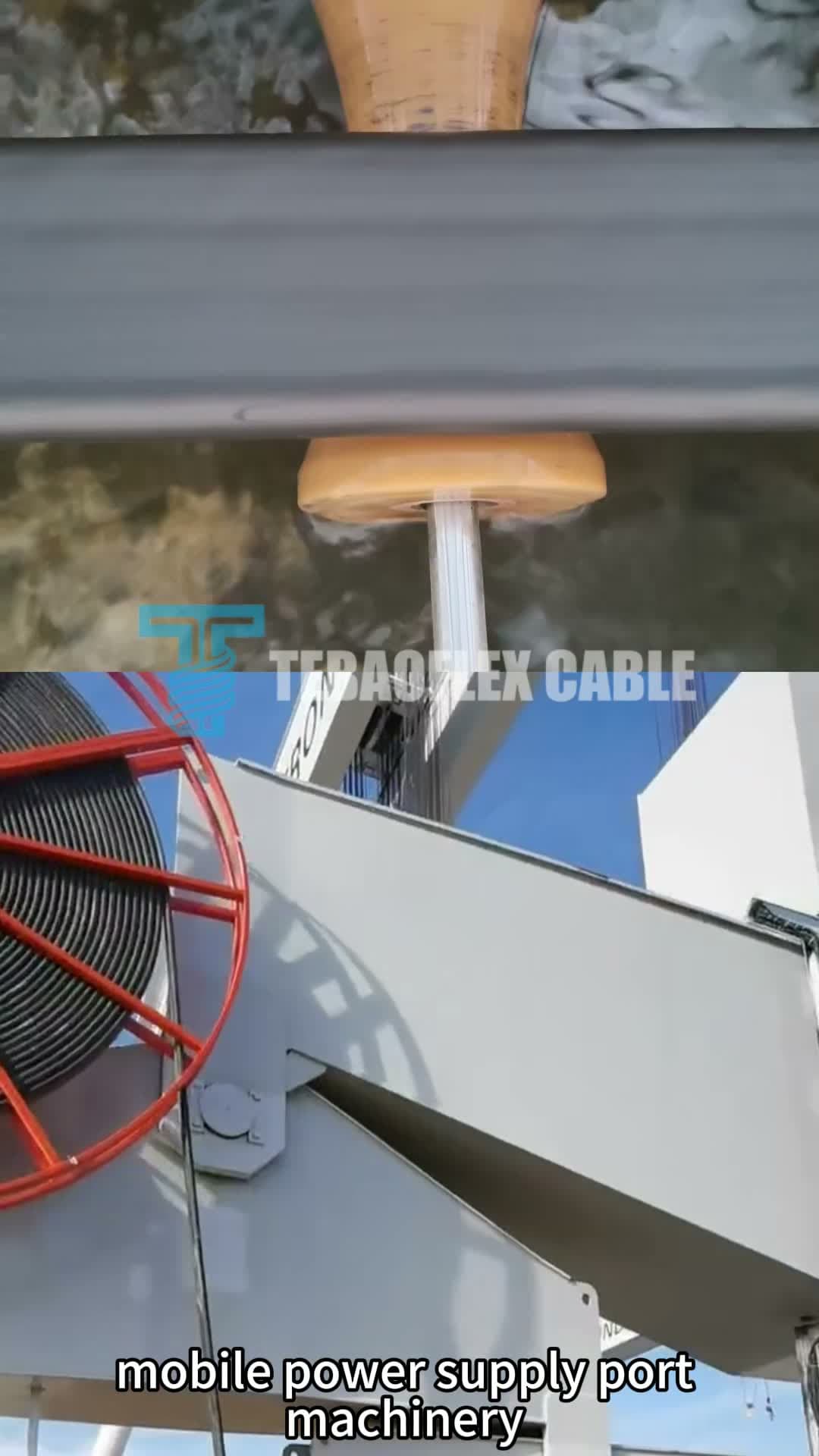
The label visible on the cable in the video — PNCT 600V 4×38 — follows the same logic as most flexible power cable designations: the cable type (PNCT), its voltage class (600 V), the core count (4), and the nominal cross-sectional area of each conductor in mm² (38). A 4×38 construction is a 4-core cable with roughly 38 mm² of copper per core — sized for a specific current-carrying and duty-cycle requirement on whatever hoist, trolley, or slewing motor it feeds. The exact core count and conductor size a given crane needs depends on its motor load, cable run length, and voltage drop allowance, which is why PNCT cable is offered across a wide range of core and size combinations rather than one fixed construction.
TEBAOFLEX's PNCT range
TEBAOFLEX manufactures PNCT-family cable across several related constructions — including PNCT-F/R and 2PNCT/2PNCT-SB/3PNCT variants — spanning voltage classes from 300/500 V and 450/750 V up to 600/1000 V, 3 kV, 6 kV, and 10 kV, with conductor sizes from roughly 2 mm² up to 300 mm² in 3-core and 4-core builds. Conductor, insulation, and sheath materials are selected per construction and duty rather than fixed across the whole range, which is what lets the same PNCT family cover a light auxiliary circuit on a small hoist and a heavy hoist or slewing motor feed on a ship-to-shore crane or stacker-reclaimer.
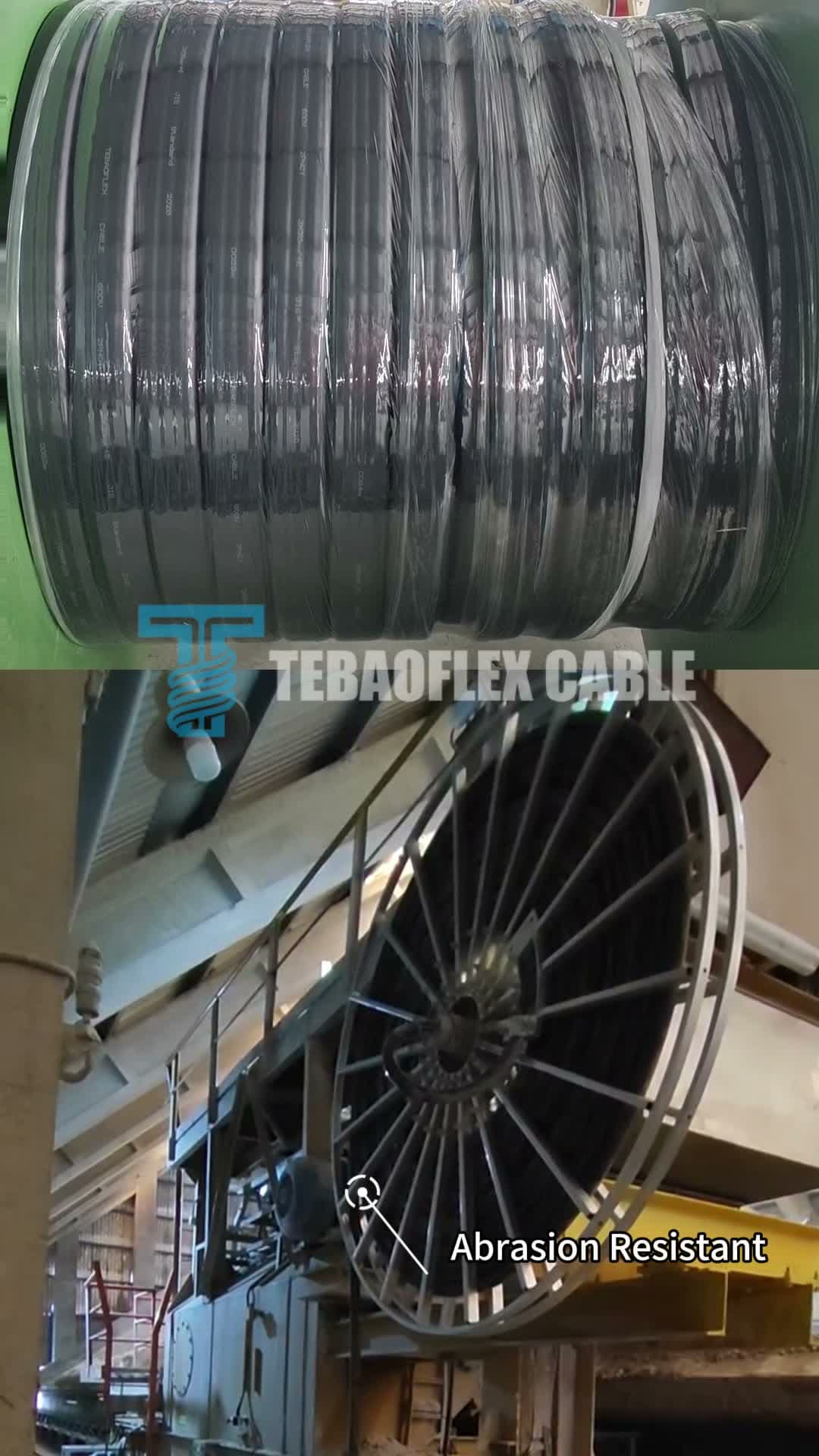
Matching the right variant and size to a specific machine is still a project-specific exercise — it depends on the reel or festoon hardware already in place, the motor's power and duty cycle, cable run length, and the ambient conditions at the terminal or yard, in the same way TEBAOFLEX approaches any reeling or festoon cable request.
Frequently Asked Questions
What is PNCT cable? PNCT is a flexible, cabtyre-type rubber power cable defined under JIS C 3327, a Japanese Industrial Standard for portable cable under Japan's Electrical Appliance and Material Safety Act. It uses flexible stranded copper conductors with rubber insulation and a rubber outer sheath, built for equipment that moves continuously — reels, festoon systems, hoists, and similar mobile power routes.
What voltage classes and sizes does TEBAOFLEX produce PNCT cable in? TEBAOFLEX's PNCT-family range spans 300/500 V, 450/750 V, 600/1000 V, 3 kV, 6 kV, and 10 kV classes, in 3-core and 4-core constructions from roughly 2 mm² to 300 mm² conductor sizes. The specific construction needed depends on the driven equipment's load and duty cycle.
What does the "4×38" in a PNCT cable designation mean? It describes the core count and conductor size: a 4-core cable with approximately 38 mm² of copper cross-section per core. The voltage figure alongside it (600 V, in this case) gives the cable's rated voltage class.
What equipment uses PNCT cable? Moving, reel- or festoon-fed equipment on ports and industrial sites: ship-to-shore and gantry cranes, container cranes, stackers and reclaimers, unloaders, hoists, and similar mobile machinery where the power cable itself is continuously wound, unwound, or carried through a trolley system.
Talk to TEBAOFLEX About a PNCT Cable Requirement
Matching a PNCT construction to a specific crane, reel, or festoon system starts with the equipment and duty cycle, not the type name alone. See TEBAOFLEX's reeling cable range and crane and material-handling cable solutions, watch the PNCT application video, or reach out through the solutions page with your machine's voltage, core count, and conductor size to start a technical review.